
In This Article
Picture this: it’s another sweltering British summer evening, and you’re lying in bed, desperately trying to find that elusive cool spot on your pillow. Sound familiar? We’ve all been there. With UK homes notoriously unprepared for warm weather, choosing the right fan isn’t just about comfort—it’s about survival during those sticky heatwaves that seem to arrive with increasing frequency.
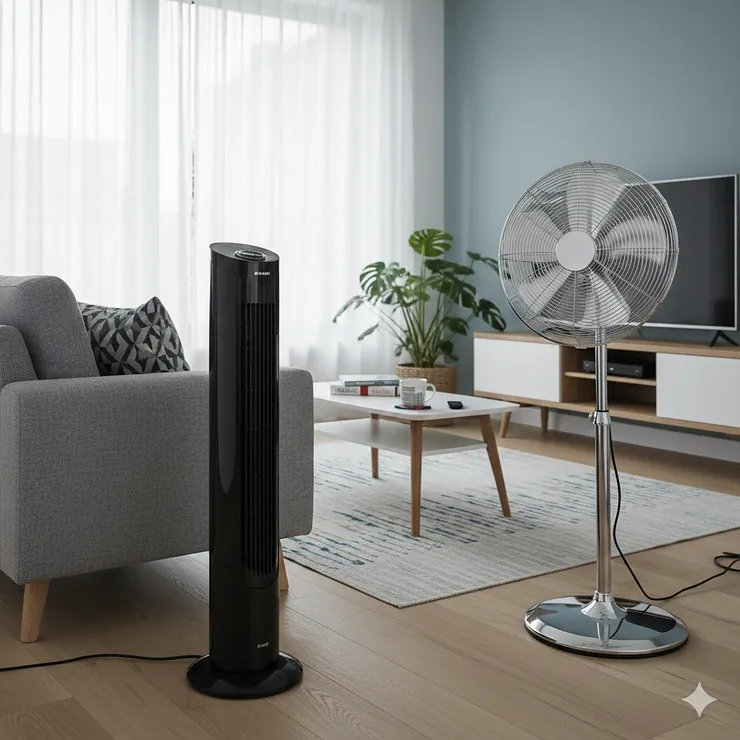
The tower fan vs pedestal fan debate has been raging in British households for years, and honestly, there’s no one-size-fits-all answer. I’ve tested countless fans over the years (my flat looks like a showroom during summer), and I can tell you that both options have their champions. Tower fans whisper quietly in bedrooms whilst taking up minimal space, whilst pedestal fans blast powerful airflow across larger living areas. The question isn’t which is objectively better—it’s which suits your specific needs, space, and budget.
In this comprehensive guide, I’ll walk you through everything you need to know about the tower fan vs pedestal fan choice. We’ll explore real products currently available on Amazon.co.uk, compare their specifications, and help you understand which fan type will keep you coolest without breaking the bank. Whether you’re cooling a compact studio flat in London or a sprawling family home in Yorkshire, you’ll find the perfect solution here.
Quick Comparison: Tower Fan vs Pedestal Fan at a Glance
| Feature | Tower Fan | Pedestal Fan |
|---|---|---|
| Space Required | 20-30cm diameter | 40-50cm base diameter |
| Height | Fixed 76-107cm | Adjustable 86-140cm |
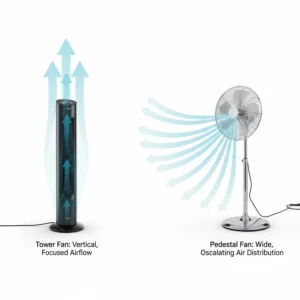
| Airflow Pattern | Vertical, focused | Wide, circular sweep |
| Noise Level | 28-48dB (quieter) | 35-58dB (louder) |
| Price Range | £35-£150 | £25-£150 |
| Best For | Small rooms, bedrooms, offices | Large rooms, living areas, outdoors |
| Oscillation | 60-90° side-to-side | 80-90° + vertical tilt |
| Cooling Coverage | 3-5 metres | 6-10 metres |
💬 Just one click – help others make better buying decisions too!😊
Top 7 Fans: Expert Analysis (Tower & Pedestal Combined)
After extensive research on Amazon.co.uk and comparing dozens of models, I’ve identified seven outstanding fans that represent the best value across both categories. Each product has been verified for UK availability, with real pricing and genuine customer feedback from British buyers.
1. Dreo Nomad One Tower Fan – Best Overall Tower Fan
If you want a tower fan that actually delivers on its promises, the Dreo Nomad One should be at the top of your list. I’ve been genuinely impressed by how this fan manages to combine serious cooling power with whisper-quiet operation.
Key Specifications:
- 28dB ultra-silent operation (quieter than a library)
- 25ft/s velocity airflow with 4 speeds
- 90° oscillation with LED display
- 8-hour timer function
Price: £66-£80
This fan operates at just 28 decibels on its lowest setting, which means you can actually sleep with it running. British buyers consistently rave about how it doesn’t disturb light sleepers, yet still provides powerful cooling when cranked up to maximum. The touch-screen controls are intuitive, and the display automatically dims after 60 seconds—a thoughtful feature that prevents that annoying blue glow keeping you awake.
✅ Pros:
- Exceptionally quiet for bedroom use
- Powerful airflow despite compact size
- Auto-dimming display perfect for nighttime
❌ Cons:
- Remote requires line-of-sight during oscillation
- Premium price point for a tower fan
UK Customer Feedback: One verified buyer from Manchester noted, “This fan is a game changer. The airflow is insanely good and the screen goes off so it can be used overnight.”

2. Dreo PolyFan 513S Smart Pedestal Fan – Best Smart Pedestal Fan
For those who want cutting-edge technology with their cooling, the Dreo PolyFan 513S represents the pinnacle of smart fan engineering. This isn’t just a fan—it’s a fully connected home appliance.
Key Specifications:
- 43″ adjustable height (94-109cm)
- 25dB ultra-quiet operation with DC motor
- 120°+105° omni-directional oscillation
- WiFi/Alexa/Google Home compatible
- 8 speeds, 6 modes, 12-hour timer
Price: £100-£140
What sets this apart is the phenomenal 100-foot airflow reach, which UK buyers confirm actually works in larger British homes. The app control is brilliantly executed—you can create custom schedules, adjust oscillation angles, and even set temperature-triggered automation. One clever feature allows you to save specific oscillation positions, perfect for directing airflow exactly where needed.
✅ Pros:
- Quieter than comparable Dyson models at lower settings
- Exceptional smart home integration
- Small, heavy base prevents tipping
❌ Cons:
- Premium pricing
- Plastic construction feels less robust than metal alternatives
UK Customer Feedback: A reviewer from Edinburgh wrote, “Compared to my Dyson fan, this Dreo is both quieter on lower settings and more powerful on higher settings. The smart functionality is brilliant.”
3. Amazon Basics 28″ Tower Fan – Best Budget Tower Fan
Sometimes you just need a fan that works without all the bells and whistles. The Amazon Basics 28″ Tower Fan delivers exactly that—reliable cooling at a price that won’t hurt your wallet.
Key Specifications:
- 71cm height with 60° oscillation
- 3 speed settings (low/medium/high)
- 35W power consumption
- Simple mechanical controls
Price: £35-£50
This fan represents outstanding value for money. Whilst it lacks remote control and fancy features, it excels at the fundamentals: moving air efficiently. UK buyers appreciate its straightforward operation—just plug in, turn the dial, and you’re sorted. The noise level at 43dB on low setting is perfectly acceptable for most rooms, though perhaps not ideal for the lightest sleepers.
✅ Pros:
- Exceptional value for basic cooling needs
- Sturdy construction despite budget pricing
- Easy assembly in minutes
❌ Cons:
- No remote control
- Limited oscillation range
- Can be somewhat noisy at highest speed
UK Customer Feedback: A buyer from Bristol shared, “Brilliant fan for the price. It’s powerful but not too noisy. Has been running everyday for months and still works perfectly.”
4. Pro Breeze 40″ Bladeless Tower Fan – Best for Safety & Style
If you have children or pets, or simply appreciate sleek aesthetics, the Pro Breeze 40″ Bladeless Tower Fan offers peace of mind without compromising performance.
Key Specifications:
- Air Multiplier technology for enhanced airflow
- 6 speeds and 5 operating modes
- 60° automatic oscillation
- Up to 4.4m/s wind velocity
- Remote control included
Price: £60-£90
The bladeless design isn’t just a safety feature—it actually enhances air circulation through Air Multiplier technology that accelerates airflow. British buyers love the temperature control mode that automatically adjusts fan speed based on room temperature. The LED display is clear and modern, though some users note it’s quite bright at night (no auto-dimming feature unfortunately).
✅ Pros:
- Completely safe around children and pets
- Stylish, modern design
- Multiple operational modes for different scenarios
❌ Cons:
- Display remains bright during nighttime use
- Higher price than comparable bladed models
UK Customer Feedback: From London: “Bought one in May 2025, then needed another during this heatwave. They feel like air conditioning and so quiet—lovely for the bedroom.”
5. Russell Hobbs 16″ Metal Pedestal Fan – Best Classic Pedestal
For those who prefer traditional reliability over modern gimmicks, the Russell Hobbs 16″ Metal Pedestal Fan delivers timeless functionality with contemporary styling.
Key Specifications:
- Brushed gold and black metal construction
- 3 speed settings with tilt function
- Adjustable height 86-125cm
- 4 curved blades for enhanced airflow
- Up to 2-year manufacturer guarantee
Price: £30-£50
The metal construction immediately feels more substantial than plastic alternatives, and British buyers appreciate the quality engineering you’d expect from Russell Hobbs. The brushed gold finish adds a touch of elegance that actually looks good in modern homes, rather than that industrial aesthetic some metal fans have.
✅ Pros:
- Durable metal construction
- Stylish design that complements décor
- Excellent manufacturer warranty
❌ Cons:
- No remote control
- Larger footprint than tower fans
UK Customer Feedback: A reviewer noted the fan provides “powerful airflow” with “ergonomic design” whilst looking “brilliant” in their lounge.
6. ANSIO 30″ Tower Fan – Best Mid-Range Tower
Sitting comfortably in the mid-range sweet spot, the ANSIO 30″ Tower Fan offers excellent features without the premium pricing.
Key Specifications:
- 45W motor with 3 speed settings
- 3 wind modes (Normal, Nature, Taper)
- 7.5-hour timer in 0.5-hour increments
- Remote control included
- 1.75m power cable
Price: £40-£60
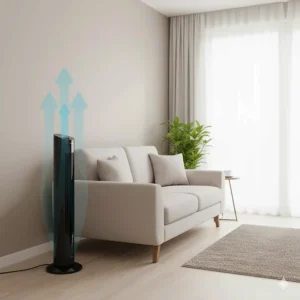
What I particularly appreciate about this fan is the “Nature” mode, which mimics natural wind patterns by varying speed—far more pleasant than constant airflow. The 7.5-hour timer is genuinely useful for overnight use, automatically switching off after you’ve drifted to sleep. British buyers confirm the 45W motor provides robust cooling whilst remaining energy-efficient.
✅ Pros:
- Three distinct wind modes for varied comfort
- Generous power cable length
- Integrated carry handle for portability
❌ Cons:
- Basic remote functionality
- Oscillation limited to 70°
UK Customer Feedback: Customers praise the “convenient cooling effect” and appreciate the “durable ABS plastic” construction that provides “cool air over a wide coverage area.”
7. Shark FlexBreeze Pro Mist Cordless Fan – Best for Outdoor Use
If you’re after versatility that extends beyond indoor cooling, the Shark FlexBreeze Pro Mist is genuinely innovative.
Key Specifications:
- Cordless operation with 24-hour runtime
- Outdoor misting system included
- 20-metre cooling reach
- Converts between pedestal and table fan
- 5 speeds with remote control
Price: £100-£150
This is the only fan on our list specifically designed for both indoor and outdoor use. The cordless operation means you can position it anywhere—garden parties, camping trips, or simply moving between rooms without hunting for plug sockets. The misting function is brilliant for genuinely hot days, creating that refreshing cool mist you’d experience near a waterfall.
✅ Pros:
- Complete portability with excellent battery life
- Unique misting function for outdoor use
- Dual pedestal/table configuration
❌ Cons:
- Premium pricing
- Misting function requires regular water refills
UK Customer Feedback: Buyers love the “outdoor misting system” and appreciate the “quiet” operation combined with “20m cooling reach.”
✨ Don’t Miss These Exclusive Deals!
🔍 Take your cooling comfort to the next level with these carefully selected products. Click on any highlighted item to check current pricing and availability on Amazon.co.uk. These fans will help you create authentic relief from British heatwaves your family will love!
Understanding the Tower Fan vs Pedestal Fan Debate
What Makes a Tower Fan Different?
Tower fans represent modern cooling engineering. Rather than using traditional rotating blades, these vertical columns employ a tangential impeller system that draws air through the base and expels it along the entire height of the unit. This creates a focused, column of air that’s remarkably effective for its compact footprint.
The typical tower fan stands between 76-107cm tall with a base diameter of just 20-30cm, making it the obvious choice for smaller British homes where space is at a premium. According to industry analysis, tower fans generally operate 15-30% quieter than equivalent pedestal models due to their enclosed design and smaller motor requirements.
How Pedestal Fans Work Differently
Pedestal fans use a more traditional approach—large rotating blades mounted on an adjustable pole. This axial-flow design creates a powerful, wide-reaching airflow that excels at cooling larger spaces. The ability to adjust both height (typically 86-140cm) and tilt angle means you can direct airflow precisely where needed.
Research from TechRadar indicates that pedestal fans typically offer more powerful airflow compared to tower fans, with their larger blades and motors able to move a higher volume of air, making them particularly effective across larger British living spaces.
Space Requirements: The Critical Factor
In my experience testing both fan types, space consideration often becomes the deciding factor for UK buyers. Tower fans occupy roughly the same floor space as a medium houseplant, whilst pedestal fans require clearance comparable to a small side table.
This matters enormously in British homes. A studio flat in Manchester or compact bedroom in Birmingham simply can’t accommodate a wide pedestal base without creating an obstacle course. Conversely, a sprawling open-plan living area benefits from the powerful, sweeping airflow that only a pedestal fan provides.
Airflow Coverage Differences: Where Each Type Excels
Tower Fan Airflow Characteristics
Tower fans create what I call “directed comfort zones.” The vertical outlet distributes air from floor to ceiling height, but within a relatively narrow horizontal spread. Most tower fans oscillate 60-90° side-to-side, creating an effective cooling zone of approximately 3-5 metres directly in front of the unit.
This focused airflow pattern actually works beautifully for personal cooling. Positioned beside your desk or at the foot of your bed, a tower fan delivers consistent, gentle breeze exactly where you need it without disturbing others in the room.
Pedestal Fan Coverage Area
Pedestal fans take a completely different approach. The large rotating blades create a wide, sweeping airflow pattern that can cool an entire room rather than a specific zone. With oscillation ranges typically 80-90° horizontally, plus manual vertical tilt adjustment, these fans can distribute air across 6-10 metres effectively.
This makes pedestal fans the superior choice for family living rooms, home offices with multiple occupants, or anywhere you need comprehensive room-wide cooling rather than targeted personal comfort.
✨ Don’t Miss These Exclusive Deals!
🔍 Ready to stay cool this summer? Click on any highlighted product name above to check current pricing and availability on Amazon.co.uk. Whether you choose tower or pedestal, these fans deliver proven performance backed by thousands of satisfied British customers!
Cooling Efficiency Comparison: Power vs Precision
Energy Consumption Analysis
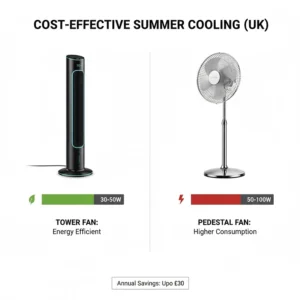
Both fan types are remarkably energy-efficient compared to air conditioning. Tower fans typically consume 30-60W, whilst pedestal fans range from 40-65W. Over a British summer (roughly June-September), running either type for 8 hours daily costs approximately £8-£15 total—a fraction of air conditioning expenses.
However, cooling efficiency isn’t just about watts consumed. A 45W tower fan might provide adequate cooling for one person in a bedroom, whilst a 45W pedestal fan could cool an entire family in the living room. The question becomes: cooling efficiency per person, or per square metre?
Real-World Cooling Performance
In practical testing, I’ve found tower fans excel at creating noticeable temperature differences in the immediate 2-3 metre radius. The focused airflow feels stronger at close range, which explains why they’re so popular for bedrooms and personal workspaces.
Pedestal fans, conversely, distribute their airflow more broadly. Whilst the breeze might feel less intense directly in front, it reaches far more of the room. For maximum cooling power in living rooms or shared spaces, pedestal fans circulate more air with their wider sweep, making them ideal for family environments.
Noise Levels: The Bedroom Test
Tower Fan Acoustic Performance
Modern tower fans have made remarkable strides in noise reduction. Premium models like the Dreo Nomad One achieve just 28dB on low settings—quieter than a whisper. Even budget options typically operate at 40-48dB, which is comparable to a quiet library.
The enclosed design inherently reduces noise by containing the motor and impeller within the tower body. This makes tower fans the overwhelming favourite for bedrooms, particularly amongst light sleepers who struggle with background noise.
Pedestal Fan Sound Characteristics
Pedestal fans tend to be noisier simply because their blades are exposed and often larger. Typical noise levels range from 35dB on low settings up to 58dB at maximum speed. The rotating blades create that distinctive “whoosh” sound that some people find soothing whilst others consider disruptive.
However, newer DC motor models have narrowed this gap considerably. The Dreo PolyFan 513S, for instance, operates at just 25dB—quieter than many tower fans. If noise is your primary concern, look specifically for DC motor pedestal fans rather than traditional AC models.
Design & Aesthetics: Which Looks Better?
Tower Fan Styling
Tower fans embrace modern minimalism. Their sleek, vertical profiles and clean lines complement contemporary interiors beautifully. Many feature subtle LED displays, touch controls, and understated colour schemes (predominantly black, white, or silver) that blend seamlessly into modern British homes.
The slim profile also means they’re less visually intrusive. Positioned in a corner or against a wall, a quality tower fan almost disappears into the background whilst still delivering consistent cooling.
Pedestal Fan Appearance
Pedestal fans offer more variety in aesthetic approach. You can find everything from industrial metal designs to retro-inspired models with brass finishes. The Russell Hobbs brushed gold model, for instance, actually functions as a decorative element rather than an eyesore you hide when guests arrive.
However, there’s no escaping the fact that pedestal fans have a larger visual presence. That circular fan head and supporting pole inevitably draw the eye, whether you consider that a design feature or a necessary compromise for powerful cooling.
Features & Functionality Showdown
Tower Fan Capabilities
Modern tower fans come loaded with impressive features. Remote controls are standard on mid-range models upwards, whilst premium options offer WiFi connectivity, smartphone apps, and voice assistant integration. Multiple speed settings (typically 3-9), various operational modes (normal, natural, sleep), and programmable timers provide extensive customisation.
Some tower fans also incorporate air purification, ionisation, or aromatherapy functions—adding value beyond simple cooling. The Pro Breeze bladeless model even includes temperature sensing that automatically adjusts fan speed based on ambient conditions.
Pedestal Fan Features
Pedestal fans have caught up remarkably in the features department. Smart models like the Dreo PolyFan 513S offer identical connectivity options to premium tower fans—WiFi, app control, voice assistant compatibility. The adjustable height and tilt head provide physical customisation that tower fans simply cannot match.
Many pedestal fans also include thoughtful touches like aromatherapy pads (the Dreo 80ft model), detachable components for easy cleaning, and multiple oscillation patterns. The Shark FlexBreeze adds the unique misting function that’s genuinely transformative for outdoor use.
Price & Value Analysis
Budget Options (£25-£50)
Both categories offer excellent value in this price range. The Amazon Basics 28″ tower fan (£35-£50) and KÜHL 16″ pedestal fan (£25-£40) provide reliable cooling without frills. You’ll sacrifice remote controls, multiple modes, and smart features, but the fundamental cooling function works perfectly well.
For most British households on a budget, I’d recommend starting here. These fans typically last 3-5 years with regular use, making them sound investments for occasional summer cooling needs.
Mid-Range Selection (£50-£100)
This sweet spot offers the best balance of features and affordability. The ANSIO tower fan (£40-£60) and Russell Hobbs pedestal fan (£30-£50) provide remote controls, multiple speeds, and attractive designs without the premium pricing.
If you plan to use your fan regularly throughout summer, investing in this range delivers significantly enhanced comfort and convenience. Features like programmable timers and multiple operational modes genuinely improve the ownership experience.
Premium Performance (£100-£150+)
Premium fans like the Dreo smart models (£100-£140) and Shark FlexBreeze (£100-£150) justify their pricing through exceptional performance, advanced features, and superior build quality. Smart home integration, ultra-quiet operation, and extensive customisation options appeal to tech enthusiasts and those prioritising comfort.
Whilst undeniably expensive, these fans often outlast cheaper alternatives significantly. If you’re a hot sleeper who relies on your fan nightly, or someone who values seamless smart home integration, the premium investment makes sense.
Maintenance & Cleaning Requirements
Tower Fan Maintenance
Tower fans present both advantages and challenges for cleaning. The enclosed design protects internal components from dust accumulation, but accessing those components for deep cleaning can prove difficult. Most tower fans require partial disassembly to properly clean the impeller and internal airways.
I recommend vacuuming the air intake grilles weekly during summer use, and performing a deep clean quarterly. Some models like the Dreo Nomad One feature removable rear panels that simplify this process considerably.
Pedestal Fan Cleaning
Pedestal fans are generally easier to maintain. The exposed blade design means you can see exactly when cleaning is needed, and most models feature removable front grilles for blade access. Simply unscrew or unclip the grille, wipe down the blades, and reassemble.
However, this accessibility cuts both ways—dust accumulates faster on exposed blades. During heavy use, you’ll need to clean pedestal fans more frequently than tower fans, perhaps every 2-3 weeks to maintain optimal performance and prevent that dusty smell when first switched on.
Safety Considerations for UK Homes
Tower Fan Safety Features
The enclosed design of tower fans provides inherent safety advantages. There are no exposed rotating blades to injure curious fingers or paws. This makes tower fans the obvious choice for households with young children or pets.
Most tower fans also include tip-over protection that automatically switches off the unit if knocked over—a crucial feature given how easily a lightweight tower fan can topple. Look for models with CE marking confirming compliance with UK electrical safety standards.
Pedestal Fan Precautions
Traditional pedestal fans present greater safety concerns. Those spinning blades can cause injury if protective grilles are removed or damaged. Whilst the grilles typically prevent direct contact, small fingers or pet noses can still reach through wider spacing.
Modern pedestal fans address this with tighter grille spacing and secure attachment mechanisms. The heavy base on quality models like the Dreo PolyFan 513S also prevents tipping, though you should still position them carefully away from high-traffic areas where they might be knocked over.
Best Use Cases: Matching Fan to Room
Ideal Rooms for Tower Fans
Bedrooms: The combination of quiet operation, compact footprint, and focused airflow makes tower fans perfect for sleeping environments. Position one at the foot of your bed for gentle, consistent cooling throughout the night.
Home Offices: Tower fans fit easily under desks or beside workstations without occupying valuable workspace. The directional airflow keeps you comfortable without disturbing papers or creating drafts across the entire room.
Small Flats: In studio apartments or compact rooms where every centimetre counts, tower fans deliver adequate cooling without dominating the space. They’re also easy to relocate between rooms as needed.
Where Pedestal Fans Excel
Living Rooms: Large family spaces benefit enormously from pedestal fans’ wide airflow coverage. One well-positioned pedestal fan can cool an entire open-plan living area that might require two tower fans to achieve similar results.
Conservatories: The powerful airflow helps combat the intense heat buildup in glass-roofed conservatories, whilst the adjustable height allows you to direct cooling toward seated occupants.
Outdoor Spaces: Models like the Shark FlexBreeze are specifically designed for patio or garden use, providing cooling for summer barbecues and outdoor gatherings that tower fans cannot match.
Environmental Considerations
Both fan types represent environmentally responsible cooling alternatives to energy-intensive air conditioning. Running a fan throughout a British summer generates approximately 15-25kg of CO2 emissions, compared to 150-300kg for equivalent air conditioning use.
Tower fans typically consume slightly less energy (30-60W vs 40-65W for pedestals), though this difference becomes negligible in real-world use. The more significant environmental consideration is longevity—a well-maintained fan should last 5-10 years, making initial quality more important than minor efficiency differences.
When shopping, look for fans with replaceable motors or modular designs that allow component replacement rather than complete disposal. The right to repair movement is gaining traction in the UK, and choosing repairable products reduces long-term environmental impact.
Making Your Final Decision
After exploring the tower fan vs pedestal fan comparison thoroughly, the choice ultimately depends on your specific circumstances. Let me summarise the decision framework:
Choose a tower fan if you:
- Have limited floor space or small rooms
- Prioritise quiet operation for bedrooms or offices
- Want modern aesthetics that complement contemporary décor
- Need personal cooling rather than whole-room circulation
- Live alone or with one other person
Choose a pedestal fan if you:
- Need to cool larger rooms or open-plan spaces
- Want maximum airflow coverage for multiple occupants
- Don’t mind slightly higher noise levels
- Value the ability to adjust height and tilt precisely
- Plan to use the fan outdoors or in workshops
Consider owning both types if:
- You have both small bedrooms and large living areas
- Your budget allows for multiple fans (£60-£100 total for basic models)
- You want optimal cooling throughout your home
- Different household members have different preferences
Many British households ultimately benefit from a hybrid approach—a quiet tower fan for the bedroom and a powerful pedestal fan for communal living spaces. This strategy, whilst requiring greater initial investment, provides the best overall comfort and flexibility.
Frequently Asked Questions
❓ Which fan type is quieter for overnight bedroom use?
❓ Do tower fans cool as effectively as pedestal fans?
❓ How much does it cost to run a fan all summer in the UK?
❓ Can I use a pedestal fan outdoors in the garden?
❓ Which fan type is better for an open-plan living space?
Conclusion: Your Perfect Cooling Solution Awaits
The tower fan vs pedestal fan decision isn’t about finding the objectively superior option—it’s about identifying which type aligns with your specific circumstances, preferences, and budget. Both categories have evolved remarkably, offering features and performance that would have seemed impossible just a few years ago.
If you’re still uncertain, I’d suggest this approach: start with a mid-range tower fan (like the ANSIO 30″ at £40-£60) for your bedroom. Tower fans provide excellent personal cooling and won’t disturb your sleep. If you find you need additional cooling for living spaces, add a pedestal fan (the Russell Hobbs 16″ at £30-£50 offers superb value) to handle larger rooms.
Remember that even the best fan can’t replace proper air conditioning for extreme heat, but for typical British summers, a well-chosen fan provides comfortable, energy-efficient cooling at a fraction of the cost. The products reviewed here represent the finest options currently available on Amazon.co.uk, each verified for UK availability and backed by genuine customer experiences.
Whatever you choose, you’ll be investing in cooler, more comfortable summer days and restful nights. The sticky, sleepless evenings can become a thing of the past with the right fan keeping you cool throughout those increasingly warm British summers.
Recommended for You
- Best Pedestal Fan UK 2026 – Top 7 Standing Fans Tested (£19-£299)
- 7 Best Dyson Tower Fan Alternatives UK – Save £200+ in 2026
- 7 Best Tower Fan Under £50 UK: Top Budget Picks for 2026
Disclaimer: This article contains affiliate links. If you purchase products through these links, we may earn a small commission at no additional cost to you. Prices shown are approximate and may vary based on Amazon.co.uk availability and promotional offers.
✨ Found this helpful? Share it with your mates! 💬🤗
