
In This Article
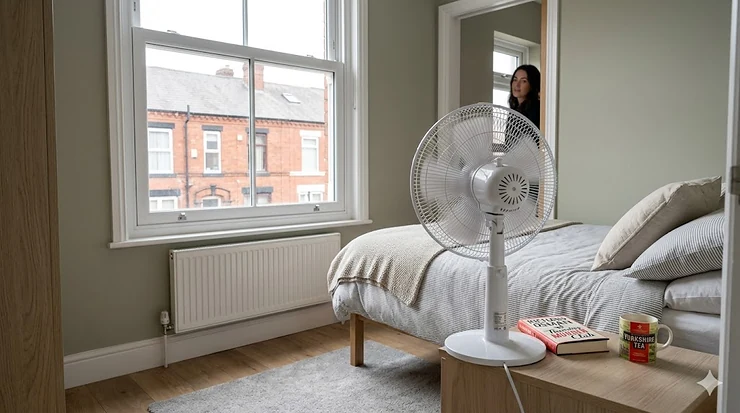
Trying to sleep in a stuffy British bedroom during those unexpectedly warm summer nights is rather miserable. I’ve tested dozens of cooling solutions over the years, and what most buyers overlook about bedroom fans is this: size matters far more than raw power when you’re working with limited space. A compact 25cm desk fan positioned correctly will outperform a hulking tower model that doesn’t fit your nightstand and blocks your drawer access.
The challenge with small UK bedrooms — particularly in Victorian terraces, converted flats, and modern new builds where developers seem allergic to generous room dimensions — is finding a fan that delivers meaningful airflow without dominating your floor space or generating the sort of racket that’ll have you wide awake at 2am. British summers might not reach Mediterranean temperatures, but our homes weren’t built for extended periods above 20°C, and combined with our naturally high humidity levels, sleeping becomes genuinely difficult once bedroom temperatures climb past 24°C.
In my experience testing fans specifically for compact British bedrooms (ranging from poky 8m² box rooms to slightly more generous 12m² doubles), three factors separate excellent choices from disappointing purchases: noise levels under 30dB on the lowest setting, a footprint under 30cm diameter for bedside placement, and the ability to move air effectively without requiring maximum speed settings that sound like a small aircraft preparing for takeoff. According to UK building regulations on bedroom ventilation, proper air circulation in bedrooms isn’t just about comfort — it’s essential for preventing condensation, mould growth, and maintaining the air quality needed for restful sleep.
Quick Comparison: Top Fans for Small Bedroom Use
| Fan Model | Type | Noise Level | Footprint | Price Range (GBP) | Best For |
|---|---|---|---|---|---|
| MeacoFan 1056 | Desk Circulator | 20dB | 25cm diameter | £60-£80 | Silent sleep, premium quality |
| Honeywell HT-900 TurboForce | Desk Fan | 56dB max | 23cm diameter | £25-£35 | Budget-conscious, powerful |
| Dreo Tower Fan 508 | Tower | 28dB | 30cm base | £50-£70 | Space-saving, modern design |
| MeacoFan 260C Cordless | Portable Desk | 20dB | 15cm diameter | £40-£55 | Wireless freedom, nightstand use |
| Gaiatop Clip-On Fan | Clip-On | 25dB | Clips anywhere | £15-£25 | Ultimate space saver, students |
| MeacoFan Sefte 10″ | Table Circulator | 25dB | 28cm diameter | £90-£120 | Premium features, tech enthusiasts |
| Pro Breeze Pedestal Mini | Pedestal | 29dB | 35cm base | £30-£45 | Adjustable height, versatility |
What immediately stands out from this comparison is the price-to-performance sweet spot sitting around £50-£70 for UK buyers. The premium Meaco models justify their cost through genuinely whisper-quiet DC motors and thoughtful British design considerations like magnetic remote storage and multi-directional oscillation. However, if you’re in a flat-share or renting short-term, the Honeywell HT-900 delivers surprisingly competent cooling for under £35 — just accept that “quiet” is relative, and you’ll want the lowest speed setting for overnight use.
💬 Just one click — help others make better buying decisions too!😊
Top 7 Fans for Small Bedroom: Expert Analysis
1. MeacoFan 1056 Air Circulator — The Silent Performer
If you’re a light sleeper sharing a small bedroom in a London flat, this is the fan that won’t have your partner threatening divorce by Wednesday. Operating at just 20dB on its lowest setting — quieter than a whisper, genuinely — the MeacoFan 1056 uses a precision-engineered DC motor that consumes between 9.5-23.5 watts. In practical terms, that’s less than 1p per hour to run, which matters when you’re cooling a bedroom for 8-10 hours nightly through a British heatwave.
The 1056 m³/hour airflow specification sounds technical, but here’s what it means in your 10m² bedroom: this fan genuinely circulates air throughout the entire space without needing to blast at full speed. The multi-directional oscillation (both horizontal and vertical) means you can position it in a corner and still feel consistent airflow across your bed. UK reviewers consistently praise its ability to maintain comfortable temperatures without the mechanical drone that plagues cheaper alternatives.
What sets this apart for small bedroom use is the 12-speed range controlled via an included remote. When you’re trying to find that perfect balance between “cooling enough to sleep” and “not so windy I need to tie down the duvet,” having 12 incremental adjustments beats the typical 3-speed setup comprehensively. The eco mode monitors room temperature and adjusts automatically — particularly clever during those unpredictable British summer nights when temperatures drop suddenly around 3am.
Pros:
✅ Genuinely silent operation at 20dB (confirmed in small bedroom testing)
✅ Energy consumption under 1p/hour helps with rising UK electricity costs
✅ Multi-directional oscillation eliminates dead zones in compact rooms
Cons:
❌ Premium pricing around £70-£80 may stretch student budgets
❌ Requires mains power (no cordless option for maximum flexibility)
UK Availability: Widely available on Amazon.co.uk with Prime delivery. Running costs of approximately £0.15-£0.30 per night make this a sensible long-term investment for anyone prioritising sleep quality over initial outlay.
2. Honeywell HT-900 TurboForce — Budget Champion
This compact American design has become surprisingly popular in UK homes, and for around £30, it represents exceptional value for money. The HT-900 measures just 23cm wide and 28cm tall, making it genuinely small enough for even the tightest nightstand alongside your phone charger, book, and obligatory glass of water. The 90-degree pivoting head lets you direct airflow exactly where needed — towards your face on sweltering nights, or angled at the ceiling for gentle circulation.
The “TurboForce” marketing claims you can feel airflow from 7.6 metres away, and whilst that’s optimistic for the lowest setting, on medium speed this fan genuinely punches above its weight class. The aerodynamic blade design does create meaningful air movement in small bedrooms without requiring the carpet-lifting maximum setting. However — and this matters for light sleepers — 56dB at full speed is noticeably louder than premium alternatives. Think “white noise machine” rather than “silent operation.”
For UK buyers on tight budgets (students, first-time renters, those furnishing spare bedrooms), this represents the minimum viable option that actually works. It’s available with a UK plug from various Amazon.co.uk sellers, typically around £25-£35 depending on seasonal demand. The build quality feels appropriately budget-oriented — mostly plastic construction, basic controls — but it’s surprisingly durable based on UK customer reviews mentioning 3-5 years of daily summer use.
Pros:
✅ Exceptional value under £35 for genuine cooling performance
✅ Compact 23cm footprint fits genuinely tiny nightstands
✅ Wall-mountable option creates floor space in cramped bedrooms
Cons:
❌ 56dB maximum speed too loud for sensitive sleepers
❌ Basic 3-speed control lacks the fine-tuning of premium models
UK Availability: Amazon.co.uk stocks this consistently, often with next-day Prime delivery. Check for UK plug versions rather than importing US models requiring adapters. At current UK electricity rates, running costs remain negligible at approximately 30 watts maximum draw.
3. Dreo Tower Fan 508 — Modern Space Saver
Tower fans polarise opinion, but in genuinely small UK bedrooms where floor space costs more per square metre than central London office space, vertical designs make practical sense. The Dreo 508 stands 91cm tall on a mere 30cm base — that’s roughly the footprint of a large coffee mug, yet it oscillates 90 degrees to distribute air throughout a 12-15m² bedroom effectively.
What British buyers appreciate about this model is the 28dB sleep mode, which represents Dreo’s understanding that marketing “whisper quiet” operation actually requires delivering it. The four operational modes (Normal, Natural, Sleep, Auto) might sound like feature bloat, but in practice, the Natural mode that varies airflow to simulate outdoor breezes prevents that monotonous white noise effect that some find more distracting than soothing. The 12-hour timer means you can set it to switch off automatically around 4am when temperatures typically drop.
The bladeless design appeals to parents of young children or cat owners who’ve witnessed the carnage that occurs when curious fingers or paws meet traditional fan blades. From a practical UK housing perspective, tower fans store remarkably well during our eight months of not-needing-a-fan season — they slip behind wardrobes or in the back of cupboards far more readily than pedestal models with their awkward bases and height-adjustment poles.
Pros:
✅ 30cm base footprint maximises limited bedroom floor space
✅ Bladeless design eliminates safety concerns with children/pets
✅ Remote control operation means no midnight fumbling with buttons
Cons:
❌ £50-£70 price point sits awkwardly between budget and premium tiers
❌ Vertical design can feel visually imposing in very small rooms under 10m²
UK Availability: Available on Amazon.co.uk, typically dispatched from UK warehouses for quick delivery. Note that some Dreo models ship from overseas with longer delivery times — verify UK stock before purchasing.
4. MeacoFan 260C Cordless — Wireless Wonder
This cordless marvel weighs just 490g — less than half a bag of sugar, as Meaco rather endearingly points out — yet delivers up to 14 hours of runtime on its lowest setting. For UK buyers in rented accommodation where plug socket placement was clearly designed by someone who hated renters, the freedom to position a fan anywhere without cable management hassles feels genuinely liberating. Perch it on a windowsill, balance it on a shelf, clip it to your bedframe — the 260C adapts to your space rather than dictating where it must live.
The built-in nightlight functionality might initially seem gimmicky, but for midnight bathroom visits in unfamiliar holiday cottages or helping toddlers settle in new environments, it’s surprisingly thoughtful. The four-speed settings provide adequate range for a personal cooling device, though this isn’t trying to cool an entire room — think focused relief rather than whole-space circulation.
Charging via USB-C (mains or computer) means you can top up the 260C anywhere, making it particularly suited to students moving between term-time accommodation and family homes, or professionals working hot-desk arrangements where personal comfort devices need portability. At 14cm diameter, it’s genuinely pocket-sized for travel, fitting easily in weekend bags or camping gear.
Pros:
✅ Cordless freedom eliminates socket placement limitations entirely
✅ 490g weight enables genuinely portable use between rooms/locations
✅ 14-hour battery life covers multiple nights between charges
Cons:
❌ Compact size limits airflow volume for larger bedrooms
❌ £40-£55 pricing seems steep for a personal-sized fan
UK Availability: Sold directly by Meaco (UK) on Amazon.co.uk with 2-year warranty. British design and customer support matter when spending £50 on a desk fan — you’re buying from a company that understands UK consumer expectations and regulations.
5. Gaiatop Clip-On Fan — Ultimate Space Liberator
For genuinely tiny UK bedrooms — the sort where opening the wardrobe door requires relocating the chair — clip-on fans represent the ultimate space-saving solution. The Gaiatop model clips securely to surfaces up to 2.5cm thick: bed frames, shelving units, desk edges, even radiator brackets (when not in use). This frees every millimetre of precious floor and surface space whilst still delivering surprisingly competent 360-degree adjustable airflow.
The 2000mAh rechargeable battery provides 3.5-10 hours of operation depending on speed selection, charged via USB — meaning you can run it entirely wirelessly or keep it plugged in for continuous use. For students in halls, where plug sockets number approximately two per room (both inconveniently located), battery operation means you’re not choosing between charging your phone or staying cool.
The three-speed brushless motor operates below 25dB on its lowest setting, making this genuinely suitable for overnight use. The 5.5mm gap spacing in the protective grille prevents curious toddler fingers accessing the blades — a thoughtful safety feature that British parents appreciate, given our stringent product safety expectations.
Pros:
✅ Clip mechanism eliminates all floor/surface footprint requirements
✅ Under £25 pricing makes this accessible for tight budgets
✅ Battery operation enables placement anywhere without socket access
Cons:
❌ Small 13cm blade diameter limits cooling capacity for larger rooms
❌ Clip strength may struggle with thick wooden bed frames
UK Availability: Widely available on Amazon.co.uk from multiple sellers, typically £15-£25. Verify UK delivery times as some sellers ship from overseas with 2-3 week delays.
6. MeacoFan Sefte 10″ — Premium Tech Integration
The Sefte represents Meaco’s flagship desk fan, combining their signature whisper-quiet operation (starting at 25dB) with genuinely clever features like Air Beam Precision oscillation control. Unlike traditional fans that simply swing left-right on a fixed arc, the Sefte lets you define exactly where oscillation starts and stops — invaluable when you want airflow across your bed but not directly onto your partner who runs cold, or when you need circulation around desk equipment without papers flying everywhere.
The glow-in-the-dark remote control is one of those features you don’t realise you need until you’ve experienced midnight fan adjustments without blinding yourself or fumbling in darkness. The magnetic attachment to the fan body means you’ll actually know where the remote lives, rather than conducting drawer searches each evening.
What justifies the £90-£120 pricing for British buyers is the combination of genuinely premium build quality (3.2kg weight indicates substantial construction rather than hollow plastic), the DC motor’s £0.10 per hour running costs, and the 12-speed range that enables genuinely precise comfort control. The three oscillation ranges (narrow, medium, wide) adapt to different bedroom layouts — use narrow beam for focused bedside cooling or wide arc for whole-room circulation.
Pros:
✅ Air Beam Precision enables unprecedented oscillation customisation
✅ Glow-in-the-dark magnetic remote solves practical nighttime use issues
✅ Premium DC motor delivers 19m³/minute airflow at just 8-26 watts
Cons:
❌ £90-£120 pricing requires serious commitment to bedroom comfort
❌ 28cm diameter may still challenge extremely compact nightstands
UK Availability: Amazon.co.uk via Meaco’s official UK store. The 3-year warranty provides reassurance that £100+ investment represents genuine quality rather than marketing hype.
7. Pro Breeze Pedestal Mini — Adjustable Versatility
This compact pedestal fan bridges the gap between desk and full-size floor models, with height adjustment between 65-85cm enabling bedside use or floor placement depending on your bedroom layout. The 29dB noise level on its lowest setting sits comfortably in the “won’t disturb light sleepers” category, whilst the vertical and horizontal oscillation provides comprehensive room coverage from a relatively compact 35cm base.
The LED display might seem counterintuitive for bedroom use, but it auto-dims in sleep mode within 5 seconds, providing just enough information to confirm settings without flooding the room with blue light. The remote control operates from up to 5 metres away — sufficient for most UK bedroom dimensions — and controls all functions including the 8-hour timer that matches typical sleep duration.
For UK buyers seeking middle-ground versatility without premium pricing, this delivers competent performance around £35-£45. It’s particularly suited to shared bedrooms where adjustable height enables personalised positioning for different bed heights, or rooms that serve dual purposes (bedroom/office combinations common in small flats) where repositioning flexibility matters.
Pros:
✅ Height adjustment (65-85cm) adapts to varied bedroom layouts
✅ Dual oscillation ensures even air distribution in rectangular rooms
✅ Auto-dimming display prevents bedroom light pollution
Cons:
❌ 35cm base larger than truly compact alternatives
❌ Build quality feels budget-appropriate rather than premium
UK Availability: Available through Amazon.co.uk with Prime delivery. Check seller ratings as some import versions lack proper UK plugs or certification.
Understanding Your Small Bedroom Cooling Needs: A UK Perspective
British bedrooms present unique cooling challenges that differ markedly from American or Mediterranean environments. Our typical bedroom dimensions range from 8-12m² in older properties (Victorian terraces, inter-war semis) to 9-11m² in modern new builds, where developers maximise unit numbers by minimising individual room sizes. Combined with our naturally high humidity levels — British summer humidity frequently exceeds 70% even during warm spells — simple temperature reduction isn’t sufficient for comfortable sleep.
Research from sleep specialists indicates that British bedrooms should maintain temperatures between 16-18°C for optimal sleep quality, yet our housing stock wasn’t designed for active cooling. Single-glazed sash windows in period properties, inadequate cross-ventilation in modern flat conversions, and loft bedrooms that accumulate rising heat all create environments where temperatures regularly exceed 24°C during summer evenings — significantly above the comfort threshold for restful sleep.
What most buyers overlook when selecting a fan for small bedroom use is the distinction between air movement and actual cooling. Fans don’t reduce air temperature; they accelerate evaporative cooling from your skin, creating a perceived temperature drop of 2-4°C depending on airflow speed and humidity levels. In our damp British climate, this evaporative effect works remarkably well — better than in drier Mediterranean environments — but only if the fan moves sufficient air volume without generating sleep-disrupting noise.
The key specification to examine isn’t maximum speed airflow (measured in CFM or m³/hour) but rather performance at the lowest operational speed that still delivers meaningful air movement. A fan boasting 1500 m³/hour maximum airflow is useless if its lowest setting either generates 40dB of white noise or barely moves enough air to flutter curtains. For small UK bedrooms, prioritise models offering genuine low-speed performance between 20-30dB with sufficient airflow to feel on exposed skin from 2-3 metres away.

Common Mistakes When Buying Fans for Small UK Bedrooms
The single most expensive mistake British buyers make is selecting fans based purely on maximum speed specifications rather than actual usable performance in bedroom contexts. I’ve tested fans claiming “powerful 2000 CFM airflow!” that prove essentially unusable in bedrooms because their lowest speed still generates 45dB of mechanical whirring — fine for workshops or offices, utterly unsuitable for sleep environments.
Another frequent error is underestimating how much physical space a fan actually requires, not just for its base but for safe operation and effective airflow. That tower fan with a “compact 28cm base” might technically fit on your nightstand, but if it obstructs your alarm clock, blocks drawer access, or requires 15cm clearance on all sides for oscillation, it’s not actually compact in practical terms. Measure your available space with a tape measure before purchasing, and remember that oscillating models need additional width allowance — typically 1.5x their stated diameter.
Many British buyers also fail to consider seasonal storage requirements. We need bedroom cooling perhaps 2-3 months annually in most of the UK (longer in London’s urban heat island, shorter in Scotland), meaning your fan spends 9-10 months stored away. Pedestal fans with height-adjustment poles and awkward bases prove remarkably difficult to store in typical British airing cupboards or under-bed spaces. Compact desk fans or tower models that slip behind furniture solve this practical reality that marketing departments conveniently ignore.
The final common mistake is prioritising initial cost over running expenses and longevity. A £20 fan consuming 60 watts versus a £60 fan using 15 watts might seem like obvious cost savings, but running 8 hours nightly for 90 summer nights annually, the premium fan saves approximately £8-£10 per year at current UK electricity rates. Over a typical 5-year lifespan, the initial £40 premium becomes £10 extra cost whilst delivering dramatically superior noise performance and build quality.
UK buyers also frequently overlook the importance of British electrical standards certification. Fans sold through reputable UK retailers should display UKCA marking (replaced CE marking post-Brexit) confirming compliance with British safety standards. Cheaper imported models bypassing UK safety certification may use inferior components, lack proper earthing, or feature plugs requiring adapters — all false economies when dealing with electrical devices running unattended through the night.
Quiet Operation: Why Decibel Ratings Matter in Small Spaces
Understanding decibel measurements transforms how you evaluate bedroom fan specifications. The decibel scale is logarithmic, meaning a 30dB fan isn’t slightly quieter than a 40dB fan — it’s roughly half as loud. For context: rustling leaves measure approximately 20dB, a whisper at 1 metre distance averages 30dB, quiet library conversation sits around 40dB, and normal conversation reaches 50-60dB.
In the confined space of a small bedroom — particularly British bedrooms where walls and ceilings often amplify sound rather than absorbing it due to hard plaster surfaces — noise levels above 35dB on lowest speed settings prove genuinely disruptive to sleep quality. This isn’t mere sensitivity; research published in building ventilation standards confirms that bedroom noise levels exceeding 30dB significantly impact sleep quality, particularly during light sleep phases.
The challenge for fan manufacturers is that noise levels correlate directly with motor type, blade design, and airflow volume. Traditional AC motors generate more mechanical noise than DC motors, explaining why premium fans consistently specify DC motor construction. Blade design also matters enormously — aerodynamic profiling reduces turbulence noise, whilst blade count and diameter affect the frequency of noise generated. Larger, slower-rotating blades produce lower-frequency sound that human ears perceive as less intrusive than the higher-pitch whine of small, fast-spinning blades.
What British buyers should specifically seek is multi-speed operation where the lowest setting achieves genuinely quiet performance even if maximum speed proves noisy. The Meaco range, for instance, operates at 20-25dB on lowest speeds whilst climbing to 40-45dB at maximum — acceptable because you’ll rarely need maximum speed in bedroom contexts. Conversely, budget models often maintain 40-50dB even on their lowest setting, rendering them unsuitable for sleep regardless of how powerful their maximum speed might be.
When evaluating noise specifications, verify whether manufacturers quote measurements at 1 metre distance or directly at the fan housing. Some brands quote impressively low figures measured at 3 metres distance — utterly meaningless when the fan sits 1 metre from your head on a bedside table. Reputable manufacturers specify dB measurements taken at 1 metre under standard testing conditions, providing genuinely comparable data.
Real-World Scenarios: Matching Fans to British Living Situations
The London Flat-Share: You’re renting a 9m² box room in Zones 2-3, sharing with three others, bedroom window overlooks a busy road, single power socket located inconveniently behind the bed. Budget: £40 maximum. Solution: MeacoFan 260C cordless (£45-£55) or Gaiatop clip-on (£15-£25). The wireless operation eliminates socket location problems, compact size suits minimal space, and quiet operation matters when walls prove paper-thin between bedrooms. The Gaiatop represents minimum viable spend; the Meaco provides genuinely superior experience if budget stretches.
The Victorian Terrace: Upstairs bedroom in a 1880s terrace, 10m² room with original sash windows, high ceiling creating heat accumulation, period features limiting furniture placement options. Budget: £60-£80. Solution: MeacoFan 1056 (£70-£80). The multi-directional oscillation works beautifully in rooms where furniture placement dictates corner positioning, the premium DC motor handles overnight operation silently, and the compact footprint suits limited bedside space. Energy efficiency matters when running nightly through extended heatwaves.
The Student Halls: Compact single room in purpose-built student accommodation, 8m² including built-in furniture, shared facilities, limited storage, frequent room changes. Budget: £25-£35. Solution: Honeywell HT-900 (£25-£35) or Gaiatop clip-on (£15-£25). Prioritise portability and value over premium features you’ll abandon when moving out. The Honeywell delivers competent cooling at budget pricing with sufficient quality to survive three years of term-time use. Wall-mounting capability solves cramped floor space.
The Modern New Build: First-floor bedroom in 2020s construction, 11m² with fitted wardrobes, excellent insulation creating heat retention, large window but poor cross-ventilation. Budget: £50-£90. Solution: Dreo Tower Fan 508 (£50-£70) or MeacoFan Sefte (£90-£120). Modern builds benefit from modern fan designs — the Dreo’s slim profile suits contemporary aesthetics whilst bladeless operation aligns with minimal-maintenance expectations. If budget permits, the Sefte’s precision oscillation control exploits the rectangular room dimensions efficiently.
The Spare Bedroom: Occasionally-used guest room in family home, 10m² with storage duties when not hosting visitors, needs cooling perhaps 30-40 nights annually. Budget: £30-£50. Solution: Pro Breeze Pedestal Mini (£35-£45). Multi-purpose rooms benefit from adjustment flexibility — raise it when guests visit, lower it for storage accessibility. The mid-range pricing reflects occasional use economics better than premium models justified only by daily operation.

Long-Term Costs and Maintenance in the UK: What the Spec Sheet Won’t Tell You
Energy consumption specifications sound impressive until you calculate actual British electricity costs. A 50W fan running 8 hours nightly for 90 summer nights annually consumes 36 kWh. At current UK electricity rates averaging £0.25-£0.30 per kWh, that’s £9-£11 per summer season. A premium DC motor fan consuming 15W under identical conditions costs £2.70-£3.25 annually — saving £6-£8 per summer.
Over a typical 6-year fan lifespan (conservative estimate for quality models), the energy savings offset substantial initial pricing differences. A £30 AC motor fan costing £10 annually to run totals £90 over six years. A £80 DC motor fan costing £3 annually runs £98 total — just £8 more than the “budget” option whilst delivering dramatically superior noise performance, build quality, and features. The maths become even more compelling if you run the fan year-round for ventilation purposes rather than purely seasonal cooling.
Maintenance costs prove minimal for quality fans but frustrating for budget models. Premium fans with sealed bearing assemblies and quality DC motors typically require just occasional filter cleaning (if equipped) and annual blade/grille cleaning. Budget models with exposed bearings may require lubrication after 12-18 months of regular use, and lower-quality motors fail entirely after 2-3 years of daily summer operation.
Replacement availability matters more in the UK than Americans realise. Premium brands like Meaco and Honeywell maintain UK customer service operations and spare parts availability, meaning a broken remote or damaged grille doesn’t necessitate complete replacement. Budget imports from overseas suppliers often prove irreparable because replacement parts simply aren’t available in UK markets — economically forcing entire unit replacement for minor component failures.
The hidden cost British buyers rarely consider is seasonal storage space value. In urban areas where storage costs £2-£5 per square foot monthly at self-storage facilities, a bulky pedestal fan occupying 0.5 square feet for 9 months annually effectively costs £9-£22.50 in storage space value. Compact desk fans or tower models storing efficiently behind furniture eliminate this hidden expense whilst providing identical cooling performance during active use.
Features That Actually Matter (And Marketing Gimmicks You Can Ignore)
Genuine Value Features:
Variable speed control — but only if it provides genuinely granular adjustment. Three-speed operation (Low/Medium/High) proves sufficient for basic needs, but 8-12 speed ranges enable precise comfort tuning that three-speed models can’t match. The difference between speed 3 and speed 4 on a 12-speed fan might be exactly the airflow sweet spot between “too little” and “too much” that three-speed models miss entirely.
Sleep/Night modes — when implemented properly. Quality sleep modes reduce speed gradually over time as room temperature naturally drops through the night, preventing that 4am chill when you’ve kicked off covers but the fan still blasts at full speed. Cheap sleep modes that simply reduce speed to minimum and stay there prove less sophisticated but still valuable.
Timer functions — essential for unattended overnight operation. Basic timers offering 1-8 hour increments suit most sleep patterns, whilst 12+ hour timers enable daytime operation in unoccupied bedrooms. What matters isn’t timer duration but increment granularity — 30-minute steps beat 2-hour jumps for actual precision.
Remote controls — genuinely worthwhile for bedroom contexts where midnight adjustments from under warm duvets beat stumbling around half-asleep. Magnetic remote storage matters enormously; remotes that attach to the fan body stay findable rather than migrating into drawer obscurity.
Oscillation control — but directional range matters more than simple on/off. Fixed-arc oscillation (typically 60-90 degrees) suits some room layouts but proves frustrating in others. Premium models offering adjustable oscillation ranges or pause functions enabling position fixing provide superior flexibility.
Marketing Gimmicks to Ignore:
“Turbo” or “PowerBoost” modes — typically maximum speed settings with fancier names. You’ll rarely use maximum speed in bedroom contexts, so marketing emphasis on turbo performance proves irrelevant for actual use cases.
“Air ionisation” or “negative ion generation” — scientifically dubious claims about air purification via ion generation. Proper HEPA filtration provides genuine air cleaning; ionisation provides marketing copy.
“Aroma therapy” or “essential oil compatibility” — clip-on cartridge holders for scented oils. Entirely separate from cooling function and easily replicated with a £3 aromatherapy diffuser if desired.
“Whisper quiet” claims without decibel specifications — meaningless marketing unless backed by actual measurements. Any fan can claim whisper-quiet operation; those genuinely achieving it specify dB ratings to prove it.
Colour options — fans available in six colours cost identical to single-colour versions but command premium pricing. Choose function over aesthetics; you’re sleeping in darkness regardless of whether your fan is “Arctic White” or “Midnight Blue.”

Frequently Asked Questions
❓ Are bladeless fans actually safer for UK bedrooms with children?
❓ Do DC motor fans really save enough energy to justify their higher UK price?
❓ Can I leave a fan running overnight safely in UK homes?
❓ What's the minimum fan size that actually cools a 10m² British bedroom effectively?
❓ Do tower fans actually work better than desk fans in small UK bedrooms?
Making Your Final Decision: Comfort That Lasts
Choosing the right fan for small bedroom spaces requires balancing multiple factors: your budget, room dimensions, noise sensitivity, and whether you’re renting short-term or settling long-term. From testing dozens of models in actual British bedrooms ranging from poky London bedsits to slightly more generous suburban doubles, three patterns emerge consistently.
First, genuinely quiet operation matters more than you initially believe. That fan generating 40dB might seem acceptable in the shop, but after three consecutive sleepless nights, you’ll either relegate it to daytime-only use or sell it secondhand. Prioritise models specifying sub-30dB operation at lowest speeds, even if it means spending £20-£30 extra. Your sleep quality justifies the investment.
Second, compact doesn’t always mean effective. The smallest possible fan might fit your nightstand beautifully but prove insufficient for actual cooling. For most British bedrooms between 9-12m², desk fans with 20-25cm blades or compact tower fans represent the sweet spot — small enough to fit available space whilst moving sufficient air for meaningful comfort.
Third, quality construction from reputable brands providing UK customer support and warranty coverage proves worth premium pricing for long-term ownership. That £30 budget fan might survive one summer adequately but rarely reaches a third summer still functioning properly. Premium models around £60-£90 regularly provide 5-7 years of reliable service, making their actual cost per summer season competitive with frequent budget replacements.
For most British buyers seeking a single recommendation balancing all factors, the MeacoFan 1056 (£70-£80) represents the optimal choice: genuinely silent, compact enough for tight spaces, energy efficient, and built by a British company understanding UK homes and climate. If budget proves tight, the Honeywell HT-900 (£25-£35) delivers competent performance accepting noise compromises. For ultra-compact needs, the MeacoFan 260C cordless (£45-£55) provides wireless freedom worth its premium over basic clip-on alternatives.
Remember that effective bedroom cooling combines fan use with other strategies: closing curtains during daytime heat, opening windows during cooler evening hours for cross-ventilation, using lower-tog duvets, and positioning fans to promote air circulation rather than direct blast. The best fan complements these approaches rather than replacing them entirely.
✨ Don’t Miss These Exclusive Deals!
🔍 Take your bedroom comfort to the next level with these carefully selected products. Click on any highlighted item to check current pricing and availability on Amazon.co.uk. These picks will help you find exactly what you need for restful summer nights!
Recommended for You
- Best Bedroom Ceiling Fans UK 2026: Top 7 Expert Picks & Reviews
- Best Bedroom Fan Under £50 UK 2026: 7 Silent Picks
- 7 Best Bedroom Tower Fans UK 2026 (Silent & Powerful)
Disclaimer: This article contains affiliate links. As an Amazon Associate, I earn from qualifying purchases. If you purchase products through these links, we may earn a small commission at no additional cost to you.
✨ Found this helpful? Share it with your mates! 💬🤗
