
In This Article
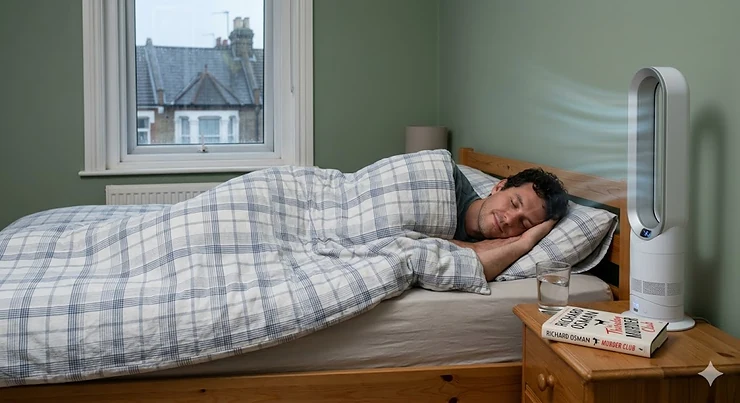
If you’ve ever found yourself flipping the pillow to the cool side at 3 AM, kicking off the duvet in frustration, or waking up drenched in sweat despite the heating being off, you’re part of Britain’s silent army of hot sleepers. The struggle is real, particularly during those unpredictable British summers when temperatures climb and bedroom windows do precious little to shift the stuffy air.
A fan for hot sleepers isn’t just about luxury — it’s about reclaiming proper rest. Your body temperature naturally drops as you enter deep sleep, but when your bedroom environment works against this process, you end up tossing about all night. The right bedroom cooling solution can mean the difference between waking up refreshed or feeling like you’ve barely slept at all. Modern fans have evolved far beyond the rattling contraptions your grandparents used. Today’s powerful bedroom cooling fans combine whisper-quiet operation, intelligent temperature regulation, and serious airflow that actually makes a difference to your night time cooling needs.
Whether you’re dealing with menopause-related night sweats, a naturally fast metabolism, or simply a bedroom that turns into a sauna come June, this guide examines the most effective fans available on Amazon.co.uk in 2026. We’ve researched everything from budget-friendly tower fans to premium air circulators, considering noise levels (crucial for light sleepers), energy efficiency (your bills matter), and actual cooling performance in British bedrooms.
Quick Comparison: Top Fans for Hot Sleepers
| Fan Model | Type | Noise Level | Key Feature | Price Range | Best For |
|---|---|---|---|---|---|
| MeacoFan Sefte 8″ | Portable Battery | 25dB | 17hr battery life | £90-£120 | Portability & versatility |
| DREO Tower Fan (2026) | Tower | 20dB | 8 speeds, 28ft/s velocity | £60-£90 | Powerful whole-room cooling |
| Devola 16″ DC Pedestal | Pedestal | 20dB | Quiet Mark certified | £70-£95 | Silent bedroom operation |
| Pro Breeze 16″ Pedestal | Pedestal | Variable | 26 speeds, LED display | £50-£75 | Customisable airflow |
| MeacoFan 1056 | Desk/Table | 20dB | 1056m³/hr airflow | £95-£135 | Powerful air circulation |
| Dyson Cool CF1 | Desk | Whisper-quiet | Air Multiplier tech | £280-£350 | Premium design & features |
| Amazon Basics 28″ Tower | Tower | 43dB (low) | Simple, reliable | £30-£50 | Budget-conscious buyers |
From this comparison, the Devola and DREO models offer exceptional value under £100, delivering whisper-quiet performance that won’t disturb light sleepers. If portability matters — perhaps you work from home in summer and need cooling in multiple rooms — the MeacoFan Sefte 8″ justifies its higher price with genuine cordless freedom. Budget buyers should note the Amazon Basics model sacrifices some noise refinement but delivers dependable airflow at half the price of mid-range options.
💬 Just one click — help others make better buying decisions too! 😊
Top 7 Fans for Hot Sleepers: Expert Analysis
1. MeacoFan Sefte 8″ Portable Battery Air Circulator
Winner of Expert Reviews’ Fan of the Year 2026, this compact marvel combines serious airflow (12.6 m³/min at maximum) with genuine portability. The rechargeable battery delivers up to 17 hours from a single 3-hour charge, meaning you can move it from bedroom to home office without hunting for plug sockets. What sets the Sefte 8″ apart is its Quiet Mark accreditation — at just 25dB on the lowest setting, it’s literally quieter than rustling leaves.
The 12-speed settings give granular control, whilst dedicated Eco and Night modes automatically adjust airflow. Wide-angle oscillation distributes air evenly rather than blasting a single spot, and the glow-in-the-dark remote lets you make midnight adjustments without fumbling for your phone. Running costs? Less than 1p per hour at just 1-18 watts consumption. For British bedrooms where plug socket placement can be awkward, this portable solution eliminates the “fan or phone charger” dilemma entirely.
UK reviewers consistently praise how the battery performance holds up through multiple British summer nights. One mentioned using it continuously for three nights on a single charge during a particularly muggy spell. The only real limitation is size — this is an 8-inch unit, so whilst powerful for its footprint, it won’t cool a massive master bedroom as effectively as a 16-inch pedestal model.
✅ Pros:
- True cordless freedom with 17-hour battery
- Whisper-quiet at 25dB
- 3-year warranty from UK brand Meaco
❌ Cons:
- Smaller 8″ size limits coverage in large rooms
- Higher price point (around £90-£120)
Expect to pay in the £90-£120 range on Amazon.co.uk, which positions it as a premium portable option. For hot sleepers who value flexibility and ultra-quiet operation, it’s a worthwhile investment.
2. DREO Tower Fan (2026 Upgraded DC Motor)
This recently upgraded tower fan tackles the hot sleeper’s two biggest frustrations: inadequate airflow and intrusive noise. The 2026 model features an improved DC motor delivering 28ft/s velocity — enough to feel the breeze from across a bedroom — whilst maintaining a remarkably quiet 20dB on lower settings. Eight speed settings and four modes (Normal, Natural, Sleep, Auto) provide flexibility for different times of night.
The 90-degree oscillation covers substantially more floor area than cheaper models stuck at 60 degrees, bouncing air off walls to create circulation rather than a direct blast. The 12-hour timer with 1-hour increments lets you programme shutdown after you’ve drifted off, preventing that 4 AM chill when temperatures drop. Both remote and touch controls are included, plus an LED display that dims in Sleep mode so you’re not staring at a glowing panel.
At around £60-£90 on Amazon.co.uk, the DREO represents excellent value in the mid-range bracket. British buyers particularly appreciate the bladeless design — safer around curious pets and easier to clean than traditional blade fans. Energy consumption maxes out at a frugal 40 watts, making it viable to run all night without panicking about the leccy bill.
One frequent mention in UK reviews: the assembly is genuinely simple, taking perhaps five minutes with no tools required. For hot sleepers who want powerful cooling without the noise penalty of budget fans, this hits the sweet spot.
✅ Pros:
- Powerful 28ft/s airflow at remarkable quietness
- 90° oscillation covers large areas
- Energy-efficient DC motor
❌ Cons:
- Tower design can topple if knocked (though base is weighted)
- LED display bright on some modes despite dimming
Price sits comfortably in the £60-£90 range depending on seasonal offers — check Amazon.co.uk for current availability.
3. Devola 16″ DC Pedestal Fan (Quiet Mark Certified)
Reaching as low as 20 decibels, this Quiet Mark certified pedestal fan is one of the genuinely silent options available to UK buyers. The certification isn’t just about volume — it ensures the frequency doesn’t shift in ways that irritate your eardrums, something cheaper fans often get wrong. With 12 fan speeds and modes including Normal, Nature (which varies speed to simulate a sea breeze), Sleep (gradually shuts off), and Eco (adjusts based on ambient temperature), the Devola 16″ adapts to different sleeping preferences.
The 69-degree vertical oscillation combined with adjustable horizontal oscillation (45°, 75°, or 120°) means you can direct airflow precisely. Height adjusts from 820mm to 1050mm, and at just 3.5kg, it’s easy to shift between rooms. The DC motor keeps running costs minimal — around 0.39p per hour based on typical UK energy rates. British buyers dealing with compact bedrooms appreciate how the adjustable height lets them position airflow above bed level without the fan taking up excessive floor space.
What’s particularly clever is the 12-hour timer and remote control — you can set it to run for a few hours after bedtime, then shut off automatically before the temperature drops in the small hours. One UK reviewer mentioned using it through an entire heatwave, running overnight for weeks, without any motor degradation or noise increase.
✅ Pros:
- Genuine 20dB quietness with Quiet Mark certification
- Adjustable height and multi-angle oscillation
- DC motor ensures longevity and low running costs
❌ Cons:
- Pedestal design requires floor space
- Assembly of fan guard can be fiddly
Price typically falls in the £70-£95 range on Amazon.co.uk — competitive for a Quiet Mark certified model with this feature set.
4. Pro Breeze 16″ Pedestal Fan with 26 Speeds
The standout feature here is the remarkable 26 speed settings — far more granularity than the standard 3-speed offerings. This lets hot sleepers find that perfect airflow sweet spot: enough breeze to prevent overheating, but not so strong it creates a wind tunnel effect. Three operating modes (Normal, Natural, and Night) work alongside the variable speeds, and the dual-blade design with 90-degree oscillation provides broader coverage than single-blade alternatives.
The LED display and remote control make nighttime adjustments straightforward, whilst the 24-hour timer offers more programming flexibility than basic models. Height adjusts between 115cm and 135cm, and the pivoting fan head tilts across a 20-degree vertical angle. At 55 watts maximum power draw, it’s reasonably efficient for a dual-blade pedestal model.
What makes the Pro Breeze appealing to British buyers is the brand’s reputation for value. Reviews from UK customers highlight reliable build quality and responsive customer service when issues arise. The fan head assembly can be awkward (a common complaint with pedestal fans), but once set up, it performs consistently. Some reviewers note that whilst quiet on lower speeds, the highest settings do generate noticeable noise — fine for daytime cooling, less ideal for light sleepers.
✅ Pros:
- 26 speed settings for precise control
- Dual blades provide enhanced airflow
- 24-hour programmable timer
❌ Cons:
- Noisier on highest speed settings
- LED display remains visible even in Night mode
Pricing sits around £50-£75 on Amazon.co.uk, making it accessible for mid-budget hot sleepers seeking customisation.
5. MeacoFan 1056 Air Circulator
Don’t let the “air circulator” label fool you — this desk-sized unit punches well above its weight class, delivering 1056 cubic metres of airflow per hour. That’s genuinely impressive for a table-top model. The multi-directional oscillation bounces air off walls and ceiling, creating whole-room circulation rather than a focused stream. Twelve speed settings via remote control, plus Eco mode (monitors room temperature and adjusts automatically) and Sleep mode (gradually slows then switches off), provide flexibility.
Operating at 20dB on its lowest setting, the MeacoFan 1056 is quiet enough for bedside placement. The DC motor runs at just 9.5-23.5 watts, costing under 1p per hour even on maximum. British customers particularly value Meaco’s UK-based customer service and the two-year warranty. This is a British brand with a solid reputation in the home comfort market.
The compact footprint makes it ideal for bedside tables or smaller bedrooms where a full-sized pedestal fan would dominate the space. One UK reviewer mentioned swapping from a large floor fan to this model and being genuinely surprised at how effectively it cooled their bedroom despite the size difference. The key is placement — position it to bounce air around rather than blow directly, and the circulation effect becomes apparent.
✅ Pros:
- Powerful 1056m³/hr airflow despite compact size
- UK brand with local warranty support
- Whisper-quiet DC motor operation
❌ Cons:
- Smaller blade size limits reach compared to pedestal models
- Higher price for a table fan
Price typically ranges £95-£135 on Amazon.co.uk — premium positioning for a table fan, but the performance and build quality justify it for serious hot sleepers.

6. Dyson Cool CF1 Desk Fan
Dyson’s bladeless Air Multiplier technology creates a smooth, uninterrupted airflow without the buffeting effect of traditional bladed fans. Whilst it doesn’t actually lower air temperature (a common misunderstanding), it provides consistent cooling through air movement. The CF1 offers adjustable oscillation angles (15°, 40°, or 70°) plus a 10-degree manual tilt, letting you target airflow precisely. Night mode dims the display and reduces operation to whisper-quiet levels, with a sleep timer programmable from 30 minutes to 8 hours.
The real draw here is the premium build quality and design aesthetic — this looks considerably more refined than budget tower fans. Controls via a single dial keep operation simple, and the MyDyson app integration allows smartphone control (though honestly, the remote does everything most people need). The bladeless design means easy cleaning and safety around children or pets.
At around £280-£350 on Amazon.co.uk, the Dyson CF1 represents a significant investment. UK reviewers split into two camps: those who love the design and quiet operation enough to justify the premium, and those who feel budget fans deliver similar practical cooling. What you’re paying for is refinement — exceptional build quality, Dyson’s typical attention to acoustic engineering, and that distinctive aesthetic. For hot sleepers who value design and can afford the outlay, it’s a worthwhile indulgence.
✅ Pros:
- Bladeless design is safe and easy to clean
- Genuinely quiet Night mode operation
- Premium build quality and aesthetics
❌ Cons:
- Very high price premium over competitors
- Some units have remote control reliability issues (check recent reviews)
Expect to pay £280-£350 range depending on sales — this is firmly premium territory.
7. Amazon Basics 28″ Tower Fan
Sometimes simplicity wins. This straightforward tower fan offers three speeds, 60-degree oscillation, and mechanical dial controls — no apps, no Bluetooth, no LED displays glaring at you in the dark. At 43dB on the lowest setting, it’s noticeably louder than premium DC motor models, but for hot sleepers on tight budgets, that noise trade-off brings significant savings.
The 71cm height and slim profile fit into corners without dominating floor space. Assembly takes minutes following the included instructions. What the Amazon Basics tower fan does well is reliability — it’s a straightforward fan that moves air consistently. British buyers appreciate the Prime delivery and Amazon’s hassle-free returns if issues arise.
The 35-watt power consumption sits in the reasonable range, and at around £30-£50 on Amazon.co.uk, this represents genuine value. UK reviewers mention using it in bedrooms, home offices, and lounges with consistent satisfaction. The limitations are real — it’s noisier, lacks programmable timers or sleep modes, and oscillation coverage is narrower than premium models — but it delivers the fundamentals at half the price of mid-range alternatives.
✅ Pros:
- Budget-friendly pricing (£30-£50 range)
- Simple, reliable operation
- Slim tower design saves floor space
❌ Cons:
- Noticeably louder at 43dB minimum
- No timer, remote, or advanced features
For hot sleepers who need immediate relief without breaking the bank, this provides functional cooling. Check Amazon.co.uk for current pricing and Prime availability.
Understanding Hot Sleepers: Why Your Body Overheats at Night
Not everyone experiences temperature regulation the same way during sleep. According to sleep research, your core body temperature needs to drop by approximately 1-2 degrees Celsius to initiate and maintain quality sleep. For hot sleepers, this natural cooling process gets disrupted by internal and external factors.
Metabolism plays a significant role — individuals with faster metabolic rates generate more heat as their bodies process energy. Research indicates that factors including body composition, hormone balance (particularly thyroid and adrenal hormones), and certain medications can interfere with the body’s natural temperature regulation. Hyperthyroidism, for instance, can increase body temperature and heat intolerance, making sleep particularly challenging.
External factors matter enormously in British homes. Poorly ventilated bedrooms, synthetic bedding materials that trap heat, and memory foam mattresses that conform closely to your body all contribute to heat retention. The ideal bedroom temperature for sleep sits between 16-18°C (60-65°F) — significantly cooler than most UK homes maintain. When your bedroom exceeds this range, even by a few degrees, your sleep quality deteriorates measurably.
Night sweats affect women experiencing menopause particularly severely, but younger adults dealing with stress, anxiety, or certain medical conditions report similar struggles. A high airflow bedroom fan addresses the external environment component, creating air movement that helps moisture evaporate from skin and prevents heat from building up around your body.
How to Choose the Right Fan for Hot Sleepers in the UK
Selecting an effective powerful bedroom cooling fan requires matching specifications to your specific bedroom conditions and sleep patterns. Here’s what actually matters:
1. Noise Level Matters More Than You Think
Decibel ratings below 30dB qualify as whisper-quiet — roughly equivalent to a library or quiet rural night. Fans operating at 20-25dB won’t disturb even light sleepers. Anything above 40dB becomes intrusive for bedroom use, though it’s fine for daytime cooling in home offices. The crucial detail most buyers miss: check whether the manufacturer lists noise at the lowest speed setting or averaged across all speeds. A fan claiming “28dB operation” might only hit that level on speed one, jumping to 45dB+ on maximum.
2. DC Motor vs AC Motor Technology
DC (direct current) motors cost more initially but deliver substantial benefits for bedroom fans. They run quieter, consume less energy (often half the wattage of equivalent AC motors), offer more speed settings for precise control, and tend to have longer lifespans. For British hot sleepers running fans nightly through summer months, the energy savings alone justify the premium within a season or two.
3. Oscillation Range and Airflow Pattern
Wide oscillation (80-90 degrees or more) distributes air across larger bedroom areas than narrow oscillation (60 degrees). Look for models offering vertical oscillation adjustment as well — this lets you angle airflow along the bed rather than just side-to-side. Air circulators that bounce airflow off walls create whole-room cooling rather than a focused stream.
4. Timer and Sleep Mode Features
Programmable timers prevent that pre-dawn chill when temperatures naturally drop. British summer nights cool considerably between midnight and 5 AM — a fan running full-blast might feel perfect at 11 PM but freezing by 4 AM. Sleep modes that gradually reduce fan speed or auto-shutoff after a set duration maintain comfort throughout the night.
5. Energy Efficiency for Nightly Use
Even low-wattage fans add up when run eight hours nightly through a British summer. A 50-watt fan costs roughly 8p per night at typical UK electricity rates, whilst a 20-watt DC model costs around 3p. Over a three-month summer, that difference compounds. Check the wattage specification, not just marketing claims about “energy efficiency.”

Tower Fans vs Pedestal Fans vs Desk Fans: Which Type for Bedrooms?
Each fan type suits different bedroom layouts and hot sleeper needs:
Tower Fans offer slim profiles ideal for compact British bedrooms where floor space is precious. They typically oscillate at the base, providing even distribution, and bladeless models eliminate exposed moving parts. The downside? Height is fixed, and cooling power sometimes lags behind equivalent-sized pedestal models. Best for: Small to medium bedrooms, renters who frequently move homes, minimalist aesthetics.
Pedestal Fans provide adjustable height, often more powerful airflow from larger blades, and broad oscillation ranges. They require more floor space and assembly can be fiddly, but for larger master bedrooms or hot sleepers needing maximum airflow, they’re the most effective option. Best for: Larger bedrooms, hot sleepers with severe night sweats, homes with higher ceilings where air circulation benefits from elevated placement.
Desk/Table Fans like the MeacoFan 1056 suit bedside table placement, providing targeted cooling without dominating the room. Modern air circulators punch above their size class, but they can’t match the raw airflow of larger models. Best for: Compact bedrooms, hot sleepers who prefer targeted cooling, multi-room use (easily portable between bedroom and home office).
Common Mistakes When Buying Bedroom Fans in the UK
Ignoring Noise Specifications
The biggest regret British buyers express is purchasing fans based on airflow ratings alone, only to discover they’re too loud for comfortable sleep. Always check decibel ratings, and read UK customer reviews specifically mentioning bedroom use. Marketing terms like “quiet operation” mean nothing without actual dB measurements.
Overlooking Seasonal UK Sales Patterns
Fan prices on Amazon.co.uk peak in late June and July when heatwaves hit. Savvy buyers purchase in April-May or September when retailers clear summer stock. You’ll find the same models for 20-30% less outside peak demand periods.
Buying US-Specific Models That Don’t Ship to UK
Amazon’s algorithm sometimes displays Amazon.com products in UK search results. Always verify the seller ships to your UK postcode and that electrical specifications match (230V, UK plug type G). Import duties on non-UK stock can add unexpected costs post-Brexit.
Underestimating Bedroom Size Requirements
Manufacturers often overstate coverage area. A fan claiming to cool “rooms up to 20m²” might barely circulate air in a 15m² bedroom if windows are closed and insulation is good. For typical UK bedroom sizes (10-15m²), look for fans rated for at least 18-20m² coverage.
Skipping the Warranty and Return Policy Check
British consumer rights provide strong protection, but Amazon Marketplace sellers vary in return responsiveness. Purchasing directly from Amazon or established UK brands like Meaco, Devola, or Pro Breeze ensures simpler returns if issues arise. Check warranty length — quality fans offer 2-3 years, budget models often just one.
Installation and Placement Tips for Maximum Cooling
Correct fan placement dramatically affects cooling performance in British bedrooms:
Position for Air Circulation, Not Direct Blast
Angle the fan to bounce air off the wall opposite your bed, creating circulation rather than blowing directly on you. This prevents waking up with a stiff neck or dry throat whilst maintaining whole-room cooling. For two-person beds, position the fan to circulate air down the middle rather than favouring one side.
Elevate Where Possible
Hot air rises. Placing pedestal fans at near-maximum height creates better air mixing than positioning them low. For tower fans, ensure they’re unobstructed by furniture that blocks the lower oscillation range.
Create Cross-Ventilation in Summer
British homes rarely have air conditioning, making window management crucial. Position your fan to draw cooler evening air through an open window whilst pushing warmer air toward an opposite window or door. This cross-breeze effect cools faster than recirculating stale bedroom air.
Winter Storage Considerations
British homes often lack extensive storage space. Before purchasing, consider where the fan will live from October through March. Bladeless tower fans and compact table models store more easily in cupboards than large pedestal fans. Some manufacturers include storage bags — worth checking if you’re tight on space.
✨ Don’t Miss These Exclusive Deals!
🔍 Take your bedroom cooling to the next level with these carefully selected products. Click on any highlighted item to check current pricing and availability on Amazon.co.uk. These picks will help you find exactly what you need!
Real-World Scenario: Matching Fans to UK Hot Sleeper Profiles
The London Flat Dweller (Small Bedroom, Budget £60-£80)
Sarah lives in a Zone 2 flat with a compact 10m² bedroom and limited floor space. Her radiator sits directly under the window, and even with the heating off, the room traps warmth from the flat below. The DREO Tower Fan fits perfectly in the corner, its slim profile saving precious floor space. The 90-degree oscillation covers her entire bedroom despite the unit sitting stationary. She sets the sleep timer for four hours, which gets her through the worst heat before temperatures naturally drop around 3 AM.
The Suburban Family (Medium Bedroom, Two Sleepers, Budget £70-£100)
James and Emma in Birmingham deal with different temperature preferences — he runs hot, she gets cold easily. They compromised on the Devola 16″ Pedestal Fan positioned on Emma’s side but angled toward the middle. The 12 speed settings let them find a gentle airflow that keeps James comfortable without freezing Emma. The 20dB operation means neither wakes during the night, and the remote lets James increase the speed if he wakes up overheating without disturbing Emma.
The Rural Hot Sleeper (Large Bedroom, Night Sweats, Budget £90-£130)
Catherine in rural Wiltshire experiences severe night sweats related to menopause. Her large bedroom means standard fans don’t circulate air effectively. She invested in the MeacoFan 1056 and was initially sceptical a table fan could help. Positioned on her bedside table angled at 45 degrees toward the wall, the air circulation effect cooled the entire room within 20 minutes. The whisper-quiet operation and three-year warranty sealed the decision.
Energy Costs: What Running a Fan Actually Costs in the UK
British electricity prices averaged around 27p per kWh in 2025-2026, making energy efficiency a practical concern for hot sleepers running fans nightly:
Budget Tower Fan (50W): Running 8 hours nightly costs approximately 11p per night, or £9.90 over a 90-night summer.
Mid-Range DC Motor Fan (25W): Running 8 hours nightly costs approximately 5p per night, or £4.50 over a 90-night summer.
Premium DC Air Circulator (15W): Running 8 hours nightly costs approximately 3p per night, or £2.70 over a 90-night summer.
The savings compound over multiple summers. A £30 premium for a DC motor fan typically pays for itself within two summers through reduced running costs, whilst delivering quieter operation. For hot sleepers planning to use fans year after year, energy efficiency isn’t just environmental consciousness — it’s practical economics.
Maintenance and Care in the British Climate
The British climate poses specific challenges for fan longevity:
Dealing with Humidity and Dust
Coastal areas and rainy periods mean fans collect dust mixed with moisture, creating stubborn grime. Wipe fan blades or grilles monthly with a slightly damp microfibre cloth, then dry thoroughly. For air circulators, vacuum the intake grilles to prevent dust buildup that reduces efficiency.
Winter Storage in Damp Spaces
British garages and sheds get damp in winter. Before storing fans, clean them thoroughly and allow complete drying. Wrap in breathable fabric (old sheets work well) rather than plastic, which can trap moisture and encourage mould growth. If possible, store fans indoors in a cupboard rather than unheated outbuildings.
Filter Maintenance
Models with filters (less common in bedroom fans, more typical in air purifiers) require cleaning every 2-3 months. Washable filters should dry completely before reinsertion to prevent mould. British tap water’s mineral content means air-drying is preferable to rinsing unless you fancy dealing with limescale deposits.

FAQ: Hot Sleeper Cooling Solutions
❓ Can a bedroom fan actually lower room temperature or just move air around?
❓ How loud is too loud for a bedroom fan if I'm a light sleeper?
❓ Are bladeless tower fans genuinely cooler and quieter than traditional blade fans?
❓ Will running a fan all night significantly increase my electricity bill in the UK?
❓ Do I need a special fan for night sweats or will any bedroom fan work?
Conclusion: Finding Your Perfect Hot Sleeper Solution
The best fan for hot sleepers depends entirely on your specific bedroom, budget, and sleep patterns. British bedrooms present unique challenges — compact spaces, varying insulation quality, and a climate that swings from damp cold to unexpected heatwaves. What works for a spacious master bedroom in Surrey won’t suit a compact London flat bedroom.
For hot sleepers prioritising silence above all else, the Devola 16″ Pedestal Fan or MeacoFan Sefte 8″ deliver genuine whisper-quiet operation backed by Quiet Mark certification. Those seeking maximum airflow for larger bedrooms should consider the DREO Tower Fan or MeacoFan 1056, both offering exceptional circulation despite different form factors. Budget-conscious buyers will find the Amazon Basics 28″ Tower Fan provides functional cooling with acceptable noise levels at half the cost of premium alternatives.
The investment in a quality bedroom fan pays dividends in improved sleep quality. Hot sleepers report falling asleep faster, waking less frequently, and feeling more refreshed. For the £50-£120 most effective fans cost, that’s remarkable value compared to the cumulative impact of poor sleep on your health, productivity, and general wellbeing.
Current 2026 models benefit from refined DC motor technology, improved noise dampening, and smarter controls that weren’t available even two years ago. British buyers have access to excellent options across all price ranges on Amazon.co.uk, with Prime delivery typically getting fans to your door within 1-2 days. Check user reviews from UK customers specifically, as bedroom size, insulation, and climate considerations differ from American or European contexts.
Recommended for You
- 7 Best Fan for Small Bedroom UK 2026
- Best Bedroom Ceiling Fans UK 2026: Top 7 Expert Picks & Reviews
- Best Bedroom Fan Under £50 UK 2026: 7 Silent Picks
Disclaimer: This article contains affiliate links. As an Amazon Associate, I earn from qualifying purchases. If you purchase products through these links, we may earn a small commission at no additional cost to you.
✨ Found this helpful? Share it with your mates! 💬🤗
