
In This Article
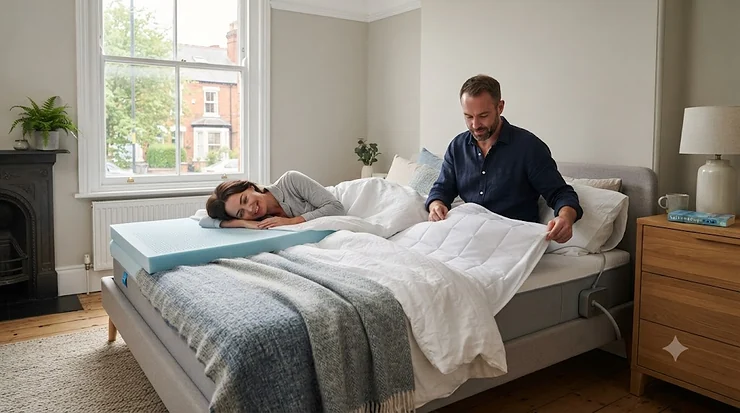
Here’s the thing nobody tells you before you spend £150-£1,000 chasing a cooler night’s sleep: gel memory foam and water cooling systems aren’t actually competing for the same job. One passively slows down heat buildup. The other actively pumps temperature-controlled water beneath you all night. Confusing the two is how people end up disappointed with an expensive purchase that was never going to solve their specific problem in the first place.
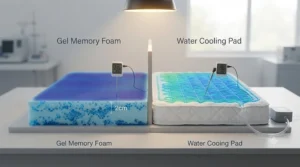
A gel memory foam topper vs water cooling mattress pad comparison boils down to this: gel-infused foam uses phase-change gel beads or graphite particles woven into the foam structure to absorb and disperse heat passively, while a water cooling mattress pad uses a pump-driven hydronic system to actively circulate chilled (or warmed) water through internal tubing, giving you precise, adjustable thermoregulation rather than a one-speed passive effect. Both aim to solve the same nightly frustration — waking up sweaty, kicking off the duvet, flipping your pillow to the “cool side” — but they get there through entirely different mechanisms, at entirely different price points, with entirely different trade-offs around noise, maintenance, and how long the cooling effect actually lasts through the night.
This guide breaks down seven real products across both categories — memory foam density, gel infusion tech, and active water-cooling systems — using genuine specifications, aggregated customer review sentiment, and honest analysis of where each one earns its price tag. Thermoregulation during sleep isn’t a minor comfort detail either: your body’s core temperature naturally drops as you fall asleep, and a cooler sleeping surface makes it measurably easier to fall and stay asleep, which is exactly why this decision is worth getting right rather than guessing. For a deeper look at why bedroom and bedding temperature matters so much, the Sleep Foundation’s overview of sleep thermoregulation is worth a read before you buy anything.
Quick Comparison: Gel Memory Foam vs Water Cooling at a Glance
| Product | Type | Cooling Mechanism | Price Range | Best For |
|---|---|---|---|---|
| ChiliSleep OOLER Sleep System | Water cooling mattress pad | Active hydronic pump, 13-46°C range | £425-£1,000+ | Precise nightly temperature control |
| BedJet 3 | Electric air-cooling system | Active airflow, no water | £350-£600 | Couples wanting dual-zone control, no wet tubing |
| Emma Original Pro Topper | Gel/graphite memory foam | Passive ThermoSync graphite layer | £250-£400 | Fast-acting passive cooling, no electricity |
| Panda London Bamboo Topper | Gel memory foam | Passive HydroFoam gel capsules | £115-£180 | Supportive dense foam plus mild cooling |
| Silentnight Impress Memory Foam Topper | Gel memory foam | Passive gel infusion | £50-£100 | Budget-friendly orthopaedic support |
| EHEYCIGA Cooling Gel Mattress Topper | Gel memory foam | Passive gel infusion | Under £60 | Cheapest genuine gel-infused entry point |
| Silentnight Restore Cooling Mattress Protector | Cool-sensation fabric protector | Passive fabric wicking | Under £40 | Lightest-touch cooling upgrade, no foam feel change |
Looking at the table above, the split is stark: water and air-based active systems sit at a genuinely premium price point because they’re mechanically doing ongoing work throughout the night, while gel memory foam toppers are a one-time passive investment that softens heat buildup rather than eliminating it. Neither is objectively “better” — they solve different degrees of the same problem, and the right pick depends heavily on how severely you overheat at night and how much control you actually want.
💬 Just one click — help others make better buying decisions too!😊
Top 7 Cooling Sleep Products: Expert Analysis
1. ChiliSleep OOLER Sleep System — the water cooling pad built for precision control
The standout feature here isn’t the cooling itself — it’s the range. The OOLER operates across a hydro-powered thermal range of 13-46°C, controlled via a dedicated app, with separate zones available for each side of the bed. That’s a genuinely enormous span compared with any passive gel topper, and it’s precisely why this sits at the premium end of any cooling mattress pad for double bed comparison — it’s not just cooling, it’s full climate control that can warm the bed too.
Based on the spec comparison with passive gel options, the honest analytical take is this: an active hydronic system directly addresses the water pump noise question that so many buyers research before purchasing. Reviewers are candid about this trade-off — the control unit that pumps water through the tubes is far from silent, and while some users find it becomes a welcome, relaxing white noise within minutes of starting up, sensitive sleepers may find it genuinely disruptive. On reliability, aggregated sentiment is mixed: one reviewer found that only the noisy “boost” setting delivered noticeable cooling, with the quieter “silent” mode barely perceptible, while others report the opposite experience of steady, unnoticed performance for months at a time. What most buyers overlook is that this variability often comes down to mattress thickness and ambient bedroom temperature rather than a fault with the unit itself.
Pros:
- ✅ Genuinely adjustable 13-46°C range, cooling or warming
- ✅ Dual-zone option lets couples set different temperatures
- ✅ App-based scheduling and warm wake-up feature
Cons:
- ❌ Pump noise is noticeable, especially on boost setting
- ❌ Some reviewers report water evaporation and leak issues
At £425 upwards depending on bed size and zones, this is a genuine investment rather than an impulse buy, and it earns that price tag specifically for people who need active, adjustable control rather than a passive assist.
2. BedJet 3 — the water-free electric alternative worth knowing about
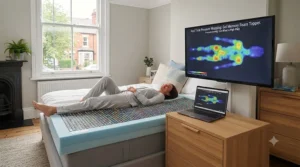
This is the product that answers the “electric cooling mattress pad vs gel topper” question from an entirely different angle, because it isn’t a pad at all — it’s an airflow system that sits under the bed. BedJet uses air-based convective cooling to remove moisture and sweat from the bed, and its ultra-rapid warming mode can turn sheets warm in around 60 seconds, avoiding water tubing entirely.
What most buyers overlook about BedJet is that sidestepping water is a genuine engineering advantage over hydronic systems: there are no leaky tubes of water to sleep on and no stiff mattress pad changing the feel of the bed underneath you. On the noise question specifically, independent testing found the unit measures 38 to 39 decibels on low to medium settings, with even the high and turbo modes not exceeding 43 decibels — genuinely quieter than most portable fans, and a meaningfully different noise profile than a hydronic pump’s continuous hum. The trade-off is that airflow cooling works differently to surface-contact cooling; it excels at whisking away sweat and humidity rather than directly chilling the mattress surface itself, so hot sleepers who specifically want a cold-to-the-touch bed may still prefer a water-based pad.
Pros:
- ✅ No water tubing, leaks, or evaporation to worry about
- ✅ Genuinely quiet even on higher settings
- ✅ Rapid warming mode alongside cooling function
Cons:
- ❌ Cools air/moisture rather than the mattress surface directly
- ❌ Needs a compatible sheet accessory for best performance
Priced from roughly £350-£600 depending on configuration, this sits below the OOLER but above premium gel toppers, carving out its own space as the quietest active option on this list.
3. Emma Original Pro Topper — passive graphite cooling that reacts fastest
Here’s what the spec sheet won’t spell out plainly: not all “cooling” toppers use gel at all. The Emma Original Pro uses ThermoSync technology, infusing graphite particles into the foam to regulate temperature, rather than the gel-bead infusion used in most competitors. This graphite-particle layer is specifically designed to help sleepers reach their ideal sleeping temperature quickly, addressing the common criticism that dense visco memory foam sleeps hot.
Reviewers give an honest, mixed picture that’s worth reading before buying. One in-depth test found it temperature-neutral and thick enough to transform an older mattress, though some sleepers found the soft foam layers lacked support for back sleeping. This is a useful reminder that “cooling” and “supportive” are separate axes entirely — a topper can excel at one and disappoint on the other. At 9cm thick in the Premium/Pro version, this is also one of the deepest toppers here, meaning it does more to mask an ageing or lumpy mattress than thinner alternatives.
Pros:
- ✅ Graphite ThermoSync layer reacts faster than passive gel
- ✅ Thick 9cm profile can rescue an older mattress
- ✅ No electricity or water required
Cons:
- ❌ Some sleepers find it lacks support for back/stomach sleeping
- ❌ Premium price for a passive (non-active) product
At £250-£400 for a double or king, this is priced closer to entry-level active systems than budget gel toppers, so it’s worth being clear-eyed that you’re paying for engineering and thickness rather than active temperature control.
4. Panda London Bamboo Memory Foam Topper — dense gel-infused support with genuine numbers behind it
What most buyers overlook about memory foam density is that it’s rarely stated clearly, which makes comparison shopping difficult — this is one of the few toppers on this list with a published figure. The Panda topper uses HydroFoam, a 3rd-generation memory foam infused with cooling micro-gel capsules, at a stated density of 5lbs per square foot (80 kg/m³), with a medium-firm and supportive feel. Higher density in memory foam generally means better durability and more consistent support over years of use, though it can also retain slightly more heat than lower-density alternatives, which is precisely why the gel infusion matters here rather than being a marketing afterthought.
Aggregated review sentiment is genuinely split on the cooling claim specifically, which is worth being transparent about. One in-depth reviewer found the foam impressively resistant to compressing to a “wafer thin” state under pressure, praising the density and build quality, while a separate detailed review noted the topper sleeps warmer than expected despite the heat-dissipating gel design. Based on the spec comparison, this tracks: a genuinely dense, supportive foam will always retain more heat than a thinner, lower-density one, so buyers prioritising density and longevity should expect the gel infusion to soften rather than eliminate heat retention.
Pros:
- ✅ Published density figure (80 kg/m³) rare among competitors
- ✅ Doesn’t compress to a thin, unsupportive layer over time
- ✅ Removable, machine-washable bamboo cover
Cons:
- ❌ Denser foam retains more heat than lighter alternatives
- ❌ Some reviewers found it sleeps warmer than the marketing suggests
At around £115-£180 depending on size, this occupies a genuine mid-tier position — a meaningful step up from basic gel toppers in build quality, without reaching premium graphite-tech pricing.
5. Silentnight Impress Memory Foam Topper — budget-friendly orthopaedic gel support
This is the honest, accessible entry point into gel memory foam for anyone whose mattress needs a supportive lift rather than serious cooling engineering. As a well-established UK bedding brand, Silentnight’s gel memory foam range is positioned around orthopaedic support for back and neck pain first, with cooling as a secondary benefit of the gel infusion rather than the headline feature. The removable, washable cover is a practical touch that budget buyers particularly value, since it means the topper itself never needs washing.
Aggregated customer sentiment across UK retailers is consistent: buyers repeatedly note that the difference this topper makes depends heavily on the age and condition of the mattress underneath — it’s a genuine improvement for a decent mattress needing refreshment, but won’t miraculously rescue a mattress that’s fundamentally past its useful life. That’s an honest, useful piece of context that applies to virtually every topper on this list, not just this one: a topper amplifies what’s underneath rather than replacing it.
Pros:
- ✅ Genuinely low price for gel-infused memory foam
- ✅ Removable, washable cover for easy maintenance
- ✅ Orthopaedic-grade support for back and neck pain
Cons:
- ❌ Won’t rescue a genuinely worn-out mattress
- ❌ Cooling effect is milder than premium graphite alternatives
At roughly £50-£100 depending on size, this is squarely a budget-conscious pick for anyone prioritising support and a modest cooling boost over serious thermoregulation engineering.
6. EHEYCIGA Cooling Gel Mattress Topper — the cheapest genuine gel-infused entry point
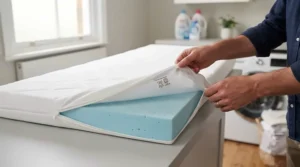
For a cooling mattress pad for double bed on a genuinely tight budget, this represents the accessible end of gel-infused foam. It’s a straightforward cooling gel-infused memory foam topper with a breathable cover and deep-pocket fit, widely available and consistently among the better-reviewed budget options in its Amazon UK category. The core proposition here isn’t sophisticated engineering — it’s making gel-infused foam accessible at a price point where a full mattress replacement isn’t yet justified but a mattress is starting to feel tired or overly warm.
What most buyers overlook at this price tier is that thinner, lower-density budget toppers are inherently less able to retain heat than the denser premium options — which sounds counterintuitive, but a slimmer foam layer with a gel infusion often feels genuinely cooler simply because there’s less foam mass to warm up in the first place, even without sophisticated graphite tech. The trade-off is durability: budget toppers at this price point typically won’t match the multi-year lifespan of a denser, better-constructed alternative.
Pros:
- ✅ Genuinely accessible entry price for gel-infused foam
- ✅ Breathable cover with deep-pocket fit for double beds
- ✅ Thinner profile can feel cooler than denser premium foam
Cons:
- ❌ Shorter expected lifespan than denser premium toppers
- ❌ Less pressure relief than thicker premium alternatives
At under £60, this is the lowest-risk way to test whether gel memory foam suits your sleep style before committing to a pricier option.
7. Silentnight Restore Cooling Mattress Protector — the lightest-touch cooling upgrade available
This product answers a specific question: what if you don’t want to change the feel of your mattress at all, but still want some cooling benefit? This protector uses a cool-sensation fabric that provides a cooling effect as soon as you lie down, and wicks moisture away from night sweats to help the mattress feel fresher, positioned specifically as useful for people who experience menopausal night sweats. That’s a meaningful distinction from every gel or water product above — it’s the only entry here that doesn’t add foam thickness or active mechanics at all.
Reviewer sentiment is honest about the limits of a fabric-only approach: one detailed review noted the protector is only marginally better than a standard mattress protector at actively cooling, and works best without a cotton sheet layered on top, which somewhat limits its practicality. On the other hand, a separate long-term user reported genuinely valuable results for a bed-bound family member on a foam mattress, describing it as close to miraculous when paired with the same range’s cooling pillow. This is a good example of honest, mixed real-world feedback: results depend heavily on the underlying mattress and how hot the sleeper genuinely runs.
Pros:
- ✅ Doesn’t alter the feel or firmness of your mattress
- ✅ Specifically useful for managing night sweats
- ✅ Machine washable and tumble-dry safe
Cons:
- ❌ Cooling effect is subtle, not a dramatic change
- ❌ Best performance requires skipping a cotton sheet layer
At under £40, this is the cheapest product on the entire list and a sensible first step for anyone unsure whether they need a full topper or pad at all.
Gel Memory Foam vs Water Cooling: Specs & Ratings Comparison
| Product | Cooling Type | Noise Level | Setup Required | Price Range |
|---|---|---|---|---|
| ChiliSleep OOLER | Active water pump | Noticeable hum, louder on boost | Electric hookup, water fill | £425-£1,000+ |
| BedJet 3 | Active airflow | 38-43 decibels, genuinely quiet | Electric hookup, no water | £350-£600 |
| Emma Original Pro | Passive graphite | Silent (no moving parts) | None | £250-£400 |
| Panda London Bamboo | Passive gel-infused | Silent | None | £115-£180 |
| Silentnight Impress | Passive gel-infused | Silent | None | £50-£100 |
| EHEYCIGA Gel Topper | Passive gel-infused | Silent | None | Under £60 |
| Silentnight Restore Protector | Passive fabric wicking | Silent | None | Under £40 |
The clearest pattern here is that “silent” and “adjustable” sit at opposite ends of a genuine trade-off. Every passive gel or graphite product on this list is completely silent because there’s simply nothing mechanical inside to make noise, but none of them can be turned up or down on demand the way the ChiliSleep OOLER or BedJet 3 can. If water pump noise is your specific concern, that alone might rule out active hydronic systems regardless of budget — and it’s worth noting the BedJet 3 solves for exactly this by using quiet airflow instead of a water pump.
Electric Cooling Mattress Pad vs Gel Topper: The Core Trade-Off
This is really the heart of the whole decision, so it’s worth spelling out plainly. A gel memory foam topper is a one-time purchase that works by absorbing and slowly dispersing heat through gel beads, graphite particles, or an open-cell foam structure — it never actively cools anything, it simply resists warming up as fast as plain memory foam would. An electric cooling mattress pad, whether water-based like the OOLER or air-based like the BedJet, is an ongoing active system: it draws power, has moving parts, and can be adjusted in real time to a specific target temperature.
The practical consequence is durability and maintenance. Gel toppers essentially never break down mechanically — the foam degrades slowly over years through normal wear, but there’s no pump, no water reservoir, and nothing to service. Active systems, by contrast, involve exactly the components reviewers flag as points of failure: water evaporation, occasional leaks, and questions around long-term unit lifespan are recurring themes in aggregated feedback on hydronic pads specifically. That doesn’t make active systems a bad choice — for genuinely severe night sweats or a couple with mismatched temperature preferences, the adjustability is worth the added complexity — but it does mean the decision should be based on how severe your overheating problem actually is, not simply which product has the most impressive-sounding technology.
Practical Usage Guide: Setting Up Your Cooling Sleep System
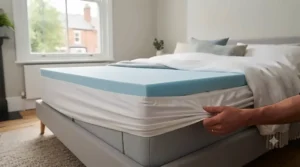
Getting the best result from either category starts with your base mattress condition, since a topper amplifies what’s underneath rather than fixing it outright. Before adding a gel memory foam topper, check your existing mattress for sagging or lumps — a topper will soften the feel but won’t correct structural problems, and layering foam over a genuinely worn-out mattress is a common first-month disappointment. Let a new memory foam topper air out for several hours before first use, since off-gassing is normal for fresh foam and dissipates quickly with ventilation.
For active systems like the OOLER or BedJet, setup requires more attention in the first thirty days. Position the control unit where it’s easy to access for refilling water reservoirs or checking cable routing, and test the app-based scheduling function for a few nights before relying on it for a big trip or important workday, since Bluetooth or Wi-Fi connectivity issues are a common early frustration. A frequent mistake with water-based systems specifically is running the unit on “boost” mode all night in an attempt to maximise cooling — reviewers note this is both the noisiest setting and not necessarily the most effective for sustained comfort, since a moderate, steady setting often outperforms an aggressive one for actual sleep quality. For any cooling mattress pad for double bed, remember that two sleepers with different temperature preferences benefit specifically from dual-zone systems rather than single-zone ones, so check zone configuration carefully before purchasing if you share a bed.
Real-World Scenario: Matching Cooling Tech to Your Sleep Profile
Picture three different sleepers, because thermoregulation needs vary enormously by circumstance.
First, there’s the budget-conscious renter upgrading a slightly tired double mattress who occasionally runs warm but isn’t dealing with a serious medical issue. For this profile, the EHEYCIGA Cooling Gel Mattress Topper or Silentnight Impress Memory Foam Topper covers the realistic need — a mild cooling boost alongside genuine comfort improvement, without committing serious budget to a problem that isn’t severe.
Second, there’s someone experiencing menopausal night sweats or a genuinely hot-sleeping partner sharing a bed with someone who runs cold. This is precisely where active systems earn their premium price tags: the ChiliSleep OOLER‘s dual-zone water cooling directly solves the “one partner too hot, one too cold” problem that no passive gel topper can address, since gel toppers cool the whole surface equally rather than by zone.
Third, there’s the sleeper who wants meaningful cooling benefit but is put off by water tubing, leaks, or maintenance concerns. The BedJet 3 occupies this specific niche well, delivering active, adjustable temperature control through airflow rather than water, at a genuinely quieter noise profile than most hydronic alternatives.
How to Choose Between Gel Memory Foam and Water Cooling
- Rate your actual overheating severity honestly. Mild warmth most nights suits gel foam; waking up drenched or needing to change sheets suggests an active system is worth the investment.
- Factor in memory foam density if you also want support. A denser foam (like the Panda’s published 80 kg/m³) delivers more durable pressure relief but retains marginally more heat than thinner budget alternatives.
- Decide how you feel about water pump noise before you buy. If ambient white noise helps you sleep, hydronic systems can be a non-issue; if you’re noise-sensitive, consider the BedJet’s quieter airflow approach or a passive topper instead.
- Check whether you need dual-zone control. Couples with mismatched temperature preferences benefit specifically from active dual-zone systems; single sleepers rarely need this feature.
- Consider your mattress’s underlying condition. A topper amplifies an existing mattress rather than fixing structural sagging — budget for mattress replacement separately if that’s the real issue.
- Weigh maintenance tolerance realistically. Active systems need occasional water refills, app troubleshooting, and long-term component reliability; gel foam requires essentially none of this.
- Match your budget tier to your genuine need. Spending premium money on active cooling for a mild, occasional warmth issue is rarely worth it; equally, expecting a budget gel topper to solve severe night sweats will likely disappoint.
Cooling Mattress Pad for Double Bed: What Changes at This Size
Double beds introduce a specific wrinkle that single-bed buyers don’t face: shared thermal preference. On a single mattress, a gel topper’s uniform passive cooling is rarely an issue because there’s only one sleeper to satisfy. On a double bed shared by two people, uniform cooling can leave one partner perfectly comfortable and the other still too warm or too cold, which is exactly why dual-zone active systems like the OOLER’s “WE” configuration exist. If a passive gel topper is still the right budget fit for a shared double bed, look specifically for options with washable, replaceable covers, since a shared mattress surface accumulates moisture and body oils faster than a single sleeper’s setup.
Memory Foam Density: What the Numbers Actually Mean
Memory foam density, typically measured in kg/m³ or lbs per cubic foot, is one of the most consistently under-explained specs on any mattress topper listing — and it’s directly relevant to how warm a topper sleeps. Higher-density foam (broadly, anything above roughly 70-80 kg/m³) tends to offer more consistent, durable support over years of nightly use, but it also has more foam mass to warm up against your body heat, which is precisely why gel infusion matters more on denser toppers than on thinner ones. Lower-density foam compresses faster and has a shorter useful lifespan, but ironically can sometimes feel cooler initially simply because there’s less material retaining heat.
This is genuinely useful context when comparing the Panda London Bamboo Topper‘s published 80 kg/m³ density against budget alternatives that rarely disclose a figure at all — a published density spec is itself a signal of a more transparent, quality-focused manufacturer, even before you factor in the actual number.
Thermoregulation: The Science Behind Why This Matters
Thermoregulation during sleep isn’t a comfort nicety — it’s mechanically tied to sleep quality itself. Core body temperature naturally drops by one to two degrees Fahrenheit in the evening, beginning a couple of hours before bedtime, and this drop is one of the primary signals that initiates sleep onset rather than simply a side effect of getting sleepy. When a mattress surface traps heat and prevents that natural cooling process, the result is measurably worse sleep, not just a subjectively uncomfortable feeling.
Overheating at night can reduce deep sleep and increase overnight wakefulness, which is exactly the mechanism both gel foam and active cooling systems are trying to interrupt — just via different routes. Some of the clearest evidence on this comes from research summarised in Frontiers in Neuroscience’s review of temperature-dependent sleep, which outlines how ambient and surface temperature directly influence sleep architecture. This is also why menopausal night sweats specifically respond well to cooling bedding interventions: while hormone replacement therapy remains the most effective treatment for hot flushes and night sweats for most women, according to NHS guidance, environmental cooling strategies like the products in this guide are a genuinely useful complementary approach rather than a medical substitute, and anyone experiencing severe or persistent night sweats should still speak to a GP about the full range of treatment options available.
Common Mistakes When Buying Cooling Sleep Products
The most frequent mistake is buying an active water-cooling system to solve a mild, occasional warmth problem that a £50 gel topper would have fixed just as well — these are expensive products, and the premium is only justified for genuinely severe thermoregulation issues. A closely related error is assuming “gel-infused” automatically means “cold to the touch” — gel toppers moderate heat buildup over the course of the night rather than delivering the instant cool-surface sensation that active water or air systems provide from the first minute.
Buyers also commonly skip checking memory foam density entirely, then find their supposedly premium topper compresses to a thin, unsupportive layer within months — always look for a published density figure where possible. On the active-system side, a frequent oversight is not testing pump noise tolerance before committing to an expensive water cooling system, since returns policies and restocking fees vary and this is a genuinely subjective preference that’s hard to judge from marketing copy alone. Finally, shared-bed buyers frequently default to a single-zone system without considering whether their partner’s temperature preference actually differs from their own, missing out on the dual-zone benefit that often justifies the extra cost.
What to Expect: Real-World Performance Through the Night
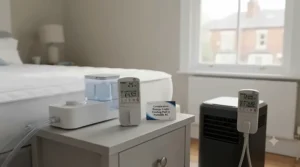
Specs rarely capture the lived experience, so here’s what genuinely happens across a typical warm night. With a passive gel topper, the cooling effect is most noticeable in the first hour or two of contact — the gel or graphite layer absorbs initial body heat effectively, but as the foam gradually warms toward body temperature over several hours, that cooling advantage naturally diminishes; it’s a head start on comfort rather than a sustained active effect all night long.
With an active water or air system, the experience is fundamentally different: the surface (or surrounding air) stays at whatever temperature you’ve set for as long as the unit runs, which is precisely why reviewers consistently describe waking up at a consistent temperature rather than gradually warming through the night. The trade-off most users report is that this consistency comes with an audible hum or airflow sound running continuously in the background — genuinely unnoticeable to some, a dealbreaker for others, which is exactly why testing your own noise sensitivity matters more than any spec sheet here.
Long-Term Cost & Maintenance
Gel memory foam toppers are close to maintenance-free: beyond an occasional cover wash, there’s nothing to service, refill, or troubleshoot, and a well-made, denser topper like the Panda can reasonably be expected to perform for several years before needing replacement. The total cost of ownership is essentially the sticker price plus the cost of a replacement every few years as foam naturally loses resilience.
Active systems carry a meaningfully different cost profile. Beyond the higher upfront price, water-based systems need periodic reservoir refills and occasional cleaning solution top-ups, and customer feedback flags genuine concerns around unit longevity and customer service response times when components eventually fail. Air-based systems like the BedJet avoid the water-specific maintenance entirely, which is a genuine long-term advantage worth weighing against its slightly different cooling mechanism. For anyone calculating value over a five-year horizon, a premium gel topper replaced once likely costs less overall than an active system’s higher upfront price plus ongoing servicing, though it will never match the active system’s adjustable, on-demand control.
Features That Actually Matter (And Those That Don’t)
Published memory foam density matters genuinely — it’s one of the few objective, comparable numbers across gel topper listings, and directly predicts both support longevity and relative heat retention. A clearly stated temperature range on active systems matters too, since a wider adjustable span (like the OOLER’s 13-46°C) offers more year-round versatility than a fixed-effect passive product. Genuine noise specifications in decibels, where manufacturers publish them, matter more than vague “whisper quiet” marketing claims — the BedJet’s published 38-43 decibel range is a useful benchmark precisely because it’s a testable number.
What matters considerably less: the specific colour or pattern of a topper’s cover, since this has zero bearing on cooling performance. Marketing language like “revolutionary” or “breakthrough” attached to gel infusion also tends to matter less than it sounds, since gel-bead technology in memory foam has been broadly similar across brands for years — the actual differentiator is foam density and construction quality, not the gel itself. Finally, app features on active systems (elaborate scheduling, sleep tracking integrations) are genuinely nice-to-have but rarely change the core cooling performance that justifies the purchase in the first place.
Safety & Practical Considerations
Active water-cooling systems involve mains electricity running near a bed overnight, so it’s worth checking that any unit you buy carries relevant UK electrical safety certification and that cabling is routed away from where it could be caught or pulled during sleep. For anyone specifically managing menopausal symptoms, it’s worth remembering that the NHS’s guidance on menopause treatment notes hot flushes and night sweats often improve within a few weeks of starting hormone replacement therapy for those who are candidates, so a cooling mattress product is genuinely best thought of as a comfort-focused complement to medical treatment where symptoms are significant, rather than a replacement for speaking to a GP.
Frequently Asked Questions
❓ Is a gel memory foam topper as effective as a water cooling mattress pad?
❓ How loud is the water pump on a cooling mattress pad?
❓ What memory foam density is best for a cooling topper?
❓ Can a cooling mattress pad help with menopausal night sweats?
❓ Do I need a dual-zone system for a double bed?
Conclusion
Gel memory foam topper vs water cooling mattress pad isn’t really a competition — it’s a decision about how severe your overheating problem is and how much active control you actually want to pay for. For mild, occasional warmth, the EHEYCIGA Cooling Gel Mattress Topper or Silentnight Impress Memory Foam Topper deliver genuine, affordable improvement without complexity. For denser, more durable support with a published density figure, the Panda London Bamboo Topper earns its mid-tier price. For genuinely severe night sweats, mismatched couple preferences, or a desire for precise nightly control, the ChiliSleep OOLER or the quieter BedJet 3 justify their premium cost through active, adjustable performance that no passive foam can match.
Whichever direction you go, be honest with yourself about your actual overheating severity before spending premium money on active tech you may not need — and if night sweats are a persistent, significant problem rather than occasional discomfort, treat any cooling product here as a helpful complement to a conversation with your GP, not a substitute for one.
Recommended for You
- 7 Best Cooling Mattress Pads Under £50 (2026 UK Guide)
- Misting Fan Handheld: 7 Best Cooling Picks for UK Summer 2026
- 7 Best Foldable Handheld Fans UK 2026: Pocket to Premium
Disclaimer: This article contains affiliate links. As an Amazon Associate, I earn from qualifying purchases. If you purchase products through these links, we may earn a small commission at no additional cost to you.
✨ Found this helpful? Share it with your friends! 💬🤗
