
In This Article
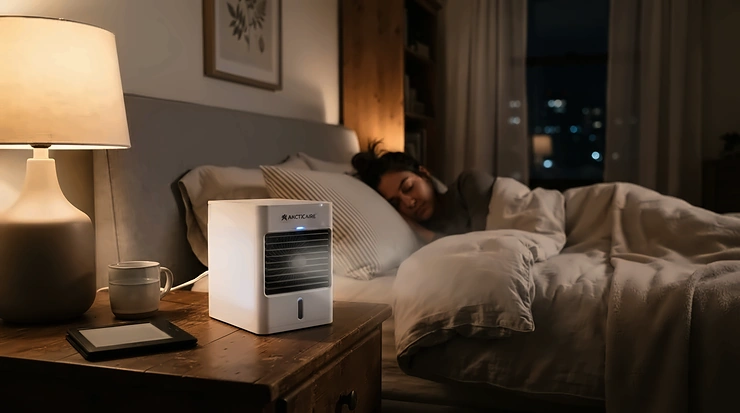
Portable air conditioners for hotel rooms are self-contained cooling units, or smaller personal coolers and fans, that you bring with you to lower the temperature around you in a hotel that lacks effective air conditioning. They range from pocket-sized USB gadgets to full 10,000 BTU units with a window hose, and they only work well when matched to the room, the climate and the hotel’s rules.
Here is the awkward truth most roundups skip. A heavy, hose-fed unit is a poor fit for a typical hotel stay. It weighs more than a suitcase, and the hose needs a window that opens properly. Many hotel windows are restricted, sealed or simply not yours to modify. So this guide is built around what actually works. I’ve covered EcoFlow Wave 3, MeacoCool MC Series Pro 10000 BTU, Pro Breeze 4-in-1 5000 BTU, DeLonghi Pinguino Compact PAC ES72 Classic, Evapolar evaCHILL, JisuLife Life 3 and Honeywell Turbo On-The-Go. I’ve been blunt about which suit hotels, which suit holiday accommodation, and which are best left at home.
Why does this matter now? Heat isn’t a niche worry any more. The NHS explains the health risks of hot weather clearly, and a bedroom that never drops below 28°C is a health issue as well as a comfort one. Meanwhile, Mumsnet’s July 2026 guide noted that its recommended portable air conditioners had sold out during the UK heatwave. If you’re planning heatwave travel, stock and timing matter as much as specs.
Everything below is based on published specifications and aggregated review sentiment from Which?, Mumsnet and retailer listings. I haven’t tested any of these products myself. Where evidence is thin, I say so.
Quick Comparison: Portable Air Conditioners for Hotel Rooms at a Glance
| Product | Type | Weight | Noise (stated) | Best For |
|---|---|---|---|---|
| EcoFlow Wave 3 | Battery-capable dual-hose AC | c. 15.6kg | 44-58dB | Car-borne trips, caravans, premium budgets |
| MeacoCool MC Series Pro 10000 BTU | Single-hose AC | 21-24.5kg | 51-55dB | Long holiday lets and serviced flats |
| Pro Breeze 4-in-1 5000 BTU | Single-hose AC | 18kg | c. 52dB | Small rooms on a budget |
| DeLonghi Pinguino Compact PAC ES72 Classic | Compact AC | 21.5kg | See Which? | Compact, brand-trusted home cooling |
| Evapolar evaCHILL | Personal evaporative cooler | c. 0.8kg | 25dB | Dry-climate bedside cooling |
| JisuLife Life 3 | Wearable neck fan | 275g | Moderate | Hands-free relief anywhere |
| Honeywell Turbo On-The-Go | Folding USB fan | Pocketable | Claimed quiet | Cheap carry-on insurance |
Read this table as a ladder of commitment. The top four need a window and a car boot, while the bottom three fit in hand luggage. For most hotel guests, the bottom three, and the Evapolar evaCHILL in particular, are the realistic travelling companions. Real room cooling is a holiday-accommodation story, which we’ll get to. Weight and noise are manufacturer or retailer figures, and they vary between listings, so treat them as guides.
💬 Just one click — help others make better buying decisions too!😊
Top 7 Portable Air Conditioners and Coolers for Hotel Rooms: Expert Analysis
1. EcoFlow Wave 3 — premium battery-capable cooling with two hoses
The standout here is cordless potential: pair the unit with EcoFlow’s optional add-on battery and it can run without a wall socket for several hours.
On paper, the EcoFlow Wave 3 delivers 6,100 BTU of cooling (about 1,800W) and 6,800 BTU of heating, in a body around 52 × 30 × 34cm. In practice, that’s a serious spot cooler for a small bedroom, not a whole-flat solution. Its dual-hose design draws outside air in and pushes hot air out, so it doesn’t pull warm air back into the room the way single-hose units do. That’s why it tends to outperform its BTU number in small, sealed spaces.
Based on the spec comparison, this is a car-trip, camper or caravan machine more than a hotel one. At around 15.6kg for the unit alone, it’s too heavy for casual luggage. Reviewers call it smart, mobile and a real step up from its predecessor. One European retailer’s tester judged cooling “decent but not spectacular”, with the unit noisier while charging. A Dutch-market retail listing shows a middling star rating from a few hundred buyers, so expect mixed experiences.
Pros:
- ✅ Dual-hose design cools small rooms efficiently
- ✅ Optional battery enables cordless operation
- ✅ Also heats and dehumidifies year-round
Cons:
- ❌ Heavy and pricey for hotel travel
- ❌ Noisier at full tilt, especially when charging
Expect the unit alone to sit around the £700-£800 range, with battery bundles costing noticeably more (check current price). It’s a premium purchase, and good value only if you’ll also use it camping or at home.

2. MeacoCool MC Series Pro 10000 BTU — best-reviewed all-rounder for holiday lets
This is the Mumsnet Best Buy pick, and the standout is how little fuss it asks of you: two window kits in the box, castors, and an app.
The MeacoCool MC Series Pro 10000 BTU is rated for rooms of roughly 18-28m², with a 1.8m hose, 310m³/h airflow and about 1,120W power draw. At Which?’s electricity price of 26.32p/kWh, that works out at roughly 29p an hour at full draw. Noise is stated at 51-55dB, so it’s audible but not unusual for the category. Castors matter more than they sound: nobody enjoys dragging 21-24kg of plastic across a rental’s floor.
Here’s the analytical take: this suits you if you’ve booked a holiday cottage, apartment or serviced flat for a week or more. It is a lot of kit to bring to a hotel. Mumsnet’s tester used it through a sunny home-office summer and praised its effective cooling, app control and A energy rating. The stickiest complaint was the Velcro on window frames. Reviewers elsewhere like the washable filter and dehumidifying mode.
Pros:
- ✅ Two window kits suit sliders and sashes
- ✅ App and timer let you pre-cool rooms
- ✅ Castors make the heavy unit manageable
Cons:
- ❌ Far too bulky for hotel luggage
- ❌ Stock can vanish during heatwaves
Expect roughly £380-£420 at the time of research, in line with the RRP Mumsnet quoted. For a repeat rental or home use, that’s fair value.
3. Pro Breeze 4-in-1 5000 BTU — lightest of the full-size units
The pitch is simplicity: a smaller 5,000 BTU body that’s easier to carry than its bigger siblings, with Wi-Fi, a remote and a 24-hour timer.
The Pro Breeze 4-in-1 5000 BTU (model PB-AC08-UK) is listed at about 30 × 30.5 × 68.2cm and 18kg, with a stated noise of around 52dB and a dual window-venting kit. Stripped of marketing, 5,000 BTU means a small bedroom. It’s a sensible match for a compact guest room or a micro-apartment, and probably not for an open-plan living area.
Aggregated review sentiment on the Pro Breeze range is genuinely mixed. Some buyers love the remote and ease of setup. Others report that the cooling feels localised, that the hose is short and gets hot, and that quality control isn’t always consistent. I’d treat it as a budget purchase with some variance. The extra weight saving versus 9,000-10,000 BTU models is real, but it isn’t enough to make this a “carry-on” product.
Pros:
- ✅ Lighter than most full-size portable units
- ✅ Remote, app and timer included
- ✅ Dehumidifier and fan modes add flexibility
Cons:
- ❌ Mixed reviews on cooling strength
- ❌ Short, hot hose limits placement
Check current price; the larger 9,000 BTU sibling carried a £450 RRP in Mumsnet’s guide, so this one typically lands below that. It’s good value only for small rooms.
4. DeLonghi Pinguino Compact PAC ES72 Classic — compact, trusted-brand simplicity
The standout is brand pedigree in a compact frame: DeLonghi’s Pinguino line is one of the better-known names in UK portable cooling.
Which? has tested the DeLonghi Pinguino Compact PAC ES72 Classic, listing it at about 68.7 × 29 × 36.3cm and 21.5kg, with a hose that stretches to roughly 165cm and a recommendation to clean the filter every two weeks. Which?’s scores sit behind a paywall, so I can’t tell you its rank. What I can say is that its portable air conditioner tests cool a 35°C room by 10°C, check evenness, and measure noise and efficiency claims. A compact, well-tested design is exactly what you want in a unit that’ll move between rooms.
On balance, this is a home or holiday-let machine. The fortnightly filter clean is a small chore that matters: a clogged filter quietly kills performance. Sentiment across DeLonghi’s range is generally favourable on build and brand support, though I couldn’t verify detailed owner feedback for this precise model, so check Amazon’s current review summary.
Pros:
- ✅ Independently tested by Which?
- ✅ Longer hose reach, up to about 165cm
- ✅ Slim footprint for a full AC
Cons:
- ❌ Still 21.5kg, so not travel-friendly
- ❌ Needs regular filter cleaning
Compact full-size units of this class generally sit in the £300-£450 bracket (check current price). It’s a safe, sensible choice if you’ll use it at home year-round.
5. Evapolar evaCHILL — whisper-quiet bedside cooling for dry air
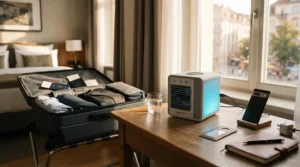
The hook is how little it asks of a hotel: it’s about 17cm square, USB-powered, and rated around 25dB.
The Evapolar evaCHILL uses an 800ml tank and a replaceable evaporative cartridge to cool and humidify the air immediately in front of it, for a claimed zone of around 2.5m². Power draw is a modest 7.5W, so a power bank or laptop port can run it. Evaporation does the cooling rather than a compressor, and that comes with a physics catch. The drier the air, the better it works, and in humid air it struggles.
Reviewers broadly agree on what it is: a personal cooler, not an air conditioner. One review summary describes the output as a few degrees cooler and a few percentage points more humid than the room. Satisfied owners report real relief at a desk or bedside. Critics report disappointment in humid conditions and some trouble sourcing replacement cartridges. An Evapolar store page on reviews.co.uk shows a high average across 85 reviews, but that’s a brand-run listing, so weigh it accordingly.
Pros:
- ✅ Tiny, light and USB-powered for travel
- ✅ Near-silent for light sleepers
- ✅ No hose, no window, no hotel permission needed
Cons:
- ❌ Weak in humid coastal climates
- ❌ Cartridge replacements can be fiddly
Historically it has been priced around the $99 mark in US listings, so expect roughly £80-£100 in the UK (check current price). Good value if your destination is dry; poor value if it’s muggy.
6. JisuLife Life 3 — hands-free neck fan with serious battery life
The standout is endurance: a 4,000mAh battery with claimed runtimes of 4 to 16 hours, depending on speed.
The JisuLife Life 3 weighs about 275g, offers five speeds and charges by USB-C, according to Which?’s listing. A neck fan doesn’t cool a room; it cools you, by moving air across your neck and jaw. That’s exactly what you want in a sweaty hotel lobby queue or a stifling room at 2am. It sits on your shoulders like a travel pillow, so your hands stay free for passports and luggage.
Mumsnet’s testers rated JisuLife’s neck fans highly for battery life, calling the model they tested not too loud but not quiet either, and noting the price premium. That’s a fair summary of what I’d expect: excellent, slightly pricey, and audible in a silent room. Which? has both neck and handheld fans in its 2026 tests, so it’s a category with real independent scrutiny.
Pros:
- ✅ Up to 16 hours on the lowest speed
- ✅ Hands-free and carry-on friendly
- ✅ USB-C charging suits modern power banks
Cons:
- ❌ Audible in a silent bedroom
- ❌ Cools you, not the room
Expect roughly £30-£40 (Mumsnet’s tested JisuLife model was £37). That’s strong value for a gadget you’ll use constantly.
7. Honeywell Turbo On-The-Go — cheap folding fan for carry-on insurance
The hook is price and pocketability: a folding fan with a 12.7cm blade, powered by USB or battery.
The Honeywell Turbo On-The-Go is the kind of gadget travel writers recommend for a reason. The Points Guy-style advice, and Rick Steves’ team, both nudge travellers to pack a small fan or ask the front desk for one. A fan doesn’t lower the room’s temperature, but it improves how hot air feels on your skin, and that’s often enough. I couldn’t find independent test data for this exact model, so the “ultra-quiet” claim is marketing until proven otherwise.
Analytically, it earns its place as a backup. It’s the thing you reach for when the Evapolar evaCHILL has run dry, the JisuLife Life 3 needs charging, or the hotel’s aircon dies. Retail listings show it discounted from £19.99 to around £10, which tells you how cheap this corner of the market is.
Pros:
- ✅ Folds small enough for any bag
- ✅ USB and battery power options
- ✅ Very low cost per use
Cons:
- ❌ Moves air, doesn’t lower temperature
- ❌ No independent test data found
Around £10-£20 at the time of research (prices may vary). Excellent value as an insurance policy.
Top 7 Compared Side by Side: Which Option Fits Your Trip?
| Product | Power Source | Cooling Style | Hotel-Friendly? | Best For |
|---|---|---|---|---|
| EcoFlow Wave 3 | Mains or add-on battery | Compressor, dual-hose | Rarely, needs window hose | Road trips and caravans |
| MeacoCool MC Series Pro 10000 BTU | Mains | Compressor, single-hose | No | Week-long rentals |
| Pro Breeze 4-in-1 5000 BTU | Mains | Compressor, single-hose | No | Small rooms, tight budgets |
| DeLonghi Pinguino Compact PAC ES72 Classic | Mains | Compressor, single-hose | No | Home and holiday lets |
| Evapolar evaCHILL | USB | Evaporative | Yes | Dry-climate bedsides |
| JisuLife Life 3 | USB-C battery | Wearable airflow | Yes | Everyone, everywhere |
| Honeywell Turbo On-The-Go | USB or battery | Airflow | Yes | Backup fan |
Look at the “Hotel-Friendly?” column and the pattern is blunt: the three cheapest items are the only ones I’d call genuinely hotel-friendly. If you’re spending £400 on a MeacoCool MC Series Pro 10000 BTU for a three-night city break, you’ve made a mistake. If you’re spending £35 on a JisuLife Life 3, you’ve made one of the best-value travel purchases of the year. For a longer stay, the gap narrows, and that’s where the compressor units start to pay back.
✨ Don’t Miss These Exclusive Deals!
🔍 Take your hotel cooling to the next level with these carefully selected products. Click on any highlighted item to check current pricing and availability, then build the kit that fits your trip!
How to Choose Portable Air Conditioners for Hotel Rooms
Choosing well comes down to a handful of questions. Work through them in order and the right product usually becomes obvious.
- Decide how long you’re staying. For one to four nights, personal coolers and fans win because they’re light and need no setup. For a week or more in one place, a compressor unit becomes worth the hassle.
- Check the accommodation type. Hotels rarely suit hose-fed units, while apartments, cottages and holiday lets often do. Ask before you pack anything heavy.
- Check the window. A portable air conditioner needs a window or door to vent through. Sealed or restricted hotel windows rule it out entirely.
- Match capacity to the room. As a rough guide from Meaco’s own range, 8,000 BTU suits around 25m², 9,000 BTU around 26m² and 10,000 BTU around 28m². Hotel rooms are usually smaller, which is why even compact units can be overkill.
- Consider climate. Evaporative coolers like the Evapolar evaCHILL shine in dry heat and flop in humid conditions. Compressor units don’t care.
- Weigh noise honestly. Compressor units run around 50-55dB. If you’re a light sleeper, that’s the sound of a fridge in your bedroom.
- Check the plug and voltage. UK plugs and 230V suit Europe with an adapter, but not other regions. Never plug a UK mains appliance into an unfamiliar supply without checking.
Will a Hotel Actually Let You Use One? Rules, Etiquette and Reality
Short answer: ask first, and don’t assume. Hotels have genuine reasons to be wary. A hose through a window can breach security restrictions, damage seals, drip condensate onto carpets, or draw complaints from neighbouring rooms. Fire and electrical safety policies can also ban guest-supplied appliances.
Here’s what tends to work in practice. Personal coolers and small fans are almost never an issue because they’re closer to a phone charger than an appliance. A compressor unit is a different matter. Email the hotel before you travel, say exactly what it is, and ask whether the window opens wide enough. If they say no, accept it graciously.
The better move is often to ask the front desk for a fan or a room change. Travel writers consistently suggest that approach, and a hotel that can’t fix your room may well swap it. Also remember that portable units produce condensate and heat. Tell the hotel how you’ll handle both, and you’ll often get a more flexible reply.
Portable Air Conditioning vs Fans vs Personal Coolers
| Option | Cools the Air? | Setup Effort | Travel Weight | Best For |
|---|---|---|---|---|
| Portable air conditioning (e.g. MeacoCool MC Series Pro 10000 BTU) | Yes, strongly | High, needs a window | Very heavy | Long stays in a rental |
| Personal evaporative cooler (e.g. Evapolar evaCHILL) | Slightly, locally | Low, fill with water | Light | Dry-climate bedside use |
| Neck or handheld fan (e.g. JisuLife Life 3) | No, cools you | None | Minimal | Every traveller |
The honest read is that the gap between a fan and an air conditioner is not about power, it’s about physics. Which?’s guidance on whether to buy an air conditioner or an electric fan makes the point that the best air conditioners can cool a room by 10 degrees in 30 minutes or less, which no fan can do. But a fan is far cheaper to run and far easier to pack. Personal evaporative coolers sit awkwardly in the middle: more effective than a fan in dry air, far weaker than a compressor, and sensitive to humidity.
Which should you pick? If your room is merely warm, a fan or neck fan is plenty. If it’s seriously hot and you can vent a hose, a portable air conditioner is the only tool that actually drops the temperature.
Rated Travel Air Cooler for Hotels: What the Ratings Really Tell You
Searching for a rated travel air cooler for hotels throws up plenty of stars and very little rigour. Here’s how to read what you find.
Genuine independent testing exists mainly for full-size units. Which? buys every air conditioner it tests and measures how fast each one cools a 35°C room by 10°C, how evenly it distributes air, how noisy it is, and whether its efficiency claims hold up. Smartphone-connected models also get a privacy and security check. That’s meaningful, and it’s why a model like the DeLonghi Pinguino Compact PAC ES72 Classic carries more weight than a mystery brand with 4.8 stars.
Personal coolers are a different story. There’s no standard UK test for a USB evaporative cooler, so “ratings” are mostly retailer star averages. I’d treat those as directional at best. Look instead for consistent complaint themes across many reviews: humidity, refilling, cartridge supply, noise. Those patterns tell you far more than the headline score. A product with a modest average and honest reviews is usually safer than one with a perfect score and vague praise.
Compact Air Cooler for Hotel Stays: Making Evaporative Cooling Work
A compact air cooler for hotel stays like the Evapolar evaCHILL can genuinely help, but only if you set it up well. The mechanics are simple: water evaporates from a cartridge, taking heat from the air that passes through. The catch is that evaporation slows when the air is already humid.
To get the best from one, start with cold water, and ice if the model allows it. Place it within a metre or so of your head, because the cooling effect drops off quickly with distance. Crack a window or door slightly so humidity doesn’t build up, since a sealed room turns the cooler into a humidifier. And choose your destination wisely: dry inland heat suits it, while muggy coastal resorts largely defeat it.
One more honest warning. Reviewers describe the effect as modest, a few degrees at best. If you expect an air conditioner, you’ll be disappointed. If you expect a nicer microclimate around your pillow, you’ll probably be pleased.
Travel Cooling Gadget for Hot Hotel Rooms: The Cheap Extras That Matter
The best travel cooling gadget for hot hotel rooms is often not a cooler at all. Small habits and cheap extras go a long way.
A JisuLife Life 3 keeps airflow on your skin without taking up bedside space. A Honeywell Turbo On-The-Go gives you a spare when batteries run flat. Beyond fans, consider a lightweight moisture-wicking travel sheet, a damp flannel for your neck, and blackout curtains drawn during the day. Hotel advice columns consistently recommend blocking sun in the daytime and using opposite windows for a cross-breeze at night, where it’s safe to do so.
Think of these as a system rather than a single purchase. A neck fan, a bedside cooler and sensible curtain management together can drop your perceived temperature far more than any one gadget alone.
Heatwave Travel: Health, Safety and Sleep
Heatwave travel brings real health stakes. The NHS flags dehydration, overheating and heat exhaustion as the main risks, and older people, young children and anyone on certain medications are more vulnerable. A cooling gadget is comfort; it is not medical protection.
Practical priorities: drink water steadily, avoid strenuous activity between roughly 11am and 3pm, and keep your sleeping space as cool as you can. If someone feels unwell with a high temperature, treat it seriously and get medical advice. Don’t rely on a USB cooler to manage a health emergency.
Sleep is the other casualty of heat. A room that stays hot overnight breaks sleep, which makes the next hot day harder. That’s why a quiet bedside option like the Evapolar evaCHILL, used sensibly, can be more valuable than its modest cooling suggests.

Holiday Accommodation: When a Full Portable Air Conditioning Unit Makes Sense
Holiday accommodation is where portable air conditioning earns its keep. A week in a top-floor apartment with no air conditioning can be miserable, and a compressor unit transforms it.
Here the maths shifts. If you’re driving, have boot space and are staying seven nights or more, a MeacoCool MC Series Pro 10000 BTU or DeLonghi Pinguino Compact PAC ES72 Classic becomes rational. Better still, ask the owner first. Many hosts will happily let you use a unit they already own, or even buy one. For smaller bedrooms, the Pro Breeze 4-in-1 5000 BTU is lighter to load into a car.
The EcoFlow Wave 3 deserves a mention for road-trippers. Its battery option, dual-hose efficiency and heating mode suit caravans and campervans particularly well, and it’s the only product here that works as a four-season purchase. Just don’t pretend it’s a hotel gadget.
Your 15-Minute Hotel Room Cooling Setup (Step by Step)
Whatever you’ve packed, a methodical setup makes a bigger difference than buying more gear. Here’s a practical routine that costs nothing.
Step 1: Assess the room. Check whether the window opens, which direction it faces, and where the aircon vent is.
Step 2: Block the sun. Close curtains on sun-facing windows before the room heats up. Preventing heat entering is far easier than removing it.
Step 3: Place your cooler properly. Put a personal cooler or fan near the bed, not in a corner. For a full unit in a rental, keep it a hand’s width or more from the wall and keep the hose as straight as possible, as one retailer’s guidance on portable air conditioners advises.
Step 4: Pre-cool. If you have a compressor unit and timer, start it earlier in the day. Cooling a room before it’s baking is quicker and quieter.
Step 5: Charge and fill. Top up your neck fan and refill an evaporative tank before bed, not at 3am.
Step 6: Manage condensation. If your unit has a drain or tank, empty it so it can’t overflow onto the floor.
Step 7: Be a considerate guest. Keep noise down, tell the hotel what you’re doing, and leave the room as you found it.
Case Studies: Three Travellers, Three Cooling Kits
Matching products to people is where the advice becomes practical. These are illustrative scenarios based on the specs and reviews above, not personal experience.
The city-break couple. Three nights in a Mediterranean hotel, hand luggage only, budget around £50. The right kit is a JisuLife Life 3 and a Honeywell Turbo On-The-Go. They’re light, silent enough and cheap. If the destination is dry, a Evapolar evaCHILL adds bedside relief.
The family renting a flat for a fortnight. They’re driving, have boot space and have two children sharing a small bedroom. A Pro Breeze 4-in-1 5000 BTU suits that room size, and they should email the host about window type before leaving. They’ll accept mixed reviews in exchange for the weight saving.
The remote worker on a month-long let. Daily use, a sunny home-office room and a decent budget. The MeacoCool MC Series Pro 10000 BTU matches the use case Mumsnet’s tester covered, and its app and timer help manage running costs. The EcoFlow Wave 3 is overkill unless they also camp.
Hot-Room Problems and Their Fixes
Most hot-hotel complaints fall into predictable patterns, and each has a practical fix.
Problem: the hotel’s air conditioning is weak. Ask the front desk to check it or to supply a fan. Then use a JisuLife Life 3 personally while you wait.
Problem: the room stays hot overnight. Block the sun all day, then use cross-ventilation at night. A bedside Evapolar evaCHILL helps if the air is dry.
Problem: you can’t sleep because of noise. Compressor units hum at 50-55dB, so they suit some sleepers and not others. Quiet personal options are better for light sleepers.
Problem: your battery fan dies mid-night. Plan for it. Charge before bed, use a lower speed, and keep a backup like the Honeywell Turbo On-The-Go. Which?’s handheld and neck fan tests are a good guide to battery and noise trade-offs.
Problem: you’re abroad and the sockets don’t fit. Pack the right adapter, and check voltage before using any mains appliance.
Long-Term Cost and Value: Is It Worth Buying?
Total cost of ownership depends on how often you’ll actually travel in heat. A £35 neck fan used on ten trips costs a few pounds per trip. A £400 compressor unit used on two holiday lets a year costs far more per use unless it also serves at home.
Running costs are modest for personal gadgets, since the Evapolar evaCHILL draws about 7.5W. A compressor unit like the MeacoCool MC Series Pro 10000 BTU costs roughly 29p an hour at full power, at the electricity price Which? uses, so a night’s use can add a few pounds. Maintenance matters too: clean filters regularly, replace cartridges as recommended, and store units dry.
The best value proposition for most travellers is clear: buy the cheap wearable gear, and treat compressor units as a home-first purchase that happens to travel. Buy a EcoFlow Wave 3 only if you’ll use its mobility every month.
Common Mistakes When Buying Portable Air Conditioners for Hotel Rooms
A few errors come up again and again.
Buying a big unit for a short stay. The weight, setup and hotel permission rarely justify it for a few nights.
Ignoring the window. A hose needs somewhere to go. Check before you buy and before you pack.
Expecting a personal cooler to behave like an air conditioner. An Evapolar evaCHILL is a bedside breeze, not a climate system.
Forgetting humidity. Evaporative cooling struggles in muggy air, so match the product to the destination.
Not checking stock and timing. Mumsnet noted its picks selling out during the July 2026 UK heatwave. Buy before the heat arrives, not during it.
Trusting stars over patterns. Read the complaint themes in reviews rather than relying on a headline score.

Frequently Asked Questions About Portable Air Conditioners for Hotel Rooms
❓ Can I bring a portable air conditioner to a hotel?
❓ What is the best travel cooling gadget for a hot hotel room?
❓ Do small evaporative coolers work in humid destinations?
❓ How much does a portable air conditioner cost to run?
❓ Is portable air conditioning worth it for holiday accommodation?
Conclusion: Choosing the Right Portable Air Conditioners for Hotel Rooms
The honest verdict is that portable air conditioners for hotel rooms come in two very different flavours. Compressor units like the MeacoCool MC Series Pro 10000 BTU, Pro Breeze 4-in-1 5000 BTU, DeLonghi Pinguino Compact PAC ES72 Classic and EcoFlow Wave 3 genuinely cool a room, but they’re heavy, need a window and rarely suit a hotel. Wearable and personal options like the JisuLife Life 3, Evapolar evaCHILL and Honeywell Turbo On-The-Go are far more realistic for travel, even though they cool you rather than the room.
If I had to boil it down: pack a neck fan for every trip, add a personal cooler for dry destinations, and save the full air conditioner for long holiday lets or home use. Ask the hotel before you bring anything with a hose, and buy before the heat arrives rather than during a heatwave.
Prices change constantly, so check current prices and availability on Amazon before you decide.
✨ Ready to stay cool on your next trip?
🔍 Click through to check current prices on your favourite pick above, and build the kit that fits your destination, your luggage and your sleep. 🌡️
Recommended for You
- Portable Cooler For Hotel Room: 7 Best Picks To Beat The Heat (2026)
- Handheld Fan For Hot Flushes: 7 Best Cooling Picks (2026)
- Mini Handheld Fan For Handbag: 7 Best Picks For UK Heat (2026)
Disclaimer: This article contains affiliate links. As an Amazon Associate, I earn from qualifying purchases. If you purchase products through these links, we may earn a small commission at no additional cost to you.
✨ Found this helpful? Share it with your friends! 💬🤗
