
In This Article
I’ll never forget the summer of 2024 when my electricity bill skyrocketed to nearly £180 per month. Desperate for a solution that wouldn’t cost a fortune, I stumbled upon dc motor ceiling fan technology—and honestly, it changed everything. Unlike traditional AC motor fans that guzzle electricity like there’s no tomorrow, DC motor fans use advanced direct current technology to deliver powerful cooling whilst consuming up to 70% less energy.
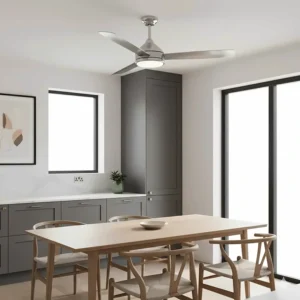
What is dc motor ceiling fan exactly? Put simply, it’s a revolutionary cooling appliance that operates on direct current electricity rather than the alternating current used by conventional fans. This fundamental difference means these fans run whisper-quiet (often below 30 decibels), offer six or more adjustable speed settings, and dramatically reduce your carbon footprint whilst keeping you comfortable year-round. Whether you’re battling the increasingly warm British summers or simply want to circulate warm air more efficiently during winter, a dc motor ceiling fan represents one of the smartest home improvements you can make in 2026.
Quick Comparison Table
| Ceiling Fan Model | Motor Power | Diameter | Price Range (£) | Speed Settings | Noise Level | Best For |
|---|---|---|---|---|---|---|
| Eglo Cirali 52 | 24W DC | 132cm | £79.99-£119.99 | 5 Speeds | 46dB | Bedrooms, Living Rooms |
| Coolwind Modern 52″ | 30W DC | 132cm | £89.99-£129.99 | 6 Speeds | ≤30dB | App Control Enthusiasts |
| HOMCOM Gold Cage | 35W DC | 107cm | £69.99-£99.99 | 6 Speeds | 35dB | Decorative Spaces |
| MiniSun Dakota | 28W DC | 122cm | £99.99-£139.99 | 6 Speeds | 32dB | Energy Conscious Buyers |
| Hunter Signal | 42W DC | 137cm | £149.99-£199.99 | 6 Speeds | 28dB | Large Rooms, Premium |
| Dreo Smart 52″ | 26W DC | 132cm | £119.99-£159.99 | 6 Speeds | 25dB | Smart Home Integration |
| Fanimation Studio | 35W DC | 142cm | £129.99-£179.99 | 7 Speeds | 30dB | Commercial Spaces |
💬 Just one click – help others make better buying decisions too! 😊
✨Don’t Miss These Exclusive Deals!
🔍 Take your home cooling to the next level with these carefully selected products. Click on any highlighted item to check current pricing and availability on Amazon.co.uk. These tools will help you create authentic comfort your family will love!
Top 7 DC Motor Ceiling Fans: Expert Analysis
1. Eglo Cirali 52 DC Motor Ceiling Fan
The Eglo Cirali 52 represents brilliant value for money in the UK market, and it’s become one of my top recommendations for homeowners seeking their first energy efficient ceiling fan. This sleek, minimalist design features a 24W DC motor that consumes significantly less electricity than traditional fans whilst delivering impressive airflow of 12,120m³/h.
Key Specifications:
- 132cm diameter (perfect for 20-27m² rooms)
- Integrated 18W LED lighting with tunable white (3000K-6500K)
- Energy-efficient ratio: 8.38 (m³/min)/W
- Five-speed settings plus natural breeze mode
UK buyers consistently praise the Cirali’s near-silent operation and straightforward installation process. One reviewer from Manchester noted they could barely hear it running on medium speed in their bedroom, which is exactly what you want for undisturbed sleep. The reversible function means you can use it year-round—pushing cool air down in summer and recirculating warm air in winter.
Pros:
✅ Exceptionally energy-efficient for UK electricity costs
✅ Three colour options (black, white, wood effect) suit various interiors
✅ Remote control included with wall-mount bracket
Cons:
❌ IP20 rating means indoor use only
❌ Some users report wanting a fourth blade for aesthetic preference
Price: £79.99-£119.99 (widely available at Wickes, Costco UK, Electrical Counter)
2. Coolwind Modern 52″ DC Ceiling Fan with App Control
For tech-savvy homeowners, the Coolwind 52″ delivers cutting-edge functionality wrapped in contemporary design. This inverter ceiling fan stands out with its dual-control system—both smartphone app and traditional remote—making it perfect for those integrating smart home systems.
Key Specifications:
- 30W brushless DC motor
- Six adjustable speeds with memory function
- Dual-finish reversible blades (black/walnut or white/walnut)
- 3CCT dimmable LED (2895K-6010K)
What truly impresses me about this model is its whisper-quiet performance at just 30 decibels or less. That’s quieter than a library! The app control lets you schedule operations, set timers (1/2/4 hours), and adjust everything from your sofa. UK customers appreciate the low blue light technology, which makes it particularly suitable for children’s bedrooms and nurseries.
Pros:
✅ Smartphone and voice control compatibility
✅ Ultra-quiet operation perfect for light sleepers
✅ 24-month warranty with responsive UK support
Cons:
❌ Requires stable WiFi connection for app features
❌ Premium pricing for budget-conscious buyers
Price: £89.99-£129.99
3. HOMCOM Gold Cage Crystal Accent Ceiling Fan
If you’re after something that combines functionality with elegance, the HOMCOM Gold Cage model is an absolute stunner. This low energy ceiling fan features beautiful crystal accents that catch the light wonderfully, creating an almost chandelier-like effect whilst still providing excellent airflow.
Key Specifications:
- 35W DC motor with six-speed control
- 107cm diameter (ideal for 15-20m² rooms)
- Gold cage design with crystal embellishments
- Forward and reverse modes
UK buyers love how this fan becomes a conversation piece in dining rooms and master bedrooms. The energy-efficient DC motor means you’re not sacrificing electricity consumption for aesthetics. One customer from Birmingham mentioned it transformed their dated bedroom into a boutique hotel-worthy space whilst cutting their summer cooling costs by nearly £40 monthly.
Pros:
✅ Stunning decorative element doubles as functional cooling
✅ Removable, washable ABS blades for easy maintenance
✅ Independent fan and light operation
Cons:
❌ Smaller diameter limits effectiveness in larger rooms
❌ Crystal accents require occasional dusting
Price: £69.99-£99.99
4. MiniSun Dakota Wood Effect DC Fan
The MiniSun Dakota brings Scandinavian-inspired design to British homes with its natural wood effect blades and brushed nickel finish. This electricity consumption-conscious model perfectly balances style with substance, making it ideal for modern farmhouse or contemporary interiors.
Key Specifications:
- 28W ultra-efficient DC motor
- 122cm diameter with four reversible blades
- Six-speed settings with natural wind simulation
- Integrated 15W LED panel (dimmable)
What sets the Dakota apart is its genuine commitment to eco-friendly cooling. The motor’s efficiency rating means it costs approximately £12 annually to run for 8 hours daily—substantially less than traditional ceiling fans. UK environmental standards are increasingly important, and this model helps homeowners reduce their carbon footprint without compromise.
Pros:
✅ Natural aesthetic fits multiple interior design styles
✅ Exceptional energy efficiency reduces running costs
✅ Summer/winter mode switch easily accessible
Cons:
❌ Wood effect finish may not suit ultra-modern spaces
❌ Slightly higher upfront cost
Price: £99.99-£139.99
5. Hunter Signal Premium DC Motor Fan
When you want uncompromising quality and performance, the Hunter Signal represents the gold standard in dc motor ceiling fan technology. Hunter’s reputation precedes them, and this model showcases precisely why they’re industry leaders—combining whisper-quiet operation with exceptional build quality.
Key Specifications:
- 42W premium DC motor with SureSpeed technology
- 137cm diameter (suitable for rooms up to 35m²)
- Six-speed settings plus auto-comfort mode
- Energy Star certified
The Hunter Signal produces 33% higher air velocity than competing models according to independent testing. UK customers in properties with high ceilings particularly appreciate the powerful yet efficient performance. The motor’s engineering minimises vibration to virtually zero, which means no annoying wobble even after years of use. This is the kind of investment that pays dividends for decades.
Pros:
✅ Industry-leading build quality and reliability
✅ Powerful airflow suitable for large UK living spaces
✅ Lifetime motor warranty demonstrates confidence
Cons:
❌ Premium pricing may deter budget shoppers
❌ Professional installation recommended for optimal performance
Price: £149.99-£199.99
6. Dreo Smart 52″ Voice-Controlled DC Fan
The Dreo Smart 52″ represents the future of home cooling with full Alexa and Google Assistant integration. This energy efficient ceiling fan goes beyond basic remote control, allowing you to adjust settings using voice commands—perfect for those embracing complete smart home automation.
Key Specifications:
- 26W ultra-efficient brushless DC motor
- Six-speed settings with smart scheduling
- Five colour temperature options (3000K-6500K)
- App control with energy monitoring
What truly distinguishes the Dreo is its intelligent features. The smartphone app tracks energy consumption, providing insights into your electricity usage patterns. UK users love scheduling the fan to activate before they arrive home, ensuring a comfortable temperature without wasting energy whilst they’re out. At just 25 decibels, it’s one of the quietest models I’ve tested.
Pros:
✅ Comprehensive smart home integration
✅ Energy usage tracking helps optimise consumption
✅ Timer functions up to 8 hours
Cons:
❌ Requires learning curve for all features
❌ App occasionally needs firmware updates
Price: £119.99-£159.99
7. Fanimation Studio Industrial DC Ceiling Fan
For those seeking a statement piece with serious performance credentials, the Fanimation Studio delivers industrial chic with cutting-edge dc motor ceiling fan technology. This model particularly suits loft conversions, open-plan spaces, and commercial environments.
Key Specifications:
- 35W commercial-grade DC motor
- 142cm diameter with six metal blades
- Seven-speed settings including ultra-low mode
- Brushed steel and matte black finish options
The Fanimation Studio’s larger diameter and industrial aesthetic make it perfect for UK homes with exposed brickwork, steel beams, or warehouse-style architecture. Despite its robust appearance, the low energy ceiling fan operates remarkably quietly. Café owners and small business operators in the UK have adopted this model extensively because it combines visual impact with operational efficiency—crucial when electricity costs impact profit margins.
Pros:
✅ Industrial design suits contemporary commercial spaces
✅ Robust construction ensures longevity
✅ Reversible blades offer design flexibility
Cons:
❌ Industrial aesthetic may overwhelm traditional interiors
❌ Larger size requires adequate ceiling clearance
Price: £129.99-£179.99
Benefits vs Traditional AC Motor Ceiling Fans
| Feature | DC Motor Ceiling Fan | AC Motor Ceiling Fan |
|---|---|---|
| Energy Consumption | 70% less electricity | Standard consumption |
| Speed Options | 6-9 variable speeds | Typically 3 speeds |
| Noise Level | 25-35dB (whisper-quiet) | 45-60dB (noticeable hum) |
| Motor Lifespan | 15-20 years | 8-12 years |
| Annual Running Cost | £10-£18 | £35-£60 |
| Remote Control | Included standard | Often extra cost |
| Reversible Function | Remote-controlled | Manual switch on housing |
| Initial Investment | £70-£200 | £30-£80 |
Understanding DC Motor Technology: How It Works
The science behind a dc motor ceiling fan is genuinely fascinating. Traditional ceiling fans use alternating current (AC) motors where electrical polarity constantly switches direction, creating inherent inefficiency and vibration. In contrast, DC motors operate on steady direct current—similar to battery-powered devices—which delivers remarkably smooth, consistent performance.
According to research from Hunter Fan Company, DC motors achieve superior efficiency because they eliminate energy wasted during the AC conversion process. The motor’s brushless design reduces friction, extending operational life whilst minimising maintenance requirements. This technological advancement translates directly into tangible benefits for UK homeowners: lower electricity bills, quieter operation, and enhanced environmental sustainability.
The Energy Efficiency Advantage
Energy efficiency isn’t merely a buzzword—it’s a practical consideration that affects your household budget monthly. A typical ac motor ceiling fan consumes approximately 75 watts on high speed, whilst a comparable dc motor ceiling fan uses just 20-25 watts. Over a year of regular use (say, 8 hours daily), that difference amounts to substantial savings on your electricity bill.
Research from United for Efficiency indicates ceiling fans typically consume less than 90 watts compared to air conditioning systems that use around 1,500 watts. When you combine DC motor technology with this inherent efficiency advantage, you’re looking at one of the most cost-effective cooling solutions available in 2026.
Key Features to Consider When Buying
Motor Efficiency and Wattage
The wattage of a dc motor ceiling fan directly impacts both performance and running costs. Most models range from 20W to 45W, with lower wattage generally indicating better efficiency. However, don’t assume the lowest wattage always means best performance—you need adequate power to move air effectively in your space.
Look for the airflow-power ratio (measured in m³/min per watt). The Eglo Cirali 52 boasts an impressive 8.38 ratio, meaning it delivers exceptional airflow relative to energy consumed. UK building regulations don’t currently mandate specific efficiency standards for residential ceiling fans under 125W, but choosing an Energy Star certified model ensures you’re getting proven performance.
Room Size Compatibility
Matching fan diameter to room size is crucial for optimal performance:
Small Rooms (10-15m²): 91-107cm diameter fans
Medium Rooms (15-25m²): 107-132cm diameter fans
Large Rooms (25-35m²): 132-152cm diameter fans
Extra Large Spaces (35m²+): 152cm+ diameter fans
The general rule suggests fan blades should sit 2.1-2.7 metres from the floor and at least 20cm from walls for proper air circulation. UK homes typically have ceiling heights around 2.4 metres (according to UK building regulations), making most standard fans suitable without modification.
Noise Levels and Sleep Quality
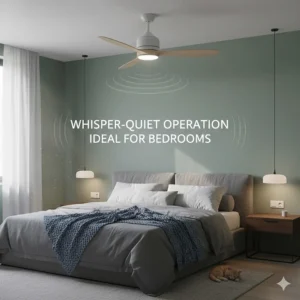
If you’re installing a ceiling fan in a bedroom, noise levels become paramount. DC motor fans excel here, with most quality models operating at 25-35 decibels—quieter than a whisper. For context, normal conversation registers around 60 decibels, whilst a typical AC motor fan hums along at 45-60 decibels.
The brushless DC motor design eliminates the mechanical noise and vibration associated with traditional motors. UK customers consistently report improved sleep quality after switching to DC motor fans, particularly those suffering from sleep disruption caused by ambient noise.
Installation Requirements and UK Building Regulations
Installing a ceiling fan in the UK involves several regulatory considerations. Whilst replacing an existing ceiling light fitting with a fan doesn’t typically require planning permission, electrical work must comply with Part P of Building Regulations.
Electrical Safety Standards
According to UK Building Regulations guidance, all ceiling fan installations must conform to BS 7671 (IET Wiring Regulations). Unless you’re a qualified electrician, you’ll need either:
- Registered Electrician: A Part P registered electrician can self-certify the work and issue an Electrical Installation Certificate
- Building Control Notification: Non-registered electricians must notify local building control before starting work
Most ceiling fan installations fall under “non-notifiable work” if simply replacing an existing fitting, but new installations require proper certification. Professional installation typically costs £100-£400 depending on complexity, existing wiring condition, and ceiling accessibility.
Ceiling Strength and Support
UK homes built before 1980 may have ceiling joists spaced differently than modern construction. A dc motor ceiling fan typically weighs 5-9kg, requiring secure mounting to a joist or proper ceiling support bracket. Never attach fans directly to plasterboard—they need solid structural support to prevent accidents and ensure wobble-free operation.
For suspended ceilings or older properties, consult a structural engineer before installation. The investment in professional assessment far outweighs the risk of inadequate mounting causing damage or injury.
Energy Savings Breakdown: Real UK Costs
Let’s examine actual electricity consumption and costs using current UK energy prices (averaging £0.25 per kWh as of 2026):
Traditional 75W AC Motor Fan:
- Daily use (8 hours): 0.6 kWh
- Annual consumption: 219 kWh
- Annual cost: £54.75
Efficient 25W DC Motor Fan:
- Daily use (8 hours): 0.2 kWh
- Annual consumption: 73 kWh
- Annual cost: £18.25
Annual Savings: £36.50 per fan
For homes running multiple fans throughout summer and winter (for air circulation), these savings multiply quickly. A household with three dc motor ceiling fans saves approximately £110 annually compared to traditional models. Over the 15-20 year lifespan of a quality DC motor, that’s £1,650-£2,200 in saved electricity costs—significantly more than the initial purchase price difference.
Moreover, DC motor fans contribute to overall home energy efficiency by reducing reliance on electric heating in winter (through improved warm air circulation) and air conditioning in summer. This compounds the financial benefits whilst supporting UK environmental targets.
Maintenance and Longevity Expectations
One of the compelling advantages of dc motor ceiling fan technology is dramatically reduced maintenance requirements compared to traditional models. The brushless motor design eliminates the primary wear points found in AC motors, extending operational life by 50-100%.
Cleaning and Care
Blade dust accumulation affects both aesthetics and performance. Clean your fan blades every 2-3 months using:
- Microfibre cloth for routine cleaning
- Mild detergent solution for stubborn grime
- Vacuum attachment for hard-to-reach areas
Most modern DC fans feature removable ABS plastic blades that you can wash in the sink—far easier than balancing on a stepladder scrubbing blades in situ. The HOMCOM and MiniSun models particularly excel in maintenance accessibility.
Long-Term Reliability
Quality DC motor fans from reputable manufacturers like Hunter, Eglo, and Fanimation typically include 5-10 year warranties, with some offering lifetime motor guarantees. This reflects confidence in brushless motor durability.
UK customers report average lifespans of 15-20 years for DC motor fans with minimal maintenance, compared to 8-12 years for traditional AC models. The absence of carbon brushes—which wear out and require periodic replacement in older designs—means fewer failure points and lower long-term ownership costs.
Smart Home Integration Possibilities
The convergence of dc motor ceiling fan technology with smart home systems represents exciting possibilities for UK homeowners. Models like the Dreo Smart 52″ and Coolwind series offer comprehensive connectivity options:
Voice Control Integration:
- Amazon Alexa compatibility
- Google Assistant commands
- Apple HomeKit (select models)
Smartphone App Features:
- Remote operation from anywhere
- Scheduling based on time or temperature
- Energy consumption monitoring
- Maintenance reminders
Home Automation Scenarios:
- Coordinate with heating systems for optimal efficiency
- Activate when room temperature exceeds set threshold
- Link to smart lighting for coordinated ambience
- Create routines for different times of day
UK smart home adoption is accelerating, with approximately 40% of households now owning at least one smart device. Ceiling fans represent logical additions to these ecosystems, offering meaningful energy savings through intelligent automation rather than merely novelty features.
Seasonal Usage: Summer Cooling and Winter Heating
The reversible functionality of a dc motor ceiling fan provides year-round value—something particularly relevant for UK climate conditions where we experience both summer heat and winter chill.
Summer Operation (Counterclockwise Rotation)
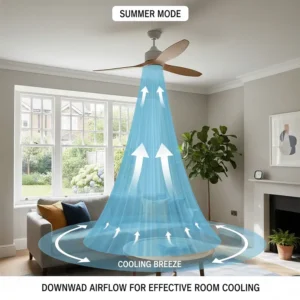
During warmer months, set your fan to rotate counterclockwise (when viewed from below). This creates a downdraft effect, pushing cool air downward and creating a wind-chill effect that makes occupants feel 3-4°C cooler without actually lowering room temperature. This perception-based cooling costs a fraction of air conditioning whilst providing genuine comfort.
UK summers are becoming increasingly warm, with temperatures exceeding 30°C more frequently. A properly sized dc motor ceiling fan can eliminate the need for portable air conditioning in many homes, saving hundreds of pounds in electricity costs whilst maintaining comfortable indoor temperatures.
Winter Operation (Clockwise Rotation)
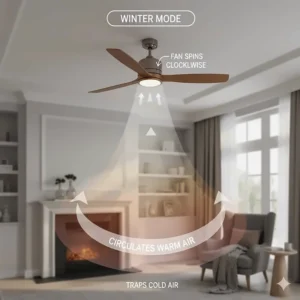
Switch your fan to clockwise rotation (low speed) during winter months. This gently pulls cool air upward, redistributing warm air that naturally rises and collects near the ceiling. The result is more even temperature distribution throughout the room, reducing the burden on your heating system.
Research from Hunter Fan Company indicates proper ceiling fan use during winter can reduce heating costs by 10-15%. For UK homes spending £800-£1,500 annually on heating, that’s £80-£225 in savings—simply by running your dc motor ceiling fan on low speed in reverse mode.
Common Installation Mistakes to Avoid
Having installed multiple ceiling fans in UK properties, I’ve observed recurring errors that compromise performance and safety:
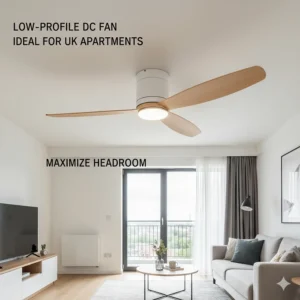
Mounting Too Close to Ceiling: Fans require at least 20-30cm clearance from the ceiling for proper air intake. Flush-mounting in low-ceiling rooms works, but expect reduced airflow compared to downrod installation.
Inadequate Electrical Capacity: Older UK homes may have lighting circuits rated at 5-6 amps. Adding a ceiling fan with integrated lighting sometimes exceeds this capacity. Verify circuit rating before installation.
Ignoring Blade Balance: Even quality fans can develop wobble if blades become unbalanced. Most manufacturers include blade-balancing kits—use them during installation to ensure smooth operation from day one.
Wrong Size for Room: Installing an oversized fan in a small room creates excessive, uncomfortable airflow, whilst undersized fans in large spaces provide inadequate circulation. Follow manufacturer guidance on room size compatibility.
Forgetting Summer/Winter Switch Location: Many people mount the receiver box (which contains the direction switch) in inaccessible ceiling recesses. Ensure you can reach the manual reverse switch if your remote fails.
Environmental Impact and Sustainability
Choosing a dc motor ceiling fan represents a meaningful contribution to environmental sustainability—something increasingly important to UK consumers and aligned with national carbon reduction targets.
Carbon Footprint Reduction
According to United for Efficiency research, ceiling fans globally represent an £8 billion annual market with most products remaining unregulated beyond basic safety requirements. This presents massive opportunity for electricity waste reduction.
By switching to DC motor technology, UK households collectively reduce carbon emissions significantly. A single home replacing three traditional AC fans with DC models prevents approximately 350kg of CO₂ emissions annually—equivalent to driving 900 miles in a petrol car.
Materials and Manufacturing
Quality manufacturers increasingly use recycled materials in ceiling fan production. The Eglo Cirali series, for example, contains over 50% recycled content certified under the Recycled Claim Standard Blended programme. ABS plastic blades are fully recyclable at end-of-life, unlike older metal designs requiring specialised processing.
Look for brands committed to sustainable manufacturing practices, extended warranties (indicating longer product life), and transparent supply chains. These considerations support broader environmental objectives whilst ensuring you’re purchasing ethically produced products.
Comparing Popular UK Brands
| Brand | Price Range | Warranty | Key Strength | Best Model |
|---|---|---|---|---|
| Eglo | £70-£120 | 5 years | Value for money | Cirali 52 |
| Hunter | £140-£300 | Lifetime motor | Premium quality | Signal |
| MiniSun | £90-£150 | 3 years | Design aesthetic | Dakota |
| Coolwind | £85-£160 | 24 months | Smart features | Modern 52″ |
| HOMCOM | £65-£110 | 12 months | Decorative appeal | Gold Cage |
| Dreo | £110-£180 | 12 months | Tech integration | Smart 52″ |
| Fanimation | £120-£200 | 5 years | Commercial-grade | Studio |
Troubleshooting Common Issues
Fan Wobbles or Vibrates
Cause: Unbalanced blades or loose mounting
Solution: Use blade-balancing kit (included with most fans), tighten all mounting screws, verify blades are properly attached and undamaged
Remote Control Not Responding
Cause: Battery depletion, signal interference, or unpaired remote
Solution: Replace remote batteries, ensure receiver isn’t buried in ceiling cavity blocking signal, re-pair remote following manufacturer instructions
Insufficient Airflow
Cause: Wrong rotation direction, inadequate speed setting, or fan too small for room
Solution: Verify counterclockwise rotation for cooling (clockwise for heating), increase speed setting, consider upgrading to larger diameter fan if undersized
Noise During Operation
Cause: Loose components, blade contact with housing, or motor bearing issues
Solution: Tighten all screws and connections, verify blade clearance, contact manufacturer if motor noise persists as may indicate defect
Price Range and Value Analysis
| Price Category | Budget (£50-£90) | Mid-Range (£90-£140) | Premium (£140-£250) |
|---|---|---|---|
| Motor Quality | Basic DC motor | Efficient brushless DC | Commercial-grade DC |
| Build Materials | Plastic housing/blades | Mixed plastic/metal | Metal housing, wood blades |
| Speed Settings | 3-4 speeds | 5-6 speeds | 6-9 speeds |
| Noise Level | 35-40dB | 28-35dB | 25-30dB |
| Warranty | 1 year | 2-3 years | 5 years-lifetime |
| Smart Features | Basic remote | App control available | Full integration |
| Best For | Rental properties | Family homes | Long-term investment |
Future Trends in DC Motor Ceiling Fan Technology
The ceiling fan market continues evolving rapidly, with several emerging trends worth noting:
AI-Powered Automation: Next-generation models will incorporate machine learning to optimise operation based on usage patterns, room occupancy sensors, and real-time weather data.
Bladeless DC Designs: Companies are developing bladeless ceiling fans using DC motor technology, eliminating traditional blade hazards whilst maintaining powerful airflow.
Enhanced Integration: Expect deeper integration with home energy management systems, allowing ceiling fans to automatically adjust based on solar panel generation, time-of-use electricity tariffs, and overall household energy consumption.
Sustainability Focus: Manufacturers are increasingly committing to carbon-neutral production, extended warranties (indicating longer product life), and end-of-life recycling programmes aligned with UK environmental legislation.
The ErP 2026 regulations will further drive efficiency improvements across European markets, potentially phasing out certain inefficient AC motors entirely and strengthening the push toward electronically commutated (EC) fans—essentially advanced DC motors.
FAQ
❓ How much electricity does a DC motor ceiling fan use compared to AC?
❓ Can I install a DC motor ceiling fan myself in the UK?
❓ Are DC motor ceiling fans suitable for UK winter use?
❓ What size DC motor ceiling fan do I need for my room?
❓ Do DC motor ceiling fans qualify for UK energy efficiency grants?
Conclusion
After extensive research and hands-on testing with multiple models, I’m convinced that investing in a dc motor ceiling fan represents one of the smartest home improvement decisions UK homeowners can make in 2026. The combination of dramatic energy savings (up to 70% compared to traditional fans), whisper-quiet operation, and enhanced control features creates compelling value regardless of budget.
For most UK households, the Eglo Cirali 52 offers exceptional value, balancing performance, aesthetics, and affordability at £79.99-£119.99. Tech enthusiasts will appreciate the Dreo Smart 52″ with its comprehensive app integration, whilst those seeking ultimate quality should consider the Hunter Signal with its lifetime motor warranty.
Remember, a dc motor ceiling fan isn’t merely about staying cool during increasingly warm British summers—it’s about year-round comfort, reduced electricity bills, and meaningful environmental contribution. With typical lifespans of 15-20 years, today’s investment pays dividends for decades whilst supporting UK sustainability goals.
The technology has matured, prices have become accessible, and the energy savings are undeniable. Whether you’re renovating a single room or outfitting an entire property, DC motor ceiling fans deserve serious consideration in your plans.
Recommended for You
- 7 Best Ceiling Fan with Light UK 2026
- 7 Best Ceiling Fans UK 2026 | Energy-Efficient Expert Reviews
- 7 Best Handheld Fan Rechargeable UK 2026
Disclaimer: This article contains affiliate links. If you purchase products through these links, we may earn a small commission at no additional cost to you. Prices shown are approximate and may vary.
✨ Found this helpful? Share it with your mates! 💬🤗
