
In This Article
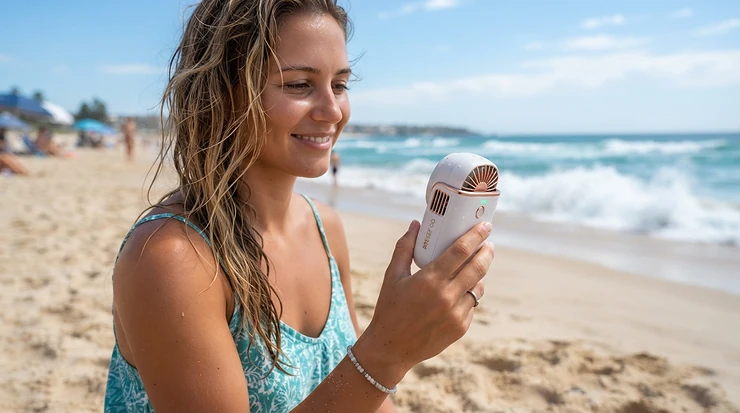
The British beach has a split personality. One minute you’re zipped into a windbreaker, the next the cloud peels back, the breeze drops dead and your deckchair becomes a rotisserie. Add sand that bounces heat straight back at you, a small mountain of bags and a long trudge to the car, and a shady spot plus a lukewarm squash won’t quite cut it.
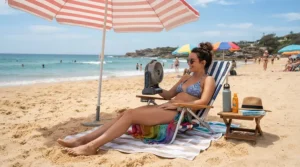
That’s the gap portable cooling for beach days fills. In 2026 the category has had a proper glow-up. Dyson and Shark both launched pocket-sized fans this year. Sony’s wearable cooler has reached its Pro Plus version. And independent tests suggest a £10 turbo fan can hold its own against gadgets costing thirteen times as much.
Here’s the plan. We’ll compare seven real products, from budget to premium, covering handheld fans, neck fans, misting units, a wearable cooler and pop-up shade. For each one we’ll explain what the specs mean on actual sand, and what published reviews consistently report. One honest note up front: I haven’t personally used these products. Everything here rests on published specs and independent reviews, and I’ve said so wherever the evidence runs thin.
A fan makes you feel cooler, but it does nothing about ultraviolet light. The NHS sun safety guidance is clear that shade, clothing and SPF30 sunscreen do the protecting. So we’ll cover sun protection gear too, because a cool sunburn is still a sunburn.
Quick Comparison: Portable Cooling for Beach Days at a Glance
Here’s the whole line-up on one screen. Prices are ranges at the time of research and will move, so check the current price before buying.
| Product | Type | Standout trait | Price range | Best For |
|---|---|---|---|---|
| Commem Turbo Fan | Handheld turbo fan | Strong airflow, tiny body | Under £15 | Budget day-trippers |
| JisuLife Portable Neck Fan Life 3 | Neck fan | Hands-free, 4000mAh | Under £25 | Readers and walkers |
| Dyson HushJet Mini Cool | Handheld bladeless fan | Long reach, up to 6 hours | Around £100 | Power in a slim body |
| Shark FlexBreeze HydroGo | Tabletop misting fan | Up to 12 hours cordless | Around £130 | Families camped for the day |
| Shark ChillPill | 3-in-1 fan, mist, cooling plate | Pulse-point cooling plate | Around £130 | Rapid personal relief |
| Sony Reon Pocket Pro Plus | Wearable cooler | Thermal cooling, no airflow | Around £200 | Heat-sensitive users, gadget fans |
| Active Era Pop Up Beach Tent | Pop-up shade shelter | Instant shade | Check current price (this class often sits at £20-£50) | Families with small children |
Looking at the table, the Commem Turbo Fan and JisuLife Portable Neck Fan Life 3 deliver the most relief per pound, while the Shark FlexBreeze HydroGo is the only pick that can cool a seated group for a full afternoon. The Sony Reon Pocket Pro Plus is the odd one out, because it cools through contact rather than airflow. Don’t overlook the Active Era Pop Up Beach Tent, since shade is the oldest and most effective cooling technology we have.
💬 Just one click — help others make better buying decisions too!😊
Top 7 Portable Cooling for Beach Days Picks: Expert Analysis
Each pick below follows the same logic. First what it does, then what the specs mean on a windy, sandy shoreline, then who should buy it, and finally what reviewers consistently report. Where I couldn’t verify customer reviews, I’ve said so rather than guess.
1. Commem Turbo Fan — pocket-sized power for under £15
Think of the Commem Turbo Fan as the sensible friend who turns up with exactly what you need and doesn’t fuss about the bill.
The Independent named it best overall in its 2026 handheld roundup, praising the compact body, surprisingly strong airflow and the way it can be propped up at different angles. That last point matters on a beach. A fan that leans against a flask or a rolled towel is a fan you don’t have to hold while you read. Exact motor and battery figures vary between listings, so check the mAh rating before buying. As a rule of thumb, a bigger battery means more minutes on the top speed.
This is for anyone who wants relief without commitment: students, solo day-trippers, or parents wanting a spare in the beach bag. Reasoning from the spec class, a turbo fan this size is a personal breeze, not a group cooler, so don’t expect it to refresh the whole picnic blanket.
On reviews, the Independent’s tester gave it 5/5 and flagged noise as the one drawback. I couldn’t verify a large pool of customer reviews for this exact listing, so treat that tested verdict as the main evidence.
Pros:
- ✅ Strong airflow for its tiny size
- ✅ Can be propped up hands-free
- ✅ Cheap enough to keep as a spare
Cons:
- ❌ Noisy in independent testing
- ❌ Battery size varies between listings
Price check: under £15 makes it the lowest-risk entry in this guide, and a safe first buy.

2. JisuLife Portable Neck Fan Life 3 — hands-free breeze for reading and wandering
If you’ve ever tried to hold a paperback, a flask and a fan at once, you’ll understand why neck fans exist.
The JisuLife Portable Neck Fan Life 3 pairs a 4000mAh battery with five speeds and a bladeless design. In practical terms, a large battery on a neck fan means a full afternoon is plausible rather than hopeful. The ring sits on your shoulders and blows upward across the neck and jaw, which is where you feel heat most acutely. The bladeless design also means fewer exposed spinning parts near hair and collars, though you’ll still want to keep sand out of the intake.
The Independent rated it 4.5/5 in its neck fan test and named it the most powerful of the bunch, noting quiet running and decent battery life. That quietness matters on a beach where you’re lying close to your own fan. Tested reviews also note neck fans generally look a bit odd in public, which is purely a vanity issue.
It suits walkers, readers and parents who need both hands free. It’s the wrong tool for cooling a group.
Honest caveat: I couldn’t verify a broad customer-review total, so the Independent’s verdict is the main evidence here.
Pros:
- ✅ Genuinely hands-free cooling
- ✅ Powerful yet quiet in testing
- ✅ Large 4000mAh battery
Cons:
- ❌ Personal airflow only, no help for groups
- ❌ The neck fan look isn’t for everyone
Price check: under £25 is strong value for a hands-free design.
3. Dyson HushJet Mini Cool — slim bladeless fan with serious reach
Dyson’s cheapest product ever is also one of its most interesting.
The Dyson HushJet Mini Cool launched in April 2026 and stands 20.1cm tall and 3.8cm wide, weighing 212g. It’s bladeless, uses a honeycomb mesh cover, and has a star-shaped tip that twists through 360 degrees. Dyson claims a boost mode reaching 25m/s. In plain English, that’s a thin jet of air that travels well, which is what you want when a sea breeze keeps trying to scatter it. T3’s reviewer found it cooled effectively, with six hours of runtime on a night in a heatwave and a three-hour charge.
Here’s what the spec sheet won’t tell you, but the review does: T3’s head-to-head says it’s loud even on the second speed. The flat base is also built for tables, so on soft sand you’ll want to prop it on a bag.
Choose it if you value reach and simple controls over extras.
Pros:
- ✅ Powerful projection from a slim body
- ✅ Up to six hours of runtime
- ✅ Simple five-speed controls plus boost
Cons:
- ❌ Loud even at low settings in T3’s test
- ❌ No mist or cooling attachments
Price check: around £100 is fair for the performance, though the budget picks cover most beach needs for a fraction of that.
4. Shark FlexBreeze HydroGo — all-day cordless runtime with a built-in mister
If the Commem Turbo Fan is a personal breeze, the Shark FlexBreeze HydroGo is a small weather system.
It’s a compact tabletop fan, under 12 inches tall and around 5lb (about 2.3kg), with a handle. It offers five speeds, a 150ml refillable mister, and a claimed 12-hour maximum cordless runtime. TechRadar’s review reports a 2.5-hour charge and a mist that lasted roughly 55 minutes in interval mode, close to the stated 60. What that means for you is that you’ll refill the tank a couple of times per afternoon, so pack a water bottle.
Expert Reviews described the mister as fantastic and the fan as powerful for its size, though it noted you can get more airflow elsewhere. It’s also described as weatherproofed for outdoor use, but that isn’t the same as sand-proof, so keep it on a towel or stool rather than directly on the beach.
It suits families holding a pitch for hours. Cordless use plus 12 hours of claimed runtime makes it the strongest fan here for a full day.
Review sentiment from US retailer listings of the sister model praises battery life, misting and portability, with frequent mister refills the common complaint.
Pros:
- ✅ Up to 12 hours claimed cordless runtime
- ✅ Built-in mister for evaporative relief
- ✅ Handle and compact size for carrying
Cons:
- ❌ Mist tank needs frequent refills
- ❌ Heavier than handheld rivals
Price check: around £130 is premium, but the mister and runtime justify it for family use.
5. Shark ChillPill — fan, mist and cooling plate in one
The Shark ChillPill looks like a pair of binoculars and behaves like a Swiss Army knife.
It’s a 3-in-1 system: a fan with ten speeds (maximum 7.5m/s), a mister attachment, and an InstaChill plate that Shark says lowers skin temperature on contact by up to 9 degrees. At 350g and 11.2cm tall, it’s chunkier than the Dyson HushJet Mini Cool, and T3 reports 3.5 hours to charge with 1.5 to 11 hours of use. High speed will drain it far quicker than low.
The cooling plate is the clever bit. Pressed against your wrist or neck, it works on pulse points, which can be a useful relief when the sand is shimmering. The Independent’s reviewer praised the fine mist and compared the plate to a mini ice pack, scoring it 5/5. T3 was less impressed by the mister, finding it soggy and the tank quickly emptied. Both reviewers agreed it gets loud.
It’s for people who want several cooling methods in one bag item. Reading the two reviews together, the plate and fan are the strongest features, and the mister is the most debated.
Pros:
- ✅ Cooling plate gives instant pulse-point relief
- ✅ Ten speeds for fine control
- ✅ Three cooling modes in one device
Cons:
- ❌ Loud at higher speeds in tests
- ❌ Mister tank runs out quickly
Price check: around £130 is steep, but you’re buying three tools rather than one.

6. Sony Reon Pocket Pro Plus — wearable air conditioning without the airflow
This one’s a different species entirely. The Sony Reon Pocket Pro Plus doesn’t blow air, it cools your body directly through thermal pads on the back of the neck.
It offers five cold modes and four warm modes, controlled through a companion app. Sony claims more than 20 per cent stronger cooling than its predecessor, with the plate surface about two degrees Celsius lower under its own test conditions. Those are manufacturer figures, so treat them as indicative. Research reported by ChannelNews suggests directing cooling at the face and neck can deliver comfort comparable to much larger desk fans, which supports the principle.
Expert Reviews called it a surprisingly effective personal air conditioner, and the Independent scored it 5/5. The noted downsides were that the highest setting eats the battery and wearers may get funny looks. It’s typically worn under a loose top, so it suits cover-ups and shirts more than swimwear, and I’d check Sony’s guidance on water exposure before the seaside, since I couldn’t verify a waterproof rating.
It’s best for heat-sensitive people who want silent, wind-proof relief and don’t mind paying for it.
Pros:
- ✅ Silent cooling, unaffected by wind
- ✅ Five cold modes with app control
- ✅ Praised as surprisingly effective
Cons:
- ❌ Highest setting drains the battery quickly
- ❌ Water and sand exposure limits aren’t verified
Price check: around £200 is the most expensive pick here, justified only if you’ll wear it daily all summer.
7. Active Era Pop Up Beach Tent — instant shade, the original cooling gadget
Every fan here moves heat around. The Active Era Pop Up Beach Tent simply stops it arriving.
Yours.co.uk named it best overall among pop-up tents, describing a lightweight, spacious polyester shelter around 200 x 120cm for one or two people. Here’s a catch worth knowing: the retailer listing markets it as UPF 50+, while Yours describes testing up to UPF 40. Both are meaningful protection, but a discrepancy like that is why I’d never treat any UPF label as a guarantee. The review also notes there’s no privacy panel for changing.
On the practical side, buying guides consistently stress that stakes alone struggle in loose dry sand, so look for sand pockets or weigh the corners down with your bags. Pop-up tents also trap heat with the door shut, so keep a vent or door open. A tent plus a cheap fan is a more effective combination than either alone.
It’s best for families with babies, toddlers or sun-sensitive skin. Without a deep review pool I can verify, I’d lean on that single tested recommendation and check the latest buyer feedback on the listing.
Pros:
- ✅ Instant shade with no batteries needed
- ✅ Lightweight and easy to carry
- ✅ Spacious enough for one or two people
Cons:
- ❌ No privacy panel for changing
- ❌ UPF claims differ between sources
Price check: pop-up tents of this class commonly sit around £20-£50, so check the current price. For shade, that’s the best value in the guide.
How the Top 7 Compare on Specs and Verdicts
| Product | Key spec | Reported runtime or size | Independent verdict | Best For |
|---|---|---|---|---|
| Commem Turbo Fan | Compact turbo airflow | Battery varies by listing | 5/5, best overall (The Independent) | Budget buyers |
| JisuLife Portable Neck Fan Life 3 | Bladeless, 5 speeds | 4000mAh | 4.5/5, most powerful neck fan (The Independent) | Hands-free users |
| Dyson HushJet Mini Cool | Boost to 25m/s (claimed) | Up to 6 hours, 212g | Powerful but loud (T3) | Reach and simplicity |
| Shark FlexBreeze HydroGo | 150ml mister | Up to 12 hours cordless | Powerful for size, great mister (Expert Reviews) | Family pitches |
| Shark ChillPill | 10 speeds, cooling plate | 1.5-11 hours | 5/5 (The Independent); mister debated (T3) | Multi-mode cooling |
| Sony Reon Pocket Pro Plus | Thermal cooling plate | Battery drains on high setting | 5/5 (The Independent) | Heat-sensitive users |
| Active Era Pop Up Beach Tent | Pop-up shelter, 200 x 120cm | Lightweight, one or two people | Best overall tent (Yours.co.uk) | Shade seekers |
The pattern is clear. Quiet and power rarely arrive together, so the Commem Turbo Fan, Dyson HushJet Mini Cool and Shark ChillPill all earn noise warnings, while the JisuLife Portable Neck Fan Life 3 and Sony Reon Pocket Pro Plus are the stealthier options. If battery matters most, the Shark FlexBreeze HydroGo has the longest claimed runtime. If budget matters most, the Commem Turbo Fan wins on cost per minute of breeze.
✨ Ready to Beat the Heat?
🔍 Take your seaside trips to the next level with these carefully selected picks. Click any highlighted product name to check current pricing and availability. A little preparation turns a sweaty slog into a genuinely relaxing day on the sand!
What Is Portable Cooling for Beach Days?
Portable cooling for beach days means any battery-powered or no-power gadget that lowers how hot you feel on sand or shingle: handheld and neck fans, misting units, wearable coolers and pop-up shade. It works by moving air, evaporating water, drawing heat from your skin, or blocking the sun, and it should always sit alongside proper sun protection.
Those four mechanisms behave very differently outdoors. Airflow helps sweat evaporate, which is why even a modest fan feels good, but a strong sea breeze can compete with it. Misting adds evaporative cooling, though it needs water and can feel damp. Contact cooling, used by the Sony Reon Pocket Pro Plus and the Shark ChillPill plate, ignores the wind entirely. Shade, as in the Active Era Pop Up Beach Tent, removes the heat load before it reaches you.
The smartest approach is layering. Start with shade, add airflow, then use a targeted tool for your hottest moments. That mix of strategies is why the best portable cooling for beach days setups rarely rely on a single gadget.
How to Choose Portable Cooling for Beach Days
Follow these six steps, and you’ll narrow the field in minutes.
- Decide your session length. Two hours at the sea wall needs less battery than a full day. Runtime claims are measured at low speeds, so expect far less on boost settings.
- Match the format to your group. Solo? A neck fan or handheld. A family on one blanket? A tabletop misting fan like the Shark FlexBreeze HydroGo.
- Check the noise reports. Several tested picks are loud, so if you nap on the beach, prioritise quieter designs.
- Plan for sand and salt. Weatherproofing isn’t sand-proofing. Keep fans off the beach surface and out of splash zones.
- Think about weight. At 212g, the Dyson HushJet Mini Cool is easy to carry; the 5lb Shark FlexBreeze HydroGo needs a bag.
- Sort your charging. USB-C charging plus a small power bank covers most scenarios.
For a broader view of how tested products compare, the guide to rated beach fans below pulls the review evidence together.
Beach Cooling Fan vs Handheld Fan: Which Suits Sand Best?
The beach cooling fan vs handheld fan debate comes down to how many people you’re cooling and how long you’ll stay.
A standalone beach cooling fan, such as the tabletop Shark FlexBreeze HydroGo, sits on a stool or cool box and works for everyone nearby. It has bigger batteries, often a mister, and it doesn’t tire your arm. The trade-offs are weight and the need for a stable surface, which soft sand doesn’t offer.
A handheld fan like the Commem Turbo Fan or Dyson HushJet Mini Cool goes wherever you go. It’s lighter, cheaper and perfect for walks along the prom, but it only cools one person at a time and demands a free hand unless you prop it up.
In a strong sea breeze, a handheld’s focused jet punches through the wind better than a wide, gentle fan. In still air, a standalone fan wins for comfort. So the beach cooling fan vs handheld fan answer is really a question about your day. For a solo wander, pick a handheld. For a family camp, pick a standalone fan and pack a small handheld for the walk to the ice cream van.
Rated Beach Fans: What Independent Reviewers Actually Say
Rated beach fans deserve some scepticism, because star ratings flatten important differences. Here’s what the published verdicts have in common.
The Independent’s 2026 tests rated the Commem Turbo Fan, Shark ChillPill and Sony Reon Pocket Pro Plus at 5/5 and the JisuLife Portable Neck Fan Life 3 at 4.5/5. Quiet running earned praise wherever it appeared. The same roundup highlighted the John Lewis Anyday Handheld Fan (rated 4/5) as a quiet alternative, and T3 has reviewed the Blueair AlwaysCool as a quiet portable fan, if silence tops your list.
The recurring theme is noise. Reviewers flagged loud running on the Commem Turbo Fan, Dyson HushJet Mini Cool and Shark ChillPill. Battery honesty is another theme: runtime figures are best-case, and boost modes shorten them considerably.
My reading: the highest rated beach fans are rarely the quietest or the longest-lasting. Decide whether you value power, silence or runtime, then read the verdict for that trait specifically.
Beach Cooling Gadgets: What Matters and What’s Hype
Beach cooling gadgets come with plenty of marketing noise, so filter ruthlessly.
What matters: battery capacity in mAh, realistic runtime at medium speed, weight, noise, a stable way to prop or wear the device, and charging convenience. A mister is only useful if you’ll carry water.
What’s mostly hype: peak airflow figures like “25m/s” (useful for comparison, but you’ll rarely run boost for long), and anything promising “air conditioner” performance from a pocket-sized fan.
| Option | Strength | Weakness | Best For |
|---|---|---|---|
| Commem Turbo Fan | Cheap, powerful | Noisy | Budget buyers |
| Shark FlexBreeze HydroGo | Long runtime, mist | Weight and refills | Group comfort |
| Sony Reon Pocket Pro Plus | Wind-proof, silent | Costly | Heat-sensitive wearers |
| Active Era Pop Up Beach Tent | Blocks the sun entirely | Needs anchoring | Families |
| Traditional wet towel and spray bottle | Cheap, reliable | Needs refreshing | Anyone, as backup |
| Traditional parasol | Light shade | Wind and coverage limits | Short stays |
The table shows gadgets don’t replace traditional tricks, they extend them. A spray bottle and damp cloth still do remarkable work, which is why I’d pair a tent with a fan rather than relying on any single gadget.

Beach Day Essentials: A Practical Set-Up Guide
Beach day essentials should be built around heat, not just towels. Here’s a routine that costs nothing extra.
The night before: charge every device fully, since cold batteries and half-charges are the usual culprits for mid-afternoon failures. Fill spray bottles and freeze one water bottle to use as a cold pack.
Pack list:
- ✅ A fan (handheld, neck or tabletop)
- ✅ A small power bank and USB-C cable
- ✅ SPF30+ sunscreen, hat and sunglasses
- ✅ Shade, such as a pop-up tent or parasol
- ✅ More water than you think you need
- ✅ A zip bag or dry bag for electronics
On arrival: set up shade first, then position the fan out of direct sun on a towel or stool, never straight on loose sand. Put the tent’s entrance away from the wind and weigh down every corner.
Mid-day routine: run fans on low or medium, saving boost for peak moments. Refill misters, reapply sunscreen and drink regularly.
After the trip: wipe devices with a dry cloth, brush sand from vents with a soft brush, and recharge before storing. Beach day essentials work best when you treat the electronics as delicate, because sand finds every gap.
Seaside Trips: Three Real-World Scenarios
Different seaside trips need different kits. Here are three profiles, with reasoning rather than invented anecdotes.
The student day-tripper (budget £20-£40, once or twice a summer). A coastal train, a long walk from the station and no car boot means weight matters. The Commem Turbo Fan plus a spray bottle covers it. If the budget stretches, the JisuLife Portable Neck Fan Life 3 frees both hands for a book.
The family of four with a toddler (budget £150-£200, weekly in school holidays). Shade is priority one. The Active Era Pop Up Beach Tent gives sun-sensitive skin a refuge, and the Shark FlexBreeze HydroGo keeps the pitch breezy. Repeated use spreads the cost thin.
The heat-sensitive walker (budget £200+, daily in summer). Children, older people and those with long-term health conditions are more vulnerable to heat illness according to NHS guidance. The Sony Reon Pocket Pro Plus offers silent, wind-proof cooling on promenade strolls, ideally paired with plenty of water and frequent shade breaks.
Match the kit to the trip and you’ll avoid both overspending and under-preparing for your seaside trips.
Sun Protection Gear: Cool Is Not the Same as Safe
A fan reduces how hot you feel, but it doesn’t reduce how much UV hits your skin. This is where sun protection gear does the real work.
According to the NHS, you should spend time in the shade between 11am and 3pm from March to October, never burn, and cover up with suitable clothing and sunglasses. Use at least SPF30 sunscreen with a UVA rating (look for four stars or the UVA-in-a-circle logo), and reapply every two hours, since sun, sweat and swimming reduce it. You can burn even when it’s cloudy.
Practical sun protection gear for the beach includes a wide-brimmed hat, UV-rated sunglasses, a rash vest for children and a shelter like the Active Era Pop Up Beach Tent. Treat any UPF label cautiously, as that tent’s differing claims illustrate.
Cooling devices also have a safety role. NHS guidance says heat exhaustion symptoms include tiredness, dizziness, headache and nausea. The advice is to move the person somewhere cool, give fluids, and cool their skin with a spray or sponge and fanning. If they aren’t improving within 30 minutes, it could be heatstroke, which is an emergency requiring a 999 call. Read the full NHS heat exhaustion and heatstroke guidance before your trip. A portable fan can support those steps but never replaces medical help.
Common Mistakes When Buying Portable Cooling for Beach Days
Even keen buyers trip over the same pitfalls.
Chasing peak airflow. A 25m/s boost claim sounds thrilling, but you’ll spend most of your time on lower settings. Judge fans on medium-speed runtime and noise instead.
Ignoring noise. Several tested fans were described as loud. A fan that sounds like a hairdryer is tiring when you’re trying to doze.
Forgetting the power plan. Runtime figures assume low speeds. Carry a power bank, or choose something with a bigger battery like the Shark FlexBreeze HydroGo.
Trusting weatherproof claims. Weather resistance is not sand immunity. Keep electronics off the surface and zipped away when not in use.
Buying the premium option without a use case. The Sony Reon Pocket Pro Plus is brilliant for the right wearer, but around £200 only makes sense if you’ll use it often.
Treating cooling as protection. A fan can make you feel comfortable while you burn. Shade, clothing and sunscreen are non-negotiable.
Long-Term Cost and Maintenance of Beach Cooling Kit
Cost per use is the honest way to compare. As illustrative maths, a £10-£15 fan used on ten beach days across a summer works out at around £1-£1.50 per outing in year one, and less each year after. A £100 fan used the same amount over three summers lands at roughly £3-£4 per outing. A £200 wearable cooler needs near-daily use to compete.
Maintenance protects that value. Brush sand from vents with a soft brush rather than blowing into them. Wipe salt residue with a barely damp cloth, then dry thoroughly. Check each manufacturer’s manual before any contact with water, because I couldn’t verify water resistance for every product here.
Lithium batteries dislike heat, so don’t leave devices in a hot car boot, and don’t store them fully drained for months. Empty and dry the mister tanks on the Shark FlexBreeze HydroGo and Shark ChillPill after each trip to avoid stale water, and rinse the mister attachment per the manual.
Finally, tents like the Active Era Pop Up Beach Tent should be shaken out and dried before folding, since damp storage invites mildew. A little care keeps your portable cooling for beach days kit working summer after summer.

FAQ: Portable Cooling for Beach Days
❓ How much should I spend on portable cooling for beach days?
❓ Do portable fans still work in a sea breeze?
❓ Will sand and salt damage a rechargeable beach fan?
❓ How long will a rechargeable beach fan last on one charge?
❓ Can a fan replace sun cream at the seaside?
Conclusion: Build Your Beach Cooling Kit Around Your Day
The best portable cooling for beach days isn’t a single gadget, it’s a layered kit. Start with shade from something like the Active Era Pop Up Beach Tent. Add airflow that fits your group: the Commem Turbo Fan for tight budgets, the JisuLife Portable Neck Fan Life 3 for hands-free comfort, the Dyson HushJet Mini Cool for reach, or the Shark FlexBreeze HydroGo for all-day family pitches. If you want multiple modes, the Shark ChillPill packs fan, mist and cooling plate together, and the Sony Reon Pocket Pro Plus is the premium route for silent personal cooling.
Compare the rated beach fans carefully, remembering that noise and runtime vary more than star ratings suggest. Pack the beach day essentials, respect the NHS advice on shade and sunscreen, and plan your seaside trips around the hottest hours rather than against them. Cool and protected is the combination that lets you stay on the sand longer.
If you’re torn, my pick for most people is the budget Commem Turbo Fan plus a pop-up tent: cheap, effective and easy to carry. Upgrade later if your seaside trips become a summer habit.
✨ Don’t Wait for the Next Heatwave!
🔍 Pick the kit that fits your beach days, then click any highlighted product name to check current pricing and availability. A cooler, safer, more comfortable day on the sand is one click away! 🏖️
Recommended for You
- Festival Cooling Gear: 7 Best Picks To Beat The Heat (2026)
- Solar Fan For Awning Cooling: 7 Best Picks For UK Vans (2026)
- Awning Cooling Fan Vs Portable Fan: 7 Proven Picks (2026)
Disclaimer: This article contains affiliate links. As an Amazon Associate, I earn from qualifying purchases. If you purchase products through these links, we may earn a small commission at no additional cost to you.
✨ Found this helpful? Share it with your friends! 💬🤗
