
In This Article
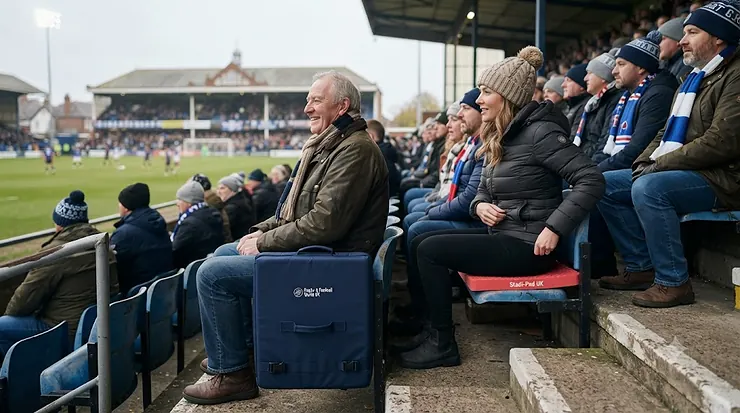
Anyone who has ever spent ninety minutes on a cold aluminium bench knows the exact moment their backside gives up on them. Somewhere around half-time, the ache stops being a minor irritation and starts being the only thing you can think about, and NHS guidance on back pain confirms that prolonged sitting without proper support is a well-recognised trigger for exactly this kind of discomfort. This is where the debate over portable stadium cushion vs bleacher cushion actually starts to matter, because the two aren’t interchangeable, whatever the listings on Amazon might suggest.
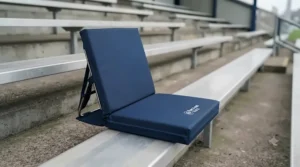
A portable stadium cushion, in the simplest possible terms, is a flat or folded pad of foam you carry to a venue and place directly on a hard seat or step for extra padding and insulation — no frame, no backrest, just cushioning. A bleacher cushion typically refers to a padded seat that includes some form of back support or a lightweight frame designed specifically to hook onto bench-style bleacher seating. Both solve the same core problem — hard, cold, unforgiving seating — but they solve it in different ways, for different bodies and different budgets.
Across this guide we’ve pulled together real, currently available products from Amazon UK, dug into their specs, and cross-referenced genuine aggregated review sentiment rather than inventing glowing endorsements nobody actually wrote. We’ll compare cushion thickness, strap-on cushions versus framed alternatives, how sports venue seating rules affect what you’re allowed to bring, and whether a bleacher cooling cushion is worth the extra outlay in a British summer. By the end, you should know exactly which category — and which specific product — suits your Saturday afternoons.
Quick Comparison Table
| Feature | Portable Stadium Cushion | Bleacher Cushion (with back support) |
|---|---|---|
| Typical thickness | 2–3 inches | 2.5–4.3 inches |
| Back support | None (sit-only pad) | Yes, usually with recline positions |
| Weight | Under 1 lb–1.5 lb | 3–8 lb (steel frame adds bulk) |
| Best for | Quick carry, backpack storage, ground-level or narrow bench seating | Long fixtures, older backs, permanent bleacher rows |
| Price range | Around £15–£35 | Around £25–£70 |
Looking at the table, the trade-off is fairly stark: a portable stadium cushion wins on portability and price but leaves your lower back to fend for itself, while a bleacher cushion with a frame adds genuine lumbar support at the cost of extra weight and bulk. If you’re walking any distance from car park to seat, that weight difference stops being trivial — carrying an 8lb reclining seat across a stadium concourse for twenty minutes is a very different experience to slipping a folded foam pad under your arm. Families with young children, in particular, tend to gravitate toward the lighter cushion-only option simply because someone is already carrying a bag, a coat and a bored eight-year-old.
💬 Just one click — help others make better buying decisions too!😊
Top 7 Portable Stadium Cushions & Bleacher Cushions: Expert Analysis
1. Alpcour Portable Extra Thick Stadium Seat Cushion — best all-round portable pick
The Alpcour Portable Extra Thick Stadium Seat Cushion leads with genuinely useful thickness rather than marketing puff. At 21 x 15 x 3 inches, it’s built to be turned vertically or horizontally, effectively giving you two seat widths from one product depending on how narrow the bench is.
That 3-inch depth matters in practice: most cushions in this category hover around 2 inches, and the extra inch is the difference between “better than bare metal” and “actually comfortable by the final whistle.” The waterproof polyester shell and anti-slip rubber base mean it copes with the damp benches you’ll find at most UK grounds from September through to March, and at under 1lb it barely registers in a bag.
Based on the spec comparison, this is the pick for anyone who wants meaningful padding without committing to a framed chair — students at university sports fixtures, parents ferrying kids between age-group matches, and anyone who values a cushion that folds flat in a rucksack. Reviewers consistently note that the shoulder strap makes a genuine difference on match days involving a long walk from parking, and the front pocket is large enough for a phone and a folded programme.
Pros:
- ✅ Extra-thick 3-inch foam beats most rivals in this price band
- ✅ Works vertically or horizontally for flexible seat width
- ✅ Waterproof shell with anti-slip base for damp UK terraces
Cons:
- ❌ No back support, so long fixtures still strain the lower back
- ❌ Cup holder placement isn’t ideal for narrow bleacher rows
At around £25–£35, this sits firmly in the “sensible upgrade” bracket rather than an impulse buy, and the value case is strong for anyone attending fixtures regularly enough that comfort actually compounds over a season.
2. Therm-a-Rest Z Seat — lightest cushion for regular commuters to matches
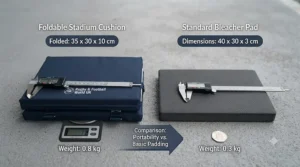
The Therm-a-Rest Z Seat comes from a hiking and mountaineering background rather than sports retail, and it shows. This accordion-folded, closed-cell foam pad weighs around 55–57 grams — genuinely light enough to forget it’s in your bag — and packs down to roughly 30 x 7cm.
What most buyers overlook about this model is that its insulation properties, not just its cushioning, are the real selling point. The reflective ThermaCapture layer was designed to stop cold and damp transferring up from the ground on a mountainside, which happens to be exactly the same problem a metal bench presents on a frosty November afternoon. At just 2cm thick, don’t expect the plush feel of a foam-stuffed cushion; this is about insulation and durability first, comfort second.
On paper this means it’s the obvious choice for anyone who walks or cycles to matches and genuinely can’t spare the bag space for a bulkier cushion, or who already carries a rucksack full of match-day essentials. The closed-cell foam construction means there’s nothing to puncture or deflate, so it should easily outlast a typical padded cushion’s foam, which tends to compress over a couple of seasons of regular use.
Pros:
- ✅ Astonishingly light at roughly 55g — barely noticeable in a bag
- ✅ Closed-cell foam is durable with nothing to puncture or split
- ✅ Doubles as insulation against cold and damp surfaces
Cons:
- ❌ Only 2cm thick, offering far less cushioning than dedicated seat pads
- ❌ No pockets, straps or cup holder — it’s a pad, nothing more
Priced around £15–£22, it’s the cheapest entry on this list, and honestly the best value if your priority is weight over plushness.
3. Picnic Time Gridiron Stadium Seat — best budget bleacher chair with back support
The Picnic Time Gridiron Stadium Seat brings a genuine steel-framed backrest into a fairly compact, budget-conscious package. It folds in half for transport, has a padded carry handle built into the frame, and includes an attached shoulder strap so you’re not juggling it alongside a cool bag and a folding stool.
The flexible backrest material is worth flagging specifically, because it moulds slightly to your spine rather than staying rigidly flat, which several buyers highlight as more comfortable over a full match than the stiffer backrests found on some rival frames. It hooks onto standard bleacher bench edges, so it’s built with the classic American-style bleacher in mind, but it works equally well on UK terracing steps and portable benching at grassroots and school-level fixtures.
Reviewers consistently report that despite the steel frame, it feels lighter than expected once you’re actually carrying it, and several specifically mention using it for swim meets and athletics fixtures — the kind of events where you’re sat for hours at a stretch rather than the ninety minutes of a football match. Here’s what to weigh: it doesn’t have armrests, so if lateral support matters to you, look further down this list.
Pros:
- ✅ Flexible backrest moulds to your spine over a long fixture
- ✅ Folds flat with a padded handle and integrated shoulder strap
- ✅ Hooks securely onto standard bleacher-style bench seating
Cons:
- ❌ No armrests, so the seat width feels narrower for larger frames
- ❌ Only one recline position rather than a multi-angle backrest
Expect to pay somewhere in the £30–£45 range, which is competitive for a framed, back-supported seat rather than a flat cushion.
4. Sportneer Stadium Seat with Back Support (2.5-inch cushion) — best adjustable recline
The Sportneer Stadium Seat with Back Support is built around a strong steel frame, a 2.5-inch high-density foam cushion, and a 16-inch backrest, with six adjustable recline positions running from fully upright through to nearly flat.
What the spec sheet won’t tell you, but reviewers note, is how much difference the recline range makes over a long afternoon. Being able to shift from upright during a tense final period to a laid-back angle during a lull is a genuinely different experience to a fixed-angle seat, and it’s the sort of feature that sounds like a gimmick until you’ve sat through extra time. The padded armrests fold to widen the seat from around 15.7 inches up to 20.5 inches, which is a smart bit of engineering for sharing a bench with a partner or older child.
Based on the spec comparison against the Picnic Time Gridiron above, the Sportneer trades a slightly heavier frame for genuinely more adjustability and a wider comfortable seat width — worth the extra cost if you’re regularly at fixtures with variable-width bench spacing, which describes most UK non-league grounds and school sports days rather well.
Pros:
- ✅ Six recline positions instead of a single fixed backrest angle
- ✅ Armrests fold flat to widen the seat when sharing a bench
- ✅ Two large pockets plus two cup holders for match-day essentials
Cons:
- ❌ Heavier than cushion-only options, noticeable on long walks
- ❌ Steel hooks can rattle slightly on thinner metal bleacher edges
Pricing typically sits around £35–£50, and the extra adjustability genuinely earns its keep if you’re at the same ground week after week.
5. VIVOHOME Stadium Seat with Back Support — best value armrest bleacher chair
The VIVOHOME Stadium Seat with Back Support is a foldable bleacher chair built around an adjustable-length shoulder strap, two cup holders and an anti-slip base, aimed squarely at buyers who want a framed seat without paying premium prices.
Its weight capacity is rated up to 350lb, which is a genuinely useful figure to check before buying any framed stadium seat — cheaper frames sometimes skimp here, and a seat that flexes or creaks under load isn’t one you’ll trust for a full season. The anti-slip bottom is a small detail that matters more than it sounds; a chair that slides an inch every time you shift your weight on a sloped terrace step becomes properly annoying by the second half.
Reviewers consistently describe it as straightforward rather than luxurious — it does the job of getting you off cold metal and onto a padded, back-supported seat without the recline flexibility of the pricier Sportneer model above. Aggregated feedback suggests it’s a popular choice for buying in pairs, since the price point makes kitting out two seats for a couple or parent-and-child duo relatively painless.
Pros:
- ✅ Rated to 350lb weight capacity, generous for a budget frame
- ✅ Anti-slip bottom keeps it in place on sloped terracing
- ✅ Adjustable shoulder strap makes carrying genuinely comfortable
Cons:
- ❌ Fewer recline positions than the pricier Sportneer alternative
- ❌ Armrests are fixed rather than foldable for a wider seat
At roughly £28–£40, it undercuts most other framed bleacher chairs on this list while still delivering the core back-support benefit.
6. Alpcour Heated Stadium Cushion — best premium pick for winter fixtures
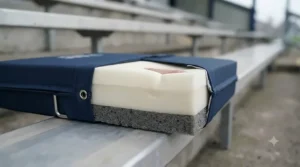
The Alpcour Heated Stadium Cushion takes the same 21 x 15 x 3-inch flat-cushion format as the standard Alpcour listed above, then adds three heat levels powered by a USB power bank, plus an upgraded 600D waterproof fabric rated around 15% more water-resistant than the standard version.
This is the clearest example on this list of a product actually solving a specific UK problem: watching lower-league football or rugby through a January cold snap, where the cushioning itself stops being the main issue and the cold creeping up through the metal becomes the dominant complaint. The reflective, heated base tackles that directly rather than just adding padding on top of the problem.
What most buyers overlook here is that the power bank isn’t included, so factor that into your total spend if you don’t already own a compatible USB battery pack — most 5V/3A power banks will work, and many people attending winter fixtures already carry one for their phone anyway. Aggregated review sentiment for the standard (non-heated) Alpcour cushion is strongly positive on comfort and durability, and the heated variant appears to extend that same build quality with the added winter-specific feature.
Pros:
- ✅ Three heat levels genuinely useful for winter terrace fixtures
- ✅ Upgraded 600D waterproof fabric, more resistant than standard
- ✅ Same versatile vertical/horizontal seating as the standard Alpcour
Cons:
- ❌ Requires a separate USB power bank, sold separately
- ❌ Premium pricing compared with unheated cushions on this list
Expect to pay in the region of £50–£70, which reflects the added electronics — but for anyone who’s ever left a match with numb fingers and a colder backside, the value case writes itself.
7. VEVOR Stadium Seat, 6 Adjustable Angle Bleacher Chair — best wide-body budget bleacher pick
The VEVOR Stadium Seat rounds out the list with a 2.9-inch cushion, six adjustable recline angles, a hook-style pocket and a built-in cup holder, positioned as a mid-budget alternative to the pricier Sportneer model.
Its recline mechanism mirrors higher-priced competitors fairly closely, which is one of the more genuinely surprising things about this product given its typical price bracket. The armrest design is wide rather than padded, prioritising a broader seating surface over plush arm cushioning — a sensible trade-off for buyers who’d rather have room to spread out than soft elbow rests they rarely lean on anyway.
Based on the spec comparison, this is best suited to buyers who want the multi-angle recline of the Sportneer without quite stretching to that price point, and who are prepared to accept a slightly less refined fit and finish in exchange. It’s a solid all-rounder for family days out at athletics meets, cricket boundaries or grassroots football, where you’re not necessarily attached to one brand but want the reclining-frame category covered on a budget.
Pros:
- ✅ Six recline angles at a genuinely competitive budget price
- ✅ Wide seating surface suits larger frames comfortably
- ✅ Hook pocket and cup holder cover the match-day basics
Cons:
- ❌ Build quality feels less refined than pricier framed rivals
- ❌ Padding is noticeably thinner than the Sportneer’s 2.5-inch foam
Typical pricing runs around £30–£45, making it a sensible middle-ground purchase for anyone comparing multiple framed bleacher chairs before committing.
Practical Usage Guide: Getting the Most From Your Cushion
Buying the right cushion is only half the job — how you use it determines whether it lasts one season or five. Start by giving any new foam cushion 24 hours out of its packaging before first use; compressed foam that’s been vacuum-packed for shipping needs time to fully expand, and using it immediately can make a genuinely thick pad feel disappointingly thin on its first outing.
For framed bleacher chairs, check the hook mechanism against your usual bench thickness before match day, not during it. UK terracing steps and school bleachers vary more in thickness than American-style stadium benches, and a hook that’s too loose will rattle and shift throughout the game. Wipe down waterproof shells after wet fixtures rather than leaving them folded up damp in a bag boot — trapped moisture is the single biggest cause of premature mildew smell in polyester-shelled cushions, something no amount of febreze fully fixes once it sets in.
A common first-30-days mistake is over-tightening adjustable straps on framed seats, which strains the stitching at anchor points faster than normal use would. Loosen straps fully before folding for storage, and store any cushion flat rather than compressed under heavier gear in a car boot, since sustained compression accelerates foam breakdown far faster than normal seasonal use.
Real-World Scenarios: Matching the Cushion to the Fan
Picture three different regulars at the same non-league ground on a Saturday afternoon. The first is a university student who cycles to matches, carries a rucksack already stuffed with textbooks, and simply can’t justify extra bulk — for them, the ultralight Therm-a-Rest Z Seat or the flat Alpcour Portable Extra Thick Stadium Seat Cushion solves the problem without adding meaningful weight to an already-full bag.
The second is a season-ticket holder in their sixties who’s been managing a dodgy lower back for a decade and attends every single home fixture without fail. For that profile, the recline flexibility and lumbar support of the Sportneer Stadium Seat with Back Support — or the winter-specific Alpcour Heated Stadium Cushion for the cold months — genuinely change the experience rather than just adding marginal comfort.
The third is a parent bringing two children to weekend youth football, juggling a folding stool, snacks and someone else’s coat before they’ve even found a seat. Budget and portability dominate here, making the VIVOHOME Stadium Seat with Back Support or VEVOR Stadium Seat sensible middle-ground picks — enough back support to matter, without premium pricing across multiple seats for the whole family.
Buyer’s Decision Framework
If you’re still torn, work through this in order: if you walk or cycle any real distance to fixtures, choose a flat portable cushion over a framed seat, because weight will matter more than you expect by the second mile. If you attend fixtures lasting over two hours regularly — cricket, athletics, extra-time-prone cup football — choose a framed bleacher cushion with back support, because the lumbar strain compounds significantly past the ninety-minute mark. If you’re outdoors through a UK winter, prioritise a waterproof or heated model over raw thickness alone, since cold and damp cause more discomfort over a season than a slightly thinner cushion ever will. And if budget is the deciding factor, a flat portable cushion nearly always beats a cheap framed seat, since low-cost frames are where corners get cut on hook durability and stitching.
Portable Stadium Cushion vs Bleacher Cushion: The Real Difference
The terminology gets blurred constantly in product listings, so it’s worth being precise. A true portable stadium cushion is, structurally, just padded fabric or foam — no moving parts, nothing to hinge or recline, and nothing that can mechanically fail beyond the foam eventually compressing. A bleacher cushion, in the sense most UK shoppers mean it, nearly always implies some form of backrest, whether that’s a simple flexible panel like the Picnic Time Gridiron or a fully adjustable, multi-position frame like the Sportneer.
The practical difference shows up in three places: weight, failure points and versatility. Cushions rarely weigh more than a pound and essentially can’t break in a way that renders them useless — worst case, the foam compresses and it’s less comfortable, not unusable. Framed bleacher seats can weigh anywhere from three to eight times that, and while the added back support is genuinely valuable, hinges, hooks and straps are all points that can eventually wear, loosen or snap under repeated folding. Versatility swings the other way, though — a flat cushion works on a car bonnet, a stone wall or a grass verge just as easily as a bench, while a hook-frame bleacher seat is specifically designed around bench-style seating and works less well anywhere else.
Independent product testing generally agrees that ample back support and cushioning matter most for watching a fixture over several hours, and that recline adjustability makes a measurable difference to comfort. That broadly matches what the aggregated review data across the products above suggests: buyers who prioritise back support tend to rate framed seats significantly higher for genuine comfort, while buyers optimising for portability consistently favour the lighter cushion-only category, even when they acknowledge the trade-off in lumbar support.
How to Choose a Portable Stadium Cushion or Bleacher Cushion
What is a portable stadium cushion vs bleacher cushion, and how do you choose between them? A portable stadium cushion is a flat, unstructured foam pad for extra padding on hard seating, while a bleacher cushion adds a frame and backrest for lumbar support — choose based on how far you’ll carry it, how long you’ll sit, and whether back support outweighs portability for you.
- Establish how far you’ll carry it. Anything beyond a short walk from car to gate favours a lightweight flat cushion over a framed seat.
- Check your typical fixture length. Sports regularly running past two hours make a backrest far more valuable than raw cushion thickness alone.
- Match thickness to the seating you’ll actually use. Concrete terracing benefits from thicker padding than a plastic bucket seat that already has some give.
- Confirm weight capacity on framed seats. A rating comfortably above your own weight avoids frame flex and premature wear.
- Factor in UK weather realistically. A waterproof shell or heated option earns its price back quickly across a full winter season of fixtures.
- Check the venue’s own seating policy before you buy. Some grounds restrict metal-framed seats in certain stands for safety reasons, covered in more detail below.
- Decide your budget by frequency of use, not sticker price alone. A £50 cushion used weekly for a decade costs less per use than a £15 pad replaced every season.
Cushion Thickness Explained
Cushion thickness is the single most misleading spec on any listing, because a bigger number doesn’t automatically mean a comfier seat. Foam density matters just as much as depth — a soft 3-inch cushion can compress under body weight to feel thinner than a firmer 2-inch pad, particularly after a season of regular use. As a rough guide, anything under 2 inches is really an insulation layer rather than meaningful cushioning; the 2–2.5 inch range, seen on the Sportneer and Alpcour cushions above, suits most fans for standard ninety-minute fixtures; and 2.8 inches upward, as on the VEVOR and heated Alpcour, is worth the extra bulk specifically for longer fixtures or older or more sensitive backs.
It’s also worth noting that thickness and portability pull in opposite directions almost by definition — the Therm-a-Rest Z Seat’s 2cm profile is deliberately minimal because its whole design brief is weight and pack size, not maximum plushness. Reviewers consistently note that thicker cushions lose their loft gradually rather than suddenly, so budgeting for gentle replacement every two to three seasons of regular use is more realistic than expecting foam to perform identically for a decade.
Bleacher Cooling Cushion Review: Do They Actually Work?
A bleacher cooling cushion — typically a gel-infused or ventilated foam pad marketed for hot-weather use — solves a genuinely different problem to winter cold. UK summers rarely reach the sustained heat where cooling gel inserts make a dramatic difference compared with warmer climates, but on the handful of properly hot fixture days each year, a ventilated or gel-layer cushion can measurably reduce the sweaty, sticky discomfort of sitting on dark fabric or metal in direct sun for hours.
None of the seven products featured above are marketed specifically as cooling cushions, and that’s a deliberate omission rather than an oversight — honestly, for the UK climate specifically, the practical case for a dedicated cooling cushion is considerably weaker than for a waterproof or thicker-padded one. If you regularly attend outdoor summer festivals or cricket test matches where full-day sun exposure is genuinely a factor, a gel-cooling pad is worth researching separately, but for the vast majority of UK football, rugby and grassroots fixtures across an average season, waterproofing and thickness deliver far more real-world value than cooling technology ever will.

Strap-On Cushions: Pros, Cons and Best Uses
Strap-on cushions — cushions with adjustable straps designed to fasten around bench seating or existing stadium chairs — sit in an interesting middle ground between a loose flat pad and a fully framed seat. The strap mechanism prevents the classic annoyance of a cushion sliding forward every time you stand up and sit back down, which becomes a genuine irritation over a full match if you’re constantly nudging a loose pad back into place.
The Alpcour Portable Extra Thick Stadium Seat Cushion includes safety straps that double as both a securing mechanism and a shoulder strap for carrying, which is a smart bit of dual-purpose design worth specifically looking for when comparing strap-equipped cushions. The trade-off is that straps add a small failure point — buckles and stitching can wear over repeated fastening cycles — but for anyone on sloped terracing or narrow benches where sliding is a real problem, the added stability comfortably outweighs that risk. Reviewers consistently rate strap-equipped cushions higher for stability on uneven or sloped seating specifically, even when they note the straps as a minor extra step versus simply placing a loose pad down.
Sports Venue Seating: What UK Grounds Actually Allow
Sports venue seating rules in the UK are shaped significantly by the Guide to Safety at Sports Grounds, commonly known as the Green Guide, which sets out recommendations for crowd safety at designated grounds. The Sports Ground Safety Authority provides strategic and proactive advice to sports bodies and grounds on identifying potential safety risks and supporting spectator safety more broadly. While this guidance is primarily aimed at ground management rather than individual fans, it does influence what larger or metal-framed seating items grounds will permit into certain stands, particularly standing or safe-standing areas where clear gangways and sightlines are a genuine safety requirement, not just a preference.
In practice, this means it’s worth checking your specific ground’s bag and seating policy before turning up with a full-sized framed bleacher chair, especially for cup fixtures or bigger clubs where security checks tend to be stricter than at routine league matches. A flat portable cushion is essentially never an issue at any UK ground, since it carries none of the same structural or trip-hazard concerns as a framed chair with legs or a wide base. If in doubt, a quick look at the club’s official matchday information page — most Premier League and EFL clubs publish one — will confirm exactly what’s allowed in your specific stand.
Common Mistakes When Buying a Stadium or Bleacher Cushion
The most frequent mistake is buying purely on thickness without checking weight capacity or hook compatibility on framed seats — a seat rated for 250lb that flexes alarmingly under a larger adult isn’t a bargain, whatever the price tag suggested. A close second is ignoring pack-down size entirely; a cushion that’s genuinely comfortable but doesn’t fold small enough for your usual bag becomes a cushion that quietly stops getting used after a couple of matches.
Buyers also commonly underestimate how much straps and pockets matter for actual usability versus how they read on a spec sheet. A cushion with a strap you’ll never adjust adds negligible value, while one with a strap that genuinely secures it to sloped or narrow bleacher seating solves a real problem every single time you sit down. Finally, plenty of buyers assume “waterproof” and “water-resistant” mean the same thing — they don’t, and a water-resistant shell left out through a genuinely wet UK match will eventually let damp through in a way a fully waterproof shell won’t.
Long-Term Cost & Maintenance
Total cost of ownership rarely gets mentioned on product listings, but it’s where the real value comparison happens. A £15 flat cushion replaced every single season works out at roughly £75 across five years of regular attendance, while a £45 framed bleacher seat that lasts the full five years with reasonable care actually costs less overall, despite the higher upfront price. The maths flips again with premium options like the heated Alpcour Heated Stadium Cushion — at £60, it needs to survive roughly four seasons to match the cost-per-season of cheaper alternatives, which is a realistic expectation given the more durable 600D fabric used.
Weather is the other variable worth budgeting for: Met Office data shows large parts of the UK see rainfall on a substantial share of days across the year, which is exactly why waterproof shells consistently outlast water-resistant ones in real-world seasonal use rather than lab conditions. Maintenance costs are minimal across every product on this list — none require anything beyond occasional wiping down and full drying before storage — but foam degradation is the one certainty. Budget mentally for replacement foam performance dropping noticeably after roughly three seasons of weekly use, regardless of how well you’ve cared for it, since that’s simply how foam behaves under repeated compression over time.
Frequently Asked Questions
❓ What's the difference between a stadium cushion and a bleacher cushion?
❓ How thick should a stadium seat cushion be?
❓ Are strap-on cushions worth it for sloped bleacher seating?
❓ Do bleacher cooling cushions make sense for UK grounds?
❓ Can I bring a framed bleacher seat into any UK sports venue?
Conclusion
The portable stadium cushion vs bleacher cushion decision ultimately comes down to how you actually attend fixtures, not which product has the flashiest listing. If you’re walking, cycling or juggling other gear, a flat cushion like the Alpcour Portable Extra Thick Stadium Seat Cushion or the featherweight Therm-a-Rest Z Seat will serve you better than a heavier framed alternative you’ll eventually stop bothering to bring. If you’re a regular at longer fixtures, or carrying a back complaint that makes ninety flat minutes genuinely uncomfortable, the recline and lumbar support of something like the Sportneer Stadium Seat with Back Support earns its extra weight and price.
Whichever category you land on, the seven products covered here span budget, mid-range and premium options across both types, with genuine spec differences rather than superficial rebranding of the same generic foam block. Check your venue’s seating policy, factor in how far you’ll actually be carrying it, and buy for the fixtures you attend most often rather than the occasional big cup day — that’s where the real comfort difference shows up, week after week.
✨ Don’t Miss These Exclusive Deals!
🔍 Take your match-day comfort to the next level with these carefully selected cushions and bleacher seats. Click on any highlighted item to check current pricing and availability. These picks will help you create genuinely comfortable stadium days your whole family will enjoy!
Recommended for You
- 7 Best Stadium Seat Cushions Under £25 (2026 UK Picks)
- 7 Best Cooling Cushion for Garden Chair Picks (UK 2026 Guide)
- Cooling Cushion for Wheelchair Users: 7 Top Picks for 2026
Disclaimer: This article contains affiliate links. As an Amazon Associate, I earn from qualifying purchases. If you purchase products through these links, we may earn a small commission at no additional cost to you.
✨ Found this helpful? Share it with your friends! 💬🤗
