
In This Article
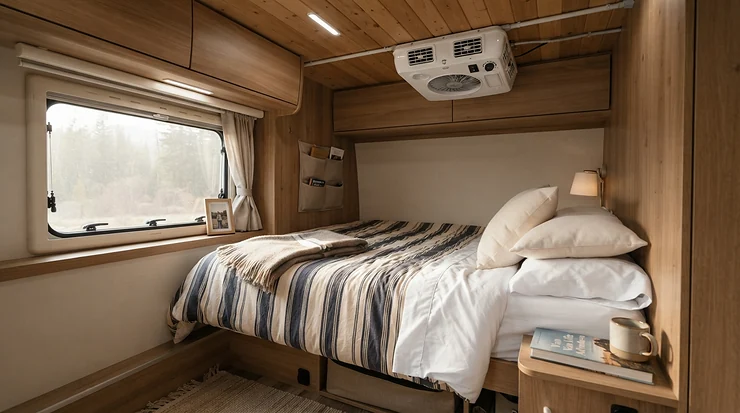
It’s 2 a.m. on a pitch somewhere in the Peak District. The awning ticks as it cools, the hook-up bollard is a field away, and your caravan has become a very expensive tin of warm beans. This is where a 12V ceiling fan for caravan use earns its keep. It shifts air for a few amp-hours of leisure battery, quietly enough that you can actually sleep.

Here’s the snag. Search for a 12V ceiling fan for caravan fitting and you’ll meet a muddle: true ceiling-hung fans, roof vent fans that double as ceiling fans, gimbal fans on the wall, and dashboard gadgets pretending to belong in a living space. Most guides paste spec sheets and move on. This one doesn’t.
I’ve compared seven real products on paper, using manufacturer specifications, UK retailer data and the genuine review themes that keep resurfacing. Then I translated every number into what it means at 3 a.m. with a flat battery looming. Whether you want a rated 12V fan for motorhome touring or you’re browsing 12V fans for campervans before a build, you’ll find a pick for your budget, a fitting guide and straight talk about trade-offs.
Prices are ranges only, because they move constantly, so always check the current listing before buying. I haven’t used these products myself. Where review evidence is thin, I say so rather than pretend.
Quick Comparison: 7 Best 12V Ceiling Fan for Caravan Picks
Here’s the whole field at a glance. Power figures are the published 12V draw, and airflow is each manufacturer’s own claim, so treat cross-brand comparisons with a pinch of salt.
| Product | Style | Published 12V draw | Published airflow | Price bracket | Best For |
|---|---|---|---|---|---|
| Caframo Sirocco II | Gimbal wall fan | 0.12–0.35A | 125–185 CFM | £110–£140 | Bedside breeze, off-grid |
| Caframo Maestro | Wall fan, light, wired pendant | 0.15–0.28A | 100–130 CFM | £100–£150 | Bunks and night-time loo trips |
| NCE 12V Oscillating Fan | Oscillating wall fan, remote | 0.11–0.49A | Not published | £90–£130 | Family dinettes |
| Montoya Oscillating Fan 12V | Suction-mount oscillating | Not published | Not published | Under £10 | Spare fan, tight budgets |
| Fiamma Turbo-Vent 40 x 40 | Roof vent fan | 0.3–3A | Up to 35 m³/min | £200–£260 | Swapping an existing 40 cm vent |
| Dometic FanTastic Vent 2250 | Roof vent, thermostat | Up to 3A | ~920 CFM (retailer-quoted) | £250–£320 | Thermostat control, pet owners |
| MaxxFan Deluxe 7500K | Roof vent, remote lid | ~0.15–2.7A | ~900 CFM | £300–£400 | All-weather airflow |
Looking at the table, the Caframo Sirocco II and Caframo Maestro offer the lowest published draw, which suits long off-grid stays. The roof vent models move several times more air, and the MaxxFan Deluxe 7500K is the one that scales its appetite from a sip to a gulp. The Montoya Oscillating Fan 12V wins on price but publishes almost nothing about performance, so it’s a spare, not a plan.
💬 Just one click — help others make better buying decisions too!😊
What Is a 12V Ceiling Fan for Caravan Use?
A 12V ceiling fan for caravan use is a low-voltage DC fan powered directly by your leisure battery. It mounts high on a ceiling, wall bracket or inside a roof vent so it circulates air without mains hook-up. Typical models draw roughly 0.1 to 3 amps, making them practical for off-grid pitches and overnight use.
Why does that matter? Your caravan’s 12V circuit is fed by a leisure battery, which, as the Caravan and Motorhome Club explains, is built to be discharged and recharged many times. It normally runs your lights, water pump and fridge. A fan is another small load on that same system, which is why low draw matters more than raw power.
There are three realistic types. Roof vent fans swap a standard roof light for a fan unit and can act like a ceiling fan when the lid is closed. Gimbal or wall fans fix to a panel and swivel. Portable fans plug into a 12V socket and clip or stick wherever you like. A purpose-built ceiling-hung 12V fan is rare in the UK caravan world, so the roof vent fan has become the de facto ceiling fan.
Top 7 12V Ceiling Fan for Caravan Options: Expert Analysis
I’ve ordered these roughly from compact and thrifty to big and powerful, so you can stop reading when you hit your budget.
1. Caframo Sirocco II — gimbal flexibility with a tiny battery appetite
The gimbal head means you can aim the airflow across a pillow rather than at a poor sleeper’s face. That’s the Sirocco’s party trick.
On paper, the Caframo Sirocco II is auto-sensing 12V/24V with three speeds and 125–185 CFM. Caframo’s UK page quotes 0.12A on low, 0.22A on medium and 0.35A on high. It has FingerSafe 7-inch blades, four auto-off timers (3, 6, 9 and 12 hours), folds flat against the wall and carries a three-year warranty. On low, eight hours costs roughly 1Ah, about 1% of a 100Ah battery.
My read: this is the sensible default for a bedroom end. The timer lets you fall asleep to a breeze without leaving it running all night. Its airflow is personal-breeze territory, though, and one UK guide suggests it suits smaller motorhomes better than large ones.
Review themes on Australian and US retailer pages are consistently positive on low draw, quiet running and years of service. A minority report latch failures, vibration or early failures, and some say the manufacturer stepped in with replacements.
Pros:
- ✅ Very low draw on all three speeds
- ✅ Folds flat for travel and storage
- ✅ Auto-off timer suits sleepers
Cons:
- ❌ Modest airflow for large living areas
- ❌ Some reports of latch or vibration faults
Expect to pay around £110–£140. Good value if longevity matters, less so if you only camp twice a year.
2. Caframo Maestro — wired pendant with a red night light
Fan and reading light in one fixture is a neat trick for a cramped bunk. The red setting is the real hero.
The Caframo Maestro is 12V only, with a 6-inch fan, variable speed, 100–130 CFM and a draw of 0.15–0.28A. Caframo quotes 30–47 dBA, and the LED draws about 0.20A white or 0.15A red. A wired pendant mounts up to roughly 1.8 metres from the fan, and the warranty is two years.
Variable speed means you can dial in exactly enough air instead of choosing between “gentle” and “gale”. The red light protects your night vision for those 3 a.m. loo trips. Fan on high plus the white light lands near 0.5A, so don’t leave the lamp on out of habit.
I couldn’t find enough verifiable UK reviews for this specific model, so I won’t guess at owner sentiment. What is verifiable is that it shares the Caframo build lineage as the Sirocco.
Pros:
- ✅ Variable speed instead of fixed steps
- ✅ Red night light preserves night vision
- ✅ Whisper-level noise range at low speeds
Cons:
- ❌ Lower airflow than the Sirocco II
- ❌ No 24V option or timer
Budget around £100–£150, though UK pricing varies by retailer. Worth it if you value the light, otherwise the Sirocco II is the stronger fan.
3. NCE 12V Oscillating Fan — brushless motor and 120° sweep
If you want genuine oscillation with a remote, this is the only dedicated option in this round-up.
The NCE 12V Oscillating Fan has a 6-inch blade, 120° auto-oscillation, a 90° manual fold, a remote and four speeds drawing 0.11, 0.13, 0.33 and 0.46A. Oscillating at maximum is 0.47A, or 0.49A with the night light. It’s brushless, weighs about 760g and has a removable grill and a child lock.
Brushless motors generally run cooler and last longer than brushed ones. That should matter on a fan you might leave on every night of a fortnight’s holiday. The 0.13A second speed is the sweet spot for sleeping, at about 1Ah over eight hours.
The catch is availability. Specifications come from Australian suppliers, UK stock appears patchy, and the warranty quoted there is only one year. I couldn’t verify meaningful owner reviews, so treat it as promising but unproven.
Pros:
- ✅ Genuine 120° oscillation with remote control
- ✅ Brushless motor and washable grill
- ✅ Child lock suits family caravans
Cons:
- ❌ Patchy UK availability
- ❌ Only a one-year warranty quoted
Roughly £90–£130 where stocked. Good value on paper, but confirm stock and returns before committing.
4. Montoya Oscillating Fan 12V — budget suction-cup breeze
Sometimes you just need something cheap that works in a heatwave. That’s the whole pitch here.
The Montoya Oscillating Fan 12V (PD-MT61010) is a compact oscillating car fan with a 360° rotating head, adjustable tilt, a suction-cup mount and a 2.5 m lead for a 12V socket. The retailer lists CE and RoHS compliance and says its CE products are UKCA compliant. It publishes no airflow or amp figures, so assume modest performance.
Suction cups grip smooth glass and gel-coat well, but they struggle on textured or vinyl-covered caravan panels. Check your surface before relying on it. It’s best as a spare, a guest-bunk fan or a “see if I even like fans” experiment.
I found no reliable review data to summarise, and with a product this inexpensive I’d rather say that than invent anything.
Pros:
- ✅ Extremely cheap to try
- ✅ Oscillation and tilt in a tiny body
- ✅ Long cable reaches from the 12V socket
Cons:
- ❌ No published airflow or power figures
- ❌ Suction mount fails on textured panels
Under £10 at the trade supplier I found, so check current prices. Excellent value as a backup, poor value as your only fan.
5. Fiamma Turbo-Vent 40 x 40 — big airflow in a familiar UK roof vent
If your caravan already has a 40 cm roof vent, this is the classic upgrade path.
The Fiamma Turbo-Vent 40 x 40 has a 12V DC variable-speed motor with a 30 cm, 10-blade fan and up to 35 m³/min of airflow. It draws 0.3–3A (36W maximum) and fits 39 x 39 cm apertures, with interchange across older 36–42 cm Fiamma vents. It has a double mosquito screen and doesn’t need a spoiler. One retailer also lists a Polar Control thermostat. The Premium variant adds finger-touch controls with LEDs.
That 0.3A floor is notable. It’s close to the Sirocco II’s high setting, so this isn’t the most frugal overnight option. But it moves far more air, and as an extractor it clears cooking heat quickly.
Marketing describes it as exceptionally quiet at minimum speed, which I’d treat as a claim, not a verdict. I couldn’t verify enough independent reviews.
Pros:
- ✅ High airflow from a compact roof unit
- ✅ Fits many older Fiamma 40 cm openings
- ✅ Works as both ventilator and extractor
Cons:
- ❌ Needs roof fitting and a fused supply
- ❌ Higher minimum draw than gimbal fans
Expect around £200–£260. Reasonable value if you’re replacing an existing vent, steeper if you’re cutting a new hole.
6. Dometic FanTastic Vent 2250 — thermostat and reversible airflow
Set the temperature and walk away. That’s the appeal, especially if you leave a dog in the van.
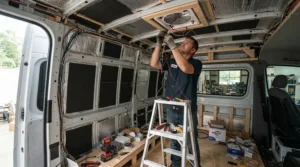
The Dometic FanTastic Vent 2250 has a 12-inch, 10-blade fan, three speeds, reversible airflow and a built-in thermostat. It fits the standard 14-inch (about 355 mm) opening under a roughly 400 mm dome, weighs around 5.5kg and carries CE marking. One supplier lists a 3A maximum draw with a built-in 6A fuse. Retailers quote around 920 CFM, and the dome lifts manually with no rain sensor.
Manual lift is the trade-off. You must open and close the dome yourself, so it’s less forgiving in a surprise shower than the MaxxFan Deluxe 7500K. Note that Dometic lists a clear-dome version as discontinued, so check which dome you’re buying.
UK guides praise it, but those aren’t customer reviews. Comparison commentary from van-conversion bloggers tends to favour the MaxxFan’s rain cover and finer speed control.
Pros:
- ✅ Built-in thermostat for unattended cooling
- ✅ Reversible airflow for intake or extraction
- ✅ Simpler and cheaper than premium vents
Cons:
- ❌ Manual dome lift, no rain sensor
- ❌ Only three fan speeds
Around £250–£320. Solid value if you want thermostat control without paying for a remote and electric lid.
7. MaxxFan Deluxe 7500K — ten speeds, rain cover and remote lid
This is the “do it all” roof vent. It opens in the rain, closes by remote and scales from whisper to gale.
The MaxxFan Deluxe 7500K has a 12-inch, 10-blade fan, ten speeds, reversible flow, a thermostat and a smoked rain cover with an electric lid. UK retailers quote about 900 CFM and a 14-inch cut-out, with 350 mm and 400 mm versions. Draw runs from roughly 0.15Ah per hour at 10% to about 2.66Ah per hour flat out. Run with the lid closed, it behaves like a true ceiling fan.
At 10% speed, eight hours costs around 1.2Ah, which is excellent for something this powerful. Owners on one international listing describe running low speeds overnight to fight condensation.
That listing shows roughly 4.4 out of 5 from nearly 800 ratings. Reported complaints include noise at high speed and questions about whether it seals perfectly when closed. A UK guide also notes the high price, the need for installation and that roof sealant is sold separately.
Pros:
- ✅ Ten speeds with a very low minimum draw
- ✅ Rain cover allows use in wet weather
- ✅ Remote operation of lid and fan
Cons:
- ❌ Highest price in this round-up
- ❌ Needs proper roof installation
Around £300–£400. Premium money, but the speed range and rain cover make it the best all-rounder here.
Top 7 at a Glance: Ratings, Mounting and Value
| Product | Mounting | Verifiable rating signal | Price bracket | Best For |
|---|---|---|---|---|
| Caframo Sirocco II | Wall bracket | Broadly positive; some fault reports | £110–£140 | Quiet nights off-grid |
| Caframo Maestro | Bulkhead | Not verified | £100–£150 | Bunks, night light |
| NCE 12V Oscillating Fan | Wall plate | Not verified | £90–£130 | Families wanting sweep |
| Montoya Oscillating Fan 12V | Suction cup | Not verified | Under £10 | Backup fan |
| Fiamma Turbo-Vent 40 x 40 | Roof aperture | Not verified | £200–£260 | Replacing a 40 cm vent |
| Dometic FanTastic Vent 2250 | Roof aperture | Limited | £250–£320 | Thermostat control |
| MaxxFan Deluxe 7500K | Roof aperture | About 4.4/5 on one listing | £300–£400 | All-weather ventilation |
Only the MaxxFan Deluxe 7500K and the Caframo Sirocco II have meaningful public review signals, so those two carry the most evidence behind them. The Dometic FanTastic Vent 2250 and Fiamma Turbo-Vent 40 x 40 sit in the middle on price and rely mostly on specifications. The three cheapest options are the least proven, which is reflected in their risk, not just their price.
✨ Don’t Miss These Exclusive Deals!
🔍 Take your caravan cooling to the next level with these carefully selected fans. Click on any highlighted item to check current pricing and availability. These picks will help you create the cool, quiet nights your family deserves!
Caravan Interior Fitting: How to Install a 12V Fan the Right Way
Good caravan interior fitting is half the battle. A great fan on bad wiring is a noisy, battery-hungry disappointment, so here’s a sensible order of play.
- Choose the spot. Pick somewhere high enough that nobody walks into it, aimed to cross your body, not your face. For wall fans, locate solid framing or fit a backing plate, because thin panels flex and rattle.
- Plan the power. Run a fused 12V feed from your distribution panel, with the fuse close to the source and sized to the fan’s maximum current and cable. Check the manual, because some units, such as the Dometic FanTastic Vent 2250, include their own fuse.
- Wire carefully. Keep cables clear of blades, secure them with clips and check polarity. Several reviewers of gimbal fans report non-working units that turned out to be wiring or connection issues, so test before final trimming.
- For roof vents, respect the seal. Cut the aperture to the manufacturer’s size, clean the surface and use a suitable roof sealant, remembering the MaxxFan Deluxe 7500K doesn’t include it.
- Test and tidy. Run every speed, listen for rattles, check the draw if you have a monitor, then fit the interior trim.
If you’re in any doubt, a UK retailer advises taking the vent and vehicle to a professional. A poorly sealed roof hole costs far more than a fitting fee.
Campervan Conversion: Planning Your Fan and Vent Layout
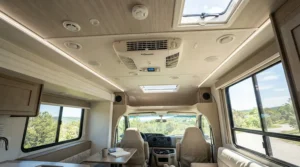
A campervan conversion gives you a rare luxury: you choose where the airflow goes before the walls are on. Here are three realistic profiles.
The weekend converter. Budget is tight, nights are mostly on sites, and the battery is a modest 100Ah. A Caframo Sirocco II at the bed end plus a Montoya Oscillating Fan 12V as a spare keeps cost sensible and draw tiny.
The full-time off-grid traveller. Wild camping, solar panels and summer heat demand serious ventilation. The MaxxFan Deluxe 7500K set low overnight, with a Caframo Sirocco II aimed at the bed, balances airflow and amp-hours.
The family in a long caravan. Four people, one dinette and a dog. The Dometic FanTastic Vent 2250 thermostat handles the empty-van hours, and the NCE 12V Oscillating Fan sweeps the table at dinner.
Whichever profile you match, plan cross-flow. A roof vent pulls air out, so crack a low window or vent on the opposite side to feed it. Without an inlet, even the best fan just argues with the walls.
Problem → Solution: Fixing Common 12V Fan Headaches
Most 12V fan complaints come down to the same few issues.
Problem: the fan is too noisy at night. Drop to the lowest speed, or choose a variable-speed model like the Caframo Maestro. Rattles are often loose mountings, so tighten fixings and add washers.
Problem: it’s draining the battery. Use timers, such as the Caframo Sirocco II‘s auto-off, or run roof vents at low percentages. Check your overall 12V load, not just the fan.
Problem: it vibrates or rattles. Some Sirocco owners report this on specific units. Check the base plate and mounting surface first, and contact the supplier if it persists.
Problem: condensation on windows. Run a vent fan at low speed and open a small inlet. Owners of roof vent fans describe low overnight settings helping with moisture.
Problem: it’s still too hot. Remember that fans move air; they don’t cool it. On very hot days the NHS guidance on heat exhaustion and heatstroke is worth reading, particularly for children, older people and anyone with long-term health conditions. If someone feels unwell, move them somewhere cooler and get proper advice.
How to Choose a 12V Ceiling Fan for Caravan Use
Follow these six steps to narrow the field.
- Check your roof. Measure any existing aperture first. A 40 cm hole points to a Fiamma Turbo-Vent 40 x 40 or a 400 mm-class vent, while no hole points to a wall fan.
- Set your power budget. Add up overnight Ah for lighting, fridge and charging, then see what’s left for a fan. Low-draw models are far easier to live with.
- Decide on airflow need. A bed-end breeze needs 100–185 CFM, whereas cooling a whole living area wants roof-vent numbers.
- Pick your controls. Remote, pendant, thermostat or simple switch? A thermostat suits unattended use, while a pendant suits bunks.
- Think about noise. Light sleepers should favour low-speed performance over peak airflow, as one UK guide also advises paying more for quieter fans.
- Check warranty and availability. Three years versus one matters on something you run nightly, so confirm UK stock before you buy.
Rated 12V Fan for Motorhome: Reading the Numbers That Matter
A rated 12V fan for motorhome use should tell you three things: current draw, airflow and noise. Many don’t, which is a red flag in itself.
Current draw (amps) is your battery’s enemy. Multiply by hours of use to estimate amp-hours. A 0.12A fan over eight hours is about 1Ah, whereas a 3A vent at full tilt is 24Ah.
Airflow (CFM or m³/min) needs care. Roof vent maximums such as 900–920 CFM or 35 m³/min are manufacturer figures under unspecified conditions and aren’t directly comparable. A gimbal fan’s 125–185 CFM is a more modest but more targeted claim.
Noise (dBA) is the rarest number. The Caframo Maestro publishes 30–47 dBA, which gives you something concrete to compare.
For a broader UK perspective, Camplify’s guide to 12V motorhome fans splits the market into portable and mountable options and highlights noise and installation difficulty. My advice is to treat any fan without published amps and airflow as “unrated” and price it accordingly.
Oscillating 12V Fan for Caravan: Is the Sweep Worth It?
An oscillating 12V fan for caravan use sounds like an obvious win. The breeze sweeps across everyone, so nobody gets frozen while somebody else bakes.
In practice, oscillation spreads airflow thinly. That’s brilliant for a dinette with four people, and less brilliant if you want a steady stream across one pillow. A gimbal fan like the Caframo Sirocco II gives pinpoint control but no sweep.
Oscillation also costs a little extra power. The NCE 12V Oscillating Fan draws 0.47A at maximum while sweeping versus 0.46A without, so the penalty is negligible. The real cost is mechanical, since a moving head is another thing that can wear out.
My verdict: choose an oscillating 12V fan for caravan living areas and a fixed or gimbal fan for beds. If you only want to experiment, the Montoya Oscillating Fan 12V is cheap enough to test the idea.

12V Fans for Campervans: Small Spaces, Different Rules
12V fans for campervans face constraints a touring caravan rarely does. Everything is closer, headroom is lower and the metal shell heats up fast.
Because the cabin volume is small, a modest fan goes a long way. A Caframo Sirocco II or Caframo Maestro can handle a bed area, whereas a big roof vent can feel like overkill unless you cook inside.
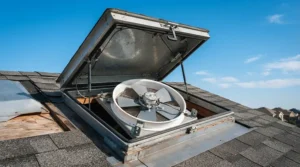
Roof real estate is the other issue. A single vent hole must serve extraction, light and airflow, so a MaxxFan Deluxe 7500K often becomes the centrepiece of a build. Check which cut-out size fits your roof, as both 350 mm and 400 mm versions are sold in the UK.
For converters on a budget, start with a gimbal fan and add a roof vent later, once you know how you actually use the van. Cheap suction-cup fans are fine for the cab and for testing, but they won’t survive full-time vibration.
Roof Vent Fan vs Wall-Mounted Fan: Which Wins?
A roof vent fan removes air from the top of the caravan, where heat gathers. A wall fan stirs the air where you actually sit and sleep. They solve different problems, which is why many owners end up with both.
| Option | Needs hook-up? | Power | Airflow | Best For |
|---|---|---|---|---|
| MaxxFan Deluxe 7500K (roof vent) | No | ~0.15–2.7A | ~900 CFM | Whole-van ventilation |
| Caframo Sirocco II (wall gimbal) | No | 0.12–0.35A | 125–185 CFM | Personal breeze |
| Mains pedestal fan (traditional) | Yes | 230V mains | Varies | Hook-up pitches |
| Open windows only | No | None | Weather-dependent | Mild nights |
Looking at the table, the MaxxFan Deluxe 7500K moves far more air but costs more to fit and run. The Caframo Sirocco II is tiny on power and ideal for sleeping. The traditional mains fan is cheap but useless off-grid, and open windows alone leave you at the mercy of the weather.
Long-Term Cost and Battery Maths
The purchase price is only half the story. Running cost is measured in amp-hours, and your battery has a finite supply.
Below are on-paper overnight figures for eight hours on each model’s lowest published setting. They’re based on manufacturer numbers, so real-world use will vary.
| Product | Approx. 8-hour use (lowest setting) | Price bracket | Best For |
|---|---|---|---|
| Caframo Sirocco II | ~1Ah | £110–£140 | Lowest draw |
| Caframo Maestro | ~1.2Ah | £100–£150 | Bunks |
| NCE 12V Oscillating Fan | ~0.9–1Ah | £90–£130 | Families |
| Fiamma Turbo-Vent 40 x 40 | ~2.4Ah | £200–£260 | Roof ventilation |
| MaxxFan Deluxe 7500K | ~1.2Ah | £300–£400 | Premium, versatile |
On a 100Ah battery, even the thirstiest of these uses a few per cent per night. The Fiamma Turbo-Vent 40 x 40 costs the most to run at its minimum, but it still sips compared with a fridge or water pump. As a rule of thumb, lead-acid batteries last longer if you avoid draining them deeply, so a fan that costs 1Ah rather than 2.4Ah quietly adds up across a season.
Safety, Regulations and Compliance Guide
A 12V fan sits below the low-voltage regulations, which cover electrical goods from 75V DC upwards. But other rules still apply. The government’s UKCA marking guidance explains how UKCA and CE markings work in Great Britain, and you’ll see these on many fans.
Practical safety matters more than paperwork. Fit a fuse sized to the fan and cable, keep wiring away from blades and mount fans where nobody can walk into them. Family-friendly features help, such as FingerSafe blades on the Caframo Sirocco II and the child lock on the NCE 12V Oscillating Fan.
For roof vents, never run the MaxxFan Deluxe 7500K without its insect screen fitted, and make sure sealant is applied properly to prevent leaks. Always follow the manufacturer’s installation manual and consider professional fitting if you’re unsure.
Common Mistakes When Buying a 12V Ceiling Fan for Caravan Use
These are the pitfalls I’d steer you around.
- Buying on peak airflow alone. A huge CFM figure at maximum speed means nothing if the fan is too loud to run at night.
- Ignoring the minimum draw. The Fiamma Turbo-Vent 40 x 40‘s 0.3A floor is far higher than gimbal fans, which matters over a whole holiday.
- Forgetting the inlet. A roof vent without a window cracked open on the opposite side just recycles stale air.
- Trusting thin evidence. A suction-cup fan with no published specifications, like the Montoya Oscillating Fan 12V, is a gamble. Fine as a spare, risky as your only fan.
- Skipping the roof measurement. A 350 mm versus 400 mm aperture mix-up turns an easy fit into a bodge.
FAQ
❓ How many amps does a 12V fan draw in a caravan?
❓ Can a leisure battery run a fan all night?
❓ Do I need a fuse for a 12V caravan fan?
❓ Where is the best place to mount a 12V fan in a campervan?
❓ Can I fit a roof vent fan myself?
Conclusion
The right 12V ceiling fan for caravan life depends on how you sleep, where you pitch and how much battery you can spare.
If you want the safest all-round buy for a bed or dinette, the Caframo Sirocco II has the strongest evidence behind it: tiny draw, a sleep timer and a long track record, with some mixed fault reports to note. If you want a light and variable speed in one fitting, the Caframo Maestro is the neat alternative, though its reviews are harder to verify.
For living-area sweep, the NCE 12V Oscillating Fan is the only dedicated oscillating model here, and the Montoya Oscillating Fan 12V is a throwaway-cheap spare. If you’re ready for a roof vent fan, the Fiamma Turbo-Vent 40 x 40 suits a like-for-like swap, the Dometic FanTastic Vent 2250 adds thermostat control, and the MaxxFan Deluxe 7500K is the premium all-rounder.
Whatever you choose, plan your inlet, fuse your wiring and respect your battery. A breeze that costs a single amp-hour is one of the cheapest comforts in caravanning.
Recommended for You
- 12V Caravan Fan: 7 Best Quiet, Low-Power Picks (2026)
- Rated Motorhome Cooling Solutions: 7 Best Picks For 2026
- Caravan Cooling Fan: 7 Best Picks To Beat The Heat (2026)
Disclaimer: This article contains affiliate links. As an Amazon Associate, I earn from qualifying purchases. If you purchase products through these links, we may earn a small commission at no additional cost to you.
✨ Found this helpful? Share it with your friends! 💬🤗
