

In This Article
A caravan cooling fan is any fan chosen to move air through a touring caravan, whether it runs from the 12V leisure battery, a built-in USB battery or a mains hook-up. A standard model cannot lower the temperature by itself, but it keeps air moving so sweat evaporates and stuffy corners clear.
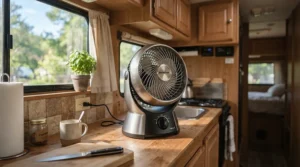
There’s a particular misery only a caravan can deliver. It’s 2pm in July, the aluminium shell is soaking up sun like a storage heater, and the air inside is thick enough to chew. Britain isn’t Spain, but the thermometer has stopped taking that personally. Anyone touring between June and September knows the moment the van tips from cosy to oven. The cure is rarely dramatic. A well-chosen caravan cooling fan, matched to your battery and your pitch, fixes more of it than you’d expect.
Comfort isn’t the only reason. NHS guidance on heat exhaustion and heatstroke says heat exhaustion usually passes if you can cool down within 30 minutes. That means moving somewhere cooler, drinking fluids and cooling the skin with water and fanning. It also flags children, older people and anyone with a long-term health condition as higher risk. A small, sun-baked cabin is exactly where that matters.
This guide covers seven real products, from a budget plug-in to a roof-mounted unit. Each one gets spec analysis and honest pros and cons. Because aggregated Amazon star ratings couldn’t be reliably verified at the time of research, the owner sentiment comes from published UK reviewer roundups, and prices are ranges only.
Quick Comparison: Caravan Cooling Fan Options at a Glance
Not every caravan cooling fan solves the same problem. Some move air, one genuinely cools it, and a couple draw so little power you can leave them running all night. Here’s the field in one glance before we dig into each.
| Product | Type | Power | Price range | Best For |
|---|---|---|---|---|
| MaxxFan Deluxe 7500K | Roof vent fan | 12V, wired in | Around £400 | Maximum airflow for regular tourers |
| Dometic Fantastic Vent 2250 | Roof vent fan | 12V, wired in | £250–£300 range | Thermostat control on a tighter budget |
| Caframo Sirocco II | Gimbal fan | 12V, direct wire | £110–£140 range | Quiet night-time airflow |
| Transcool | Evaporative cooler | 12V/24V/240V | £300–£380 range | Hot, dry days when airflow isn’t enough |
| RoadPro 12V Metal Fan | Plug-in fan | 12V socket | £40–£55 range | The cheapest quick fix |
| Pro Breeze Rechargeable Telescopic Fan | USB rechargeable | Built-in battery | Budget bracket, check current price | Beds, awnings and flexible placement |
| berssen DC Pedestal Fan | Pedestal fan | 240V mains | Mid-range bracket, check current price | Hook-up pitches or power-station setups |
Looking at the comparison above, the Caframo Sirocco II and RoadPro 12V Metal Fan are the easy wins for anyone who wants airflow without drilling holes. The MaxxFan Deluxe 7500K justifies its premium only if you tour often enough to spread the cost across many summers. Buyers watching their budget should note that the two cheapest options trade some noise or airflow for the saving. The roof fans and the Transcool are the only ones that change the character of the whole caravan rather than just one corner.
💬 Just one click — help others make better buying decisions too!😊
Top 7 Caravan Cooling Fan Picks: Expert Analysis
The seven below span roof-mounted, 12V, rechargeable and mains designs. Specs are paired with what they mean in practice, and the sentiment lines summarise what UK reviewers and owners have published, not invented quotes.
1. MaxxFan Deluxe 7500K — best roof fan for serious airflow
The headline trick is that the vent, fan and rain shield live in one unit, so the lid can stay open while the heavens do their worst. It has a ten-speed motor and a remote with backup ceiling controls. A thermostat mode lifts the lid and starts the fan once your set temperature is reached, and a reverse function pulls air in or pushes it out. It fits a 14 x 14 inch opening and is listed at roughly 161W at the top end. That works out at around 13 amps at 12V, so full blast is best saved for hook-up pitches.
On paper this is the strongest caravan cooling fan in the group. It’s also the one that asks the most of you: a roof aperture, proper sealing and ideally professional fitting. Reviewers also note that roof units add height, which matters on European routes with 3.05m toll thresholds. Modifications done badly can also complicate your warranty.
UK roundups treat it as the premium benchmark. Camplify’s guide calls it the most expensive in its list but worth the money, with the usual caveats about installation and separate sealant.
Pros:
- ✅ Ten speeds with a remote-operated lid
- ✅ Thermostat auto mode works while you’re out
- ✅ Reversible airflow in or out
Cons:
- ❌ Needs fitting, and sealant is extra
- ❌ Top-speed draw is heavy for small batteries
Price: around £400. Excellent value if you tour most summers, overkill if you don’t.
2. Dometic Fantastic Vent 2250 — best thermostat-driven roof option for less
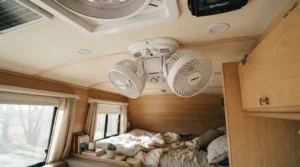
This one wins the “set it and forget it” award. A built-in thermostat holds a steady temperature while you’re out on a walk, so the caravan isn’t an oven when you return. A ten-blade rotor gives it real push for a 14 x 14 inch footprint. It has three speeds, a reverse switch and a roof-light design that lets daylight in.
Based on the spec comparison, it’s the sensible middle path between a plug-in fan and the top-spec roof unit. The trade-off is that the hood is manual, so someone has to open and close it. That’s a small chore until the first surprise shower. It suits owners who want serious through-ventilation but can live without a remote.
Camplify’s UK guide describes it as compact, powerful and quiet, with installation as the main consideration. No other UK roundup I found flagged durability problems, though none tested it over many seasons either.
Pros:
- ✅ Built-in thermostat holds a steady temperature
- ✅ Quiet for a ten-blade roof fan
- ✅ Reversible airflow with a simple switch
Cons:
- ❌ Manual hood must be opened and closed
- ❌ Roof installation is non-negotiable
Price: £250–£300 range. Strong value for committed tourers.
3. Caframo Sirocco II — best quiet gimbal fan for bedrooms
The standout feature is the gimbal head, which lets you aim airflow in nearly any direction. It weighs under a kilogram. A timer shuts it off after two, four, six or eight hours, with three speeds in between. It stows flat against a wall and can be hard-wired or used on its base. UK listings sometimes carry other brand names for the same design.
For a caravan, think of it as the bedside fan that never keeps you awake. The timer is the clever bit: it stops you waking at 3am to a flat battery and a cold neck. Camplify notes it suits smaller spaces better than large ones, which fits a caravan bedroom perfectly. Wiring it in means fusing it properly, so be honest about your DIY confidence.
Everywhere With Claire’s roundup picks it as the best hard-wired, energy-efficient option, and Camplify highlights its low draw and minimalist operation.
Pros:
- ✅ Timer settings stop overnight battery drain
- ✅ Gimbal head aims airflow precisely
- ✅ Light enough to mount almost anywhere
Cons:
- ❌ Too small to move air through a whole van
- ❌ Direct wiring needs competence and a fuse
Price: £110–£140 range. Superb value for night-time use.
4. Transcool — only option here that genuinely cools the air
Where most of this list pushes air around, the Transcool pulls air across wet pads so it leaves cooler than it arrived. It runs on 12V, 24V or 240V. It has an internal 1.8-litre tank, four directional vents and a low-battery cut-out that protects your leisure battery. A published review of the Australian-market model quotes 0.7 to 1.7 amps, depending on speed.
A fan alone can’t beat a 30°C interior, but evaporative cooling can take the edge off. The catch is physics: evaporation works best in dry heat and adds moisture to the air, so it’s less effective on a muggy day. Park in the shade and keep the blinds closed, and it works much harder for you.
Wandering Bird’s author says she has used one for years and finds it definitely helps on very hot days, though it takes time to get going. Camplify flags noise at full speed.
Pros:
- ✅ Cools air rather than merely moving it
- ✅ Low-battery cut-out protects the leisure battery
- ✅ Runs on 12V, 24V or 240V
Cons:
- ❌ Noisy at full speed
- ❌ Less effective in humid weather
Price: £300–£380 range. Worth it for hot-weather specialists.
5. RoadPro 12V Metal Fan — cheapest plug-in fix
The standout is simplicity. It plugs into a 12V socket with a roughly 3.1m cable and a ball-joint mount, so you can aim it without moving it. The model, E19-1F3-A86, has a 6-inch (150mm) blade and weighs about 460g. It has high and low speeds, draws up to roughly 1.7 amps and screws into place rather than clipping.
Think of it as the pocket-money caravan cooling fan: no installation, no fuss, no wiring. It doesn’t oscillate, so you’ll aim it and leave it. Camplify’s roundup is blunt about the trade-off: metal blades are noisier than plastic ones, and they can’t be removed for cleaning.
It’s a brilliant first purchase for a budget caravan cooling plan and a sensible spare for a second sleeping area.
Pros:
- ✅ Plugs in with no installation
- ✅ Ball-joint mount aims airflow where needed
- ✅ Long cable offers flexible placement
Cons:
- ❌ Metal blades are noisier than plastic rivals
- ❌ Blades can’t be removed for cleaning
Price: £40–£55 range. Outstanding value for the money.
6. Pro Breeze Rechargeable Telescopic Fan — best cordless flexibility
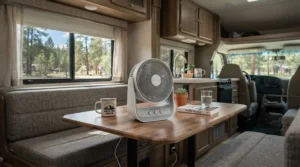
The headline is freedom from your leisure battery. It has a built-in 10,000mAh battery that the maker claims runs up to 24 hours. The pole telescopes from about 41cm to 91cm, and it has three speeds, a head that tilts about 120° and legs and pegs for stability.
Claimed runtimes usually describe the lowest setting, so expect fewer hours at full speed. Still, this is the one that works in an awning, on a bedside table or on a picnic bench, then folds away. It sits outside your 12V system entirely, which keeps your caravan cooling system simple.
Wandering Bird lists it among the best rechargeable options and points to its large review volume. Independent verification of review counts wasn’t possible for this guide.
Pros:
- ✅ Cordless, so no leisure battery drain
- ✅ Telescopic pole suits beds and awnings
- ✅ Folds small for storage
Cons:
- ❌ Needs recharging between uses
- ❌ Gentler airflow than mains or roof fans
Price: budget bracket, check current price. Good value as a flexible second fan.
7. berssen DC Pedestal Fan — quiet mains power for hook-up pitches
The standout is the efficient DC motor: 35W, 13 speeds, five modes and a remote. Oscillation widens from 30° to 90°, and the listing quotes airflow up to 7.1 metres per second. It weighs close to 6kg, and the head and base separate for storage.
That 35W figure is the interesting number. On a 1,000Wh power station it would run for well over a day in theory, though inverter losses will trim that. It needs 240V, so it belongs on a hook-up pitch or a power-station setup, not a bare 12V circuit.
Wandering Bird calls it an amazing off-grid option when paired with a portable power station. A listing, however, isn’t a long-term test, so durability remains unverified.
Pros:
- ✅ Low 35W draw for a pedestal fan
- ✅ Wide 3D oscillation covers more of the van
- ✅ Remote with sleep and nature modes
Cons:
- ❌ 240V only, so no direct 12V use
- ❌ Heavy at nearly 6kg
Price: mid-range bracket, check current price. A strong pick for hook-up regulars.
Top 7 at a Glance: Installation, Power and Best-Use Scenarios
| Product | Installation | Power source | Noise note | Best For |
|---|---|---|---|---|
| MaxxFan Deluxe 7500K | Roof cut-out | Leisure battery | Varies by speed | Whole-van ventilation |
| Dometic Fantastic Vent 2250 | Roof cut-out | Leisure battery | Described as quiet | Unattended temperature control |
| Caframo Sirocco II | Wall or base | Leisure battery | Low | Bedroom use |
| Transcool | None | 12V, 24V or 240V | Loud at full speed | Dry, hot days |
| RoadPro 12V Metal Fan | Screw-fix or place | 12V socket | Noisier | Budget caravan cooling |
| Pro Breeze Rechargeable Telescopic Fan | None | Built-in battery | Light | Awnings and bedsides |
| berssen DC Pedestal Fan | None | 240V | Low | Hook-up pitches |
Read the table and a pattern emerges: roof units are installed once and forgotten, while everything else is portable. The Sirocco II and RoadPro 12V Metal Fan are the best choices if your caravan has no spare roof aperture. The berssen DC Pedestal Fan only makes sense if you either tour on hook-up or already own a power station.
How to Set Up Your Caravan Cooling Fan for Maximum Airflow
Buying the right fan is half the battle. Placing it properly is the other half, and it’s where most people leave comfort on the table.
- Create a through-draught. Open a window on the shaded side and push air out through the opposite end. Wandering Bird recommends two roof fans, one set to pull air in and one set to push it out.
- Pre-cool at the edges of the day. Open everything at dawn and dusk when the air outside is cooler. Close up and shade the windows once the sun is up.
- Aim for the people. A fan blowing at a sofa does nothing. Point it at where bodies are, and use a Caframo Sirocco II or Pro Breeze Rechargeable Telescopic Fan at bed height overnight.
- Know your battery before you commit. The Caravan and Motorhome Club’s battery guidance explains that leisure batteries are built to supply a few amps for long periods. Do the sums: a 100Ah battery holds roughly 1,200Wh, and lead-acid should only be discharged to about half to preserve lifespan.
- Keep it clean. Wipe blades monthly and check connections and fuses.
The common mistakes in the first 30 days are predictable. People run a high-draw fan flat out all night, forget the timer exists, or mount a roof fan over a spot where it fights the rooflight seal. Fit professionally if in doubt, and measure twice before cutting anything.

Real-World Scenarios: Matching a Caravan Cooling Fan to Your Touring Style
Specs only matter in context. Here are three typical tourer profiles and the setup that would suit each, as illustrative case studies rather than real people.
The weekend couple on a Lake District hook-up (about 20 nights a year). They have mains power, a modest budget and a bedroom that stays warm. A berssen DC Pedestal Fan in the living area and a Pro Breeze Rechargeable Telescopic Fan at bedside handle everything at modest cost. Neither touches the leisure battery.
The family of four with a dog on Cornish caravan holidays (three weeks every August, often off-grid). Battery discipline matters here. A wired-in Caframo Sirocco II with its timer covers the children’s bunks, and a RoadPro 12V Metal Fan keeps the dog’s corner moving. If budget allows, a Transcool on dry afternoons gives a real temperature drop. They’d add solar to keep the battery topped up.
The retired full-season tourer (six months a year). Frequency justifies investment. A MaxxFan Deluxe 7500K or Dometic Fantastic Vent 2250, professionally fitted, pays back across dozens of nights. Add a Sirocco II for sleeping comfort and you’ve covered every scenario.
The pattern: the more nights you tour, the more a fixed installation earns its keep. The fewer you do, the more portable options win.
Problem → Solution: Fixing Five Common Hot-Weather Caravan Headaches
Can’t sleep in the heat. Use a low-noise fan on a timer. The Caframo Sirocco II cuts off after your chosen hours, while the Pro Breeze Rechargeable Telescopic Fan runs without touching the 12V system.
Battery flat by midnight. Lower the fan speed, swap a high-draw unit for a low-draw one, and consider solar. The berssen DC Pedestal Fan only sips 35W, but remember it needs 240V.
Hot air trapped under the ceiling. Hot air rises, so a roof unit like the Dometic Fantastic Vent 2250 is the natural exhaust. Run it in reverse mode to push warm air out.
Stuffy, still air on humid days. Evaporative coolers help least here. Prioritise through-ventilation with a roof fan or a pedestal fan instead of adding water vapour.
Keeping children, older relatives and pets comfortable. Fans help, but they aren’t a substitute for shade, fluids and common sense. The NHS advice above is clear that cooling the skin and drinking water matter most. Never leave a dog in a closed caravan, however many fans are running.
How to Choose a Caravan Cooling Fan: 6 Steps That Matter
- Know your power source. Is it 12V from the leisure battery, 240V on hook-up, or a rechargeable battery? This narrows the field instantly.
- Decide fixed or portable. Roof units suit frequent tourers, portable fans suit casual ones.
- Check the amp draw. Divide watts by 12 to get amps, then compare with your battery capacity.
- Weigh the noise. Light sleepers should prioritise models described as quiet or those with timers.
- Think about airflow targets. A gimbal fan aims at a bed, a roof fan moves the whole van, a pedestal sweeps a room.
- Budget for fitting. Roof fans need sealant, time and ideally a professional, so add that to the true cost.
Work through those six in order and the right caravan cooling fan usually becomes obvious before you’ve opened a single product page.
Building a Caravan Cooling System: Layer by Layer
Think of a caravan cooling system as a stack of small wins rather than one big purchase. Each layer reduces the work the next one has to do.
Layer one: stop the heat getting in. Shade the pitch, close the blinds on the sunny side and park with the awning on the hot face where possible.
Layer two: exhaust the heat. A roof fan like the MaxxFan Deluxe 7500K pulls hot air out of the highest point, which is where it collects.
Layer three: circulate what’s left. A gimbal or pedestal fan keeps air moving across skin. This is where the Caframo Sirocco II and berssen DC Pedestal Fan earn their place.
Layer four: personal cooling. Rechargeable fans such as the Pro Breeze Rechargeable Telescopic Fan target people, not rooms.
Layer five: active cooling. The Transcool adds genuine evaporative cooling for the hottest afternoons.
You don’t need all five. Most touring families will be happy with layers one, three and four. Build the caravan cooling system gradually, and only add the next layer when the last one proves insufficient.
Budget Caravan Cooling: Staying Comfortable Without Spending a Fortune
Good budget caravan cooling isn’t about buying the cheapest thing. It’s about spending in the right order. The two best-value purchases in this guide are the RoadPro 12V Metal Fan at £40–£55 and the Pro Breeze Rechargeable Telescopic Fan in the budget bracket. Together they give you a fixed 12V fan and a flexible cordless one for a modest outlay.
Before spending anything, fix the free stuff. Reflective window covers, shaded pitches and early-morning airing cost nothing and often do more than a gadget. After that, a sensible budget caravan cooling order is: one portable fan, then a timer-equipped bedside unit like the Caframo Sirocco II, then consider a roof fan only if you tour heavily.
The mistake to avoid is buying a cheap fan that’s too weak to notice. A budget caravan cooling fan that doesn’t move enough air is wasted money, however small the price. Match airflow to your space: a six-inch fan is fine for one berth, hopeless for a twin-axle family van.

Caravan Cooling vs Portable Air Conditioner: Which Wins?
The caravan cooling vs portable air conditioner debate comes down to power. A fan uses tens of watts and an air conditioner uses hundreds or thousands, so the question is whether you have the electricity to run one.
| Option | Typical draw | Cools the air? | Best For |
|---|---|---|---|
| 12V fan such as the RoadPro 12V Metal Fan | Low (up to ~1.7A) | No, moves air | Everyday summer touring |
| Transcool evaporative cooler | Roughly 0.7–1.7A (published model figure) | Yes, modestly | Dry, hot days |
| EcoFlow Wave 3 portable AC | Listed at 1800W | Yes, strongly | Hook-up or big power-station users |
| Fitted roof air conditioning | High, needs hook-up | Yes | Heavy users willing to pay |
The EcoFlow Wave 3, a 6,100 BTU unit, is the portable air conditioner Wandering Bird recommends for motorhome and campervan use. That 1800W rating dwarfs the 35W berssen DC Pedestal Fan, which is the heart of the matter. Which?’s air conditioner testing focuses on cooling speed, evenness and noise in domestic rooms, so treat it as a guide to the category rather than a caravan test. In a caravan the real constraint is electricity.
For most British touring, a fan covers the vast majority of hot days at a fraction of the power. Air conditioning is a genuine luxury for hook-up pitches and heatwave weeks, not a default.
Features That Actually Matter (And Those That Don’t)
Marketing copy loves a long feature list. Here’s what’s worth caring about and what’s noise.
Worth caring about:
- Timers. The Caframo Sirocco II‘s two-to-eight-hour timer is genuinely useful for sleep and battery health.
- Thermostats. Roof units like the Dometic Fantastic Vent 2250 manage the temperature while you’re out.
- Low-battery cut-out. The Transcool includes one, which protects you from a flat leisure battery.
- Reversible airflow. Pulling air in or pushing it out makes a roof fan twice as useful.
Nice but not essential:
- Thirteen speeds. The berssen DC Pedestal Fan offers them, but most people settle on two.
- Night lights and app control. Pleasant, rarely decisive.
- Fancy modes. Sleep and nature modes are fun, though a timer does most of the same job.
Often overlooked: blade cleanability. The RoadPro 12V Metal Fan‘s fixed blades are a small but real drawback. Dust accumulates, and a fan you can’t clean eventually works less well.
Summer Touring and Caravan Holidays: Planning Around the Heat
Summer touring in Britain is a gamble that increasingly pays off. Warm, sunny stretches are more frequent than the stereotype suggests, and a heatwave week can catch even seasoned tourers out.
Plan caravan holidays with the weather in mind. Book shaded pitches where you can, and check whether a site offers hook-up if you plan to run a mains fan like the berssen DC Pedestal Fan. Travelling in the cool of early morning protects both you and your fridge. For longer summer touring trips, factor your cooling kit into the payload as well as the cost, because roof fans add height and weight.
If you split time between hook-up and wild pitches, a layered approach works best. Carry one battery-independent fan, such as the Pro Breeze Rechargeable Telescopic Fan, and one hard-wired unit for the bedroom. Then you’re covered whichever kind of pitch you end up on.
Finally, pack sensibly. Summer touring comfort is mostly about habits: fluids, shade, early starts and a fan within reach. Gadgets help, but good caravan holidays are built on those basics.
Motorhome Accessories That Pair With a Caravan Cooling Fan
Plenty of motorhome accessories translate neatly to caravans, and cooling is one of the best examples. The roof units in this guide, the MaxxFan Deluxe 7500K and Dometic Fantastic Vent 2250, are motorhome accessories first, yet fit caravan rooflight openings equally well.
Beyond fans, the most useful motorhome accessories for hot weather are portable power stations, which let mains fans like the berssen DC Pedestal Fan run off-grid. Solar panels keep the leisure battery topped up through the day. Reflective window screens cut solar gain before it reaches the cabin, and awning fans carry airflow outside.
A word of caution on installation. Any change to the roof structure should be done carefully, and Wandering Bird warns that non-professional modifications can affect warranties. Roof units also raise overall height, which matters if you take your van abroad.
The best motorhome accessories for cooling are the ones that match your actual touring pattern. If you’re mostly on hook-up, buy fans. If you’re mostly off-grid, buy power and shade first.
Long-Term Cost and Maintenance: What Each Option Really Costs
Purchase price is only part of the story. Spread over several summers, expensive fixed units can work out cheaper per hot night than cheap portables you replace. The figures below are illustrative, assuming 20 hot nights a year over five summers.
| Product | Price range | Approx. cost per hot night over 5 summers | Best For |
|---|---|---|---|
| MaxxFan Deluxe 7500K | Around £400 | About £4 | Frequent tourers |
| Dometic Fantastic Vent 2250 | £250–£300 range | About £3 | Value-minded regulars |
| Transcool | £300–£380 range | About £3–£4 | Hot-weather specialists |
| Caframo Sirocco II | £110–£140 range | About £1–£1.50 | Bedroom comfort |
| RoadPro 12V Metal Fan | £40–£55 range | Under £1 | Occasional tourers |
The analysis is straightforward: the cheapest fan wins on cost per night, but the roof fans deliver a bigger comfort jump. If you’d use the van fewer than 20 nights a year, the RoadPro 12V Metal Fan or Pro Breeze Rechargeable Telescopic Fan make far more sense than a fitted unit.
Maintenance is cheap. Wipe blades and check fuses. Replace the Transcool‘s cooling pad when it degrades, and store rechargeable fans partly charged over winter. Spend an hour a year and the kit will outlast the caravan’s next respray.

FAQs: Quick Answers Before You Buy
❓ How much should I spend on a caravan cooling fan?
❓ Can a caravan cooling fan run off the leisure battery overnight?
❓ Is a roof vent fan better than a plug-in caravan cooling fan?
❓ Are rechargeable fans worth buying for caravans?
❓ Can I use a mains pedestal fan on a campsite hook-up?
Conclusion
The best caravan cooling fan isn’t the most expensive or the most feature-packed. It’s the one that matches your battery, your caravan and the number of hot nights you’ll actually face.
If you tour often and want a fit-and-forget solution, the MaxxFan Deluxe 7500K and Dometic Fantastic Vent 2250 are the standouts. For quiet, battery-friendly airflow at night, the Caframo Sirocco II is hard to beat. The Transcool is the only genuine cooler in the group, and the RoadPro 12V Metal Fan is the cheapest way to start. Add the Pro Breeze Rechargeable Telescopic Fan for flexibility, or the berssen DC Pedestal Fan if you’re usually on hook-up.
Build the system in layers, fix the free stuff first, and be honest about how much power you really have. Do that, and even a scorching afternoon becomes manageable. Keep an eye on the NHS advice above too, because comfort and safety share the same airflow.
✨ Ready to Cool Down?
🔍 Take your summer touring to the next level with a caravan cooling fan that fits your battery, your budget and your pitch. Click on any highlighted product to check current pricing and availability. Your coolest, calmest caravan holidays are one click away!
Recommended for You
- Solar Powered Fan For Off Grid Camping: 7 Smart Picks (2026)
- Solar Camping Fan: 7 Best Picks & Honest Verdicts (UK 2026)
- Battery Cooler For Van Life: 7 Best Picks For UK Vans (2026)
Disclaimer: This article contains affiliate links. As an Amazon Associate, I earn from qualifying purchases. If you purchase products through these links, we may earn a small commission at no additional cost to you.
✨ Found this helpful? Share it with your friends! 💬🤗
