
In This Article
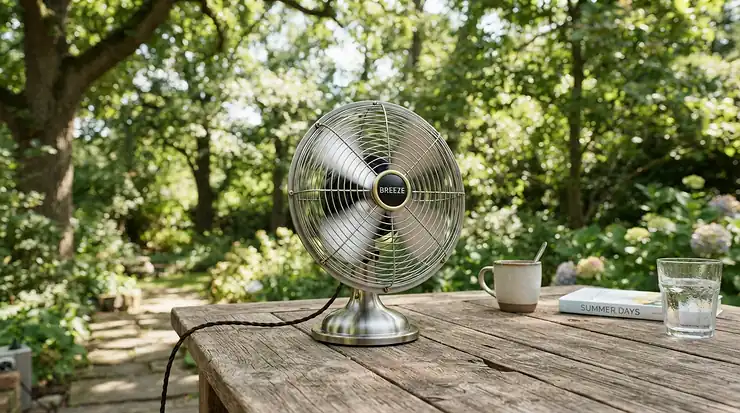
A solar camping fan is a portable, battery-backed fan that recharges, fully or partly, from a small photovoltaic panel built into the casing or attached by cable. It circulates air around your tent, awning or campsite, usually adds an LED lantern and USB power-bank output, and keeps running after sunset on stored charge.

The pitch is lovely: no plug, no petrol generator, no trudging to the hook-up point with a sleepy toddler. Just a fan, a lantern and a patch of sky. The catch is one you’ve already guessed, because you’re British. The sky doesn’t always cooperate. Britain logged its sunniest year on record in 2025, yet 2024 had been the dullest since 1998. Met Office figures for summer 2023 show sunshine finishing the season 6% above average thanks to a dazzling June. August then came in 8% under, with Wales a gloomy 21% down. That swing is why a solar camping fan needs sums, not slogans.
So this guide does the sums. I haven’t slept beside any of these seven fans, and I won’t pretend otherwise. Instead, I’ve compared manufacturer specifications, independent reviews and listing data. Then I’ve translated the numbers into what they mean on a soggy Saturday in the Lakes or a scorching Cornish weekend. Along the way you’ll see how a solar camping fan stacks up against a plain battery fan, what counts as a genuinely small solar fan for backpacking, and which solar power gadgets earn their weight. Think of it as renewable energy camping with the romance trimmed and the arithmetic left in.
Solar Camping Fan Quick Comparison Table
Short on time? Here are all seven picks side by side. Price ranges are indicative bands at the time of research, so check current price on the listing before you commit.
| Product | Panel Type | Battery | Approx. Weight | Price Range | Best For |
|---|---|---|---|---|---|
| Raddy CF3 | Built-in, 3W | 20,000mAh | 1.4 kg | £35-£50 | All-round tent use |
| VEVOR 10400mAh Solar Fan | Separate, 7W | 10,400mAh | 1.4 kg | £25-£40 | Budget buyers, shaded tents |
| Qardoz 26800mAh Portable Solar Fan | Detachable, 18W | 26,800mAh | Not stated | £40-£80 | Multi-day basecamps |
| Vilupvie 24000mAh Misting Fan | Built-in (reported ~5W) | 24,000mAh | ~2 kg | £60-£100 | Hot, dry car camping |
| ITEHIL Portable Solar Fan | Built-in | 10,000mAh | 1.8 kg | £70-£90 | Emergencies and camping |
| Astarama 20000mAh Dual-Panel Fan | Two panels | 20,000mAh | Check listing | £30-£50 | Faster top-ups |
| HOZVOMI Clip-On Solar Fan | Tiny built-in | 300mAh | Ultralight | Under £15 | Day walks, backpacking |
Read across and a pattern jumps out: the panel, not the fan, is usually the weak link. The Qardoz 26800mAh Portable Solar Fan pairs a big battery with an 18W panel, while the Raddy CF3 asks a 3W panel to refill a 20,000mAh cell, which takes several sunny days. Budget buyers should start with the VEVOR 10400mAh Solar Fan, whereas ultralight walkers should look only at the HOZVOMI Clip-On Solar Fan. Listings and bundles differ between Amazon stores, so confirm on amazon.co.uk that your chosen variant ships to your postcode.
💬 Just one click — help others make better buying decisions too!😊
Top 7 Solar Camping Fan Picks: Expert Analysis
A quick note on method. Battery sizes are quoted in mAh, but the useful figure is watt-hours: multiply mAh by 3.7, then divide by 1,000. So 20,000mAh is about 74Wh. Divide that by a panel’s watts and you get the hours of perfect sun a full refill needs. Keep that sum in your pocket, because it decides almost every verdict below.
1. Raddy CF3 — best all-rounder with a built-in panel
The standout is how much the Raddy CF3 crams into one housing: a 3W panel, a 20,000mAh battery, USB-C charging and a 90° oscillating head. Six speeds and three light colours let it be a tent-ceiling breeze at midnight and a warm lantern at supper. The maker quotes 8-46 hours of fan-only running, or 7-8 hours with everything switched on. At roughly 1.4 kg, it’s car-camping weight rather than rucksack weight.
Here’s what the spec sheet won’t shout. That 74Wh battery needs around 25 hours of perfect, rated-output sun from a 3W panel. The 46-hour low-speed figure works out at roughly 1.6W of draw, so on gentle settings the panel can nearly keep pace in full sun. On higher speeds it can’t. Treat USB-C as your main charging route and solar as a bonus.
I couldn’t find a deep pool of independent long-term reviews for this model, so read the runtime figures as best-case numbers rather than promises.
Pros:
- ✅ Six speeds plus oscillation for tent-wide airflow
- ✅ Doubles as a power bank for phones
- ✅ Solar, battery or USB-C power options
Cons:
- ❌ The 3W panel is a trickle charger at best
- ❌ At 1.4 kg, too heavy for backpacking
Price range: around £35-£50 at the time of research, a fair verdict for a tent fan that doubles as a power bank, provided you don’t expect solar to do the heavy lifting.

2. VEVOR 10400mAh Solar Fan — best budget setup with a separate panel
What sets the VEVOR 10400mAh Solar Fan apart is that its 7W panel is separate, on a bracket and a cable, rather than glued to the back of the fan. That matters more than it sounds. A fan hanging inside a tent can’t see the sun, but a detachable panel can sit on a pitch-side chair while the fan works in the shade.
The listing data gives model code F910B, an 8-inch (20 cm) fan, four speeds and a maximum airflow of 4.5 m/s, which is a proper breeze at arm’s length. The 10,400mAh cell is about 38Wh, so the 7W panel needs roughly five and a half hours of perfect sun to refill it. That’s a far healthier ratio than the Raddy CF3‘s, and realistic over a sunny day or two. Sellers of this 10,400mAh class claim 8-36 hours of running, so assume the top end applies only on low speed. At around 1.4 kg it’s heavier than the capacity deserves.
Reviewers on retailer listings for this class of fan generally call the included panel handy and decent value. A few mention improvising a mount for it, and some admit they haven’t yet tried the solar charging, which is telling in itself.
Pros:
- ✅ Detachable 7W panel can sit in sun while the fan stays shaded
- ✅ 4.5 m/s airflow figure is brisk for a tent
- ✅ Remote and Type-C cable included
Cons:
- ❌ Heavy at 1.4 kg for such a small battery
- ❌ 10,400mAh runs out quickly on high speed
Price range: around £25-£40, a strong value verdict for anyone who will actually leave the panel in the sun.
3. Qardoz 26800mAh Portable Solar Fan — best for serious solar top-ups
Big battery, big panel: the Qardoz 26800mAh Portable Solar Fan is for people who want solar to genuinely matter. Its foldable, detachable 18W panel feeds a 26,800mAh battery of about 99Wh. A full refill therefore needs roughly five and a half hours of ideal sun, the best panel-to-battery ratio on this list. Sellers quote up to 58 hours on the lowest of three speeds, and the 11-inch head pushes a healthy breeze. The panel also charges phones directly, a useful redundancy on a long weekend.
The honest caveat is bulk. An 11-inch fan, a large cell and a folding panel make boot-of-the-car kit, not day-pack kit. The same specification also appears under several brand names, so compare listings carefully and check the returns route.
Independent coverage from The Gadgeteer describes a pleasant breeze, enough speed range and quiet running. That reviewer also used it as a flashlight. Retailer averages for the near-identical spec I found sat in the mid-3-star range on a modest review count, which hints at some seller or unit-to-unit variation.
Pros:
- ✅ 18W detachable panel refills the battery quickly
- ✅ Huge battery suits multi-day basecamps
- ✅ Panel can charge phones directly
Cons:
- ❌ Bulky 11-inch fan plus folding panel
- ❌ Same spec sold under several brand names
Price range: around £40-£80 depending on seller, a good value verdict if you camp for four nights or more.
4. Vilupvie 24000mAh Misting Fan — best for hot, dry heat with a mist option
The Vilupvie 24000mAh Misting Fan bolts a 160ml water tank, a height-adjustable tripod and a solar panel onto a 24,000mAh battery (around 89Wh). The tripod stretches from roughly 90 cm to well over 1.5 m, so you can park a breeze over a hammock or camp chair instead of aiming up from the groundsheet. Six brightness levels and two light colours cover lantern duty, and there’s a remote and timer too.
One review outlet naming it a premium pick reports about 5W of solar input and roughly two full sunny days to refill from empty. Do the sum yourself: 89Wh at 5W is about 18 hours of ideal sun, so those figures are plausible but unforgiving in a typical British week. The mist is the real talking point. Evaporative cooling shines in dry heat, but in damp British air it adds little. Inside a tent it also invites condensation, so use it on the awning side, not the sleeping side.
That outlet praises the versatility and a 5-8 degree drop in perceived temperature, while flagging weight and price. It’s a single source, so hold it lightly.
Pros:
- ✅ Tripod lifts airflow overhead for chairs and hammocks
- ✅ Mist adds evaporative cooling outdoors
- ✅ Large 24,000mAh battery for long stays
Cons:
- ❌ Around 2 kg, strictly car-camping territory
- ❌ Mist does little in humid British weather
Price range: around £60-£100, a pricey verdict that only makes sense if you chase genuinely hot, dry spells.
5. ITEHIL Portable Solar Fan — best self-contained premium build
The party trick of the ITEHIL Portable Solar Fan is being one tidy slab. Panel, battery, fan and USB output share a single case, so nothing dangles, tangles or gets left in the car. A prepper-focused review site lists a 10,000mAh battery (about 37Wh), five speeds including a pulse mode, a three-position pivot, 2.7 m/s peak airflow and 10-24 hours of running. It weighs 64 oz, about 1.8 kg, and measures roughly 4 × 11 × 12.5 inches.
On paper, that’s a modest battery for the weight and money, so you’re paying for integration and build. At around 60 dB on high it’s roughly conversation-loud, which means low speeds for sleeping. That same reviewer found the controls intuitive and the construction solid, and noted good performance in high heat. They also flagged the lack of any charge indicator and a pulse mode that was more distracting than useful.
Based on the spec comparison, it suits anyone wanting one grab-and-go unit for the tent, the garage and the next power cut.
Pros:
- ✅ Single-unit build, nothing to lose or tangle
- ✅ Intuitive three-button controls
- ✅ USB-A output tops up phones
Cons:
- ❌ No battery or charging indicator
- ❌ Premium price for only 10,000mAh
Price range: around £70-£90, a fair-but-not-cheap verdict that rewards simplicity over capacity.
6. Astarama 20000mAh Dual-Panel Fan — best for faster top-ups from two panels
Two panels beat one, at least in theory, and that’s the pitch of the Astarama 20000mAh Dual-Panel Fan. The Amazon UK listing describes a 20,000mAh battery (about 74Wh), twin solar panels, four speeds, an oscillating head, a timer, a flashlight and a digital display. That display solves one of the ITEHIL Portable Solar Fan‘s frustrations: you can keep tabs on the battery instead of guessing at 2 a.m.
The catch is that the listing title doesn’t give panel wattage, and wattage is everything. Two 3W panels would add up to 6W and need around twelve hours of ideal sun. Two 10W panels would be a different story. Check the full specification before ordering, and expect to angle the panels toward the sun rather than leaving the fan casually on the grass.
I couldn’t find independent reviews or aggregated customer feedback I’d trust for this model, so sentiment is unverified. Treat it as a spec-led mid-range gamble that deserves a close read of the listing.
Pros:
- ✅ Dual panels increase sun-collecting area
- ✅ Digital display for keeping tabs on the battery
- ✅ Oscillating head covers a whole tent
Cons:
- ❌ Panel wattage isn’t clear from the title
- ❌ Little independent review data to lean on
Price range: around £30-£50, a reasonable value verdict if the full listing confirms a decent panel rating.
7. HOZVOMI Clip-On Solar Fan — lightest option for backpacking
Most solar camping fans are really small power stations with a propeller. The HOZVOMI Clip-On Solar Fan is the opposite. It’s a palm-sized personal fan, about 7.5 cm tall, that clips to a cap, rucksack strap or pole at an adjustable 45° angle. It runs on a 300mAh battery with three speeds, and in solar mode it starts automatically when sunlight hits the panel. Plug in USB for about half an hour and the listing promises up to three hours of use.
That makes it a legitimate small solar fan for backpacking, with caveats. Solar mode is essentially direct drive: sun on, fan on; cloud over, fan off. A drizzly British day turns it into a very small ornament. It’s a face-and-neck breeze, not a tent cooler, and 300mAh (about 1.1Wh) means the USB backup is a brief rescue, not a plan. The upside is negligible pack weight and a trivial price.
The listing I found had no ratings yet, so there’s no customer sentiment to summarise. Marketplace delivery windows for gadgets like this often run to a week or two, so order well before your trip.
Pros:
- ✅ Feather-light clip for hat or rucksack strap
- ✅ Starts automatically in sunlight
- ✅ USB charging for cloudy days
Cons:
- ❌ Tiny 300mAh battery means roughly three hours per charge
- ❌ Personal breeze only, not tent cooling
Price range: under £15, a no-regret impulse buy for day walks, though no substitute for a proper tent fan.
Spec Snapshot: What the Numbers Say
| Product | Claimed Runtime | Panel Rating | Standout Extra | Best For |
|---|---|---|---|---|
| Raddy CF3 | 8-46 h fan-only (maker) | 3W | 90° oscillation, power bank | Tent comfort with USB-C backup |
| VEVOR 10400mAh Solar Fan | 8-36 h (seller claim) | 7W | Remote included | Shaded tents, tight budgets |
| Qardoz 26800mAh Portable Solar Fan | Up to 58 h on low (seller) | 18W | Panel charges phones | Long weekends off-grid |
| Vilupvie 24000mAh Misting Fan | Not firmly stated | ~5W (reviewer-reported) | Misting and tripod | Hot, dry basecamps |
| ITEHIL Portable Solar Fan | 10-24 h (reviewer-listed) | Not stated | USB-A output | Outages and camping |
| Astarama 20000mAh Dual-Panel Fan | Not stated | Two panels, wattage unstated | Digital display | Quick top-ups |
| HOZVOMI Clip-On Solar Fan | ~3 h per USB charge | Tiny panel | Hat and strap clip | Day hikes, backpacking |
Two lessons fall out of this table. Claimed runtimes almost always describe the lowest speed, so expect far less when you turn the fan up. And on paper, only the VEVOR 10400mAh Solar Fan and the Qardoz 26800mAh Portable Solar Fan can refill inside a day or two of decent sun. The rest are really battery fans with a solar bonus.
✨ Ready to Pick Your Perfect Fan?
🔍 Click on any highlighted product name above to check current pricing and availability. Match the panel to the battery, think about how far you’ll carry it, and you’ll stay cool on your next trip without a generator droning next door. 🏕️
How to Set Up and Look After Your Solar Camping Fan: A First-30-Days Guide
Amazon listings tell you what a fan does. They rarely tell you how to get the best from it, so here’s a practical first-month routine.
- Charge by USB-C before the trip. A solar-only first charge can take days. Start every trip full and treat sunshine as the top-up.
- Put the panel, not the fan, in the sun. With integrated models such as the Raddy CF3 or ITEHIL Portable Solar Fan, stand the unit outside on a dry surface during the day and re-aim it every couple of hours. With detachable panels (the VEVOR 10400mAh Solar Fan, Qardoz 26800mAh Portable Solar Fan), run the cable under a vent flap and keep the fan indoors.
- Hang it high, aim it at vents. One reviewer’s tent advice is to circulate air through the rainfly gap and vents rather than blast yourself directly. That keeps the whole tent drier as well as cooler.
- Use low speed plus the timer overnight. Most of the runtime in the specs lives on the lowest setting.
- Wipe the panel and cover the ports. A damp cloth after dusty trips and a scrap of tape over USB ports do more than any accessory.
Common first-month mistakes include leaving the fan in a sealed car on a hot day, forgetting the timer, and storing it flat at 0%. Most battery makers advise storing lithium cells around half charge in a cool, dry place.
Real-World Scenarios: Matching a Solar Camping Fan to Your Trip
Specs only matter once you picture your own trip. Here are three hypothetical profiles, each with a budget, a setting and a suggested match.
The festival camper (four nights, small tent, budget under £40). Tents turn into saunas by 8 a.m. once the sun hits the fabric. The VEVOR 10400mAh Solar Fan suits this well, since its separate panel can sit on a guy-line chair while the fan hangs in the shade. Add a power bank for night-time insurance.
The family week in Cornwall (five people, six-person tent, budget £60-£100). Seven nights is long enough for solar to pay off. The Qardoz 26800mAh Portable Solar Fan gives you an 18W panel and a large battery, and it can top up tablets during a wet afternoon. If you’ll be sitting under an awning in dry heat, the Vilupvie 24000mAh Misting Fan adds mist, but expect little help from it in humid air.
The solo summer walker (three days, rucksack only, budget under £20). Weight is the enemy. The HOZVOMI Clip-On Solar Fan gives a clip-on breeze for walking breaks at a trivial weight, with USB as backup for cloudy days. It’s a morale gadget, not a sleep aid. Frequency of use matters too: a weekend-only camper may never earn back the cost of a premium fan, whereas a seven-night-a-summer camper certainly will.
Five Common Solar Camping Fan Problems and How to Fix Them
Problem 1: The sun hides and the battery sulks. Carry a USB-C power bank, use low speed with the timer, and top up the fan from the bank during dull spells. Think of solar as the bonus, not the guarantee.
Problem 2: The tent still feels muggy. A fan only moves air; it doesn’t cool it. Place it by a vent so it exchanges warm air for cooler outside air, and don’t point the mist from a Vilupvie 24000mAh Misting Fan inside the sleeping area, where it may add condensation.
Problem 3: It’s too noisy to sleep. Noise often rises sharply on high; the ITEHIL Portable Solar Fan reaches about 60 dB there. Choose low or medium and set a timer so the fan stops once you’ve dropped off.
Problem 4: The panel can’t keep up. If you’re stuck with a 3W panel, as on the Raddy CF3, add a separate foldable 10-20W USB panel. The detachable 18W design of the Qardoz 26800mAh Portable Solar Fan shows how much faster a bigger panel refills.
Problem 5: It flops, slides or won’t point where you want. Use the hook, tripod or clip that comes with the fan. The Astarama 20000mAh Dual-Panel Fan and the Raddy CF3 both offer oscillation, which spreads airflow without constant re-aiming.
How to Choose a Solar Camping Fan
To choose a solar camping fan, match the panel’s wattage to the battery’s watt-hours, decide whether you want a detachable panel, confirm airflow and noise figures, and weigh the whole kit against how you camp. Here’s the seven-step version:
- Do the watt-hour sum. Multiply mAh by 3.7, divide by 1,000, then divide by the panel’s watts. That’s roughly 25 hours of perfect sun for the Raddy CF3 (74Wh ÷ 3W) and about 5.5 for the Qardoz 26800mAh Portable Solar Fan (99Wh ÷ 18W). Real life takes longer, because rated watts assume ideal conditions and even a silicon cell’s theoretical ceiling is only about a third of incoming sunlight, according to Energy Education’s photovoltaic cell explainer.
- Pick your panel style. Integrated panels are tidy but must sit in the sun with the fan; detachable panels let the fan stay in the shade.
- Check airflow in metres per second. Figures like 4.5 m/s (VEVOR 10400mAh Solar Fan) or 2.7 m/s (ITEHIL Portable Solar Fan) are comparable. Adjectives like “powerful” aren’t.
- Check noise. Sleepers should look for roughly 30 dB or less on low.
- Weigh the kit honestly. Anything near 1.4 kg or more is car-camping gear.
- Think about mounting. Hooks, tripods and clips decide where the breeze actually lands.
- Look for a charge display and USB output. You’ll want to see the battery level and rescue a phone.
Skip step one and you may buy a very optimistic night light.
Solar Camping Fan vs Battery Fan: Which Is Smarter for UK Trips?
The solar camping fan vs battery fan debate is less ideology and more arithmetic. Take one review outlet’s discharge figures for a 20,000mAh battery fan, the VOSFEEL 20000mAh: about 58 hours on low and 12 on turbo. Spread 74Wh across those hours and you get a draw of roughly 1.3W on low and about 6W on turbo.
Now compare panels. A 3W panel like the Raddy CF3‘s can nearly cover low-speed running in full sun but never turbo. An 18W panel, like the Qardoz 26800mAh Portable Solar Fan‘s, can power the fan flat out and charge the battery at the same time. For a two-night festival, a plain battery fan plus a power bank is lighter, cheaper and has fewer things to lose. Beyond three or four nights off-grid, a solar camping fan starts paying its way. And if your pitch has an electric hook-up, a mains-charged battery fan wins on simplicity.
| Factor | Solar Camping Fan | Battery or Power-Bank Fan |
|---|---|---|
| Off-grid recharge | Yes, slowly, weather permitting | Only via power bank |
| Typical weight | Heavier (panel and bigger case) | Lighter for the same runtime |
| Dull-day behaviour | Needs USB backup | Unaffected |
| Upfront cost | Higher | Lower |
| Best For | Multi-day pitches, e.g. Qardoz 26800mAh Portable Solar Fan | Short trips and festivals, e.g. VOSFEEL 20000mAh |
The table confirms that solar buys independence at the price of weight and cost. If you camp mostly on serviced sites or for a weekend, a battery fan is the rational choice. If you wander further or stay longer, the solar variant becomes a genuine convenience rather than a gimmick.
Small Solar Fan for Backpacking: Weight, Reality and Gear Strategy
What a small solar fan for backpacking can and can’t do
Let’s be blunt: the camping-size picks in this guide, at 1.4-2 kg, can weigh as much as a lightweight one-person tent. For walking trips, a small solar fan for backpacking has to be a personal gadget, not a tent cooler. That’s the role of the HOZVOMI Clip-On Solar Fan: clipped to a strap in sun, it gives a face-and-neck breeze for almost no weight. Its direct-drive solar mode only works while the sun is out, so for cloudy days you want a rechargeable alternative.
One option is a rechargeable personal fan such as the Tunise Portable Fan (4,000mAh, about 6.9 oz). A reviewer reports 4-18 hours of runtime, though the top-speed claim fell short in testing. Charged by a small foldable panel or power bank, it’s a more dependable breeze than a tiny solar clip.
Backpacking gear: the weight-budget test
Good backpacking gear earns its place by solving a problem you actually have. Ask whether heat is genuinely your biggest comfort issue. If so, spend grams on the fan; if not, a wet buff and a shady lunch stop are free. Count the fan, any cable, and the power bank you’d need for it, not just the headline weight. When in doubt, take the lighter option and leave the tent fan for car camping.

Solar Power Gadgets That Pair Well With a Solar Camping Fan
A fan is rarely the only thing on a campsite that wants electrons, so it’s worth thinking about the wider ecosystem of solar power gadgets.
Foldable panels
A separate 10-20W USB panel is the most useful solar power gadget for fan owners. It lets you charge a fan whose built-in panel is too small, such as the Raddy CF3, and your phone too. The Qardoz 26800mAh Portable Solar Fan shows the idea in a bundle, with its 18W detachable panel.
Power banks and lanterns
A decent USB power bank is the cloudy-day insurance policy for every fan in this list. Solar lanterns and head torches are the other sensible additions, because they stop you draining the fan’s battery for light.
When to go bigger
Manufacturers such as Anker market 100-200W panels paired with power stations (for example the Anker SOLIX C1000 Gen 2) for UK camping and festivals. That’s sensible if you also want to run a kettle or a laptop, but it’s overkill for a fan alone. A fan draws somewhere between 1W and 6W, so a modest panel and a good battery are plenty.
Renewable Energy Camping: Is a Solar Fan Genuinely Greener?
Renewable energy camping sounds virtuous, and in one respect it is: a solar camping fan lets you leave the generator, and its noise and fumes, at home. But let’s keep the claim honest. A fan only draws a watt or a few, so the energy it uses is tiny whichever way you charge it. The bigger environmental cost sits in manufacturing the lithium battery, panel and plastic case.
That changes the green calculation. The most sustainable fan is the one you use for many summers rather than the shiniest new gadget. A fan that gets used on 30 nights spreads its manufacturing footprint thinly; one that lives in a cupboard does the opposite.
If you want renewable energy camping with real impact, think about the whole kit. Choose rechargeable over disposable D cells where you can, buy from sellers with sensible returns and warranties, and recycle old batteries properly. Solar helps, but longevity helps more.
Features That Actually Matter (And Those That Don’t)
What matters
- Panel-to-battery ratio. It decides whether solar is a real recharge or a token gesture.
- Quiet low speed. You’ll spend most nights there.
- Mounting. A hook, clip or tripod puts the air where you want it.
- A charge display and USB output. You can see what’s left and rescue a phone.
What doesn’t
Headline mAh figures matter less than the ratio above. Aromatherapy pads, SOS strobes and extra light colours are pleasant but rarely decisive. Neither is a fan’s “speed count” if the top speeds drain the battery in a morning.
A note on what a fan actually does
A fan moves air; it doesn’t cool it. A Cochrane review of electric fans in heatwaves concluded that the available evidence neither supports nor refutes their use during heatwaves, because studies pointed in different directions. So think of a camping fan as a comfort tool for sleeping and sitting about, not as a medical device. It makes a muggy night more bearable by helping sweat evaporate and swapping stale tent air for fresher air.
Long-Term Cost and Maintenance
A solar camping fan costs more upfront than a basic battery fan, so does it earn its keep? Do the sums on a £40 fan used on eight nights a summer for four summers. That’s 32 nights, or roughly £1.25 a night. Disposable D cells, by contrast, are a recurring cost for fans that rely on them.
Battery life
Built-in rechargeable cells lose capacity gradually. One reviewer notes that they typically manage several hundred charge cycles before any measurable impact, and that the fan then simply holds less charge rather than dying outright. A weekend camper charging once a trip could be waiting a very long time.
Looking after it
- Wipe the panel with a damp cloth after dusty trips.
- Keep USB ports covered from sand and moisture.
- Store at around half charge, cool and dry, over winter.
- Top up every couple of months if it’s sitting idle.
The cost verdict comes down to usage. Frequent campers will find even the pricier ITEHIL Portable Solar Fan or Vilupvie 24000mAh Misting Fan justifies itself, while occasional campers are better served by the cheaper VEVOR 10400mAh Solar Fan.
Safety, Regulations and Heat: What UK Campers Should Know
Product safety
Look for a CE or UKCA marking and a seller with a clear UK returns route. Seller-quoted certifications aren’t the same as independent testing, so favour listings that give full specifications. Never charge a fan inside a sealed bag or leave it baking in a closed car. If a battery swells, smells hot or gets damaged, stop using it.
Travelling with batteries
Airlines set their own rules on power banks and lithium batteries, usually requiring them in hand luggage. Check your airline before flying with a battery-backed fan.
Heat awareness
A camping fan is not a cure for overheating. The NHS guidance on heat exhaustion and heatstroke says heat exhaustion doesn’t usually need emergency help if you can cool down within 30 minutes, but heatstroke is an emergency. It also advises checking on children, older people and anyone with long-term health conditions, who are at higher risk. If someone is dizzy, confused or stops sweating, treat it seriously rather than reaching for the fan.

FAQ
❓ How long does a solar camping fan take to charge in UK weather?
❓ Can a solar camping fan run all night?
❓ Can a solar camping fan charge my phone?
❓ How heavy is too heavy for a small solar fan for backpacking?
❓ Will a solar camping fan charge through a tent window or on a cloudy day?
Conclusion
A solar camping fan is a brilliant idea with one honest limitation: the panel rarely matches the ambition of the battery. Choose by the sums, not the slogans.
Here are the verdicts in brief. The Raddy CF3 is the best all-rounder if you’ll mostly charge by USB-C. The VEVOR 10400mAh Solar Fan is the sensible budget buy thanks to its detachable 7W panel. The Qardoz 26800mAh Portable Solar Fan is the pick for multi-day pitches where solar must genuinely refill the battery. The Vilupvie 24000mAh Misting Fan suits hot, dry basecamps, the ITEHIL Portable Solar Fan suits those who value a single tidy unit, and the Astarama 20000mAh Dual-Panel Fan is a spec-led gamble worth checking closely. For walkers, the HOZVOMI Clip-On Solar Fan is the featherweight option.
Whichever you choose, pair it with a power bank, aim the panel at the sun and keep expectations rooted in watt-hours. That’s renewable energy camping with the romance trimmed and the comfort intact.
Recommended for You
- Battery Cooler For Van Life: 7 Best Picks For UK Vans (2026)
- Battery Powered Cooler For Camping: 7 Best Picks For UK (2026)
- Tent Fan With Light: 7 Brilliant Picks For UK Camping (2026)
Disclaimer: This article contains affiliate links. As an Amazon Associate, I earn from qualifying purchases. If you purchase products through these links, we may earn a small commission at no additional cost to you.
✨ Found this helpful? Share it with your friends! 💬🤗
