
In This Article
A tent fan with light is a compact, battery-powered fan with a built-in LED lantern, designed to hang from a tent ceiling or stand on the groundsheet. It keeps air moving to ease stuffiness while lighting your pitch, so one rechargeable unit replaces a separate fan and torch on every trip.
Here’s the thing about a British summer. You get four days of drizzle, then one afternoon at 28°C when your tent turns into a polytunnel. Nylon traps heat and breath adds humidity, and by 6 am you’re awake, sticky and cross with the sunrise. A fan can’t cool the air, but moving air helps sweat evaporate, and that’s often the difference between a restful night and a grim one. It’s also worth knowing the warning signs the NHS lists for heat exhaustion and heatstroke, such as headache, dizziness and intense thirst, because a hot tent is a surprisingly good place to overheat.
This guide covers seven real models, from budget to premium. It looks at what a rated battery tent fan can and can’t deliver, and how to set up a hanging tent fan for camping. It also covers how tent fans for festivals cope when you’re pitched shoulder to shoulder with strangers. Along the way, it tackles safety, the camping lantern question, and the wider appeal of multi-function camping gear.
One honesty note. Everything below comes from manufacturer specs, independent test write-ups and aggregated buyer feedback. I haven’t personally used these fans, and I won’t pretend otherwise. Prices are ranges only, so check current price before buying.
Quick Comparison: Which Tent Fan with Light Fits You?
| Product | Rated Battery | Light Output | Price Range | Best For |
|---|---|---|---|---|
| Nitecore NEF10 | 10,000mAh | 34–124 lumens (independently measured) | Around £50 | Quiet sleepers, families |
| FRIZCOL 3-in-1 | 24,000mAh | 2 brightness levels | £40–£50 range | Long off-grid trips |
| Socool 20000mAh | 20,000mAh | LED, modes vary by variant | £35–£55 (indicative) | Big cabin tents |
| Maxesla | Around 10,400mAh | 4 light modes | £25–£35 range | All-round value |
| Odoland | 10,000mAh | Up to 150 lumens (listed) | £20–£30 range | Tight budgets |
| Amacool F120 | 5,000mAh | Up to 75 lumens (listed) | £20–£30 range | Solo and small tents |
| Coleman CPX 6 | 4 × D cells | 99 lumens (listed) | Under £35 plus batteries (indicative) | Trips with no charging |
On paper, the Nitecore NEF10 is the refined choice, while the FRIZCOL 3-in-1 wins on sheer battery stamina. If money is tight, the Odoland and Amacool F120 keep the entry price low, though they trade away airflow or runtime. The Coleman CPX 6 is the odd one out, because its swappable D cells suit people who can’t plug in at all.
💬 Just one click — help others make better buying decisions too!😊
Top 7 Tent Fan with Light Options: Expert Analysis
1. Nitecore NEF10 — quietest airflow with a proper ring light
The Nitecore NEF10 feels designed rather than assembled: a five-blade brushless fan wrapped in an LED ring, standing on a ball-head tripod you can swap for a hook.
Its 10,000mAh battery is rated for up to 27 hours on low and about 8 hours on high, with airflow peaking at 4.0 m/s. In practice, one charge covers a weekend of low-speed nights, but a heatwave afternoon on full blast will want a top-up. At roughly 655 g it’s no ultralight, yet the detachable head and tripod pack down sensibly. The ring light has three levels, and an independent tester measured roughly 34 to 124 lumens. That’s soft, frosted light, better for bedtime reading than for lighting a whole pitch.
Based on the spec comparison, this suits couples and families in three- to four-person tents who value sleep over spectacle. The same tester found it noticeably quieter than the Coleman and Odoland units and reported airflow reaching around ten feet on high. It also doubles as a 10W power bank, which makes it a charging-station purchase as much as a fan purchase.
Review data is thin. The UK stockist page I found carried only a single review, so lean on the independent testing rather than star ratings. That tester’s main caution was to keep it out of heavy rain.
Pros:
- ✅ Noticeably quiet brushless motor at every speed
- ✅ Doubles as a 10W power bank
- ✅ Tripod, hook and handheld modes all included
Cons:
- ❌ Ring light is gentle, not floodlight-bright
- ❌ Not designed for heavy rain exposure
Price: around £50, which is the dearest here but fair if quiet matters most.

2. FRIZCOL 3-in-1 — a battery that outlasts the whole weekend
Two 12,000mAh cells give the FRIZCOL 3-in-1 the biggest rated battery in this round-up, and it ships with a remote.
Runtime claims vary wildly by retailer, from 11 to 60 hours on one listing to figures up to 140 hours elsewhere. Read those as best-case numbers. The sensible takeaway is that low speed will carry you through several nights, which matters when the nearest socket is a field away. It has four speeds, a two-level light and timer options, and the manufacturer claims noise below 30 dB. Treat that last figure as a claim rather than a measurement.
The remote is the quietly clever bit. Adjusting speed from your sleeping bag beats unzipping a tent in the cold, and it’s a genuine advantage for festival camping. It also works as a power bank for phones in a pinch.
Aggregated buyer feedback is positive on hanging, remote use and phone charging. Common criticisms are that it doesn’t oscillate, the swivel range is limited, the light can feel glaring at night, and airflow is gentler than bigger fans.
Pros:
- ✅ Huge 24,000mAh rated battery for multi-night trips
- ✅ Remote control and timer for hands-free use
- ✅ Power bank function for emergency phone top-ups
Cons:
- ❌ No oscillation and limited swivel range
- ❌ Light can be harsh in a dark tent
Price: £40–£50 range, which is good value per hour of battery.
3. Socool 20000mAh — the feature-packed pick for cabin tents
The Socool 20000mAh goes big: an 8.5-inch head, a digital display and auto-oscillation in one hang-or-stand unit.
Listings quote up to 112 hours at the lowest speed and eight speeds (with a natural-wind setting on some variants). Oscillation runs at 45° or 90°, with a 270° manual pivot, a hook, a timer and a remote. A wider head moves more air at a lower, quieter blade speed, which suits a six-person cabin tent where small fans give up. The display shows speed and remaining battery, so no more guessing whether it’ll last until morning. The trade-off is bulk, and a roughly ten-hour charge time per the listing.
Here the light is the supporting act, so check which variant you’re buying before assuming lantern-level brightness. That makes it less of a camping lantern replacement and more of a fan with mood lighting.
I couldn’t verify a deep body of UK reviews for this exact listing, so the picture is spec-led. Treat the quiet-running claims (listings mention levels as low as 20–30 dB) as manufacturer figures until independent testing says otherwise.
Pros:
- ✅ Oscillation covers an entire large tent
- ✅ Digital display shows battery at a glance
- ✅ Long claimed runtime on low speed
Cons:
- ❌ Bulkier and heavier than compact rivals
- ❌ Slow charge, roughly ten hours
Price: indicative £35–£55, so worthwhile only if you’ll use the oscillation and remote.
4. Maxesla — the practical, UK-listed all-rounder
The Maxesla keeps things refreshingly simple: a fan and lantern with separate controls, plus both a hook and a retractable stand.
Its roughly 10,400mAh battery gives about 8 to 36 hours according to a third-party UK roundup. That’s plausible for this capacity, with low speed at the long end and high at the short end. Four speeds and four light modes are controlled independently, so you can dim the light and keep the breeze going. The 360° foldable hook and the stand mean it works hanging, on a camping table or on a car boot floor. The listing claims a 30 dB noise level, with Type-C charging in and a USB port out for topping up devices.
For me, this is the safest recommendation for first-time buyers. It avoids gimmicks, it sits in the sensible mid-price bracket, and the separate controls mean you aren’t draining the battery on light you don’t need. That same roundup rates it around 4.5 out of 5, though that’s editorial scoring rather than a verified review average.
Pros:
- ✅ Separate fan and light controls
- ✅ Hook and retractable stand both included
- ✅ Type-C charging plus USB output for devices
Cons:
- ❌ Mid-sized airflow in larger tents
- ❌ Listing details vary between product versions
Price: £25–£35 range, a strong value verdict for first tents.
5. Odoland — the budget camping lantern with a fan attached
The Odoland rechargeable model is the low-risk entry point: 10,000mAh, a hook and a removable tripod for around the price of a pub lunch.
The listing quotes 27, 13 and 8 hours at low, medium and high speed, with a four-to-five-hour charge via USB-C. Those are the same battery-class numbers as the Nitecore NEF10. Three light modes top out at a listed 150 lumens, bright enough to read by or find the tent zip at midnight.
One caution matters here. Odoland also sells a D-battery version, and an independent tester scored that sibling just 6.3 out of 10, mainly for a harsh, glaring light and modest 5.8-foot airflow reach. So check you’re buying the rechargeable model, and treat that review as a warning about the cheap end of the market rather than this exact listing. A third-party UK roundup rates the rechargeable around 4.2 out of 5.
Pros:
- ✅ Hook and tripod give flexible mounting
- ✅ USB-C rechargeable with decent battery size
- ✅ Cheapest sensible entry point here
Cons:
- ❌ Only three speeds and basic controls
- ❌ Light quality can feel harsh
Price: £20–£30 range, good value for kids’ tents and trial runs.
6. Amacool F120 — featherlight hanging tent fan for camping
At around 320 g, the Amacool F120 is the lightest unit here and sized for backpacks rather than car boots.
The built-in 5,000mAh battery is rated at 5.5 to 40 hours depending on speed, and 147 to 440 hours on light alone. Three speeds, three brightness levels (max 75 lumens) and a rotating head round out the specs. A small cell means short high-speed runtime, so it’s a low-speed-overnight companion rather than a heatwave warrior. Charging takes around three to four hours, per the brand.
Honest take: perfect for solo campers, hikers and anyone in a one- or two-person tent. In a family tent it’ll feel underpowered, and its light is better for reading than for lighting up a pitch.
The UK listing showed roughly 4.6 out of 5 across more than a thousand ratings when I checked. Buyers praise its weight, quiet running and a light that’s bright on high but cosy on low.
Pros:
- ✅ Remarkably light and pack-friendly
- ✅ Quiet running that suits night use
- ✅ Hook rotates for flexible angles
Cons:
- ❌ Small battery limits high-speed runtime
- ❌ Weak for large family tents
Price: £20–£30 range, an excellent value verdict for solo trips.
7. Coleman CPX 6 — swappable D batteries and a magnetic mount
The Coleman CPX 6 Lighted Tent Fan is the veteran, built around four D cells in a battery cartridge and a clever magnetic plate that clamps through the tent fabric.
It has four 5 mm LEDs listed at 99 lumens, two fan speeds and soft foam blades, which parents will appreciate around curious fingers. Coleman claims 10 hours on high and 30 on low, and an independent tester logged about 25 hours on high with premium alkaline cells. The same tester disliked the weak airflow, the noise and the running cost of fresh D cells, scoring it 5.9 out of 10. Coleman’s own site shows about 4.1 out of 5 from 58 reviews.
So where does it fit? Its niche is the trip with no charging whatsoever, because you simply carry spare cells. Stock on amazon.co.uk can be patchy, so confirm availability first.
Pros:
- ✅ Magnetic mount fixes almost anywhere
- ✅ Swappable D cells need no charger
- ✅ Soft foam blades are child-friendlier
Cons:
- ❌ Weak airflow with only two speeds
- ❌ Ongoing cost of fresh D batteries
Price: indicative under £35 before batteries, a niche value verdict for no-charger trips.
How to Choose a Tent Fan with Light
- Match fan size to tent size. Small heads suit one- or two-person tents, while cabin tents need wider blades or oscillation.
- Read battery claims as best-case. Runtime is quoted at the lowest speed, so judge the figure you’ll actually use.
- Check the mounting. A sturdy hook, a stand and ideally a magnet or clip give you options when tent loops are awkward.
- Judge the light by quality, not lumens. Dimmable, frosted light beats a harsh blast, and independent testers criticised glare on some budget units.
- Listen for noise claims. Sleep is the whole point, so brushless motors and verified quiet running matter.
- Look for charging flexibility. USB-C in and a power bank output make the fan useful when your phone dies.
- Think about weather. Most units aren’t built for rain, so plan to hang them inside and keep them dry.
Features That Actually Matter (And Those That Don’t)
Marketing loves big numbers, so let’s separate signal from noise. The lumen is the SI unit of luminous flux, which measures perceived light output. It says nothing about how pleasant that light is. A 400-lumen glare in a small tent is worse than 100 soft lumens, so dimmable output matters more than the peak figure.
What matters: quiet running at low speed, a secure mounting method, honest battery capacity, separate fan and light controls, and a battery gauge so you know when you’re about to lose the breeze.
What doesn’t: eight-plus speed settings (you’ll use two), flashy colour modes, and headline runtimes of 100 hours you’ll never reach.
Use the Quick Comparison table above as a filter, then ask what you’ll use at 2 am rather than what looks impressive in a listing.
Rated Battery Tent Fan: What the mAh Numbers Really Mean
A rated battery tent fan advertises capacity in milliamp-hours, but that figure tells only half the story. A 10,000mAh cell at roughly 3.7 V stores about 37 watt-hours. The Nitecore NEF10 is rated at a maximum of 4 W, so a quick sum suggests around nine hours at full tilt, which matches an independent test that logged about nine hours on high. That’s useful arithmetic: bigger batteries and lower speeds are the only two levers on runtime.
| Product | Rated Capacity | Claimed Runtime | Reality Check |
|---|---|---|---|
| Nitecore NEF10 | 10,000mAh | 8 h high to 27 h low | Independent test matched the high-speed claim |
| FRIZCOL 3-in-1 | 24,000mAh | 11–60 h on one listing; up to 140 h elsewhere | Treat the top number as marketing |
| Socool 20000mAh | 20,000mAh | Up to 112 h on lowest speed | Expect far less on high |
| Maxesla | Around 10,400mAh | 8–36 h | Plausible for the capacity |
| Odoland | 10,000mAh | 8–27 h | Same class as the Nitecore |
| Amacool F120 | 5,000mAh | 5.5–40 h | Short on high speed |
| Coleman CPX 6 | 4 × D cells | 10 h high, 30 h low | Tester logged about 25 h on high |
Looking at the table, runtime claims cluster by battery size, with outliers explained by lowest-speed testing. If you only run a fan overnight on a gentle setting, the Amacool F120 will manage; for daytime blasts in a heatwave, the FRIZCOL 3-in-1 or Socool 20000mAh earn their size. Always compare the high-speed figure, because that’s where weak batteries show up.
Hanging Tent Fan for Camping: A Practical Setup Guide
A hanging tent fan for camping only works as well as its hang point. Here’s the routine that gets the most from any of the seven.
Pick the right loop. Use the ceiling loop or gear-loft hook near the centre of the tent. A hook with a carabiner backup beats a single dangling hook if the tent gets blustery.
Angle it across the sleeping area, not at your face. Aim diagonally so air sweeps the whole space and doesn’t blast one head. The Nitecore NEF10 and Socool 20000mAh both let you tilt and pivot, which helps here.
Keep it clear of the fabric. A swinging fan that taps the inner skin will annoy you more than the heat. Shorten the cord or tuck it to a pole.
Pair it with vents. A fan moves air but can’t replace ventilation. Open doors and vents slightly so stale, humid air has somewhere to go.
First-night test. Charge fully at home, try each speed, and learn which setting you’ll use after dark.
Maintenance. Wipe grilles with a dry cloth, check the hook for cracks, and store it away from heat. If you use the Coleman CPX 6, its magnetic plate sits on the outside of the fabric, so test the hold in wind.
Tent Fans for Festivals: A Real-World Scenario Guide
Tent fans for festivals face a different challenge from quiet-campsite use. Pitches are tight, nights are noisy, and sockets are scarce. The Oxfam Festivals packing list includes a tent light and a foil blanket to stop the tent overheating in the day, which hints at how real this problem is.
Profile 1: A couple at a three-day festival, no hook-up, camping with sleeping bags. Budget around £50, with high usage after dark. The FRIZCOL 3-in-1 suits them because the large battery and remote mean fewer unzipped doors, and it can top up a phone.
Profile 2: A solo traveller arriving by train with one rucksack. Weight and size rule. The Amacool F120 at roughly 320 g slips into a pocket, and low-speed overnight use fits its small battery.
Profile 3: A family of four at a weekend family festival. Mixed ages call for a safer design. The Coleman CPX 6 has soft foam blades, and a pack of spare D cells solves the charging problem.
Whichever you choose, check each festival’s rules on battery items and charging, since policies vary. Quiet matters twice over, because your neighbours are three metres away.
Common Tent Fan Problems and How to Fix Them
The fan dies at 3 am. You’ve probably run it on high. Use the timer on units that have one (the Nitecore NEF10 offers 1, 3 or 5 hours) and drop to low once the tent cools.
The hook sways and the light flickers. Add a carabiner or tie off the cord so the unit can’t swing. Hanging from a stiff pole loop is steadier than from fabric.
The light wakes neighbours. Dim it to the lowest setting or switch it off using the remote on the FRIZCOL 3-in-1. Separate controls on the Maxesla make this simple.
Your phone is flat on day two. Use the fan’s power bank output, but keep a reserve so you aren’t sacrificing the breeze.
Dust, damp or sand has got in. Wipe it dry, keep it off the ground, and bring it inside during rain. Most of these units aren’t built to be rained on.
Tent Fan with Light vs Camping Lantern: Which Do You Need?
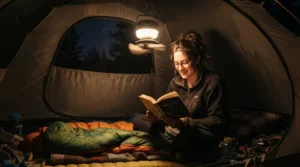
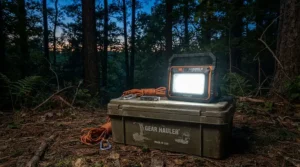
A dedicated camping lantern throws light in every direction and usually outshines a combo for cooking, card games or finding guy ropes. A tent fan with light, meanwhile, earns its place inside the tent by saving weight and a second battery to charge.
| Option | Strengths | Weaknesses | Best For |
|---|---|---|---|
| Tent fan with light (e.g. Nitecore NEF10) | One unit, light plus airflow, saves space | Light is softer than a lantern | Sleeping inside the tent |
| Camping lantern plus a separate clip fan | Brighter pitch lighting, more choice | Two batteries to charge, more weight | Cooking and evening socialising |
| Mains hook-up fan | Unlimited runtime | Needs an electric hook-up and cable | Campsites with a pitch socket |
| Vents only | Free, silent | No airflow on still nights | Cool nights |
The table shows why many campers carry both: a camping lantern for the pitch outside, and a combo fan inside the tent. If you can only carry one item, the combo is more useful in warm weather, while a lantern wins in cool, damp conditions where the fan sits idle.
Multi-Function Camping Gear: Is a 3-in-1 Fan Worth It?
Multi-function camping gear promises to save weight, and a fan with a light and a power bank can genuinely do that. Three jobs in roughly 650 g (the Nitecore NEF10) beats three separate gadgets, and one USB-C cable charges everything.
The catch is shared dependency. If the light drains the battery, your fan stops, and if you charge a phone from it, you lose cooling hours. A sensible rule is to treat the power bank as an emergency feature rather than a daily one.
Choose multi-function camping gear when you’re limited on space, such as festival camping or train travel. Otherwise, separate devices give you redundancy. The Maxesla and FRIZCOL 3-in-1 both offer device charging, but I’d still pack a dedicated power bank for longer trips.
Festival Camping Safety, Rules and Compliance
Lithium-ion cells are safe in normal use, but the fire service is clear that damaged or abused batteries are a real risk. Guidance from Humberside Fire and Rescue on lithium-ion batteries advises against charging while you sleep, on escape routes, or while covered. It also suggests avoiding very hot or cold storage and buying from reputable sources.
Applied to a tent, that means a few simple habits. Charge before you go, or in a vehicle or open space while you’re awake, and never under a sleeping bag. Keep the fan away from fabric when running on high, and don’t leave it baking on a dashboard. Look for UKCA or CE marking and the correct charger, and avoid unbranded, unmarked units.
For festival camping specifically, check your festival’s rules on batteries and power use before you pack. Dispose of old cells at proper recycling points, never in household bins.
Long-Term Cost and Maintenance
A rechargeable fan costs more up front but little to run, whereas D-cell models like the Coleman CPX 6 keep charging you in fresh batteries. Over a few seasons, USB-rechargeable units usually pull ahead.
| Product | Price Bracket | Running Cost | Value Verdict |
|---|---|---|---|
| Nitecore NEF10 | Around £50 | Free after charge | Best for quiet quality |
| FRIZCOL 3-in-1 | £40–£50 | Free after charge | Best battery value |
| Socool 20000mAh | £35–£55 (indicative) | Free after charge | Fair if you use the extras |
| Maxesla | £25–£35 | Free after charge | Strong mid-range |
| Odoland | £20–£30 | Free after charge | Cheapest sensible entry |
| Amacool F120 | £20–£30 | Free after charge | Great for small tents |
| Coleman CPX 6 | Under £35 plus batteries | Recurring D cells | Niche, no-charger trips |
Reading across, the cheapest unit isn’t automatically the best value, because a fan that’s too weak for your tent gets left at home. For upkeep, charge lithium cells every few months if stored, keep them cool and dry, and wipe the blades before packing away. Treat a fan like any other camping kit and it’ll last several seasons.
Frequently Asked Questions
❓ How long will a 10,000mAh tent fan with light run overnight?
❓ Can a tent fan with light charge my phone at a festival?
❓ Is it safe to leave a tent fan with light running while I sleep?
❓ Will a rated battery tent fan work in the rain?
❓ What's the best hanging tent fan for camping in a small tent?
Conclusion
Choosing a tent fan with light comes down to three questions. How big is your tent, how long are you off-grid, and how much does sleep matter to you?
For quiet, quality airflow and a handy power bank, the Nitecore NEF10 is the one I’d lean towards. For the longest rated battery, the FRIZCOL 3-in-1 is hard to beat, while the Socool 20000mAh suits big cabin tents that need oscillation. The Maxesla is the safe all-rounder, and the Odoland keeps costs low. The Amacool F120 is the featherlight choice for solo trips, and the Coleman CPX 6 is for no-charger adventures.
Remember the practical rules too. Treat battery claims as best-case, hang your fan sensibly, charge safely, and check festival rules before you pack.
✨ Ready to Cool Down Your Campsite?
🔍 Take your next trip to the next level with these carefully selected products. Click on any highlighted product name to check current pricing and availability, and pick the tent fan with light that fits your tent, your budget and your sleep!
Recommended for You
- Tent Fan Vs Clip-On Fan: 7 Honest Picks For UK Camping (2026)
- Portable Cooler For Family Camping: 7 Proven Picks (2026)
- Camping Cooling Devices: 7 Best Picks To Beat The Heat (2026)
Disclaimer: This article contains affiliate links. As an Amazon Associate, I earn from qualifying purchases. If you purchase products through these links, we may earn a small commission at no additional cost to you.
✨ Found this helpful? Share it with your friends! 💬🤗
