
In This Article
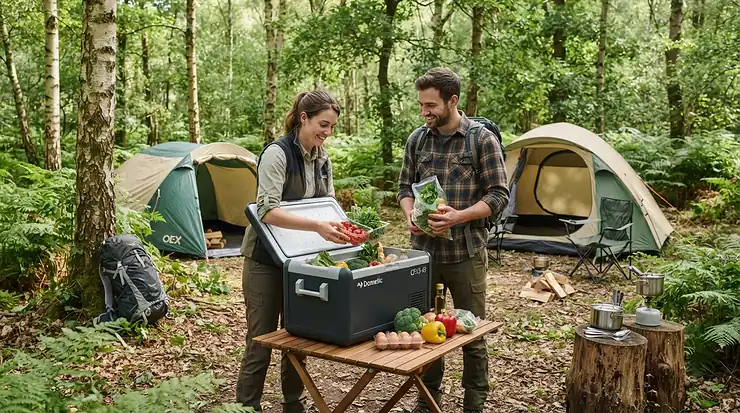
A battery powered cooler for camping is an electric cool box or portable fridge that runs from its own rechargeable battery, a 12V vehicle socket or a portable power station instead of relying on ice. Compressor models refrigerate to a set temperature, while thermoelectric models chill to a fixed gap below the surrounding air.
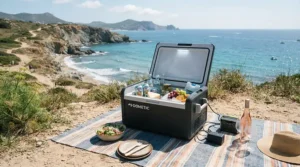
Ice is a sprint. A bag of cubes gives you a glorious first evening and a puddle of lukewarm sausages by Sunday lunch. A well-chosen battery powered cooler for camping runs a marathon instead. It keeps the butter firm, the milk safe and the burgers on the right side of bacteria for the whole trip.
The catch is that “battery powered” means different things on different product pages. Some coolers carry their own battery. Others only run from a 12V socket. Cheaper ones use thermoelectric cooling, the Peltier effect, which can only chill to a set number of degrees below the outside air. A compressor is a miniature fridge engine. It will hit 2°C on a 30°C afternoon, provided you can feed it.
This guide compares seven real models using manufacturer specifications, independent editorial tests and published owner feedback. I haven’t tested any of them myself, so what follows is spec-led analysis, not a hands-on diary. We’ll also untangle battery camping cooler vs cool box, battery powered cool boxes, the portable fridge question and camping food storage, so you can buy once and buy right. Prices are ranges only, so check current prices before you buy.
Quick Comparison: Battery Powered Cooler for Camping at a Glance
| Product | Cooling Type | Capacity | Power Source | Best For |
|---|---|---|---|---|
| Anker Solix EverFrost 2 40L | Compressor | 40L | Removable 288Wh battery, 12V, mains, solar | Off-grid weekends |
| EcoFlow Glacier | Compressor + ice maker | 38L | Separate 297Wh battery, 12V, mains, solar | Gadget fans with deep pockets |
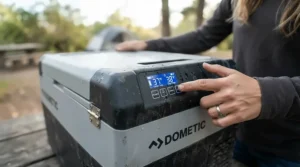
| Dometic CFX3 35 | Compressor | 36L | 12/24V and 230V (no built-in battery) | Vans and long trips |
| Alpicool TWW35 | Compressor, dual-zone | 35L | Removable 173Wh battery, 12/24V, mains | Mid-budget battery-first camping |
| Alpicool K25 | Compressor | 25L | 12/24V and mains | Couples and car campers |
| Mobicool MT35W | Thermoelectric | 34L | 12V and 230V | Cool-weather family trips |
| Mobicool ME 26 AC/DC | Thermoelectric | 26L | 12V and 230V | Short trips on a tight budget |
Only the Anker Solix EverFrost 2 40L, the EcoFlow Glacier (with its optional pack) and the Alpicool TWW35 carry their own batteries. The other four need a 12V socket, a leisure battery or a power station, which matters if you pitch far from a hook-up. The best value depends on where you camp. The Alpicool K25 gives the strongest cooling per pound, while the Mobicool ME 26 AC/DC is the cheapest way in, provided your summers stay mild.
💬 Just one click — help others make better buying decisions too!😊
Top 7 Picks for a Battery Powered Cooler for Camping: Expert Analysis
The list runs from premium to budget. Each entry covers what the specification means in practice, who it suits and what owners and reviewers report.
1. Anker Solix EverFrost 2 40L — longest built-in battery runtime
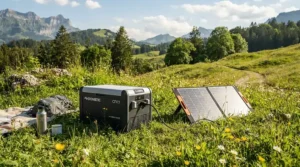
Most coolers here need you to bring the electricity. The Anker Solix EverFrost 2 40L brings its own. Its removable 288Wh battery is the headline. Anker claims roughly 52 hours at 4°C in Eco mode on one battery and over four days with two. That figure comes from an empty cooler at 25°C, so a loaded, sun-baked one will fall short. The spec sheet also promises a drop from 25°C to 0°C in 15 minutes, a -20°C to +20°C range, big wheels with a retractable handle, USB outputs and solar charging. In practice, you can leave it in the tent porch for a whole weekend without nursing a 12V socket.
It suits campers pitching without hook-ups who want properly safe food. It’s overkill for a beach afternoon. Tom’s Guide’s side-by-side test found it beat the EcoFlow Glacier on design, battery life and price, with 22% charge left after 24 hours. Auto Motor und Sport also rated it best of seven compressor coolers. Both are editorial tests, not aggregated shopper ratings, and I couldn’t verify a robust UK owner-review average.
Pros:
- ✅ Genuinely long runtime from the built-in battery
- ✅ Wheels and handle make loading painless
- ✅ Solar, car, mains and USB-C charging options
Cons:
- ❌ Premium pricing, especially for the 40L size
- ❌ Second battery costs extra
Expect roughly £800-£1,000 for the 40L, depending on the retailer. It’s expensive, but it’s the best value here per day of true independence.
2. EcoFlow Glacier — built-in ice maker novelty
Ice cubes from a camping fridge sound like a party trick until the first gin and tonic of the trip. The EcoFlow Glacier pairs a 120W compressor with a dedicated ice-making compartment, which EcoFlow says turns out 18 cubes in about 12 minutes. It holds roughly 38 litres, about 60 cans. The 297Wh battery plugs in separately and wasn’t included in the base price at launch. Runtime claims range from 24 to 39 hours depending on the source and mode, so read the small print.
In practice, that 120W compressor pulls hard during pulldown and ice-making. In Tom’s Guide’s test, the EcoFlow Glacier was fully drained after 24 hours, while its Anker rival still had charge in reserve. That makes it a fair choice for a short, social trip where ice is part of the fun. As pure camping food storage, the Anker looks stronger on the evidence. I found no sizeable pool of verified UK owner ratings, so treat the reviews as editorial rather than crowd-sourced.
Pros:
- ✅ Built-in ice maker is a genuine differentiator
- ✅ Roomy 38L interior for group trips
- ✅ Solar charging through the battery pack
Cons:
- ❌ Battery is a separate extra purchase
- ❌ Drained within 24 hours in one comparison test
Pricing sits well over £1,000 once the battery is added, based on launch pricing, so check current prices. Only buy it if the ice maker is a must-have.
3. Dometic CFX3 35 — most efficient compressor here
Efficiency is where the Dometic CFX3 35 earns its keep. A variable-speed compressor adjusts its effort rather than blasting on and off. Dometic’s published figure is 0.98Ah per hour at 12V, with a 32°C ambient and a fridge interior around 4°C. That works out at roughly 280Wh over 24 hours, close to one EverFrost battery per day in hot conditions. It holds 36 litres, weighs 16.9kg, runs on 12/24V or 230V, and has three-stage battery protection and Bluetooth/Wi-Fi app monitoring. The listed minimum is -22°C.
The catch is the lack of an internal battery. For a battery powered cooler for camping, you must pair it with a leisure battery or power station. It’s the natural choice for campervans and long trips where you’ll recharge from a vehicle or solar. European tests describe the CFX3 family as efficient and solar-friendly, with higher cost, weight and compressor noise as drawbacks. I’d add that the build quality (a protective frame and spring-loaded aluminium handles) is aimed at people who’ll still use it in five years.
Pros:
- ✅ Variable-speed compressor sips power
- ✅ Tough frame and sturdy handles
- ✅ App shows temperature and power history
Cons:
- ❌ Heavy at nearly 17kg
- ❌ No built-in battery included
European retail listings sat in the mid-€800s, which suggests roughly £700-£850 in the UK, so check current prices. It’s pricey, but frugal on power.
4. Alpicool TWW35 — removable battery without the premium tag
The Alpicool TWW35 offers the battery-in-the-box idea at about half the price of the Anker. It’s a 35-litre dual-zone compressor fridge with an LG compressor and a removable lithium pack of about 173Wh (15,600mAh). It weighs 17.5kg and charges from 12/24V, mains or solar. The app tracks battery level and each zone’s temperature. UK supplier Transporter HQ points out that the lid doubles as a seat or prep surface. Dual-zone means one side can run as a freezer, and the other as a fridge, which is handy for ice cream and milk on the same trip.
On paper, 173Wh is roughly 60% of the Anker’s battery. Plan on a day trip or one night of independence, then top up from the car or a solar panel. It suits budget-conscious campers who occasionally go off-grid and don’t need four days of runtime. I couldn’t find independent, aggregated review data or a third-party runtime test, and the glowing seller write-up isn’t independent, so treat claims accordingly.
Pros:
- ✅ Removable battery included in the package
- ✅ Dual-zone flexibility for fridge and freezer
- ✅ Charges from car, mains or solar
Cons:
- ❌ Smaller battery limits off-grid time
- ❌ No independent runtime test found
Expect from around £500, rising with accessories. For battery-first camping, it’s the sensible middle ground.
5. Alpicool K25 — best compact compressor value
The Alpicool K25 is the sensible little workhorse. It’s a 25-litre compressor fridge, rated at 60W, with an LG compressor and ECO and MAX modes. It’s 585 x 335 x 350mm, runs under 45dB, and has three-stage battery protection and a Bluetooth app. Its range is -20°C to +20°C. What that means in practice is that it fits a hatchback boot, runs quietly beside a tent and will chill below ambient even in a heatwave.
Mighty Gadget’s detailed K25 review reported 2°C drinks all day at 30°C ambient. Run from a 1,000Wh power station from a cold start, the pack dropped from 64% to 16% in about 18 hours, and the reviewer noted that pre-cooling on mains would have helped. It’s 10.2kg, holds around 44 cans, and has two side handles but no wheels, so loaded it’s a two-handed carry. The reviewer scored it 90% and observed that Alpicool’s boxes tend to be among the best reviewed on Amazon, which is his observation rather than a figure I could verify.
Pros:
- ✅ Excellent cooling versus thermoelectric rivals
- ✅ Light enough for easy car loading
- ✅ Quiet running with sensible battery protection
Cons:
- ❌ No wheels, so awkward when full
- ❌ Needs an external battery for off-grid use
Prices ran roughly £170-£260 across listings. It’s the value pick for couples and short-break campers.
6. Mobicool MT35W — roomy thermoelectric for cooler weather
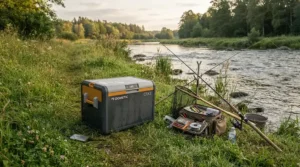
The Mobicool MT35W is the big-capacity thermoelectric. It holds 34 litres, runs on 12V or 230V, and cools up to about 18°C below ambient while also heating up to 65°C. It draws a rated 47W at 12V, runs at about 36dB, and has battery-protection logic, wheels and a handle. It works upright like a fridge or lying down like a chest, and weighs around 8-9kg depending on the source. In practice, a 20°C pitch gives you contents at roughly 2°C, but a 30°C afternoon leaves them at around 12°C. That’s above the 8°C chill limit.
Thermoelectric coolers typically run continuously, so that 47W could mean up to about 1.1kWh over a day if it never cycles, roughly four times the CFX3 figure, though the test conditions differ. It suits UK family trips on a hook-up in spring and autumn, or as a pre-chiller. One Italian outlet reviewed it as capacious and well built and recommended it. I couldn’t find a large pool of UK owner scores for this exact model.
Pros:
- ✅ Generous 34L capacity for the money
- ✅ Doubles as a food warmer
- ✅ Wheels and light weight ease transport
Cons:
- ❌ Struggles in heatwave conditions
- ❌ Constant power draw drains off-grid batteries
Continental listings sat around €135-€145, suggesting roughly £110-£150, so check current prices. It’s good value if you camp in cool weather.
7. Mobicool ME 26 AC/DC — lightest option for short trips
The Mobicool ME 26 AC/DC is the minimalist option. It holds 26 litres, weighs about 4kg, and is rated to cool 17°C below ambient. The 12V draw is 47W and the mains draw 55W. It has a dual-fan system for faster air distribution, extra-thick insulation, and a dedicated Eco mode for lower power on 230V. It holds an upright 1.5-litre bottle. In practice, it’s a day-trip box that can serve an overnight campsite if you pre-chill the contents and keep it in the shade. At 4kg, it’s the only one here you could carry one-handed up a field.
A review of Mobicool’s larger W40 reported a UK heatwave camping trip at 27-28°C where it “worked perfectly”, with the owner adding that a higher-spec model would have been welcome. That’s a different model, so I can’t pin ME 26 sentiment on it. The lesson transfers: thermoelectric performance follows the weather.
Pros:
- ✅ Only around 4kg, easy to carry
- ✅ Eco mode trims mains power use
- ✅ Dual fans improve cooling consistency
Cons:
- ❌ Limited 26L capacity
- ❌ Struggles well below ambient in heat
Availability varied at the time of research, so check current stock and price. Pricing looked firmly in the budget bracket, so it’s good value only for short trips.
Top 7 Specs Compared
| Product | Weight | Cooling Claim | Battery | Best For |
|---|---|---|---|---|
| Anker Solix EverFrost 2 40L | Heavier, wheeled | 0°C in 15 mins, down to -20°C | Removable 288Wh | Multi-day off-grid |
| EcoFlow Glacier | Heavy, wheeled | Compressor plus ice maker | Optional 297Wh | Ice-loving groups |
| Dometic CFX3 35 | 16.9kg | Down to -22°C | None built in | Van life |
| Alpicool TWW35 | 17.5kg | -20°C to 20°C | Removable 173Wh | Budget battery camping |
| Alpicool K25 | 10.2kg | -20°C to +20°C | None built in | Car campers |
| Mobicool MT35W | ~8-9kg | ~18°C below ambient | None built in | Cool-weather families |
| Mobicool ME 26 AC/DC | ~4kg | ~17°C below ambient | None built in | Light packers |
The table shows the real split: compressor models cost more and weigh more, but they hold a set temperature in any weather. The Dometic CFX3 35 and Anker Solix EverFrost 2 40L are the long-haul picks. The Alpicool K25 is the budget all-rounder. If you only camp in mild weather, the Mobicool MT35W saves a lot of money.
How to Set Up and Maintain Your Battery Powered Cooler for Camping
A good cooler can still disappoint if you set it up badly. Here’s the routine that squeezes the most from any of the seven.
Before You Leave
Plug it into the mains the night before and let it reach temperature. A cold box starts the trip with a head start, and a compressor pulling a warm box down from 25°C on battery eats a huge slice of your reserve. Pre-chill the food, too. Fridge-cold food is a thermal battery, and warm food is a power drain.
At the Pitch
Park the cooler in shade, with a gap of around 10cm round the vents so the compressor can shed heat. Fill it about two-thirds full, since a packed box holds temperature better than a half-empty one. Set the 12V battery protection to “high” if you run it from a starter battery, so it can’t leave you stranded.
Maintenance Schedule
- After every trip: wipe the interior with a mild bicarbonate solution, dry it fully and leave the lid ajar.
- Monthly in use: check the seal for cracks and the vents for fluff.
- Before storage: charge removable batteries to roughly half and store them somewhere cool.
Common First-30-Day Mistakes
Opening the lid constantly, letting the cooler run in the sun, and forgetting to switch off ECO mode during the first pulldown are the usual culprits. Once it hits temperature, ECO mode saves power.
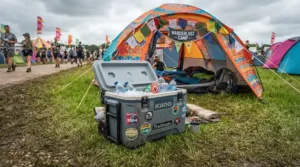
Real-World Scenarios: Matching a Portable Fridge to Your Trip
The Weekend Couple (Lake District, No Hook-Up)
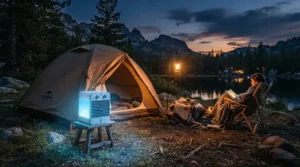
Three nights, ten litres of food, 22°C days. Budget: around £500-£900. The Alpicool TWW35 or Anker Solix EverFrost 2 40L fits, because both carry their own batteries. The Anker Solix EverFrost 2 40L pulls ahead if rain keeps the car parked and solar is unrealistic. Either way, pre-chill on mains first.
The Family Fortnight (Cornwall, Electric Hook-Up)
Four people, seven nights, 28°C heatwave potential. Mains is available, so battery life isn’t the bottleneck, but ambient heat is. Here the Dometic CFX3 35 wins on capacity and efficiency. A Mobicool MT35W works as a second box for drinks, because it cools to roughly 12°C at 30°C ambient, which is fine for cans and no good for chicken.
The Festival Weekender (One Night, Tight Budget)
One night, snacks, drinks and a long walk from the car. Budget: under £150. The Mobicool ME 26 AC/DC is light, cheap and just enough, provided you use ice packs to help in warm weather. If you’ll be pitched on a field with no power, consider a traditional cool box with ice instead.
Problems and Fixes: Troubleshooting Your Portable Fridge on the Pitch
Problem 1: The Fridge Keeps Cutting Out on 12V
That’s usually the battery protection doing its job. Raise the protection level only if your battery can take it, or switch to a separate leisure battery or power station.
Problem 2: Food Isn’t Cold Enough
Check the real food temperature with a probe thermometer. The Food Standards Agency advises a fridge at 5°C or below. If a thermoelectric box can’t reach that, move it into shade, add frozen ice packs and keep the lid shut.
Problem 3: The Battery Dies Overnight
Switch to ECO mode once the box has reached temperature, fill empty space with water bottles and shade the unit. Don’t open it during the first hour after loading.
Problem 4: Condensation Pools Inside
Wipe the box dry, check the drain plug where there is one, and keep warm food from going straight in.
Problem 5: Compressor Noise at Night
Move the box away from the tent wall onto a firm, level surface. Compressor hum drops when the box has a stable base and clear air gaps.
How to Choose a Battery Powered Cooler for Camping
Here’s the fast version, in order of importance:
- Decide how long you’ll be off-grid. A weekend without hook-up needs a built-in battery or a big power station. A hook-up pitch changes everything.
- Pick the cooling technology. Compressor for hot weather and freezing. Thermoelectric only for mild weather and short trips.
- Size it sensibly. As a rough rule of thumb, aim for around 10-15 litres per person for a weekend. Bigger boxes weigh more and demand more power.
- Check the battery protection. Three-stage cut-off protects a car battery. Without it, you risk a flat start.
- Think about weight. Compressor boxes run from about 10kg to nearly 18kg empty. Wheels and handles matter more than they look.
- Count the total cost. Add a power station or second battery if the cooler doesn’t include one.
Battery Camping Cooler vs Cool Box: Which Wins?
The battery camping cooler vs cool box question comes down to trip length and discipline. A traditional passive cool box is light, silent and cheap, and it works perfectly well for a day out with fresh ice. Premium rotomoulded versions stretch that to a few days. But ice melts, food floats, and you’ll have to replenish it.
A battery powered cooler for camping removes that chore. It holds a set temperature for as long as it has power. The cost is weight, price and the need to manage electricity.
| Feature | Compressor Battery Cooler | Thermoelectric Cool Box | Passive Cool Box + Ice |
|---|---|---|---|
| Temperature control | Set and hold, down to freezing | Fixed gap below ambient | None, depends on ice |
| Weight (similar size) | Heavy | Around 4kg for ~25L | Lightest |
| Ongoing cost | Electricity | Electricity | Ice |
| Best For | Multi-day trips, heatwaves | Mild weather, short trips | Day trips, festival weekends |
The table shows why the best choice depends on your trip. For three nights or more, or any heat, a compressor cooler like the Alpicool K25 removes the guesswork. For a day at the beach, a passive box wins on weight and simplicity. A Mobicool MT35W sits in the middle, offering electric convenience without compressor cost, as long as you accept the weather limit.
Battery Powered Cool Boxes: Thermoelectric vs Compressor Explained
Battery powered cool boxes split into two camps, and the difference decides whether your steak stays safe.
How Thermoelectric Works
A Peltier element moves heat across a junction when current flows. Dometic notes that a thermoelectric unit keeps contents cool rather than cooling them itself, so you should pre-chill the contents. German magazine Auto Motor und Sport reports thermoelectric units weigh roughly 3-7kg and cool 15-20°C below ambient, running continuously.
How Compressor Works
A compressor moves refrigerant to pull heat out of the box. The same test says compressor models can reach as low as -22°C and run intermittently, drawing power only when running. That’s why the Dometic CFX3 35 can sip power while the thermoelectric Mobicool ME 26 AC/DC can’t.
Which Should You Buy?
If you only camp in spring and autumn, thermoelectric saves money. If you camp in July, or want to freeze things, buy a compressor. Mixed use? A compressor box covers both.
Portable Fridge Running Costs and Long-Term Value
Buying price is only half of it. A portable fridge has running costs in electricity, battery wear and replacement parts.
| Product | Power Note | Price Band | Best For |
|---|---|---|---|
| Anker Solix EverFrost 2 40L | 288Wh removable pack | ~£800-£1,000 | Off-grid independence |
| Dometic CFX3 35 | ~280Wh/day in hot conditions | ~£700-£850 | Long-term efficiency |
| Alpicool K25 | Rated 60W, cycles on and off | ~£170-£260 | Budget compressor |
| Mobicool MT35W | Rated 47W, runs continuously | ~£110-£150 | Mild-weather savings |
| Mobicool ME 26 AC/DC | 47W at 12V, 55W on mains | Budget bracket | Occasional use |
Running a compressor box on household mains costs pennies per charge. The bigger long-term cost is the power station or leisure battery you may need for off-grid trips. Thermoelectric units look cheap, but their continuous draw can drain a battery roughly four times faster than the efficient Dometic CFX3 35, so the cheap box can cost more in batteries.
Based on the spec comparison, the Alpicool K25 gives the lowest cost per year of use for occasional campers. The Dometic CFX3 35 pays back over many trips, thanks to its efficiency and robust frame. Frequent off-grid campers should factor the Anker Solix EverFrost 2 40L battery pack into the price, because it replaces a separate power station.
Camping Food Storage: Keeping Food Safe in the UK
Camping food storage is about temperature discipline. The government’s food hygiene guidance says chilled food must be kept at 8°C or below as a legal requirement for businesses in England, Wales and Northern Ireland, and recommends setting a fridge to 5°C or below. That’s business guidance, but it’s a sensible benchmark for a campsite kitchen.
Practical Rules
- Check the food temperature, not the display. A cheap probe thermometer settles arguments.
- Keep raw meat at the bottom, sealed and separate from ready-to-eat food.
- Keep chilled food out of the cooler for as short a time as possible while cooking.
- Use the freezer zone on a dual-zone fridge such as the Alpicool TWW35 for ice packs and frozen meat.
Thermoelectric Warning
A thermoelectric box cooling 18°C below ambient hits roughly 7°C on a 25°C day. That’s borderline. On a 30°C afternoon it’s about 12°C, so don’t store raw chicken or dairy in it without ice packs.
Features That Actually Matter (And Those That Don’t)
Features Worth Paying For
- Three-stage battery protection: it stops your cooler from flattening a starter battery.
- Good insulation and a tight lid seal: they cut the compressor’s workload.
- Wheels and a sensible handle: at 17kg loaded, these matter more than the app.
- Dual-zone: worth it only if you want a freezer section.
Features That Sound Better Than They Are
- App connectivity: useful for monitoring, but not essential. The Alpicool K25 works perfectly without the app.
- Built-in ice makers: the EcoFlow Glacier has one, but it adds cost and a power draw.
- Cup holders and chopping boards: nice, but not decisive.
What the spec sheet won’t tell you, but reviewers note, is that noise and weight are the two features owners mention most after a few trips. Weigh them as heavily as the cooling numbers.
Common Mistakes When Buying a Battery Powered Cooler for Camping
Buying Thermoelectric for Heatwave Camping
It cools to a fixed gap below ambient. In a British heatwave, that gap isn’t enough for raw meat.
Assuming “Battery Powered” Includes a Battery
Several coolers here are 12V only. Check what’s in the box. Only the Anker Solix EverFrost 2 40L and Alpicool TWW35 include their own packs, while the EcoFlow Glacier needs its battery bought separately.
Oversizing
A 50-litre fridge is a pain to carry and a drain to power. Match the capacity to your group, not your ambition.
Ignoring Ventilation
Compressors need airflow. Wedge a fridge between sleeping bags and it will struggle.
Skipping the Pre-Chill
Starting with warm contents is the single biggest battery waste. Chill everything first.
Forgetting Weight
A 17kg fridge plus 10kg of food is a serious carry. Wheels, like those on the Anker Solix EverFrost 2 40L, matter.
FAQ
❓ How long does a battery powered cooler for camping run on one charge?
❓ Can I run a portable fridge off my car battery overnight?
❓ What size cool box do I need for a family camping trip?
❓ Can I charge a battery powered cooler with a solar panel?
❓ How much does a good battery powered cooler for camping cost in the UK?
Conclusion
A battery powered cooler for camping isn’t a luxury once you’ve lost a weekend’s food to a flat bag of ice. The real question is which type fits your trips.
For multi-day off-grid trips, the Anker Solix EverFrost 2 40L offers the strongest battery story, backed by independent tests. For vans and long trips, the Dometic CFX3 35 gives the best efficiency. Mid-budget campers should look at the Alpicool TWW35 if they want a removable battery, or the Alpicool K25 for outstanding value and proven cooling. The EcoFlow Glacier is for people who want ice cubes badly enough to pay for them. The Mobicool MT35W and Mobicool ME 26 AC/DC are fine for cool-weather trips and short stays, but they can’t match compressor performance in a British heatwave.
Whichever you choose, pre-chill the box, keep it shaded, check the food temperature with a thermometer and keep raw and ready-to-eat food apart. Do that, and your camping food storage stays safe, your drinks stay properly cold and your Sunday lunch stays edible.
✨ Ready to ditch the soggy ice for good?
🔋 Click on any highlighted product above to check current pricing and availability. Pick the cooler that matches your trips, and enjoy cold drinks and fresh food wherever you pitch! ⛺
Recommended for You
- Tent Fan With Light: 7 Brilliant Picks For UK Camping (2026)
- Tent Fan Vs Clip-On Fan: 7 Honest Picks For UK Camping (2026)
- Portable Cooler For Family Camping: 7 Proven Picks (2026)
Disclaimer: This article contains affiliate links. As an Amazon Associate, I earn from qualifying purchases. If you purchase products through these links, we may earn a small commission at no additional cost to you.
✨ Found this helpful? Share it with your friends! 💬🤗
