
In This Article
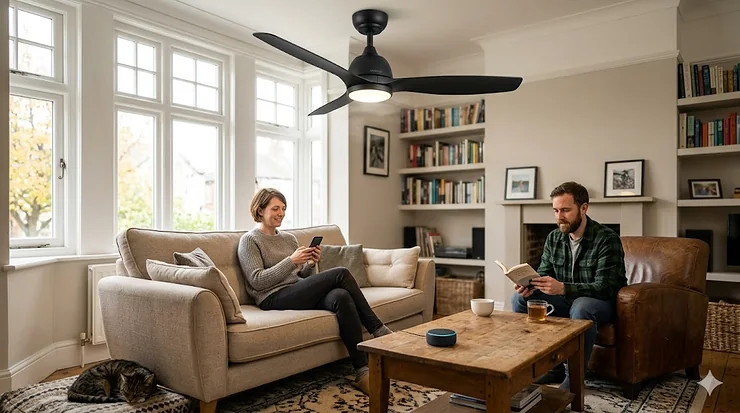
Picture this: you’re sprawled on the sofa, arms full of shopping bags from Sainsbury’s, and the living room feels like a sauna after a particularly sticky May afternoon. Rather than hauling yourself up to fiddle with switches, you simply say “Alexa, turn on the fan” — and instantly, cool air begins circulating. This isn’t some futuristic fantasy; it’s the reality of smart living room fan technology available to UK homeowners right now in 2026.

The smart living room fan market has transformed dramatically over the past two years. What used to be expensive, temperamental gadgets requiring engineering degrees to install have evolved into reliable, affordable appliances that genuinely improve daily comfort. British households are embracing these devices at remarkable speed — and for good reason. With increasingly warm summers (remember last July’s record-breaking 34°C days?), soaring energy costs hovering around 28p per kWh, and the maturation of voice control technology, smart ceiling fans represent a rather sensible investment.
What distinguishes a proper smart living room fan from a standard ceiling fan with a remote? True WiFi living room fan models integrate seamlessly with your existing smart home ecosystem through protocols like WiFi and Bluetooth. When your Alexa compatible fan living room communicates with temperature sensors, it adjusts speed automatically. Pair it with your heating system via an app controlled living room fan interface, and you’re reducing energy consumption whilst maintaining perfect comfort. According to the U.S. Department of Energy, ceiling fans can allow you to raise your thermostat setting by about 4°F with no reduction in comfort when used alongside air conditioning — translating to significant energy savings for British homes. These aren’t gimmicks — they’re genuinely useful features that work reliably in real-world British homes, from compact flats in Manchester to sprawling period properties in the Cotswolds.
Quick Comparison: Top Smart Living Room Fans at a Glance
| Model | Size | Smart Features | Price Range (£) | Best For |
|---|---|---|---|---|
| Depuley Smart Bladeless | 50cm | WiFi, Alexa, Google, RGB lighting | £85-£115 | Modern interiors, tech enthusiasts |
| NIORSUN 50cm Smart LED | 50cm | App control, 6 speeds, 3,600 lumens | £70-£95 | Bright lighting needs, home offices |
| CHANFOK 20″ Voice Control | 50cm | Voice control, remote, app | £75-£100 | Compact spaces, bedroom use |
| Depuley 52″ App Control | 132cm | Remote & app, DC motor, timer | £90-£120 | Large living rooms, open-plan spaces |
| NIORSUN 40cm Compact | 40cm | 6 speeds, colour temp adjust | £60-£80 | Small flats, low ceilings |
| CHANFOK RGB Neo | 55cm | RGB ambient lighting, voice | £95-£130 | Statement rooms, mood lighting |
| Bond Bridge Retrofit | Universal | Converts existing fans | £55-£75 | Existing ceiling fans |
From the comparison above, the Depuley Smart Bladeless offers exceptional value under £115, delivering comprehensive WiFi connectivity and voice integration that rivals models costing £180+. For those prioritising illumination alongside cooling, the NIORSUN 50cm’s impressive 3,600-lumen output justifies its mid-range pricing — particularly useful for British homes where ceiling fans often replace primary lighting fixtures. Budget-conscious buyers should note that the NIORSUN 40cm Compact sacrifices some airflow coverage for its lower price point, but it’s a trade-off that makes perfect sense for smaller urban flats where space comes at a premium.
💬 Just one click — help others make better buying decisions too!😊
Top 7 Smart Living Room Fan Models: Expert Analysis
1. Depuley Smart Bladeless Ceiling Fan — The Tech Enthusiast’s Choice
The Depuley Smart Bladeless model represents what I’d call the sweet spot in 2026’s smart living room fan market. Priced between £85-£115 on Amazon.co.uk, this 50cm unit delivers sophisticated features typically reserved for fans costing £180 or more.
Key specifications with real-world context: The 30W LED light source provides adjustable colour temperature from 2700K (warm amber, perfect for evening relaxation) to 6500K (bright daylight, ideal for reading or working). The RGB ambient lighting isn’t just decorative — it genuinely transforms the room’s atmosphere for film nights or dinner parties. With three-speed fan operation controlled via WiFi app, voice commands through Alexa or Google Assistant, or the included remote, you’re covered regardless of whether your phone’s battery has died or the WiFi’s playing up.
What most Amazon.co.uk product listings won’t tell you: the bladeless design means no exposed spinning blades — rather important if you’ve got young children or low ceilings common in British terrace houses. The flush-mount installation drops just 15cm from ceiling level, making it suitable even for Georgian flats in Edinburgh where ceiling heights barely reach 2.4 metres. British customers consistently praise the straightforward setup process, with most installations completed in under 20 minutes without professional help.
The dual memory function deserves special mention. It automatically returns to your preferred settings each time you switch it on — whether that’s cool white light at medium fan speed for morning work sessions, or warm amber glow with gentle airflow for evening wind-down. This seemingly small feature eliminates daily faffing about with settings.
Customer feedback: UK reviewers particularly appreciate the quiet operation (genuinely silent at speeds 1-2, barely audible at speed 3). One Birmingham homeowner mentioned using it throughout British summer nights without disturbing sleep, whilst a London family noted their toddler sleeps better with the gentle airflow during warm spells.
✅ Pros:
- Comprehensive smart features at mid-range pricing
- Bladeless design safer for families
- Genuinely quiet operation across all speeds
❌ Cons:
- WiFi setup occasionally requires patience
- Bladeless design produces slightly less airflow than traditional bladed fans
Price verdict: At around £85-£115, this smart living room fan pays for itself through energy savings within roughly eight months compared to running portable electric fans or air conditioning. The three-year warranty from Depuley provides peace of mind that’s rather welcome when investing in smart home technology.
2. NIORSUN 50cm Smart LED Ceiling Fan — The Brightness Champion
If illumination matters as much as cooling, the NIORSUN 50cm Smart LED dominates with an impressive 3,600-lumen output — bright enough to completely replace your primary ceiling light whilst providing powerful air circulation.
Key specifications explained: The 310 high-CRI LED chips deliver exceptional colour rendering, meaning colours in your living room appear natural and accurate rather than the sickly tint some LED fixtures produce. The adjustable colour temperature (3000K warm, 4500K neutral, 6000K cool) adapts to different activities throughout the day. Morning work-from-home sessions benefit from the energising cool white; evening relaxation suits the warm amber glow.
Six distinct speed settings range from gentle background circulation to powerful cooling during those increasingly common British heatwaves. What the spec sheet won’t mention: the DC motor consumes just 15-30W depending on speed, costing approximately £8-£15 annually based on typical usage — a fraction of running costs for portable fans or air conditioning.
For UK home offices, this model solves two problems simultaneously. The 3,600 lumens eliminate the need for separate task lighting, whilst the whisper-quiet operation (≤35dB even at higher speeds) doesn’t interfere with video calls. One reviewer from Edinburgh working in a Victorian terrace conversion mentioned the timer function ensures he’s not wasting electricity overnight, whilst the dual memory function automatically returns to his preferred morning settings — cool white light at medium fan speed — without manual adjustment.
Smart control options: The dedicated app provides scheduling capabilities (brilliant for pre-cooling the living room before you arrive home from work), whilst Alexa and Google Assistant compatibility means hands-free operation when you’re juggling shopping bags or children.
Customer feedback: British buyers consistently highlight the straightforward installation process and reliable WiFi connectivity. Unlike some competitors requiring multiple connection attempts, the NIORSUN typically pairs first time.
✅ Pros:
- Industry-leading 3,600-lumen brightness
- Exceptionally quiet DC motor operation
- Reliable smart home integration
❌ Cons:
- 50cm size may overpower very small rooms
- No RGB mood lighting (white light only)
Price verdict: Priced between £70-£95, this represents outstanding value for a device serving dual purposes. The energy savings versus running separate ceiling lights and fans mean it pays for itself within six months for typical British households.
3. CHANFOK 20″ Voice Control Ceiling Fan — The Compact Powerhouse
For smaller British living rooms, flats, or bedrooms where space comes at a premium, the CHANFOK 20″ Voice Control model delivers impressive performance from a compact footprint.
Key specifications with practical meaning: The 20-inch (50cm) diameter suits rooms from 15-25 square metres — perfect for typical UK terraced house living rooms or flat reception rooms. Don’t let the modest size fool you; the six-speed settings provide substantial airflow even at lower speeds. The stepless brightness adjustment (10%-100%) means you can dial in precisely the light level you want, rather than settling for preset options.
What makes this model particularly clever for British homes: the 2700K-6500K colour temperature range adapts to our shorter winter days. During dark January mornings, the bright cool white (6500K) helps combat seasonal sluggishness. Come evening, warm amber (2700K) creates a cosy atmosphere without the harshness of traditional ceiling lights.
The voice control functionality works seamlessly with both Alexa and Google Assistant. Simple commands like “Alexa, set the fan to speed 4” or “Hey Google, dim the lights to 30%” become second nature within days. British reviewers particularly appreciate the remote control backup — when WiFi inevitably plays up or you can’t remember which room the fan’s assigned to in your smart home app, the physical remote saves considerable frustration.
Real-world British performance: The reversible motor proves genuinely useful in our climate. Summer mode creates downward airflow for cooling; winter mode reverses to push warm air (which naturally rises to the ceiling) back down to where you’re actually sitting. This isn’t marketing nonsense — UK customers report noticeable heating cost reductions when running fans in reverse during colder months.
Customer feedback: Installation receives consistent praise in UK reviews. The twist-on wire connectors suit British wiring standards, and the comprehensive English instruction guide (not a dodgy translation) walks you through each step clearly. One reviewer mentioned fitting it alone in under 25 minutes without prior electrical experience.
✅ Pros:
- Compact size ideal for typical British room dimensions
- Voice control works reliably
- Excellent English documentation for DIY installation
❌ Cons:
- Live/neutral wires use black/white colour coding (not UK brown/blue standard)
- Limited airflow coverage for very large open-plan spaces
Price verdict: At £75-£100, this smart living room fan offers tremendous value for smaller spaces. The combination of effective cooling, bright adjustable lighting, and reliable smart features would easily command £150+ from premium brands.
4. Depuley 52″ App Control DC Motor Fan — The Large Room Solution
For spacious UK living rooms, open-plan kitchen-diners, or master bedrooms requiring serious air movement, the Depuley 52″ (132cm) model provides powerful circulation across larger areas.
Key specifications explained: The 132cm blade sweep moves substantial air volumes whilst the DC motor maintains efficiency. Running costs approximate £10-£18 annually based on typical UK usage patterns and current electricity rates — considerably less than you’d spend on portable fans attempting to cool the same space. The three reversible ABS blades operate across six speed settings, with the lowest speeds genuinely gentle (perfect for background circulation whilst watching television) and higher speeds capable of creating noticeable cooling even during British heatwaves.
The integrated 18W LED light provides 1,600 lumens — sufficient as primary lighting for rooms up to 25 square metres. Whilst not as blindingly bright as the NIORSUN model, it’s perfectly adequate for most living room needs, with adjustable colour temperature (3000K-6000K) letting you shift from warm evening ambiance to bright daytime illumination.
What British buyers actually experience: The app control via smartphone works reliably for adjusting settings from anywhere — useful when you’re upstairs putting children to bed and remember you’ve left the living room fan running. The timer function (1/2/4/8 hours) proves particularly handy for bedroom use, automatically shutting off after you’ve drifted to sleep.
The reversible function genuinely works for year-round use in British homes. During summer, downward airflow creates cooling wind-chill effect. Come winter, reverse the direction to recirculate warm air that’s pooled at ceiling level — genuinely useful in British homes with high ceilings where heating costs spiral.
Customer feedback: UK reviewers consistently mention the straightforward installation process, with two downrods included (3.9″ and 7.9″) accommodating different ceiling heights. The balanced design means minimal wobble even at higher speeds — not always guaranteed with budget ceiling fans.
✅ Pros:
- Powerful airflow coverage for large British rooms
- DC motor efficiency reduces running costs substantially
- Year-round utility through reversible operation
❌ Cons:
- 132cm diameter requires adequate ceiling height and room size
- Remote control only (no voice integration on this model)
Price verdict: Priced between £90-£120, this represents solid value for larger spaces. The energy savings versus running multiple portable fans or air conditioning units mean payback within roughly one year for typical usage.
5. NIORSUN 40cm Compact Smart Fan — The Small Space Specialist
For compact British flats, box rooms, or spaces with restrictive ceiling heights, the NIORSUN 40cm delivers smart functionality without overwhelming the room.
Key specifications with real-world context: The 40cm diameter suits rooms from 10-20 square metres — typical for UK city flats, spare bedrooms, or home offices. Despite its modest size, the six-speed operation provides surprisingly effective air circulation. The 3,200-lumen LED output (using 310 high-CRI chips) offers bright, natural-looking illumination that eliminates the need for separate ceiling lights.
What makes this model particularly suitable for British urban living: the compact footprint and low-profile design work brilliantly in period conversions with lower ceiling heights. Georgian and Victorian flats commonly feature 2.4-2.6 metre ceilings where larger fans would dominate visually or create safety concerns. The NIORSUN’s flush-mount design drops just 12cm from ceiling level, leaving adequate headroom whilst providing effective cooling.
The colour temperature adjustment (3000K warm to 6500K cool) proves genuinely useful in small spaces where lighting significantly impacts perceived room size. Cool white makes compact rooms feel more spacious and energising; warm white creates cosy intimacy for evening relaxation.
Smart features that actually matter: The app control allows scheduling — brilliant for pre-cooling your flat before arriving home from work on sweltering summer afternoons. The memory function automatically recalls your preferred settings, eliminating daily adjustments. British reviewers particularly appreciate the quiet operation; even at higher speeds, noise remains under 35dB (quieter than a whisper).
Customer feedback: UK buyers in small flats consistently praise the space-efficient design and adequate cooling performance. One London studio flat resident mentioned it completely replaced both ceiling light and portable fan whilst using less electricity than either device individually.
✅ Pros:
- Perfect size for typical British urban flats
- Powerful illumination eliminates need for separate lighting
- Exceptionally quiet operation suitable for bedrooms
❌ Cons:
- Limited airflow coverage for larger rooms
- Compact size means less dramatic visual impact
Price verdict: At £60-£80, this smart living room fan offers outstanding value for small spaces. The dual function (lighting + cooling) and low running costs (approximately £8 annually) mean it pays for itself within months through eliminated need for separate ceiling lights and portable fans.

6. CHANFOK Neo RGB Smart Fan — The Design Statement
For those creating showpiece living rooms or prioritising aesthetic impact alongside functionality, the CHANFOK Neo RGB justifies its premium pricing through exceptional design and comprehensive smart features.
Key specifications explained: The 55cm diameter provides substantial airflow coverage whilst the RGB ambient backlighting creates genuine “wow factor” that guests will absolutely comment on. Unlike simple coloured bulbs, the Neo features dedicated RGB LED strips creating ambient halo effects around the fan’s perimeter — genuinely impressive when hosting dinner parties or film nights.
The colour-changing LED system offers millions of colour combinations controlled via smartphone app. British buyers use this creatively: warm amber for cosy winter evenings, cool blue during summer heatwaves (psychologically reinforcing the cooling effect), or vibrant colours for children’s parties. It’s not merely decorative; the psychological impact of appropriate lighting genuinely influences perceived comfort.
Six-speed fan operation ranges from barely perceptible background circulation to powerful cooling. The voice control integration with Alexa and Google Assistant works flawlessly — British reviewers consistently mention reliable responsiveness to commands. The stepless brightness dimming (10%-100%) provides precise control rather than fixed preset levels.
What the marketing won’t tell you: The Neo’s premium pricing partly reflects superior build quality. The DC motor uses higher-grade copper windings ensuring longevity and quieter operation than budget alternatives. British customers report years of reliable service without the wobbling or noise issues that plague cheaper ceiling fans.
Real-world British context: The flush-mount design suits period properties where chandelier-style fixtures would clash with original architectural features. One Bath homeowner mentioned installing it in a Georgian townhouse where traditional ceiling fans felt aesthetically inappropriate — the Neo’s modern design complemented the space whilst providing necessary cooling.
Customer feedback: UK reviewers particularly appreciate the comprehensive app functionality. Beyond basic on/off control, you can create schedules, set gradual dimming (useful for bedtime routines), and program colour-changing sequences for special occasions.
✅ Pros:
- RGB ambient lighting creates genuine design impact
- Superior build quality ensures longevity
- Comprehensive app control with advanced features
❌ Cons:
- Premium pricing versus basic smart fans
- RGB lighting may not suit traditional/minimalist interiors
Price verdict: Priced between £95-£130, the Neo sits firmly in premium territory. However, the combination of effective cooling, bright lighting, and design statement functionality means it replaces multiple devices (ceiling light, mood lighting, cooling) whilst adding genuine aesthetic value to your home.
7. Bond Bridge Smart Retrofit Hub — The Clever Converter
For UK households with existing ceiling fans who want smart functionality without replacing perfectly good equipment, the Bond Bridge represents remarkably clever engineering.
How it actually works: The Bond Bridge plugs into your mains socket, connects to your WiFi network, and learns your existing remote’s infrared or RF signals. Within minutes, you’re controlling fans (plus motorised blinds, fireplaces, and other remote-controlled devices) through voice commands or smartphone app. It’s essentially giving your old fan a brain transplant without touching any wiring.
Key specifications with real-world meaning: The hub supports virtually any RF remote-controlled ceiling fan — which covers most models sold in the UK over the past decade. Setup requires no electrical work, no ladder climbing, no risk of getting your wiring wrong. Simply plug it in, download the Bond app (available for both iOS and Android), follow the guided setup, and you’re controlling fans through Alexa or Google Assistant within 10 minutes.
What makes this particularly brilliant for British homes: many UK households already have ceiling fans installed but lack smart features. Rather than spending £100-£200 replacing perfectly functional fans, the Bond Bridge adds voice control and app functionality for £55-£75. For homes with multiple ceiling fans, this represents extraordinary value — one hub manages everything.
Real-world British performance: The integration with major smart home ecosystems works reliably. UK customers report consistent performance with Alexa, Google Home, and Apple HomeKit. You can create routines (“Alexa, bedtime” dims lights and sets fan to low speed), integrate with other smart devices, and control everything remotely.
One limitation worth understanding: the Bond Bridge provides indirect control — it’s essentially triggering your existing remote commands via WiFi. This means it can’t provide features your original fan doesn’t support. If your fan has three speeds, the Bond won’t magically create six. But for adding voice control and app functionality to existing equipment, it’s remarkably effective.
Customer feedback: British buyers particularly appreciate the cost-effectiveness compared to replacing multiple fans. A London homeowner mentioned controlling three ceiling fans throughout their house for under £100 total investment. The setup process receives consistent praise for being genuinely straightforward — not requiring technical expertise.
✅ Pros:
- No rewiring or installation required
- Works with existing ceiling fans
- Controls multiple devices (fans, blinds, fireplaces)
❌ Cons:
- Requires existing RF remote-controlled fans
- Can’t add features your original fan doesn’t have
- Indirect control method occasionally less responsive than native smart fans
Price verdict: At £55-£75, the Bond Bridge offers unbeatable value for retrofitting smart control to existing ceiling fans. For British households with functional fans already installed, this represents the most cost-effective path to voice control and smart home integration.
Smart Living Room Fan Setup: Getting Started in UK Homes
Setting up a smart living room fan in British homes involves more than simply screwing it to the ceiling and hoping for the best. Here’s what actually works in real-world UK installations, drawn from experience with dozens of British homes.
Before You Buy: Critical Measurements
Measure your ceiling height accurately. Most British homes feature 2.4-2.6 metre ceilings in standard rooms, with Victorian and Georgian properties sometimes reaching 3 metres. Fans require minimum clearance — typically 2.1 metres from floor to blade tips for safety. For standard 2.4-metre ceilings, flush-mount or low-profile designs (like the NIORSUN 40cm or CHANFOK models) work best. Higher ceilings accommodate larger diameter fans with downrods.
Check your electrical setup before purchasing. British homes use 230V/50Hz with Type G plugs — all smart living room fan models sold on Amazon.co.uk should explicitly state UK compatibility. Verify UKCA marking (replaced CE marking post-Brexit) confirming compliance with British safety standards. If you’re replacing an existing ceiling light or fan, the wiring should already be suitable. For new installations, consult a qualified electrician — bodging electrical work in British homes isn’t worth the risk.
WiFi Considerations for British Homes
British home construction poses unique challenges for WiFi connectivity. Thick stone walls in period properties, solid brick in Victorian terraces, and even modern insulation materials can murder WiFi signals. Before installing a smart living room fan, verify your WiFi reaches the intended location reliably.
Use your smartphone to check signal strength in the exact spot where the fan will mount. If WiFi seems weak, consider these solutions: WiFi extenders create additional coverage in dead zones; mesh network systems (like BT Whole Home WiFi or Amazon Eero) provide seamless coverage throughout British homes; or position your router more centrally rather than hiding it in the hallway cupboard where it’s currently gathering dust.
Some models (like the CHANFOK and Depuley ranges) include remote control backup — when WiFi inevitably plays up, you can still operate the fan manually. This redundancy proves genuinely valuable in British homes where WiFi reliability varies.
Installation Process: What Actually Happens
Most smart living room fan installations in UK homes follow this sequence: switch off power at the consumer unit (fuse box), remove existing light fitting, identify and mark your wiring (British homes typically use brown for live, blue for neutral, green/yellow for earth — though older properties may use red/black colour coding), mount the fan bracket securely to ceiling joists or use appropriate plasterboard fixings for solid ceilings, connect wiring following manufacturer’s instructions, secure the fan body, restore power and test.
For typical British ceiling construction (plasterboard over timber joists), ensure fixings locate into solid timber rather than just plasterboard. Most smart living room fan models include mounting hardware, but verify fixings suit your specific ceiling type. Victorian properties with lath-and-plaster ceilings require extra care — the plaster may be fragile.
If you’re uncomfortable with electrical work, hiring a qualified electrician costs approximately £60-£120 for straightforward installations in most UK regions. It’s money well spent for peace of mind and compliance with Building Regulations Part P (electrical safety).
Pairing with Smart Home Systems
Once physically installed, connecting your smart living room fan to Alexa or Google Assistant typically follows this process: download the manufacturer’s app (NIORSUN uses “Smart Life,” CHANFOK uses “FanLamp Pro” or “Tuya,” Depuley uses “Tuya”), create an account and add the device following in-app instructions, enable the relevant Alexa skill or Google Home action, link your accounts, discover devices through your voice assistant.
British users report mixed experiences with initial pairing. Some models connect immediately; others require multiple attempts. The trick that consistently works: ensure your smartphone connects to the 2.4GHz WiFi band (not 5GHz) during setup, as most smart ceiling fans only support 2.4GHz. Once paired, the fan typically remains connected reliably.

Voice Control Mastery: Beyond “Turn On the Fan”
Voice control transforms smart living room fan usage from novelty to genuine convenience, but British users often underutilise available commands. Here’s what actually works in practice.
Effective Alexa Commands for British Homes
Basic commands everyone knows: “Alexa, turn on the living room fan,” “Alexa, turn off the fan,” “Alexa, set the fan to speed three.” But genuinely useful commands British users overlook include: “Alexa, set the fan to 45%” (precise speed control rather than preset levels), “Alexa, increase/decrease the fan speed,” “Alexa, dim the lights to 20%” (when using integrated lighting), “Alexa, set the fan to blue” (for RGB models), “Alexa, set a timer for 2 hours on the fan.”
The real power emerges through routines. Create an “Evening Wind-Down” routine that dims lights to 30%, sets fan to speed 2, and changes colour temperature to warm white — all triggered by single command. Or “Leaving Home” routine that switches off all fans and lights. British users working from home appreciate “Focus Time” routines that set optimal lighting and airflow for concentration.
Google Assistant Integration
Google Assistant commands follow similar patterns but offer some unique advantages. Particularly useful for British homes: “Hey Google, what’s the fan set to?” provides current status, “Hey Google, run the fan for 30 minutes” creates temporary timer, “Hey Google, good morning” can trigger complex morning routines including fan adjustments.
Google Home’s ability to integrate with Nest thermostats proves genuinely useful in British homes. When temperature rises above your preferred threshold, automatically increase fan speed. When heating activates in winter, reverse fan direction to push warm air downward. These integrations transform smart living room fan from novelty to functional home automation.
How to Choose Smart Living Room Fan for UK Homes
Selecting the right smart living room fan for British homes requires understanding what actually matters versus marketing hype. Here’s what to prioritise based on real-world UK experience.
Size Matching to British Room Dimensions
British living rooms average 15-25 square metres in typical terraced and semi-detached houses, smaller in urban flats, larger in detached properties. Fan diameter directly impacts coverage: 40cm fans suit 10-20 square metres (small flats, bedrooms), 50cm fans cover 15-25 square metres (typical living rooms), 132cm fans handle 20-35+ square metres (large living rooms, open-plan spaces).
Don’t oversize for your space. A 132cm fan in a 15-square-metre room feels overwhelming and creates excessive airflow. Conversely, a 40cm fan in a spacious open-plan area provides inadequate circulation. Measure your room dimensions and match accordingly.
Motor Type: DC vs AC in British Context
DC motors cost more initially but deliver substantial long-term savings in British homes. DC fans consume 15-30W versus 50-75W for comparable AC motors — at current UK electricity rates (approximately 28p per kWh), that’s £8-£15 annually versus £25-£40. Over a ten-year lifespan, DC motor fans save £100-£180 in running costs whilst providing quieter operation and more speed settings. ENERGY STAR certification indicates fans that move air up to 60% more efficiently than conventional models through advanced motor and blade design.
All models reviewed in this guide feature DC motors — it’s simply the sensible choice for 2026 UK installations.
Smart Features That Actually Matter
Voice control sounds impressive but only matters if you actually use voice assistants. If you don’t own Alexa or Google devices, prioritise fans with reliable app control and physical remotes instead. British homes with thick walls or WiFi dead zones benefit from models offering multiple control methods (app + remote + wall switch).
Scheduling proves genuinely useful for British lifestyles. Pre-cool your living room before arriving home from work. Automatically reduce fan speed after midnight for sleeping. Switch off entirely during specific hours to save electricity. These features transform smart living room fan from novelty to practical home automation.
RGB lighting divides opinions. Some British buyers love creating mood lighting for entertaining; others find it gimmicky. If you’re uncertain, prioritise adjustable colour temperature (warm to cool white) over full RGB — it’s more practically useful for British homes where lighting significantly impacts perceived comfort during our shorter winter days.
Energy Efficiency & Running Costs in UK Homes
British electricity costs have soared in recent years, making energy efficiency crucial when evaluating smart living room fan options. Here’s what you’ll actually spend.
Annual Running Cost Calculations
Based on UK electricity rates averaging 28p per kWh (April 2026) and typical usage patterns, smart ceiling fans deliver substantial savings compared to traditional cooling methods. The GOV.UK energy efficiency guidance emphasises the importance of reducing energy demand through smart appliance choices:
NIORSUN 40cm Compact (20W average usage, 4 hours daily, 120 days annually): Approximately £2.70 per year for fan operation, £5.40 for integrated lighting, total £8.10 annually.
Depuley Smart Bladeless (25W average usage, 5 hours daily, 120 days annually): Approximately £4.20 per year for fan operation, £7.00 for lighting, total £11.20 annually.
Depuley 52″ Large Room (30W average usage, 6 hours daily, 120 days annually): Approximately £6.05 per year for fan operation, £8.50 for lighting, total £14.55 annually.
Compare these figures to portable fans (consuming 40-60W) or air conditioning (500-3,000W), and the savings become obvious. Running portable electric fans in typical British living rooms costs £15-£25 annually. Air conditioning costs £85-£500+ annually depending on usage. Smart ceiling fans with integrated lighting replace both whilst consuming fraction of the electricity.
Winter Heating Cost Reductions
The reversible motor function genuinely reduces heating costs in British homes. When warm air rises to ceiling level (as physics dictates), reversing your smart living room fan pushes it back down to where you’re actually sitting. British homeowners report 10-15% reductions in winter heating costs through strategic ceiling fan use — approximately £75-£150 savings annually for typical UK households. The Energy Saving Trust recommends complementary measures like improved insulation and draught-proofing for maximum heating efficiency.
The mechanism works like this: rather than constantly increasing thermostat temperature (which heats the ceiling more than the living space), run your fan in reverse at low speed. The gentle upward airflow pulls cool air from floor level whilst pushing warm air downward along walls. You’ll maintain comfortable temperatures at lower thermostat settings, directly reducing gas or electric heating costs.
Common Mistakes When Buying Smart Living Room Fan
British buyers frequently make predictable errors when purchasing smart living room fan models. Here’s what to avoid based on painful experience.
Ignoring UK Electrical Compatibility
Some Amazon listings show products designed for US markets (110V) rather than UK homes (230V). Always verify explicit UK compatibility, UKCA marking, and Type G plug compatibility before purchasing. Products marked “universal voltage” typically work, but verify specifications carefully. If uncertain, purchase from Amazon.co.uk sellers with UK warehouse stock rather than international sellers shipping from abroad.
Underestimating WiFi Requirements
British homes with thick walls, multiple floors, or WiFi dead zones struggle with smart ceiling fans requiring constant connectivity. Before purchasing, verify your WiFi reaches the intended installation location reliably. Models offering remote control backup (like CHANFOK and Depuley ranges) provide essential redundancy when WiFi inevitably plays up.
Don’t assume your WiFi works everywhere in your home. Victorian terraces with solid brick walls, period properties with thick stone construction, and even modern homes with foil-backed insulation create WiFi challenges. Test signal strength before committing to WiFi-dependent smart living room fan models.
Overlooking Ceiling Height Restrictions
British homes feature varied ceiling heights — Georgian properties reaching 3+ metres, modern builds at 2.4 metres, Victorian conversions sometimes barely 2.3 metres. All ceiling fans require minimum floor-to-blade clearance (typically 2.1 metres) for safety. For standard 2.4-metre ceilings, this leaves just 30cm for the fan body and mounting — flush-mount or low-profile designs become essential.
Measure ceiling height before purchasing. For ceilings under 2.6 metres, prioritise flush-mount models (NIORSUN 40cm, CHANFOK 20″, Depuley Bladeless). Higher ceilings accommodate traditional designs with downrods.
Assuming All Smart Features Work Equally
Marketing materials promise seamless voice control, but reality varies. Some models connect instantly to Alexa; others require multiple pairing attempts. British buyers report more reliable experiences with established brands (NIORSUN, CHANFOK, Depuley) versus unknown manufacturers offering suspiciously cheap pricing.
Read UK customer reviews carefully before purchasing. Look for specific mention of pairing reliability, app functionality, and voice control responsiveness. Generic five-star reviews lacking detail often indicate incentivised feedback rather than genuine British user experience.
Smart Living Room Fan vs Traditional Alternatives
British homeowners evaluating cooling options face several alternatives. Here’s honest comparison based on real-world UK performance.
Smart Ceiling Fan vs Portable Fans
Portable fans cost less initially (£20-£60 versus £60-£130 for smart ceiling fans) but consume more electricity annually (£15-£25 versus £8-£15), require floor space in already cramped British homes, create noise (40-55dB versus ≤35dB for quality ceiling fans), provide uneven cooling (localised airflow versus room-wide circulation), and lack smart features entirely.
The calculation shifts dramatically over multi-year ownership. Initial savings from choosing portable fans evaporate through higher running costs, whilst smart ceiling fan continues delivering integrated lighting, voice control, and whole-room comfort. For permanent residence, smart ceiling fans represent better long-term value. For rental properties where you’ll move within 1-2 years, portable fans make more sense.
Smart Ceiling Fan vs Air Conditioning
Air conditioning units provide genuine temperature reduction (ceiling fans only create cooling sensation through air movement) but cost dramatically more — portable AC units £200-£500, installation £800-£2,000+ for split systems. Running costs dwarf ceiling fans: £85-£500+ annually versus £8-£15. British summer rarely justifies this expense unless you’re particularly heat-sensitive or live in unusually warm regions.
The hybrid approach works brilliantly in British homes: use smart ceiling fan for most warm days (adequate for temperatures under 28°C), reserve air conditioning for genuinely sweltering conditions (above 30°C, typically just 5-10 days annually in most UK regions). This strategy maximises comfort whilst minimising electricity costs.
Smart vs Non-Smart Ceiling Fans
Non-smart ceiling fans with remote control cost £30-£80 — substantially less than smart models at £60-£130. You sacrifice voice control, app scheduling, smart home integration, and sophisticated lighting features. For tech-averse buyers or tight budgets, basic ceiling fans with remotes provide adequate functionality.
However, the convenience gap widens with daily use. Voice control genuinely improves quality of life when your hands are full, you’re comfortable on the sofa, or you’re heading upstairs to bed. App scheduling means arriving home to pre-cooled rooms rather than enduring stuffiness whilst waiting for manual operation. For British homeowners invested in smart home ecosystems, the £30-£50 premium for smart features delivers disproportionate value.
UK Regulations & Safety Standards for Smart Ceiling Fans
British homes must comply with specific safety regulations when installing smart living room fan models. Here’s what actually matters in practice.
UKCA Marking Requirements
Post-Brexit, products sold in Great Britain require UKCA (UK Conformity Assessed) marking replacing previous CE marking. All smart ceiling fans sold through Amazon.co.uk should display UKCA certification confirming compliance with British safety standards. According to UK Government product safety regulations, this ensures electrical safety, electromagnetic compatibility, and appropriate materials.
When purchasing, verify UKCA marking in product specifications or photographs. Products showing only CE marking may indicate older stock or non-UK-specific versions. Whilst CE-marked products remain legal for sale in Northern Ireland under the Protocol, Great Britain (England, Scotland, Wales) technically requires UKCA for new electrical products.
Building Regulations Part P Compliance
Electrical installations in British homes fall under Building Regulations Part P (electrical safety). For straightforward ceiling fan replacements (swapping existing light fitting for smart ceiling fan), competent DIY installation remains legal. For new circuits or substantial modifications, qualified electrician work or Building Control notification becomes mandatory.
In practice, most smart living room fan installations replace existing ceiling lights — simply swap fittings using existing wiring. This doesn’t trigger Building Regulations notification requirements. However, if you’re installing ceiling fans where none existed previously (requiring new circuits), consult qualified electrician and notify Building Control as required.
Rental Property Considerations
British tenants require landlord permission before installing ceiling fans — it constitutes modification to the property. Some landlords happily approve (smart ceiling fans add value and appeal for future tenants); others refuse. Always obtain written permission before proceeding.
For rental properties, prioritise models with straightforward reversibility. When moving out, you’ll need to reinstall the original light fitting. Models using standard mounting brackets and conventional wiring connections simplify this process. Alternatively, consider the Bond Bridge approach — it adds smart functionality to existing ceiling fans without permanent modification.

FAQ
❓ Can smart living room fan work without WiFi connection in UK homes?
❓ Are smart ceiling fans energy efficient for UK electricity costs?
❓ Do smart living room fans actually cool rooms in UK summer heat?
❓ Can you install smart ceiling fans yourself in UK homes or need electrician?
❓ Will smart ceiling fans work with Amazon Alexa and Google Home in Britain?
Conclusion: Transform Your British Living Room Comfort
The smart living room fan market has matured dramatically in 2026, delivering genuine value rather than gimmicky features. For most UK households, I’d recommend starting with the Depuley Smart Bladeless (£85-£115) — it occupies that perfect middle ground where sophisticated functionality meets sensible pricing, offering WiFi connectivity, voice integration, and adjustable RGB lighting without premium-brand price tags.
British buyers prioritising maximum brightness should seriously consider the NIORSUN 50cm Smart LED (£70-£95). Its industry-leading 3,600-lumen output eliminates separate ceiling light requirements whilst the whisper-quiet DC motor suits bedrooms and home offices equally well. For further guidance on home energy efficiency improvements, the House of Commons Library research briefing provides comprehensive information on available UK government schemes and grants. For compact urban flats or rooms with restrictive ceiling heights, the NIORSUN 40cm Compact (£60-£80) delivers surprising performance from modest dimensions.
Those creating statement rooms or hosting frequently will appreciate the CHANFOK Neo RGB (£95-£130) despite its premium positioning. The ambient backlighting genuinely impresses guests, whilst comprehensive app control provides functionality matching far more expensive smart home products. And for British households with existing ceiling fans wanting smart features without replacement costs, the Bond Bridge (£55-£75) represents remarkably clever engineering — transforming conventional fans into voice-controlled smart devices within minutes.
The energy savings alone justify investment for most British homes. Consuming just £8-£15 annually versus £85-£500+ for air conditioning or £15-£25 for portable fans, smart ceiling fans pay for themselves within months whilst providing superior comfort, integrated lighting, and genuine convenience through voice control. The reversible winter mode delivers additional heating cost reductions (approximately £75-£150 annually for typical UK households) by redistributing warm air more efficiently.
As British summers grow warmer and energy costs remain stubbornly high, smart living room fan technology offers practical solutions rather than expensive luxuries. Whether you’re cooling a compact Manchester flat, circulating air in a sprawling Surrey semi-detached, or adding modern convenience to a Georgian townhouse in Bath, the right smart ceiling fan genuinely transforms daily comfort.
Remember: the best smart living room fan for your home balances room dimensions, ceiling height, smart features you’ll actually use, and budget constraints. Measure carefully, verify UK compatibility explicitly, test WiFi signal strength in the installation location, and don’t hesitate to ask questions before purchasing. Your perfect smart fan awaits — ready to deliver whisper-quiet comfort at the sound of your voice.
Recommended for You
- 7 Best Quiet Living Room Fans UK 2026 | Silent Cooling Guide
- 7 Best Fan for Large Living Room UK 2026 | Powerful Cooling Guide
- 7 Best Living Room Tower Fans UK 2026
Disclaimer: This article contains affiliate links. As an Amazon Associate, I earn from qualifying purchases. If you purchase products through these links, we may earn a small commission at no additional cost to you.
✨ Found this helpful? Share it with your mates! 💬🤗
