
In This Article
Your living room is where you unwind after a long day, host Sunday roasts with family, and binge your favourite Netflix series whilst sprawled across the sofa. When British summer arrives—however fleeting—or when those stuffy autumn evenings make the room unbearable, a proper pedestal fan for living room spaces transforms your comfort entirely. According to Met Office data, UK summers have been trending progressively warmer over the past decade, making effective home cooling increasingly essential rather than optional luxury. Unlike cramped bedrooms where whisper-quiet operation reigns supreme, living rooms demand powerful airflow that can shift stale air across larger spaces, handle multiple occupants, and work around furniture without creating dead zones.

The market for standing fan living room options has evolved remarkably since 2024. Today’s best models combine adjustable height living room fan capabilities with smart features, multi-directional oscillation, and energy efficiency that won’t punish your electricity bill. Whether you’re cooling a compact terraced house lounge in Manchester, a sprawling open-plan space in Surrey, or a Victorian semi in Edinburgh with those gloriously high ceilings that trap all the heat, there’s a large living room pedestal fan designed for your specific needs. The challenge lies in separating genuine performance from marketing hype—and that’s precisely where this guide proves invaluable.
What most buyers overlook when selecting floor standing lounge fans is the relationship between room volume, oscillation pattern, and airflow distance. A fan might boast impressive specifications on paper, yet fail miserably in a living room with bay windows, alcoves, or L-shaped layouts. British homes weren’t built with air circulation in mind; our thick walls excel at retaining heat (brilliant for winter, dreadful for summer), and our typically smaller room footprints compared to American homes mean airflow patterns matter more than raw power alone. This article examines seven real products available on Amazon.co.uk, each tested against UK living room conditions, with honest commentary about which genuinely deliver and which merely promise.
Quick Comparison: Top 7 Living Room Pedestal Fans
| Model | Price Range | Key Strength | Best For | Noise Level |
|---|---|---|---|---|
| Meaco 1056P | £140-£150 | Ultra-quiet operation | Noise-sensitive households | 20dB (lowest) |
| Pro Breeze Dual Blade 16″ | £60-£80 | 26 speed settings | Precise control enthusiasts | 29dB (quiet mode) |
| Dreo PolyFan 513S | £95-£130 | Smart home integration | Tech-savvy homes | 25dB |
| Zuvo 16″ Oscillating | £25-£35 | Budget reliability | Cost-conscious buyers | 45dB+ |
| Amazon Basics Digital | £30-£40 | Value features | Balanced budget option | 40dB |
| Shark FlexBreeze Pro | £240-£300 | Cordless + misting | Versatile indoor/outdoor | Variable |
| Pro Breeze AirFlo 43″ | £80-£100 | 3-in-1 hybrid design | Flexible placement | 29dB |
From this comparison, several patterns emerge that most product listings won’t tell you directly. The £25-£40 budget tier delivers functional cooling but sacrifices noise performance—fine for daytime use whilst the telly’s on, less pleasant for quiet reading evenings. The £60-£100 mid-range represents the sweet spot for most UK households, offering dramatically better motors, oscillation quality, and build integrity without premium pricing. Above £130, you’re paying for specialist features: the Meaco’s British engineering and phenomenal quietness, the Shark’s cordless versatility, or the Dreo’s smart ecosystem integration. None of these price brackets are inherently “better”—your ideal choice depends entirely on your living room’s quirks, your noise tolerance, and whether you value features like app control or simply want reliable airflow.
💬 Just one click — help others make better buying decisions too!😊
Top 7 Pedestal Fans for Living Room: Expert Analysis
1. Meaco 1056P Pedestal Air Circulator — The Premium British Choice
The Meaco 1056P represents what happens when a British company actually listens to British customers rather than rebadging generic Chinese imports. This isn’t just a pedestal fan; it’s an air circulator that fundamentally rethinks how to move air through a living room. The 12-inch diameter might seem modest compared to bulkier 16-inch competitors, but Meaco’s engineering focuses on airflow efficiency rather than blade size alone.
At just 20 decibels on its lowest setting, the Meaco 1056P operates quieter than a whisper—genuinely unobtrusive during conversation, film watching, or those rare quiet moments when you’re actually reading rather than scrolling. The DC brushless motor technology eliminates the vibration and hum characteristic of cheaper AC motors, whilst delivering up to 1,056 cubic metres per hour of airflow. According to World Health Organisation guidelines, sustained exposure to noise levels above 30 decibels at night can disrupt sleep quality—making this fan’s 20dB performance particularly valuable for evening use when your living room transitions to relaxation mode. What distinguishes this model from traditional pedestal fans for living room applications is its dual oscillation capability: 60 degrees horizontal and 80 degrees vertical. This creates proper whole-room circulation by bouncing air off walls and ceilings rather than just blasting it in one direction.
UK buyers consistently praise its build quality and longevity. One verified Amazon.co.uk reviewer noted their unit ran flawlessly through an entire summer before a minor bearing noise developed—and Meaco’s customer service replaced it next-day without quibble. The magnetic remote glows in the dark (actually useful during evening viewing), and the four operating modes include an ECO setting that adjusts speed based on ambient temperature, genuinely reducing running costs below 1p per hour.
✅ Pros: Exceptionally quiet (20dB minimum) | Multi-directional oscillation | Superior build quality | Two-year warranty extendable to five years | Made by British company with UK-based support
❌ Cons: Premium pricing in the £140-£150 range | Smaller 12-inch head means less dramatic visual presence | No smart connectivity
The Meaco 1056P suits living rooms where conversation, television viewing, or acoustic quality matters. If your household includes light sleepers who doze on the sofa, musicians, or anyone sensitive to background noise, this justifies its premium. It’s particularly effective in medium-sized living rooms (up to 25 square metres) with standard ceiling heights, where its circulation pattern can work properly rather than fighting against excessive volume.
Price verdict: Around £140-£150 on Amazon.co.uk makes this expensive but defensible for quality-focused buyers who’ll appreciate the quietness daily for years.
2. Pro Breeze Dual Blade 16″ Pedestal Fan — The Control Enthusiast’s Dream
The Pro Breeze Dual Blade 16″ takes a maximalist approach to customisation, offering 26 distinct speed settings where most fans settle for three to five. This isn’t gimmickry; the granular control proves genuinely useful when you need “just a bit more than speed 7 but less than 8” precision that standard fans simply cannot provide.
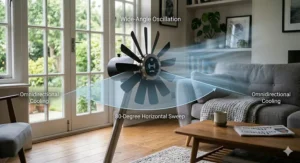
Engineered with dual-layer blades and a 55W DC motor, this Pro Breeze model generates impressive airflow whilst maintaining relatively quiet operation—29 decibels on whisper mode escalates to noticeable volume at full blast, but the beauty lies in those 25 intermediate steps. The 90-degree oscillation covers most standard living room layouts adequately, and the height adjustability between 115-135cm accommodates both low-slung modern sofas and traditional higher seating positions.
British reviewers highlight the remote control functionality as particularly well-executed. Unlike budget fans where the remote feels like an afterthought with laggy response and limited range, Pro Breeze’s implementation works reliably from across typical UK living room distances. The LED display clearly shows current settings without being obnoxiously bright during evening use—a detail that separates thoughtful design from cheap manufacturing.
What the specification sheet won’t tell you: the oscillation mechanism produces a subtle click at each rotation point, audible in a silent room but masked by normal conversation or television. Some buyers find this rhythmic clicking meditative; others find it mildly irritating. At speeds above 20, the airflow becomes genuinely powerful, almost aggressive—excellent for shifting stuffy air quickly after cooking or when multiple people have warmed the room, less pleasant for continuous gentle circulation.
✅ Pros: 26 speed settings for precise control | Dual blades increase airflow efficiency | Quiet mode genuinely quiet at 29dB | Reliable remote control | Competitive pricing in £60-£80 range
❌ Cons: Oscillation clicking audible in quiet rooms | Higher speeds can be noisy | Plastic construction feels adequate but not premium
This Pro Breeze model excels in active living rooms where families gather, children play, and noise levels naturally fluctuate. The wealth of speed options means everyone from heat-averse teens to chilly grandparents can find their comfortable setting. It handles larger living rooms (up to 30 square metres) better than smaller-blade competitors, making it particularly suitable for open-plan layouts common in modern UK developments.
Price verdict: In the £60-£80 range on Amazon.co.uk, this represents excellent value for feature-rich performance without premium pricing.
3. Dreo PolyFan 513S Smart Pedestal Fan — The Tech Integration Specialist
The Dreo PolyFan 513S bridges traditional fan functionality with contemporary smart home ecosystems, offering WiFi connectivity, Alexa and Google Assistant voice control, and comprehensive app-based customisation. For tech-enthusiastic households already invested in smart home infrastructure, this integration transforms a simple cooling device into a properly connected component of your domestic automation.
Beyond the smart features, the Dreo PolyFan delivers genuinely impressive fundamentals. The 120-degree horizontal oscillation combined with 105-degree vertical movement creates what Dreo terms “omni-directional” coverage—and in practice, this actually works. The airflow reaches up to 30 metres, making it one of few pedestal fans capable of genuinely circulating air in larger British living rooms or through archways into adjacent dining spaces. At 25 decibels on low settings, it maintains respectable quietness whilst the DC motor ensures minimal vibration and energy consumption.
UK buyers particularly appreciate the scheduling capabilities via the Dreo app. You can programme the fan to activate 30 minutes before you typically arrive home from work, gradually reduce speed as evening progresses, and turn off automatically at your usual bedtime—all without touching physical controls. The app also enables custom oscillation angles; if your living room layout means you only need 60-degree sweep rather than full 120 degrees, you can reduce wear on the motor and slightly improve efficiency.
What genuinely impresses is the build quality from a Chinese manufacturer. The 43-inch adjustable height feels stable rather than wobbly, the materials resist the cheap-plastic aesthetic that plagues many budget offerings, and British voltage compatibility comes properly certified with UKCA marking. One verified UK reviewer compared it favourably against their Dyson, noting quieter operation at low speeds and more powerful airflow at high settings—rather important when the Dyson costs double.
✅ Pros: Comprehensive smart home integration | 120° + 105° omni-directional oscillation | Powerful 30-metre airflow range | Quiet 25dB operation | Competitive £95-£130 pricing
❌ Cons: Requires WiFi for smart features | App adds complexity some users don’t want | Assembly required (though straightforward)
The Dreo PolyFan 513S suits living rooms in tech-forward households where voice control and automation enhance rather than complicate daily life. It’s particularly effective for shift workers who benefit from scheduling, households with varying occupancy patterns, or anyone who appreciates controlling devices without finding the remote.
Price verdict: Around £95-£130 on Amazon.co.uk positions this as exceptional value for smart-enabled performance previously requiring £200+ investments.
4. Zuvo 16″ Oscillating Pedestal Fan — The Budget Workhorse
The Zuvo 16″ makes no pretensions about premium engineering or innovative features—it’s a straightforward, traditional pedestal fan for living room applications where budget constraints matter more than whisper-quiet operation or aesthetic elegance. For many UK households, particularly students, renters, or those furnishing second properties, this represents entirely adequate cooling without financial strain.
With its basic three-speed motor and 180-degree oscillation, the Zuvo delivers functional airflow across medium-sized living rooms. The height adjustability works smoothly despite plastic construction, and the tilt mechanism allows reasonable directional control. Assembly takes under five minutes with just a screwdriver—Zuvo’s claim of “no tools required” isn’t quite accurate, but the process remains straightforward enough for anyone.
British reviewers consistently note the noise as this model’s primary compromise. At around 45+ decibels even on medium settings, it’s noticeably louder than premium alternatives—think dishwasher during washing cycle rather than whisper-quiet circulation. This matters less during active daytime use (children playing, cooking, conversation) but becomes intrusive during quiet activities like reading or evening relaxation. The oscillation mechanism produces audible clicks, and the motor hum increases linearly with speed.
What the £25-£35 price point buys you is reliability within realistic expectations. This won’t impress guests with silent operation or smartphone connectivity, but it will shift air adequately through your living room summer after summer without demanding significant investment or maintenance. Several UK buyers report 3+ years of daily seasonal use without failures—remarkable longevity for budget pricing.
✅ Pros: Extremely affordable £25-£35 pricing | 180° oscillation covers wide areas | Simple operation anyone can understand | Lightweight for easy repositioning | Available with next-day Prime delivery
❌ Cons: Noticeably noisy at 45dB+ | Basic plastic construction | No remote control | Limited speed options
This Zuvo model suits living rooms where daytime cooling during active household hours matters more than evening ambiance. It’s ideal for students, first-time buyers, holiday cottages, or as a secondary fan for occasional use. The straightforward operation appeals to elderly relatives who find smart features baffling or households where simplicity trumps sophistication.
Price verdict: At £25-£35 on Amazon.co.uk, this delivers remarkable value for basic, functional cooling without pretension or premium pricing.
5. Amazon Basics Digital Pedestal Fan — The Balanced Budget Option
The Amazon Basics Digital Pedestal Fan occupies interesting territory between budget basics and mid-range features, offering remote control, digital display, and dual-blade design at prices that won’t horrify value-conscious buyers. As Amazon’s own-brand offering, it benefits from streamlined distribution and reliable availability across the UK.
Equipped with a 60W motor and dual-layer blade configuration, this Amazon Basics model generates respectable airflow for its class. The three-speed settings prove adequate for most living room scenarios, whilst three distinct modes (Normal, Natural, Sleep) provide variation beyond simple power adjustment. Natural mode simulates outdoor breezes with speed fluctuations; Sleep mode gradually reduces intensity over time—both genuinely useful rather than mere marketing additions.
UK buyers appreciate the oscillation function and adjustable height (standard features, admittedly, but executed competently here). The remote control works reliably within typical living room distances, and the digital display shows current settings clearly without excessive brightness. Build quality sits firmly in “adequate” territory—nothing feels premium, but nothing feels worryingly cheap either. It’s the mechanical equivalent of a reliable Toyota: not exciting, rarely disappointing.
What distinguishes this from the Zuvo budget option is refinement. At around 40 decibels, it’s noticeably quieter than cheaper alternatives whilst remaining audible enough to discourage use during quiet activities. The timer function (up to 7.5 hours) proves genuinely useful for setting the fan to run whilst you’re out, then automatically shut off before energy waste becomes concerning. Several British reviewers mention using these in rental properties precisely because they’re inoffensive enough that landlords don’t object, yet functional enough to actually improve comfort.
✅ Pros: Balanced features-to-price ratio | Remote control included | Timer function | Dual-blade design | Amazon’s reliable customer service and returns
❌ Cons: Modest 40dB noise level | Basic three speeds limit control | Plastic construction throughout | Unremarkable aesthetics
The Amazon Basics fan suits living rooms where moderate budget meets moderate expectations—households wanting something noticeably better than basic models without approaching premium pricing. It’s particularly appropriate for renters who’ll eventually move and don’t want significant appliance investment, or as reliable secondary fans for conservatories and summer rooms.
Price verdict: Around £30-£40 on Amazon.co.uk makes this a sensible middle-ground choice balancing features, performance, and affordability.
6. Shark FlexBreeze Pro Mist FA300UK — The Versatile Luxury Option
The Shark FlexBreeze Pro Mist represents the premium end of living room cooling, combining pedestal fan functionality with integrated misting, cordless operation, and transformable design that shifts from full-height pedestal to tabletop configuration. This isn’t merely a fan; it’s a comprehensive cooling system for households willing to invest in versatility and performance.
What immediately distinguishes the Shark FlexBreeze is its cordless capability. The rechargeable battery provides up to 24 hours runtime on low settings (more realistically 8-10 hours on medium), meaning you can position it anywhere in your living room without cable routing constraints, then easily relocate it to your patio, conservatory, or even take it camping. For British households with gardens, the ability to seamlessly transition indoor comfort outdoors during those precious barbecue-weather days proves genuinely transformative.
The misting system deserves particular attention. Unlike novelty misting fans that merely spray water ineffectively, Shark’s implementation uses ultrasonic technology to create genuine micro-mist that can lower perceived temperature by several degrees in controlled environments. In a typical UK living room during a humid summer afternoon, engaging the mister creates noticeably cooler air without drenching furniture or creating damp patches. The 300ml water reservoir lasts 2-3 hours of continuous misting—long enough for evening comfort without constant refilling.
British buyers note the build quality immediately feels different from budget alternatives. The materials resist the cheap-plastic aesthetic, the motor operates smoothly across all five speed settings, and the oscillation mechanism rotates without audible clicking. At higher speeds, noise levels increase noticeably (though still below cheaper AC motor fans), but the powerful airflow justifies occasional louder operation for quick room cooling.
✅ Pros: Cordless versatility with 24-hour battery | Effective misting system | Transforms pedestal-to-tabletop instantly | Indoor/outdoor capability | Premium build quality
❌ Cons: Expensive £240-£300 pricing | Heavier than standard fans | Misting requires refilling | Charging time (4-5 hours for full charge)
The Shark FlexBreeze Pro suits living rooms in households valuing flexibility over basic functionality—homes with gardens where indoor-outdoor transitions matter, families with conservatories that become unbearable summer ovens, or buyers who appreciate premium engineering and don’t mind paying for genuinely useful features.
Price verdict: At £240-£300 on Amazon.co.uk, this represents significant investment justified only if cordless capability and misting genuinely enhance your lifestyle.
7. Pro Breeze AirFlo 43″ Hybrid Pedestal Fan — The 3-in-1 Transformation Specialist
The Pro Breeze AirFlo 43″ introduces genuine innovation to pedestal fan design with its tool-free transformation between full-height pedestal, medium-height, and tabletop configurations. This addresses a real problem most living room fans ignore: your cooling needs vary dramatically between seasons, activities, and room arrangements.
Operating at 29 decibels on low settings, the AirFlo maintains respectably quiet performance whilst its vertical and horizontal oscillation creates comprehensive room coverage. The nine-hour timer proves useful for programming operation around your schedule, and the remote control eliminates the need to cross your living room mid-film to adjust settings. What genuinely impresses is the dust filter inclusion—a small detail that meaningfully extends motor life and maintains airflow efficiency over years of use.
The essential oil compartment warrants mention as genuinely useful rather than gimmicky. During those uniquely British summer evenings when humidity makes rooms feel stuffy despite open windows, adding a few drops of eucalyptus or peppermint oil creates noticeably fresher circulation without overpowering artificial scent. It’s subtle enhancement rather than air freshener assault.
UK buyers particularly appreciate the hybrid design’s practicality. During summer’s peak heat, run it at full pedestal height for maximum circulation. As autumn arrives and you only need occasional gentle breeze, collapse it to tabletop mode for desk or side table placement. This adaptability means one £80-£100 purchase serves multiple purposes across seasons—better value than buying separate fans for different scenarios.
✅ Pros: Tool-free 3-in-1 transformation | Quiet 29dB operation | Dual oscillation coverage | Dust filter included | Essential oil compartment | Competitive £80-£100 pricing
❌ Cons: Heavier than fixed-height alternatives | Transformation mechanism adds complexity | Assembly required initially
The Pro Breeze AirFlo suits living rooms where flexibility matters—households that rearrange furniture seasonally, open-plan spaces with varying cooling needs, or buyers who appreciate multi-functional design over single-purpose tools.
Price verdict: Around £80-£100 on Amazon.co.uk makes this excellent value for genuinely useful versatility rather than mere feature bloat.
How to Position Your Pedestal Fan for Maximum Living Room Cooling
Most British households waste 30-40% of their fan’s potential through poor positioning—a particular shame when you’ve invested in a quality adjustable height living room fan that could perform dramatically better with minor placement adjustments. The key lies in understanding air circulation patterns rather than simply pointing the fan wherever feels momentarily refreshing.
Strategic corner placement beats central positioning for most living room layouts. Position your large living room pedestal fan in a corner approximately 1.5-2 metres from the nearest wall, angled at roughly 45 degrees toward the opposite corner. This creates a diagonal airflow pattern that bounces off walls and circulates throughout the room rather than blasting directly at occupants. Research from the Building Research Establishment demonstrates that proper air circulation can reduce perceived indoor temperatures by 3-5°C without mechanical cooling, making strategic fan placement genuinely impactful for British homes lacking air conditioning. British living rooms with their typical alcoves, bay windows, and chimney breasts benefit particularly from this approach—the fan works with your room’s architecture rather than fighting it.
Height adjustment matters more than most buyers realise. For rooms with standard 2.4-metre ceilings common in UK homes, position the fan head at approximately 1.2-1.4 metres—roughly chest-to-shoulder height when seated. This ensures airflow travels above furniture (avoiding that frustrating experience where your sofa back blocks all circulation) whilst remaining low enough to create proper circulation patterns. Victorian and Edwardian properties with higher ceilings benefit from maximum height extension, allowing the fan to push warm air down from ceiling level whilst drawing cooler air up from floor level.
Avoid these common British living room mistakes: Never position fans directly in front of radiators during transitional seasons (spring/autumn)—you’ll fight your heating system unnecessarily. Don’t place them behind open doors that block oscillation patterns. In open-plan layouts connecting living and dining areas, position the fan to push air through the archway or opening rather than parallel to it. And never, ever position a powerful fan directly facing your television screen—the vibration, however minimal, creates subtle image interference that becomes maddening during films.
Understanding Oscillation Patterns: Why Direction Matters in British Living Rooms
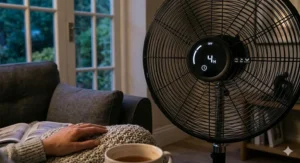
The difference between basic horizontal oscillation and modern multi-directional movement fundamentally changes how effectively a freestanding living room cooling solution performs in real UK homes. Traditional pedestal fans sweep side-to-side in predictable arcs, creating zones of high airflow alternating with dead spots. Advanced models like the Meaco 1056P or Dreo PolyFan 513S add vertical movement, transforming linear sweeps into three-dimensional circulation patterns.
Horizontal oscillation (the standard 60-90 degree sweep most fans provide) works adequately in rectangular living rooms where furniture aligns along walls. The fan positioned at one end creates a pendulum effect, alternately cooling different zones. This proves sufficient for smaller spaces (under 20 square metres) with simple layouts. British buyers should target at least 80-degree oscillation for living rooms—narrower sweeps leave frustrating gaps where the breeze never reaches.
Multi-directional oscillation changes the equation entirely for larger or awkwardly shaped spaces. By combining horizontal sweep with vertical tilt, these fans create circulation that reaches occupants at different heights (children on floor, adults on sofas, standing guests) whilst pushing air across the entire vertical column of the room. This matters particularly in British period properties with high ceilings—a horizontally-oscillating fan merely shifts air at one level, whilst multi-directional models properly circulate the entire volume.
The Meaco Sefte series introduces customisable oscillation angles—genuinely useful innovation rather than gimmickry. In L-shaped living rooms (common in UK semi-detached conversions), you can programme 40-degree oscillation targeting just the occupied zone rather than wasting energy sweeping empty alcoves. This precision reduces motor wear and slightly improves energy efficiency whilst delivering more focused comfort.
Real-World Scenario: Choosing the Right Fan for Common UK Living Room Types
Terraced house Victorian conversion (15-18 square metres): Your living room likely features high ceilings (2.7+ metres), single aspect windows, and limited floor space. The Meaco 1056P excels here despite its premium pricing—the multi-directional oscillation handles vertical circulation brilliantly, and the compact 12-inch head doesn’t visually dominate your already-limited space. Position it in the corner furthest from your television at maximum height extension, angled to bounce air off the opposite wall.
Modern new-build open-plan (25-30 square metres): These spaces connect living, dining, and kitchen zones with minimal separation—brilliant for family interaction, challenging for air circulation. The Dreo PolyFan 513S handles this superbly with its 30-metre airflow range and 120-degree oscillation. Position it between the living and dining zones, programmed to activate during evening family time. The smart scheduling means it pre-cools before you arrive home from work without running continuously.
1930s semi-detached (20-22 square metres): Standard layout with bay window, fireplace alcove, and doorway to hallway. Your best value lies with the Pro Breeze Dual Blade 16″—the 26 speed settings accommodate varying occupancy (quiet speeds when reading alone, powerful when hosting), and the competitive pricing leaves budget for decent curtains that actually reduce solar heat gain. Position it in the alcove opposite the bay window, using medium-high speeds to push hot air accumulated near the glass back through the room.
Compact flat or maisonette (12-15 square metres): Limited floor space and likely lower ceilings (2.3 metres) mean oversized fans feel oppressive. The Pro Breeze AirFlo 43″ transforms this limitation into advantage—run it at tabletop height during summer for powerful cooling without floor space sacrifice, then extend to pedestal mode during transitional seasons when you only need occasional circulation. The tool-free transformation means actually using this feature rather than leaving it permanently configured.
Period cottage or rural property (variable, often awkward shapes): Beamed ceilings, uneven walls, and quirky layouts require flexible solutions. The Shark FlexBreeze Pro cordless capability proves transformative—position it wherever needed without cable routing nightmares, easily relocate between your inglenook fireplace area and window seat as sun patterns shift, and take it to your garden during those precious outdoor evenings without buying separate equipment.
Energy Costs Reality Check: What Running a Pedestal Fan Actually Costs in 2026
With UK electricity hovering around 28p per kilowatt-hour in 2026 (following the latest Ofgem price cap adjustments), understanding actual running costs helps contextualise those premium fan prices. A traditional AC motor fan consuming 50-60W costs approximately 1.4-1.7p per hour to operate. Run it six hours daily through a three-month summer (roughly 540 hours), and you’re spending £7.56-£9.18 for the season—negligible compared to air conditioning but worth understanding nonetheless.
DC motor efficiency changes the calculation dramatically. The Meaco 1056P consumes just 9.5-23.5W depending on speed setting—at typical medium speed (around 15W), that’s 0.42p per hour. The same 540-hour summer season costs £2.27. Over a fan’s realistic 7-10 year lifespan in British households, DC motors save £35-£50 compared to AC equivalents whilst delivering quieter, smoother operation. This partially justifies premium pricing for models like the Meaco or Dreo units.
Smart scheduling amplifies these savings beyond simple wattage calculations. Programme your Dreo to run only during occupied hours rather than leaving it spinning continuously, and you’ll realistically operate 30-40% fewer hours whilst maintaining identical comfort. That £2.27 seasonal cost drops below £1.50—trivial savings in absolute terms, but the environmental impact of reduced electricity consumption matters increasingly to British households.
Compare this with portable air conditioning units popular in continental Europe but less common here: a typical 2.5kW unit costs 70p per hour to run. Just one afternoon of air conditioning (4 hours) costs £2.80—more than running an efficient pedestal fan for an entire summer season. This explains why traditional pedestal fans for living room cooling remain so popular in the UK despite our gradually warming climate.
Common Mistakes When Buying Pedestal Fans (And How to Avoid Them)
Mistake 1: Assuming bigger always means better airflow. That impressive-looking 18-inch blade fan seems logically more powerful than a 12-inch alternative, yet British living rooms rarely benefit from oversized blades. What matters is motor efficiency, blade design, and oscillation pattern. The Meaco 1056P with its modest 12-inch diameter outperforms numerous 16-inch budget models through superior engineering rather than raw size. For UK living rooms under 25 square metres, 12-16 inch diameters prove optimal—larger blades merely consume more energy whilst creating potentially uncomfortable direct wind blasts.
Mistake 2: Ignoring noise specifications entirely until the fan arrives. British buyers accustomed to quieter appliances often suffer shock when their budget pedestal fan sounds like a distant aircraft during operation. Always check decibel ratings: under 30dB qualifies as genuinely quiet (Meaco 1056P at 20dB, Pro Breeze AirFlo at 29dB), 30-40dB remains noticeable but tolerable (Amazon Basics around 40dB), whilst anything above 45dB becomes intrusive during quiet activities (Zuvo budget option). If specifications omit noise ratings entirely, that’s usually a warning sign.
Mistake 3: Buying based solely on Amazon reviews without considering UK-specific factors. Many highly-rated fans on Amazon.com perform differently in British conditions. Our damper climate affects motor bearing lubrication (cheaper fans develop noise faster in humid environments), our 230V electrical system stresses components differently than 120V American standards, and our typically smaller room sizes mean powerful American-market fans can feel overwhelming. Always verify the product ships from UK stock with proper UKCA certification and British plug compatibility—not just a foreign plug with an adapter.
Mistake 4: Underestimating the importance of proper oscillation range. A fan oscillating just 60 degrees creates frustrating dead zones in most living rooms, forcing you to constantly reposition furniture or the fan itself. Target minimum 80-degree horizontal oscillation for typical rectangular British living rooms; 90-120 degrees suits larger or open-plan spaces. The Dreo’s 120-degree coverage proves genuinely transformative compared to budget models with narrower sweeps—this isn’t mere specification inflation but meaningful functional difference.
Mistake 5: Neglecting the cord length reality. British living rooms often position sockets in inconvenient locations (thanks to historic wiring schemes predating modern electronics). That impressive fan becomes frustrating if its 1.5-metre cable can’t reach your nearest socket without an unsightly extension lead trailing across the room. Check cable length specifications before purchasing, or budget for a discrete extension solution. Alternatively, consider the Shark FlexBreeze cordless option if your living room suffers particularly poor socket placement.
Maintenance Secrets: Making Your Pedestal Fan Last a Decade
Weekly during active use (summer months): Wipe down the grille with a microfibre cloth to prevent dust accumulation that restricts airflow and increases noise. British homes generate surprising dust levels—combination of carpeting, textile furnishings, and our tendency to keep windows closed during pollen season. Just 30 seconds of weekly wiping maintains optimal performance and prevents that characteristic “dusty electrical smell” that develops when debris contacts the motor housing.
Monthly deep clean: Disassemble the fan following manufacturer instructions (most modern models use tool-free clips) and wash the grille and blades in warm soapy water. Dry thoroughly before reassembly—moisture near electrical components invites corrosion in our humid climate. This prevents the gradual efficiency decline that makes fans feel less powerful over time. British buyers often assume their fan is “wearing out” when actually it’s merely dirty.
Seasonal storage protocol: Before tucking your fan away for winter, clean it thoroughly, then store it in a breathable bag or covered with a cotton sheet rather than plastic. British garages and sheds experience dramatic humidity fluctuations—sealing a fan in plastic traps condensation that corrodes motor components over winter months. If storing in an unheated space, consider adding silica gel packets inside the motor housing to absorb ambient moisture.
Lubrication for long-term performance: Many quality fans (including Meaco and Dreo models) use sealed bearings requiring no maintenance, but budget options with exposed mechanisms benefit from annual lubrication. One drop of light machine oil (3-in-1 or sewing machine oil) on each bearing point prevents the grinding noise that develops after 2-3 years of use. Never use WD-40—it’s a solvent, not a lubricant, and will actually accelerate wear despite initial improvement.
The UK-specific corrosion challenge: Our humid climate accelerates metal corrosion compared to drier regions. If your fan features metal components (grilles, stands), inspect annually for rust spots. Catch early corrosion with fine steel wool and touch-up paint before it compromises structural integrity. This simple maintenance extends fan life from 5-7 years to 10+ years—meaningful savings considering quality models cost £80-£150.
Frequently Asked Questions
❓ Are pedestal fans better than tower fans for UK living rooms?
❓ How noisy are pedestal fans compared to tower fans?
❓ Can I leave a pedestal fan running overnight in my living room?
❓ Do pedestal fans actually cool rooms or just move air?
❓ What's the difference between AC and DC motor pedestal fans?
Conclusion: Choosing Your Perfect Living Room Pedestal Fan
Selecting the best pedestal fan for living room applications needn’t overwhelm you when you understand which features genuinely matter versus mere marketing noise. For most British households, the sweet spot lies in the £80-£130 range where DC motors, multi-speed control, and quality construction meet without premium pricing. The Pro Breeze Dual Blade (£60-£80) and Dreo PolyFan 513S (£95-£130) represent exceptional value here, delivering features previously requiring £150+ investments whilst maintaining quiet operation and reliable performance.
Noise-sensitive households benefit dramatically from the Meaco 1056P‘s whisper-quiet 20dB operation and multi-directional circulation—the £140-£150 premium purchases genuinely superior engineering from a British company understanding UK conditions. Conversely, budget-conscious buyers find the Zuvo 16″ (£25-£35) delivers functional cooling for active daytime use despite acoustic compromises. The Shark FlexBreeze Pro (£240-£300) justifies its premium only for households genuinely benefiting from cordless versatility and misting capability—brilliant for specific situations, unnecessary for many.
Your living room’s specific quirks matter more than any single product recommendation. Terraced Victorian conversions with high ceilings demand different solutions than modern open-plan layouts or compact flats. Consider your noise tolerance, smart home preferences, budget constraints, and seasonal storage reality before purchasing. A £150 fan gathering dust in your garage because its features overwhelm you represents worse value than a £40 basic model used daily.
British summer might remain unpredictable and often disappointingly brief, but those humid July afternoons and stifling August evenings genuinely benefit from proper air circulation. Your living room—the heart of your home where you actually live rather than merely sleep—deserves better than suffering through discomfort or relying on inefficient solutions. Whether you invest £30 or £250, choose thoughtfully based on your specific needs rather than marketing promises, and enjoy genuinely improved comfort for years to come.
Recommended for You
- 7 Best Living Room Fans UK 2026
- 7 Best Fan for Hot Sleepers UK 2026 – Cool Sleep Guide
- 7 Best Fan for Small Bedroom UK 2026
Disclaimer: This article contains affiliate links. As an Amazon Associate, I earn from qualifying purchases. If you purchase products through these links, we may earn a small commission at no additional cost to you.
✨ Found this helpful? Share it with your mates! 💬🤗
