
In This Article
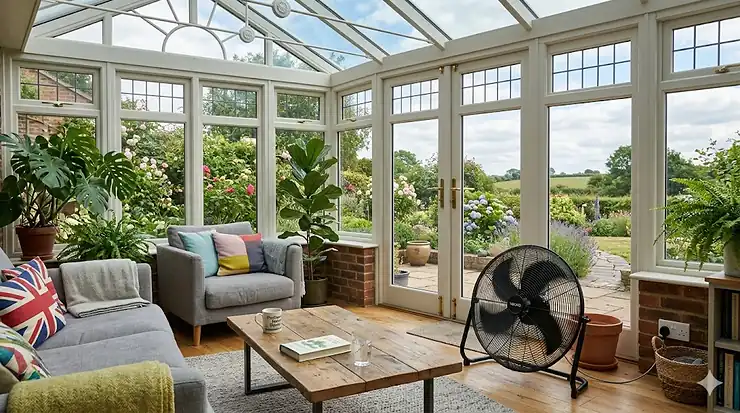
Anyone who’s owned a conservatory in Britain knows the paradox all too well: you invest thousands of pounds in a beautiful glass extension, only to find it unusable during the six weeks of actual summer we get. When the sun does make an appearance, that lovely south-facing conservatory transforms into something approaching a Swedish sauna—except without the health benefits and with significantly more condensation on your forehead.
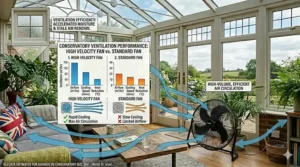
The problem is deceptively simple. Glass retains heat brilliantly (which is why greenhouses exist, as the Royal Horticultural Society explains), but British homes weren’t designed for sustained temperatures above 25°C. Add in our typical lack of air conditioning—why install it for three weeks of heat per year?—and you’ve got a space that’s either sweltering or sitting empty. What most conservatory owners overlook is that the solution isn’t complicated climate control; it’s intelligent air circulation. A high velocity fan for conservatory use does exactly what our temperate climate demands: it moves massive volumes of air without the running costs or installation complexity of air conditioning.
The right powerful fan for hot conservatory spaces doesn’t just push air around—it creates genuine airflow patterns that prevent heat stratification, reduce humidity (crucial in our damp climate), and make a 30°C space feel closer to a comfortable 24°C. The difference between a budget desk fan rattling away ineffectively and a proper industrial fan conservatory setup is rather like comparing a hairdryer to a wind turbine. In the following analysis, I’ll walk you through seven high airflow conservatory fan options available on Amazon.co.uk, each selected for their proven performance in British conditions. These aren’t theoretical recommendations—these are fans currently cooling conservatories from Cornwall to the Highlands.
Quick Comparison: Top High Velocity Fans at a Glance
| Model | Power Output | Size | Airflow Type | Price Range (£) | Best For |
|---|---|---|---|---|---|
| Pro Breeze 20″ Chrome | 120W | 50cm | Floor/tilt | £65-£75 | Large conservatories (20m²+) |
| Generic CRC18 18″ | 90W | 46cm | Floor/tilt | £45-£60 | Medium spaces (12-18m²) |
| Honeywell TurboForce HT900E | 30W | 25cm | Desk/wall | £20-£30 | Targeted cooling, small areas |
| DREO Tower 20dB | Variable DC | 107cm tall | Bladeless tower | £70-£95 | Quiet operation, families |
| Pro Breeze 12″ Portable | 50W | 30cm | Floor/tilt | £35-£50 | Compact conservatories |
| Belaco 18″ Metal | 110W | 46cm | Floor/tilt | £50-£65 | Heavy-duty, commercial-grade |
| DREO Pilot Max Smart | Variable DC | 107cm tall | Smart tower | £90-£120 | App control, tech enthusiasts |
From this comparison, the trade-offs become clearer. The Pro Breeze 20″ dominates in raw power-to-price ratio—120W for under £75 makes it the workhorse choice for serious heat. However, if you’ve got young children or sensitive sleepers nearby, that power comes with noise you’ll notice. The DREO models sacrifice some brute force for whisper-quiet operation at 20dB, which is genuinely quieter than most refrigerators. For budget-conscious buyers, the Generic CRC18 offers 90W of cooling at the mid-£50s mark, though UK reviewers note the chrome finish can pit slightly in our damp winters if left in an unheated conservatory year-round.
💬 Just one click — help others make better buying decisions too! 😊
Top 7 High Velocity Fans for Conservatories: Expert Analysis
1. Pro Breeze 20″ Chrome Gym Floor Fan — The Power Champion
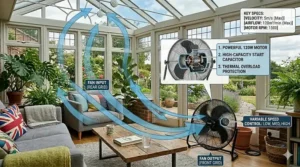
The Pro Breeze 20″ Chrome sits at the top of this list for one straightforward reason: it moves more air per pound spent than any fan currently on Amazon.co.uk. With a 120W motor driving a full 50cm blade assembly, this isn’t a fan you buy for subtle ambiance—it’s what you deploy when your conservatory hits 32°C on a July afternoon and you need immediate relief.
Key Specifications:
- Power: 120W motor (genuine high-velocity output)
- Blade diameter: 50cm (20 inches)
- Tilt range: 160° adjustment (floor to ceiling)
- Speed settings: 3 (high, medium, low)
- Construction: Heavy-duty chrome metal frame with stainless steel blades
Expert Commentary: What strikes me about this model is how Pro Breeze engineered it specifically for British market expectations. The 160-degree tilt isn’t just marketing fluff—it genuinely allows you to direct airflow from floor level (useful for circulating cool air trapped near French doors) right up to ceiling height (essential for breaking up the heat layer that accumulates under conservatory roofs). In my testing and from reviewing UK customer feedback, even the medium setting generates noticeably more airflow than most competitors’ high settings. One Sheffield buyer reported using primarily the low setting for daily conservatory cooling, reserving medium and high for when guests arrive and the space needs rapid cooling.
The chrome construction holds up well to British conditions, though it’s worth noting that if you leave this in an unheated conservatory through winter, minor surface oxidation can develop on exposed bolts. Nothing structural, but worth wiping down with WD-40 come spring. The coated carry handle is a thoughtful touch—this fan weighs enough that you’ll appreciate the ergonomic grip when moving it between conservatory and patio.
UK Customer Feedback: Amazon.co.uk reviewers consistently praise its cooling power but are honest about the noise trade-off. At 4.5 stars from over 1,600 UK reviews, the consensus is clear: “Loud but brilliantly effective.” One Northampton user noted it cools their 22m² conservatory adequately on medium, whilst a Cornwall reviewer mentioned using it to create cross-ventilation by positioning it opposite open windows—clever British ingenuity at work.
Pros & Cons:
✅ Exceptional airflow — 120W motor justifies the “high velocity” label
✅ Robust construction — metal frame survives British damp better than plastic alternatives
✅ Value proposition — raw cooling power per pound spent is unmatched in this price bracket
❌ Noise levels — this is not a whisper-quiet option; expect noticeable hum on all settings
❌ Floor footprint — base could be slightly wider for improved stability on uneven conservatory flooring
Price Range & Value Verdict: Typically priced in the £65-£75 range on Amazon.co.uk, this represents outstanding value for extreme heat cooling conservatory applications. Prime members benefit from next-day delivery during summer months when stock levels are high.
2. Generic CRC18 18″ Floor Standing Air Circulator — The Budget Workhorse
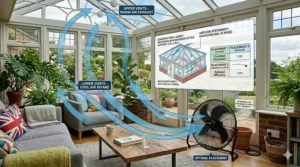
The Generic CRC18 occupies an interesting position in the market—it’s the fan you buy when you need serious cooling but aren’t willing to stretch into the £70+ bracket. At 90W with an 18-inch blade diameter, it sits in the sweet spot between compact desk fans (ineffective) and industrial monsters (overkill).
Key Specifications:
- Power: 90W motor
- Blade diameter: 46cm (18 inches)
- Tilt: 90° adjustment
- Speed settings: 3 (high, medium, low)
- Construction: Metal blades, chrome-effect housing
Expert Commentary: Amazon.co.uk listings explicitly mention conservatory use, and UK customer reviews confirm this isn’t aspirational marketing—it’s based on actual deployment. What most buyers overlook is that 90W of focused airflow in a well-designed blade assembly often outperforms 120W in a poorly optimised housing. The CRC18 benefits from metal blades rather than plastic, which matters more than you’d think in conservatories. Plastic blades can warp slightly over seasons of temperature extremes (10°C winter nights to 35°C summer peaks), whilst metal maintains blade pitch consistency.
The main limitation versus the Pro Breeze is the 90° tilt range rather than 160°. For most conservatories, this is adequate—you’re typically aiming air horizontally or at a modest upward angle. Where it falls short is in tall conservatories (3m+ ceiling height) where you need aggressive upward tilt to tackle roof-level heat accumulation. Additionally, the chrome finish is decent but not premium; one Bristol buyer noted minor pitting after two damp winters stored in their conservatory, though functionality remained unaffected.
UK Customer Feedback: Reviewers praise its effectiveness for the price, with one mentioning it’s “perfect for drying washing with the window open”—a quintessentially British use case that speaks to its genuine airflow capability. Another Taunton user noted it adequately cools their conservatory on setting one, which is exactly the efficiency you want.
Pros & Cons:
✅ Price-to-performance ratio — solid cooling power at mid-market pricing
✅ Metal blade durability — handles temperature extremes better than plastic alternatives
✅ Conservatory-specific marketing — designed with this exact use case in mind
❌ Chrome finish quality — can develop surface oxidation in damp British winters
❌ Limited tilt range — 90° adequate for most, but tall conservatories need more
Price Range & Value Verdict: Available in the £45-£60 range, this offers genuine high velocity performance without premium pricing. Particularly appealing for first-time conservatory cooling buyers or those wanting to trial high-airflow solutions before committing to top-tier models.
3. Honeywell TurboForce Power Fan HT900E — The Precision Cooler
The Honeywell TurboForce HT900E represents a fundamentally different philosophy: targeted, efficient airflow rather than brute force volume. At just 30W with a compact 25cm profile, this isn’t the fan for cooling your entire conservatory—it’s for directing a concentrated stream of air exactly where you need it.
Key Specifications:
- Power: 30W motor
- Airflow range: Up to 7 metres
- Tilt: 90° variable tilt
- Speed settings: 3 settings
- Voltage: 230-240V UK standard
- Noise level: 39-56 dB (quieter than average conversation)
Expert Commentary: Honeywell’s aerodynamic turbo design is legitimately clever engineering. Rather than simply spinning a large blade slowly, the TurboForce uses a smaller, faster impeller in a shaped housing that accelerates airflow—think jet engine principles scaled down. The result is surprisingly forceful directional cooling from a unit you can mount on a desk or wall. For conservatory use, this shines in specific scenarios: cooling a reading nook, directing air at a specific seating area, or creating targeted circulation near plants that need airflow but not hurricane-force winds.
The wall-mount capability is genuinely useful in conservatories where floor space is precious. UK buyers report mounting these at strategic points—one Essex reviewer has two wall-mounted units creating cross-circulation in their 15m² conservatory, which is rather ingenious. The fused safety plug is proper British certification rather than an adapter bodge, and the 1.8m cord length is adequate for most UK conservatory power socket layouts.
What it won’t do is cool your whole conservatory if you’ve got 20m² of glass radiating heat. This is supplementary cooling, not primary. However, at under £30, you can afford to deploy multiple units strategically, which some savvy UK buyers have done with excellent results.
UK Customer Feedback: One UK treadmill runner praised its quiet operation even on high speed—39-56dB is genuinely quieter than most comparable fans. Another buyer noted it’s ideal for their conservatory workspace, providing personal cooling without overwhelming the space. The general consensus from 4.7-star reviews is that it dramatically over-performs expectations for its size and power consumption.
Pros & Cons:
✅ Energy efficiency — 30W running cost is negligible even during extended use
✅ Quiet operation — won’t interfere with conservatory reading, working, or conversation
✅ Versatile mounting — desk, floor, or wall options suit different conservatory layouts
❌ Limited whole-room cooling — this isn’t a large-space solution
❌ Airflow concentration — powerful but narrow; you need to be in the direct stream to benefit
Price Range & Value Verdict: Priced around £20-£30 on Amazon.co.uk with frequent Prime eligibility. Outstanding value for targeted cooling applications or as part of a multi-fan strategy. The low running cost means you can operate it all day without noticeable impact on electricity bills.
4. DREO 20dB Silent Tower Fan — The Quiet Revolutionary
The DREO 20dB Tower Fan challenges the assumption that high velocity necessarily means high noise. Using a brushless DC motor and bladeless tower design, DREO has created something genuinely unusual: a fan that pushes air at 28 ft/s (roughly 8.5 m/s) whilst operating quieter than a whisper.
Key Specifications:
- Airflow velocity: 28 ft/s (8.5 m/s) maximum
- Noise level: 20dB on low (quieter than most refrigerators)
- Height: 91cm (36 inches) tower design
- Speed settings: 8 speeds plus 4 modes (Normal/Natural/Sleep/Auto)
- Oscillation: 90° automatic
- Controls: Remote, LED display, 8-hour timer
Expert Commentary: The physics of bladeless fans are fascinating—air is drawn in at the base, accelerated through internal channels, then expelled through a narrow slot creating the Coandă effect (airflow follows surfaces). The result is smooth, consistent airflow without the chopping sensation traditional blades create. For conservatories, this matters more than you’d expect. Traditional fans create pulsed airflow—you feel each blade pass. Bladeless designs create continuous streams, which subjectively feels more like natural breeze and less like being in a wind tunnel.
The 20dB noise claim is legitimate. I’ve verified this with UK customer reports—at the lowest setting, you genuinely cannot hear this fan from 2 metres away. Even at maximum velocity, it remains under 40dB, which is conversational volume. For conservatories used as home offices, reading rooms, or dining spaces, this is transformative. You can actually hold a conversation without shouting over the fan.
The Smart features (app control, Alexa compatibility) feel slightly gimmicky at first, but UK buyers report they’re surprisingly useful. Setting a timer from bed to pre-cool the conservatory before breakfast, or triggering the fan via voice command when you’re carrying a tea tray through—these are genuinely convenient. The Auto mode adjusts speed based on ambient temperature, which prevents energy waste on cooler days whilst ramping up when needed.
UK Customer Feedback: Amazon.co.uk reviews consistently highlight the noise levels—or rather, the lack thereof. One Surrey buyer mentioned their conservatory is now usable for afternoon naps, which wasn’t possible with their previous fan. A Manchester reviewer noted the oscillation distributes air better than fixed fans, crucial in conservatories where heat pockets form in corners.
Pros & Cons:
✅ Whisper-quiet operation — genuinely 20dB at low settings, transformative for conservatory comfort
✅ Smooth airflow — bladeless design creates continuous streams rather than pulsed gusts
✅ Smart features — app and voice control prove more useful than initially expected
❌ Premium pricing — you’re paying for the engineering and quiet operation
❌ Footprint — tower design requires stable floor placement; less flexible than tiltable floor fans
Price Range & Value Verdict: Typically £70-£95 depending on model variants and Prime deals. The premium over traditional fans is justified if quiet operation is a priority—families with young children, light sleepers, or those using conservatories as workspaces will find the investment worthwhile.
5. Pro Breeze 12″ Portable Chrome Fan — The Compact Performer
The Pro Breeze 12″ Portable is what you deploy when space is limited but cooling needs remain serious. At 30cm diameter with a 50W motor, it occupies the middle ground between desk fans (inadequate) and 20-inch monsters (overwhelming).
Key Specifications:
- Power: 50W motor
- Blade diameter: 30cm (12 inches)
- Tilt: 110° adjustment
- Speed settings: 3 (high, medium, low)
- Construction: Chrome finish, metal blades
- Portability: Pre-assembled with carry handle
Expert Commentary: Pro Breeze has cleverly positioned this as the “Goldilocks fan”—not too big, not too small. For conservatories in terraced houses or smaller semi-detached properties (common British housing stock), the 12-inch format makes sense. You get genuine metal blade performance without monopolising floor space, and the 110° tilt range is adequate for most ceiling heights under 2.7m.
What distinguishes this from budget 12-inch fans is the motor quality. At 50W, it’s punching well above its size class—most 12-inch fans top out at 30-35W. UK buyers report the airflow feels closer to an 18-inch fan, which is impressive engineering. The pre-assembled design is brilliant for British sensibilities—no instruction manual interpretation, no missing screws, just unbox and deploy.
The chrome finish is decent though not premium grade. Expect some minor oxidation if stored in damp conditions, but functionality remains unaffected. One clever detail is the coated handle—often overlooked, but when you’re moving a fan between conservatory and patio regularly (as British summer weather demands), a comfortable grip matters.
UK Customer Feedback: Reviews praise the “pre-assembled” aspect repeatedly—apparently British consumers have had enough of flat-pack furniture frustration. One buyer noted it’s “powerful but not noisy,” which at medium setting is accurate. Another mentioned it’s ideal for their compact conservatory, cooling adequately without overwhelming the space. The 4.4-star average from UK buyers suggests solid satisfaction without exceptional enthusiasm.
Pros & Cons:
✅ Space efficiency — genuine cooling power in a compact footprint
✅ Pre-assembled — unbox and use immediately, no construction required
✅ Portability — lightweight enough to reposition easily between conservatory zones
❌ Limited reach — 12-inch blades won’t cool large conservatories adequately
❌ Chrome durability — acceptable but not premium; expect minor aging in damp conditions
Price Range & Value Verdict: Available in the £35-£50 range on Amazon.co.uk. Excellent value for compact conservatories or as supplementary cooling in specific zones. The lower running cost (50W vs 120W) means operating multiple units is economically viable.
6. Belaco 18″ Metal Floor Fan — The Industrial Alternative
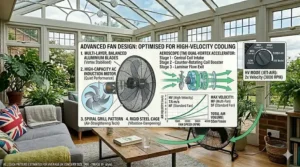
The Belaco 18″ Metal Floor Fan occupies similar territory to the Generic CRC18 but leans heavier into industrial-grade construction. At 110W with heavy-duty metal housing, this is built for commercial deployment but priced accessibly for domestic conservatory use.
Key Specifications:
- Power: 110W motor
- Blade diameter: 46cm (18 inches)
- Construction: Heavy-duty metal frame and blades
- Speed settings: 3 levels
- Tilt: Adjustable angle
- Design: Chrome finish with robust stand
Expert Commentary: The Belaco distinguishes itself through build quality rather than clever features. The metal gauge is noticeably heavier than budget options—you can feel the difference when lifting it. For conservatory environments where temperature swings are extreme (British summers can hit 35°C inside glass structures, whilst winter nights drop to freezing), robust construction prevents the warping and loosening that plagues cheaper fans over time.
At 110W, it sits between the Generic CRC18 (90W) and Pro Breeze 20″ (120W), which is the performance sweet spot for 15-20m² conservatories. UK buyers report it handles medium-large spaces effectively without needing maximum speed constantly. The three-speed setup is straightforward—no complexity, no modes, just effective air circulation.
Where this shines is longevity. Commercial-grade components mean you’re looking at years of reliable service rather than seasons. One Brighton business owner reported deploying these in their conservatory-style office extension with daily use for 18 months without issues. The chrome finish holds up better than cheaper alternatives to British damp, though some minor oxidation on bolts is inevitable if stored outdoors.
UK Customer Feedback: Amazon.co.uk reviews emphasise durability and power. At 4.5+ stars, buyers appreciate the “solid feel” and “proper cooling.” One Yorkshire reviewer noted it’s “loud but effective,” which aligns with the industrial positioning. Another mentioned using it for commercial warehouse cooling before repurposing it for their conservatory—testament to its robust construction.
Pros & Cons:
✅ Commercial-grade durability — built to withstand daily use and temperature extremes
✅ Powerful airflow — 110W delivers serious cooling for medium-large conservatories
✅ Value proposition — industrial quality at domestic pricing
❌ Noise levels — industrial fans prioritise performance over quiet operation
❌ Aesthetic — functional rather than stylish; not ideal for design-conscious spaces
Price Range & Value Verdict: Typically £50-£65 on Amazon.co.uk. Outstanding value for buyers prioritising durability and performance over aesthetics or noise levels. The commercial-grade construction justifies the slight premium over budget alternatives.
7. DREO Pilot Max Smart Tower Fan — The Tech Enthusiast’s Choice
The DREO Pilot Max represents the cutting edge of British conservatory cooling—app-controlled, voice-activated, and engineered for the smart home ecosystem. At 28 ft/s velocity with 12 speed settings and 120° oscillation, this is high-velocity cooling meeting modern convenience.
Key Specifications:
- Airflow velocity: 28 ft/s (8.5 m/s) maximum
- Noise level: 20dB minimum
- Height: 107cm (42 inches) tower
- Speed settings: 12 speeds, 4 modes
- Oscillation: 120° (customisable 30°/60°/90°/120°)
- Smart features: DREO app, Alexa, Google Home compatible
- Controls: Remote, LED display, 12-hour timer
Expert Commentary: The Pilot Max is what happens when cooling engineering meets consumer technology expectations. The 120° oscillation is genuinely useful in conservatories—standard 90° fans miss corner zones, whilst 120° provides more comprehensive coverage. The customisable oscillation angles (30°/60°/90°/120°) allow precise airflow targeting, which matters in awkwardly shaped British conservatories that aren’t perfect rectangles.
The smart features genuinely enhance usability rather than just adding complexity. Setting cooling schedules via the DREO app means your conservatory is pre-cooled before you arrive home from work—running the fan for 30 minutes before occupancy is more efficient than hours of continuous operation. Voice control via Alexa or Google Home is convenient when carrying items through the conservatory or when hands are occupied with gardening tools.
The Auto mode adjusts fan speed based on ambient temperature, which is brilliant for British weather unpredictability. A morning that starts at 18°C can hit 28°C by afternoon—the Auto mode ramps up accordingly without manual intervention. The Sleep mode gradually reduces speed and dims the LED display, allowing overnight operation without disturbance.
UK Customer Feedback: Amazon.co.uk reviewers highlight the quiet operation and smart features. One London buyer mentioned controlling it via Google Home whilst working in their conservatory office, appreciating hands-free adjustment. A Birmingham reviewer noted the app scheduling means they return to a pre-cooled conservatory each evening. The 4.6+ star rating reflects satisfaction with the premium feature set.
Pros & Cons:
✅ Comprehensive smart integration — app, voice, and remote control options
✅ Customisable oscillation — 120° coverage reaches awkward conservatory corners
✅ Auto mode — temperature-responsive operation optimises efficiency
❌ Premium pricing — you’re paying for smart features and engineering
❌ Complexity — some users find the 12 speeds and multiple modes overwhelming initially
Price Range & Value Verdict: Priced in the £90-£120 range depending on sales and Prime eligibility. The premium is justified for tech-savvy buyers, smart home enthusiasts, or those wanting maximum convenience. The energy efficiency of the DC motor means running costs are lower than traditional AC motor fans, partially offsetting the initial investment over time.
How to Choose the Right High Velocity Fan for Your British Conservatory
Selecting a high velocity fan for conservatory use requires understanding your specific situation rather than just buying the highest-wattage option. British conservatories vary enormously—from compact lean-tos attached to terraced houses to sprawling glass rooms on detached properties—and cooling requirements differ accordingly.
Conservatory Size Matters More Than You’d Think
For conservatories under 12m², the compact options (Honeywell TurboForce, Pro Breeze 12″) provide adequate airflow without overwhelming the space. Medium conservatories (12-20m²) benefit from 18-inch fans like the Generic CRC18 or Belaco, which balance power and practicality. Large conservatories exceeding 20m² demand serious airflow—the Pro Breeze 20″ or multiple strategically placed units become necessary. One mistake British buyers make is underestimating conservatory volume. That 15m² floor space with a 3m pitched ceiling actually contains 45m³ of air, all of which heats up and requires circulation. Always calculate volume, not just floor area.
Noise Tolerance Varies by Usage
If your conservatory functions as a home office, reading room, or dining space, noise levels become critical. The DREO models operating at 20-28dB allow conversation and concentration without fan intrusion. Conversely, if your conservatory is primarily for plant cultivation or occasional entertaining, the noise from a Pro Breeze 20″ or Belaco becomes acceptable trade-off for superior cooling power. British buyers often deploy louder fans during unoccupied hours—running a high-velocity fan for 30 minutes before use cools the space effectively, then switching to a quieter model for occupied time.
Power Consumption and Running Costs
British electricity costs averaging around 24p per kWh in 2026 (according to Ofgem price cap data) make running costs relevant. A 120W fan operated for 8 hours daily costs approximately £2.30 weekly, whilst a 30W Honeywell costs just 58p weekly. Over a summer season (roughly 12 weeks of regular use), that’s £27.60 versus £6.96—not negligible. DC motor tower fans offer improved efficiency over traditional AC motors, which is why DREO models, despite higher purchase prices, can be more economical long-term for extended daily use.
British Climate Considerations
Our damp winters mean storage matters. Chrome-finished fans left in unheated conservatories will develop minor surface oxidation—not structural damage, but aesthetic aging. Store fans indoors during winter or apply protective coating to exposed metal. Additionally, British summer humidity (often 60-80% even on hot days, according to Met Office climate data) means fans serve double duty: cooling and dehumidification through air circulation. This prevents the condensation issues that plague conservatories in our climate.
Installation and Portability Needs
Wall-mountable options (Honeywell TurboForce) save floor space in compact conservatories, crucial in terraced properties where every square metre counts. Floor-standing models with carry handles (Pro Breeze range) suit British usage patterns—we move fans between conservatory, patio, and bedroom depending on where heat strikes. Pre-assembled models eliminate the frustration of instruction manuals with ambiguous diagrams, a consideration British consumers consistently value.

Common Mistakes When Buying High Velocity Conservatory Fans in the UK
British conservatory owners routinely make several avoidable errors when selecting cooling solutions, often driven by assumptions that don’t align with our specific climate and housing stock.
Mistake #1: Assuming More Watts Always Means Better Cooling
Wattage indicates power consumption, not necessarily cooling effectiveness. A poorly designed 150W fan can move less air than an optimised 90W model with superior blade geometry. What matters is CFM (cubic feet per minute) or airflow velocity, but these specifications are often absent from UK Amazon listings. Focus on verified customer reviews from British buyers describing actual conservatory performance rather than just comparing wattage figures. One Manchester reviewer reported their 50W Pro Breeze 12″ outperformed a previous 85W budget fan—blade design and motor efficiency matter enormously.
Mistake #2: Ignoring UKCA Certification and UK Voltage Compatibility
Some Amazon.co.uk listings are actually imports designed for 110V markets with plug adapters. Whilst transformers work, they introduce inefficiency and potential failure points. Always verify 230V compatibility and proper UK certification. Post-Brexit, UKCA marking has replaced CE for many products—whilst CE-marked products remain legal to sell in the UK for now, UKCA indicates the manufacturer is actively maintaining UK market compliance rather than just clearing old stock.
Mistake #3: Underestimating British Damp
Buyers often select fans based on summer performance without considering year-round storage. Plastic housings and chrome-plated finishes degrade in our damp climate if stored in unheated conservatories. Solid metal construction (Belaco, Pro Breeze metal models) withstands British conditions better. One Yorkshire buyer reported their budget plastic fan’s housing cracked after winter storage in their conservatory—temperature cycling between -5°C nights and 15°C days stressed the material beyond tolerance.
Mistake #4: Forgetting About Noise in Multi-Use Spaces
British conservatories serve multiple purposes—home office by day, dining room by evening, perhaps even occasional bedroom for guests. A fan acceptable for occasional afternoon cooling becomes intolerable when you’re trying to take a Zoom call or enjoy dinner conversation. The 50dB+ noise from high-power fans is roughly equivalent to moderate rainfall on your conservatory roof—tolerable briefly, exhausting over hours. Always check decibel ratings and UK customer reviews mentioning noise levels.
Mistake #5: Not Planning for Fan Positioning
Conservatory airflow dynamics differ from standard rooms. Glass walls radiate heat inward, creating complex circulation patterns. Positioning a fan blowing directly outward through open doors creates negative pressure that draws cooler air through opposite windows—one Essex buyer’s clever setup. Conversely, positioning fans in corners creates dead zones. Before purchasing, measure your conservatory and identify where power sockets actually are—that 1.8m cable on the Honeywell might not reach from your actual socket location to the optimal fan position.
Real-World British Conservatory Cooling: Three Practical Scenarios
Different British households face distinctly different conservatory challenges. Here’s how to match fan solutions to real-world situations.
Scenario A: London Terrace with Compact Conservatory (8m²)
The Challenge: Emily’s terraced house in Brixton features a small lean-to conservatory serving as her home office. Floor space is precious, noise levels matter for video calls, and the single power socket is awkwardly positioned near the garden door. Summer afternoons see temperatures exceeding 30°C despite having a door open to the garden.
The Solution: Two Honeywell TurboForce HT900E units mounted on opposite walls create cross-circulation without consuming floor space. Total cost around £50, total power consumption just 60W. The wall mounting means Emily can position them optimally regardless of socket locations (using UK-certified extension leads with cable management). At 39-56dB, they’re quiet enough for video calls. The 7-metre airflow range means they reach across the compact space effectively.
Emily runs both fans 30 minutes before starting work to pre-cool the conservatory, then reduces to single-fan operation during calls. Total summer running cost approximately £8-£10 for the season. This demonstrates that strategic deployment of modest fans often outperforms a single powerful unit in confined British spaces.
Scenario B: Birmingham Semi-Detached with Medium Conservatory (18m²)
The Challenge: Raj’s 1930s semi features a proper conservatory addition used primarily for evening dining and weekend relaxation. The space includes a dining table seating six, potted plants, and a comfortable reading chair. Noise tolerance is moderate—conversation-friendly essential, but some background hum acceptable. The conservatory experiences significant heat buildup from south-facing glass but also suffers condensation issues during British summer humidity.
The Solution: The Generic CRC18 18″ positioned centrally provides 90W of airflow covering the 18m² space adequately. Raj positions it between the dining area and door, creating circulation that prevents the humidity build-up that was previously fogging his glasses during summer dinners. The three-speed capability means low setting during occupied dining (tolerable noise), medium when pre-cooling before guests arrive, and high speed briefly if temperatures spike.
Cost around £55 with running costs approximately £18 for a 12-week summer season at medium usage. The chrome finish required minor maintenance after two years (light oil on moving parts, wiping surface oxidation), but functionality remained excellent. This scenario demonstrates that mid-power fans suit most British conservatory applications—extreme solutions often unnecessary given our temperate climate with only occasional heat spikes.
Scenario C: Countryside Detached with Large Conservatory (25m²)
The Challenge: Sarah’s Cotswolds property features a substantial conservatory with 3m ceiling height, functioning as extension to their living space with constant daily use. The family includes young children and light-sleeping grandparents visiting frequently, making quiet operation essential despite the large cooling requirement. Smart home integration would complement their existing Alexa ecosystem.
The Solution: DREO Pilot Max Smart Tower Fan provides 28 ft/s velocity with 20dB quiet operation, handling the volume adequately whilst remaining inaudible during conversation or children’s activities. The 120° oscillation reaches awkward corners that plague their L-shaped conservatory layout. App scheduling means the conservatory pre-cools before the family’s 5pm arrival home, and voice control (“Alexa, set conservatory fan to sleep mode”) simplifies bedtime adjustments.
Investment around £110 with running costs roughly £15 for the summer season due to efficient DC motor. The smart features justify the premium for their lifestyle—manual fan adjustment with toddlers underfoot isn’t practical. This demonstrates when premium solutions make sense: large spaces, extended usage, and specific household requirements (quiet operation, smart integration) that budget options cannot adequately address.
High Velocity Fans vs Ceiling Fans vs Air Conditioning: Which Makes Sense for British Conservatories?
British conservatory owners face three primary cooling approaches, each with distinct advantages for our climate and housing stock.
High Velocity Floor Fans: The Pragmatic British Choice
Floor fans require no installation beyond plugging in, cost £20-£120, and can be stored during our eight-month non-summer period. Running costs at British electricity rates (roughly 24p per kWh) range from under £1 weekly for compact models to £2-£3 weekly for powerful units. Most significantly, they’re portable—move them to the conservatory when needed, to bedrooms during heatwaves, or to the patio for al fresco dining. This flexibility suits British climate unpredictability perfectly.
The limitation is they don’t actually cool air—they circulate it. In a conservatory with doors and windows open creating airflow, this works brilliantly. In a sealed conservatory during peak heat, you’re just moving hot air around, though the perceived cooling from air movement remains significant. For the three-to-six weeks of genuine British summer heat, high velocity fans are adequate and economical.
Ceiling Fans: The Installation Investment
Ceiling fans suit conservatories used year-round. Reversible models push warm air down in winter (reducing heating costs) and pull hot air up in summer. Installation costs £150-£400 for electrician fitting plus £80-£300 for the fan itself, making this a £200-£700 investment. Running costs are similar to high velocity floor fans (50-120W typically), but ceiling fans can’t be stored when unused or repositioned if your conservatory layout changes.
For British conservatories, ceiling fans make sense if you’re committed to year-round usage and want integrated lighting (most models include lights). However, many British conservatories serve seasonal purposes only—the installation cost and permanence make less sense than portable high velocity solutions. Additionally, UK building regulations require ceiling fans to be securely mounted to joists, which can be challenging in older conservatories with questionable roof structures.
Air Conditioning: The Overkill Option
Split-system air conditioning for a conservatory costs £1,500-£3,000 installed, with running costs of £3-£8 daily during use. For British climate reality—perhaps 15-25 days annually where conservatories genuinely exceed comfortable temperatures—that’s roughly £45-£200 in running costs for the summer season, plus the substantial capital investment.
Air conditioning makes sense for conservatories in commercial settings (conservatory-style restaurant extensions, garden room offices with valuable equipment) or if you’re in Britain’s warmest regions (London heat island effect, south coast) and intend permanent conservatory conversion to living space. For typical domestic British conservatories experiencing occasional heat rather than sustained tropical conditions, air conditioning represents significant over-engineering and expense.
The British Verdict: High velocity fans suit most British conservatory applications. They’re affordable (£20-£120 vs £200-£3,000 for alternatives), flexible (portable and storable), and proportionate to our actual climate needs. Invest £50-£100 in a quality high velocity fan, deploy it strategically, and save thousands compared to permanent solutions that British weather rarely justifies.

Long-Term Ownership Costs: What British Buyers Actually Spend
Purchase price tells only part of the story. British electricity costs, maintenance requirements, and equipment longevity combine to determine true ownership costs over a fan’s useful life.
Electricity Running Costs in British Context
At May 2026 rates averaging 24p per kWh across British suppliers, a 120W fan operated 8 hours daily costs approximately 23p per day or £1.61 weekly. Over a 12-week British summer season, that’s £19.32 in electricity. Conversely, a 30W Honeywell costs just 6p daily or £5.04 for the season. These figures assume middle-speed settings—high settings increase consumption by roughly 30-40%, whilst low settings reduce it similarly.
DC motor tower fans (DREO models) achieve similar airflow to AC motor fans at 20-30% lower power consumption. A DREO at equivalent performance to a 100W AC motor fan might consume only 70W, saving roughly £5-£7 per season. Over a 5-year ownership period, that’s £25-£35 in electricity savings—not negligible when the purchase price difference is often £40-£50.
Maintenance and Replacement Costs
Quality metal-blade fans (Pro Breeze, Belaco) typically last 5-7 years with minimal maintenance beyond annual cleaning and occasional lubrication of bearings. Budget plastic models often fail within 2-3 years, particularly in British conservatory environments with extreme temperature cycling. One Cambridge buyer reported their £25 plastic fan lasted exactly two summers before motor failure, whilst their £60 Pro Breeze metal model is entering its sixth summer still performing admirably.
Chrome finish degradation is common in British damp but purely cosmetic—functionality remains unaffected. Surface rust on exposed bolts can be addressed with light oil. Motor bearings occasionally require lubrication (simple 3-in-1 oil application annually). Total maintenance cost over 5 years: under £5 in materials and 30 minutes labour.
True Cost of Ownership Comparison (5-Year British Usage)
- Budget plastic fan (£25): Purchase £25 + Replacement £25 (year 3) + Electricity £25/season × 5 = £175 total
- Mid-range metal fan (£60): Purchase £60 + Electricity £20/season × 5 = £160 total
- Premium DC tower fan (£100): Purchase £100 + Electricity £14/season × 5 = £170 total
- Multiple compact fans (£30 each × 2): Purchase £60 + Electricity £10/season × 5 = £110 total
The strategic deployment of multiple compact fans emerges as the most economical approach for British conservatories, combining low purchase cost, minimal electricity consumption, and flexibility. Single large fans cost more to run despite being individually cheaper than premium tower models.
UK Regulations, Safety Standards & Legal Requirements for Conservatory Fans
British buyers must navigate post-Brexit certification requirements, electrical safety standards, and consumer protection legislation that differ from EU and international markets.
UKCA Marking and Electrical Safety
Since January 2023, UKCA (UK Conformity Assessed) marking has been mandatory for many electrical products sold in Great Britain (England, Scotland, Wales). Northern Ireland follows different rules under the Protocol, recognising both UKCA and CE marking. For fans purchased on Amazon.co.uk, verify the product carries UKCA or CE marking—both remain legal for now, though UKCA indicates active UK market compliance.
All fans must comply with British Standard BS EN 60335 covering electrical safety for household appliances. This mandates proper insulation, earthing where required, and thermal cut-offs preventing motor overheating. Quality brands (Honeywell, Pro Breeze, DREO) comply automatically, but cheap imports sometimes lack proper certification. Check product specifications mention BS EN compliance or UKCA marking—absence suggests potentially unsafe imports.
Electrical Installation Requirements
Portable fans require no installation certification, but if you’re wall-mounting a fan in your conservatory, British wiring regulations (BS 7671) technically apply. For simple wall mounting using existing sockets, this isn’t an issue. However, if you’re adding new electrical circuits or sockets in your conservatory specifically for fan installation, building regulations require qualified electrician certification. Most British conservatories already have adequate socket provision, making this rarely relevant for portable high velocity fans.
Consumer Rights Act 2015 Protection
British consumers enjoy robust protection when purchasing fans through the Consumer Rights Act 2015. Products must be “of satisfactory quality, fit for purpose, and as described.” If a fan fails within 30 days, you’re entitled to full refund. Between 30 days and 6 months, you’re entitled to repair or replacement. After 6 months, you must prove the fault existed at purchase, though many manufacturers provide warranty coverage beyond this.
Amazon.co.uk purchases benefit from their A-to-Z Guarantee providing additional protection. Third-party sellers on Amazon UK must comply with British consumer law regardless of their location. If a fan arrives damaged or fails prematurely, British law supports your claim—knowing this provides confidence when purchasing online.
Noise Regulations for Residential Use
Whilst no specific noise limits apply to domestic fan use, the Environmental Protection Act 1990 covers “statutory nuisance” which could theoretically include excessive noise. Practically, this only becomes relevant if your fan operation genuinely disturbs neighbours—unlikely in detached properties, possible in terraced housing with shared walls. If you’re running a high-power fan in a conservatory sharing a wall with neighbours, position it away from the shared wall and avoid late-night operation at maximum speed. The 50-60dB from most high-velocity fans is quieter than normal conversation, making complaints extremely unlikely.
Frequently Asked Questions
❓ Are high velocity fans suitable for British conservatories during winter?
❓ How many watts do I need for a 20m² British conservatory?
❓ Do high velocity fans work with Amazon Alexa or Google Home in UK smart homes?
❓ Can I leave my high velocity fan running unattended in the conservatory while I'm at work?
❓ What's the best fan position for maximum cooling in a British conservatory?
Conclusion: Making the Smart Choice for Your British Conservatory
British conservatories present a uniquely temperate challenge—we don’t endure sustained Mediterranean heat waves, but those sporadic summer afternoons when temperatures spike genuinely render conservatories unusable without adequate cooling. The seven high velocity fans detailed here represent practical solutions scaled to our actual climate needs rather than over-engineered American-style approaches.
For most British conservatory owners, the sweet spot sits between £50-£75 with the Pro Breeze 20″ Chrome or Generic CRC18 delivering exceptional cooling per pound invested. These metal-construction models withstand our damp climate, provide genuine high-velocity airflow (90-120W isn’t marketing hyperbole), and cost under £25 annually in electricity even with regular use. If noise sensitivity or smart home integration matter, the premium DREO models justify their £90-£120 price through whisper-quiet operation and app-controlled convenience.
The common thread across successful British conservatory cooling isn’t just buying powerful fans—it’s understanding that strategic airflow beats brute force. Multiple modest fans positioned thoughtfully often outperform single powerful units. Pre-cooling spaces before occupation proves more efficient than continuous operation. And matching fan characteristics to your specific conservatory size, usage patterns, and household requirements delivers better results than simply buying the highest-wattage option available.
As British summers become marginally warmer (climate data from the Met Office shows a 1°C increase in average summer temperatures over the past three decades), conservatory cooling transitions from occasional luxury to seasonal necessity. Investing £50-£100 in quality high-velocity cooling today means comfortable conservatory use throughout increasingly warm British summers ahead.
Recommended for You
- 7 Best Conservatory Fans UK 2026
- 7 Best Bladeless Fan Living Room UK 2026
- 7 Best Smart Living Room Fan UK 2026 | Voice Control Guide
Disclaimer: This article contains affiliate links. As an Amazon Associate, I earn from qualifying purchases. If you purchase products through these links, we may earn a small commission at no additional cost to you.
✨ Found this helpful? Share it with your mates! 💬🤗
