
In This Article
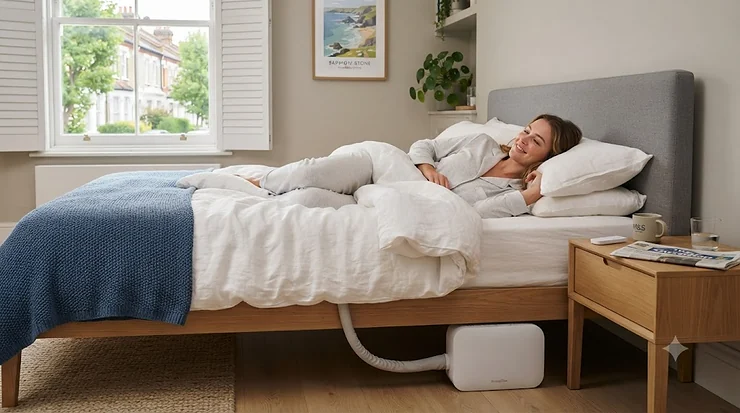
Three a.m., top sheet stuck to your shoulder blades, pillow already flipped twice — you know the drill. An under-sheet bed fan is a small pedestal-style fan that sits at the foot of the bed and blows room-temperature air directly between your sheets, and for a lot of people in this situation, it’s the difference between a decent night and another 6am scroll through “why am I always so hot in bed.” Unlike a bedside fan aimed at your face, an under-sheet bed fan is aimed at the actual problem: the pocket of warm, damp air your body builds up under the duvet.

This isn’t a gadget that cools the room. On paper it’s simple — a motor, a nozzle, and a wired remote — but the effect on sleep quality can be surprisingly outsized, particularly for menopause-related night sweats, warm bedrooms in Victorian terraces with no loft insulation, or anyone sharing a bed with someone who runs three degrees hotter than they do. We’ve dug into seven genuinely available models, from a £25 entry-level option to a £600 dual-zone system, and worked out which one actually suits your bed, your budget and your bedroom.
Quick Comparison Table
| Product | Type | Best For | Price Range |
|---|---|---|---|
| bFan by BedFan | Standalone under-sheet fan | Solo hot sleepers wanting simplicity | £130–£160 range |
| BedJet 3 | Dual-zone climate system | Couples with mismatched temperatures | £550–£650 range |
| Adamson B10 | Water-cooled mattress pad | Deep, consistent cooling | £150–£180 range |
| NeonVrs Bed Cooling System Fan | Under-sheet fan | Mid-range value seekers | £30–£50 range |
| ANIMOASIS Under-Sheet Midnight | Under-sheet fan | Year-round use (heating + cooling) | £25–£40 range |
| BallNiche Bed Cooling Fan System | Under-sheet fan | Strongest airflow on a budget | £30–£45 range |
| Midnight Bed Cooling System | Under-sheet fan | Absolute lowest entry cost | Under £25–£30 range |
Looking at the spread here, the gap between the cheapest and priciest option isn’t really about how much air moves — it’s about control, quietness and durability. The BedJet 3 justifies its premium mainly through dual-zone independent temperature control, which none of the budget fans attempt. Meanwhile bFan and the Adamson B10 sit in a middle tier where you’re paying for brand reliability and (in the B10’s case) genuinely different cooling tech rather than just a bigger motor. If you’re testing the concept for the first time, there’s a reasonable argument for starting cheap before committing to the premium end.
💬 Just one click — help others make better buying decisions too! 😊
Top 7 Under-Sheet Bed Fans: Expert Analysis
We’ve covered budget, mid-range and premium here, along with one genuinely different technology (water-cooling) for anyone who’s already tried airflow and wants something with a bit more cooling punch behind it.
1. bFan by BedFan — the original under-sheet cooling pioneer
The standout here is pedigree: bFan is widely credited as one of the products that created this category, and its build reflects that maturity. It runs on a brushless DC motor paired with dual squirrel-cage blower wheels, which in practice means noticeably more static pressure than single-fan competitors — useful if your duvet is heavy or your mattress sits deep. Height adjusts from roughly 18 to 38 inches, covering the vast majority of UK beds without an extension accessory. Based on the spec comparison, the low wattage draw (averaging around 12W even at full speed) means running cost is genuinely negligible, letting some owners raise their thermostat several degrees and still sleep cooler overall. Aggregated customer feedback consistently highlights the quiet operation and describes the sensation as a steady, enveloping breeze rather than a blast — useful context if you’ve been put off by noisier fans before. It’s aimed squarely at hot sleepers, menopausal women managing night sweats, and anyone sharing a bed with a partner who runs cold, since it cools one side without affecting the other.
Pros:
- ✅ Genuinely quiet brushless motor for overnight use
- ✅ Wide height range fits most UK bed types
- ✅ Very low running cost at all speed settings
Cons:
- ❌ Sits toward the higher end of the budget bracket
- ❌ No heating mode for colder months
Typically listed in the £130–£160 range, the bFan sits at a fair midpoint — not the cheapest, but arguably the most field-tested standalone fan on this list.

2. BedJet 3 — dual-zone climate control for couples
The standout feature is independent temperature control for each side of the bed, which no other product here offers. The BedJet 3 uses a more powerful climate unit connected via air hose to a cloud sheet or your existing bedding, delivering both cooling and a rapid warming mode — genuinely useful in a UK climate where a chilly spring night can follow a warm one within 48 hours. Reviewers consistently note the app-based biorhythm scheduling as a standout, letting you programme the bed to cool at bedtime and gently warm before you wake. Based on the spec comparison, this is the only system on our list that meaningfully replaces both a fan and an electric blanket in one device. It’s aimed at couples with genuinely mismatched temperature preferences, and at anyone willing to pay a premium to solve the problem completely rather than partially.
Pros:
- ✅ True dual-zone control for couples
- ✅ Doubles as a heating system in colder months
- ✅ App-based scheduling and biorhythm modes
Cons:
- ❌ Substantially more expensive than every other option here
- ❌ Cloud sheet accessory adds further cost for full functionality
Typically listed in the £550–£650 range for a single-zone unit (with sales fairly common), the BedJet 3 only makes financial sense if night sweats or temperature mismatch are a recurring, serious problem rather than an occasional nuisance.
3. Adamson B10 Bed Cooling System — water-cooled twin mattress pad
Unlike everything else on this list, the standout here is that it isn’t airflow-based at all — the Adamson B10 circulates chilled water through a silicone-tubed mattress pad, giving a more consistent, deeper cooling sensation than moving air alone. The reversible pad offers a mesh side and a cushioned side depending on preference, and the accompanying pump and remote let you dial in temperature more precisely than an airflow-only system can manage. What most buyers overlook about this model is the trade-off: it’s currently only available in one size (twin, roughly 79 x 35 inches), so double and king beds need creative placement or a different product entirely. Based on the spec comparison, it draws relatively little power for what it delivers, and reviewers note it can noticeably cut summer energy use compared with running air conditioning overnight.
Pros:
- ✅ Consistent, deeper cooling than airflow-only systems
- ✅ Reversible pad suits different comfort preferences
- ✅ Lower running cost than overnight air conditioning
Cons:
- ❌ Only available in one pad size currently
- ❌ Requires occasional water changes and tube maintenance
Typically listed in the £150–£180 range, the Adamson B10 is worth considering specifically if airflow fans haven’t been enough and you want a genuinely different cooling mechanism.
4. NeonVrs Bed Cooling System Fan — quiet mid-range Amazon favourite
The standout feature is a genuinely wide fit range, supporting beds up to roughly 25.2 inches tall out of the box with an optional extension accessory for taller frames. The NeonVrs Bed Cooling System Fan uses a straightforward adjustable-speed motor aimed at delivering a continuous, gentle breeze rather than a strong blast, which suits people who find aggressive airflow uncomfortable against the skin overnight. Based on the spec comparison, it positions itself specifically for night sweats, menopause hot flushes and general hot-sleeper discomfort rather than trying to double as a heater or premium climate system. The motor’s steady hum is marketed as a secondary benefit, functioning as light white noise for anyone who sleeps better with consistent background sound. It’s best suited to buyers who want a proper dedicated under-sheet fan without paying premium-brand pricing.
Pros:
- ✅ Wide bed-height compatibility with extension option
- ✅ Gentle, adjustable airflow rather than a harsh blast
- ✅ Doubles as light white noise overnight
Cons:
- ❌ Fewer verified long-term reviews than more established brands
- ❌ Single-zone only, no dual-side control
Typically listed in the £30–£50 range, the NeonVrs Bed Cooling System Fan sits comfortably as a genuine mid-range pick for buyers testing the category for the first time.
5. ANIMOASIS Bed Cooling System Under-Sheet Midnight — budget pick with a winter mode
What most buyers overlook about this model is the standout feature: it’s compatible with standard 4-inch ventilation pipes, meaning it can connect to heating equipment for winter use rather than sitting in a cupboard for nine months of the year. The ANIMOASIS Under-Sheet Midnight delivers targeted airflow via a removable neck extender, letting you fine-tune height to align with different mattress thicknesses. Based on the spec comparison, its focus on moisture control alongside plain cooling is a genuine differentiator — the aim is reducing the “sticky” feeling associated with memory foam mattresses specifically, not just moving air around generally. As with several budget marketplace listings in this category, verified long-term review data is still limited, so it’s worth treating early feedback as indicative rather than exhaustive.
Pros:
- ✅ Rare year-round versatility with heating compatibility
- ✅ Adjustable neck extender fits varied mattress heights
- ✅ Specifically targets moisture, not just heat
Cons:
- ❌ Limited long-term, verified review history
- ❌ Extension accessories sold separately
Typically listed in the £25–£40 range, the ANIMOASIS Under-Sheet Midnight earns its spot through genuine year-round usefulness rather than raw cooling power.

6. BallNiche Bed Cooling Fan System — strongest airflow on a budget
The standout feature is raw airflow volume for the price bracket — the BallNiche Bed Cooling Fan System is positioned specifically around “powerful airflow,” and its wider discharge nozzle spreads air more evenly across the mattress than some narrower budget competitors, addressing the edge-of-bed stuffiness problem we flagged earlier in the airflow section. Based on the spec comparison, this makes it a sensible pick for larger beds (doubles and kings) where a narrow-jet fan tends to leave one side noticeably less cool than the other. Reviewers consistently frame it as a strong option specifically for people who found cheaper alternatives too weak to feel a real difference. What the spec sheet won’t tell you is that stronger airflow at the top speed setting can be noticeably louder than the quieter premium options, so light sleepers may prefer running it one notch below maximum.
Pros:
- ✅ Wider discharge spreads air more evenly across the bed
- ✅ Well suited to double and king mattresses
- ✅ Strong value relative to airflow output
Cons:
- ❌ Top speed setting is louder than premium alternatives
- ❌ Adjustable height range is narrower than pricier models
Typically listed in the £30–£45 range, the BallNiche Bed Cooling Fan System is the pick for buyers who specifically want more airflow rather than more features.
7. Midnight Bed Cooling System — cheapest genuine under-sheet fan
The standout feature is simply price: the Midnight Bed Cooling System is regularly available under £25–£30, making it the most accessible genuine entry point into this whole category rather than a compromise product. It offers five-level speed adjustment and fits mattresses roughly 22cm to 53cm tall, which covers most standard UK divan and platform beds without needing an extension. Based on the spec comparison, you’re trading some refinement for the price — the motor and housing are simpler than the premium options, and there’s no dual-zone or heating capability — but the core function (pushing air under the sheets) works as intended. This makes it the natural first purchase for anyone who wants to test whether under-sheet cooling actually helps before committing serious money, especially students, renters, or anyone furnishing a summer-only spare room.
Pros:
- ✅ Genuinely cheap entry point into the category
- ✅ Five-level adjustment for a budget unit
- ✅ Fits a wide range of standard UK mattress heights
Cons:
- ❌ Build quality trails the premium options
- ❌ No heating or dual-zone functionality
Typically listed under £25–£30, the Midnight Bed Cooling System is the obvious answer if your priority is testing the concept cheaply rather than buying the best possible version of it.
✨ Don’t Miss These Exclusive Deals!
🔍 Take your hot-sleeper setup to the next level with these carefully selected under-sheet bed fans. Click through to check current pricing and availability before stock runs low this summer.
Under-Sheet Bed Fan vs Bedside Fan: Which One Actually Works?
This is probably the single most common question we see, and the honest answer is “it depends what’s actually keeping you awake.” A bedside fan — the classic pedestal or tower fan aimed at your face — cools your skin through evaporative airflow and works well if you’re generally warm all over. An under-sheet bed fan targets a narrower, more specific problem: the humid microclimate that builds up under a duvet regardless of how cool the rest of the room feels.
Here’s what most buyers overlook: a bedside fan pointed at your face does nothing for your feet, back, or the small of your back where sweat tends to collect first. An under-sheet fan solves that specific pocket of heat but leaves your face untouched, which some people find less immediately refreshing even though it’s arguably solving the real problem. Reviewers of under-sheet systems consistently note that the appeal is being able to keep a duvet on (rather than kicking it off all night) while still staying dry underneath — something a bedside fan simply can’t replicate.
| Factor | Under-Sheet Bed Fan | Bedside Fan | Electric Blanket (as contrast) |
|---|---|---|---|
| Targets trapped body heat | Yes, directly | Indirectly | No — adds heat |
| Cools face/whole room | No | Yes | No |
| Noise at night | Low (28–34 dB typical) | Varies, often higher | Silent |
| Best For | Duvet-users with hot pockets | General room warmth | Cold sleepers, not hot ones |
The table makes the trade-off fairly clear: if your complaint is “I’m sweaty under the duvet but my face feels fine,” the under-sheet option wins outright. If you’re generally warm all over and don’t mind losing the duvet on hot nights, a decent bedside or tower fan may be cheaper and just as effective. It’s also worth noting the reverse-technology comparison here — an electric blanket sits in the same physical space as an under-sheet fan (between the mattress and top sheet) but does the exact opposite job, which is a useful way to picture how the airflow fan actually sits and works.

How to Choose an Under-Sheet Bed Fan
- Check your mattress height first. Most models cap out around 25–38 inches; taller divan beds or beds with deep toppers may need an extension pipe accessory.
- Prioritise noise rating over raw power. A fan running at 40+ dB all night can undo the sleep benefit it’s supposed to provide — look for models under 35 dB where the spec is published.
- Decide if you need dual-zone control. Couples with different temperature preferences benefit hugely from independent airflow; solo sleepers rarely need it.
- Think about winter use. A handful of models (like the ANIMOASIS Under-Sheet Midnight) double as gentle heat outlets, which extends the value beyond three warm months a year.
- Factor in genuine running cost. Under-sheet fans use single-digit to low-double-digit wattage, which is negligible next to running an air conditioning unit overnight.
- Read the height and bed-type compatibility carefully. Some units struggle with platform beds that have no gap underneath for the base unit.
- Match budget to how often you’ll actually use it. A £25 fan used four nights a week for one summer can be perfectly good value; a £600 system makes more sense for someone managing severe, year-round night sweats.
Airflow & Circulation: What’s Actually Happening Under Your Sheets
The physics here is genuinely simple, which is part of why these devices work as well as they do. Your body constantly loses heat and moisture as vapour, and under a duvet that vapour has nowhere to go — it just sits there, raising the humidity right against your skin until you wake up sticky. Airflow circulation breaks that cycle by constantly replacing the stagnant air pocket with drier air from the room, which lets sweat evaporate properly instead of just sitting on your skin.
What the spec sheet won’t tell you, but reviewers note repeatedly, is that airflow direction matters almost as much as volume. A fan that blasts air straight up the centre of the bed tends to cool one narrow strip while leaving the edges stuffy; wider, funnel-shaped outlets (like those on the BallNiche Bed Cooling Fan System) spread the airflow more evenly across the mattress width. This is also why static box fans or oscillating tower fans aimed at the bed from across the room rarely solve the problem as well as a dedicated under-sheet unit — the air simply doesn’t reach the actual pocket of trapped heat with any consistency by the time it crosses the room.
Mattress Ventilation: The Overlooked Half of the Cooling Equation
Airflow gets all the attention, but mattress ventilation — how well heat escapes through the mattress itself, not just the sheets above it — plays a bigger role than most buyers realise. Memory foam mattresses in particular are notorious heat-trappers because the same dense cell structure that gives them support also blocks airflow almost completely, which is part of why so many memory foam owners report sleeping hot regardless of what bedding they use.
An under-sheet bed fan can’t fix a mattress’s internal ventilation, but it compensates by attacking the problem from above rather than below: by constantly moving air across the top surface, it prevents heat from building up in the first place rather than trying to draw it out through a mattress that wasn’t designed to release it. Based on the spec comparison across our seven picks, this is exactly why models with wider, flatter nozzles tend to outperform narrow-jet designs on memory foam specifically — spread the air, don’t concentrate it. The Met Office’s guidance on keeping cool makes a similar point about indoor spaces generally: closing curtains during the day and creating airflow at night work together, and the same logic scales down to the size of a single bed.
Setting Up Your Under-Sheet Bed Fan: A Practical First-Week Guide
Installation on most of these units follows the same basic pattern, but a few small habits make a real difference to how well they perform. Start by placing the base unit at the foot of the bed with the nozzle tucked between your mattress and top sheet, angled slightly upward so airflow spreads across the bed rather than shooting straight down one side. On your first night, run it on a low-to-medium setting rather than full power — most people find maximum speed genuinely too strong to sleep comfortably next to, and it wastes the fan’s quietest setting, which is often its best one.
A common mistake in the first 30 days is leaving the fan running at the same speed regardless of the weather, then concluding it “doesn’t work” on cooler nights. Treat the speed dial the way you’d treat a duvet tog rating — adjust it to the night, not to a fixed habit. For maintenance, most under-sheet fans need nothing beyond an occasional wipe of the intake vents to clear dust, since there’s no water reservoir or filter to replace on the airflow-based models. If you’ve gone for the Adamson B10‘s water-cooled system, budget five minutes every couple of weeks to drain and refresh the water, which meaningfully extends the pump’s lifespan and keeps the cooling effect consistent.
Real-World Scenarios: Who Actually Needs One?
The menopausal hot sleeper. A 52-year-old waking three or four times a night drenched in sweat, in a bedroom that’s already cool by 10pm, isn’t dealing with a room-temperature problem — she’s dealing with a body-heat problem the room can’t fix. For this profile, a mid-range fan like the NeonVrs Bed Cooling System Fan or premium BedJet 3 (if budget allows) tends to deliver the most noticeable improvement, since the issue is specifically trapped heat under the covers rather than an overly warm bedroom.
The student in a poorly insulated flat. Limited budget, a landlord who won’t install air conditioning, and a bedroom that holds heat into September. Here the calculus flips toward value: the Midnight Bed Cooling System or ANIMOASIS Under-Sheet Midnight solve 80% of the problem for a fraction of the premium price, and the ANIMOASIS option’s winter compatibility stretches its usefulness well past a single summer.
The couple with mismatched thermostats. One partner sleeps under a duvet in July; the other kicks every layer off by midnight. This is genuinely the one scenario where paying for the BedJet 3‘s dual-zone control makes clear financial and relationship sense, since single-zone fans simply can’t solve a two-person problem by design.
Cheap Under-Sheet Bed Fan Under £25: Is Budget Good Enough?
It’s a fair question, and the honest answer is: for most people, yes — with caveats. A cheap under-sheet bed fan under £25, like the Midnight Bed Cooling System, uses the same basic principle as its £150+ competitors: a motor pushing air through a nozzle tucked between your sheets. What you’re giving up isn’t the core function, it’s refinement — expect a slightly louder motor at higher speeds, a narrower height-adjustment range, and build materials that feel noticeably lighter-duty than the premium brands.
Here’s what to weigh before buying at this price point: if you’re testing whether under-sheet cooling works for you at all, spending under £25 to find out is a sensible, low-risk way to answer that question before committing to a £150+ purchase. If you already know it works and are shopping for a long-term daily-use solution, the durability gap tends to matter more, and stepping up to a £30–£50 mid-range option like the NeonVrs Bed Cooling System Fan often pays for itself in longevity within a year or two of nightly use.

Heatwave Sleep Tips: Getting the Most From Your Fan This Summer
An under-sheet bed fan works best as part of a system, not as a standalone fix, particularly during a genuine UK heatwave. During the day, keep curtains or blinds drawn on sun-facing windows to stop the room heating up in the first place — a bedroom that starts the evening at 26°C rather than 22°C puts far more pressure on any fan, however powerful. The official government guidance on staying safe in hot weather recommends closing windows and curtains during the hottest part of the day and opening them once temperatures drop in the evening, which pairs naturally with switching your bed fan on as the room finally starts to cool.
A few practical additions make a real difference: swap a heavy duvet for a lighter cotton or linen sheet during a heatwave so the fan’s airflow can actually reach your skin rather than being trapped under thick tog ratings. Keep a glass of water by the bed, and if you’re running the fan on a timer, set it to stay on through the warmest part of the night (typically midnight to 4am) rather than switching off after an hour, since heat continues building under the covers throughout the night, not just at bedtime.
✨ Beat This Summer’s Heat Before It Beats You
🔍 Don’t wait for the next 30°C night to start shopping — under-sheet bed fans are cheap enough to try now and genuinely change how you sleep through a UK heatwave.
Long-Term Cost & Maintenance
The running costs on airflow-based under-sheet fans are genuinely trivial compared with the alternatives most people reach for instead. A typical unit drawing 10–20 watts, run for eight hours a night through a three-month warm season, costs a small fraction of what a portable air conditioning unit or overnight fan-and-AC combination would use over the same period. The Adamson B10‘s water pump draws slightly more but still comes in well under air conditioning running costs, and its main ongoing cost is simply the occasional water refresh rather than anything financial.
| Product | Estimated Wattage | Ongoing Maintenance | Annual Running Cost Feel |
|---|---|---|---|
| bFan by BedFan | ~12W average | Occasional vent dusting | Very low |
| BedJet 3 | Higher (climate unit) | Cloud sheet care, filter checks | Low-moderate |
| Adamson B10 | Moderate (pump) | Fortnightly water refresh | Low |
| Budget fans (Midnight, ANIMOASIS) | 5–15W | Minimal | Very low |
Interpreting this table, the real long-term cost differentiator isn’t electricity — it’s durability and warranty support. Premium brands like BedJet 3 typically carry stronger multi-year warranties, which matters more over a five-year ownership period than the modest wattage difference. Budget units tend to have shorter or no formal warranty, so treat a sub-£30 purchase partly as a lower financial commitment rather than expecting it to last as long as a premium unit.
Common Mistakes When Buying an Under-Sheet Bed Fan
The single most common mistake is buying based on wattage or “power” claims alone without checking the noise rating — a stronger motor that’s also louder can genuinely undermine sleep quality more than it helps, defeating the entire purpose of the purchase. A close second is ignoring mattress height compatibility; buyers with deep pillow-top mattresses or divan bases regularly discover after purchase that the standard nozzle doesn’t reach properly, requiring an extension accessory that should have been budgeted in from the start.
Another frequent pitfall is assuming any fan will fix a genuinely overheated bedroom — if your room regularly sits above 28–30°C even at night, an under-sheet fan alone likely won’t be enough, and pairing it with basic heatwave measures (blackout curtains, evening ventilation) matters more than upgrading to a stronger fan. Finally, plenty of buyers skip checking dual-zone availability and only realise after living with a single-zone fan for a summer that their partner’s different temperature preference was never actually solved — a five-minute conversation before buying saves a return-and-reorder cycle later.

FAQ
❓ Do under-sheet bed fans actually work for menopause night sweats?
❓ Can I use an under-sheet bed fan on a memory foam mattress?
❓ How loud are under-sheet bed fans at night?
❓ Will an under-sheet bed fan work with an electric blanket?
❓ Do I need a dual-zone fan if I sleep alone?
Conclusion
An under-sheet bed fan isn’t a miracle cure for a hot bedroom, but for the specific, common problem of trapped heat and moisture under the duvet, it’s one of the most cost-effective fixes available — genuinely more targeted than a bedside fan, and dramatically cheaper to run than air conditioning. Whether you land on the budget-friendly Midnight Bed Cooling System, the well-rounded NeonVrs Bed Cooling System Fan, or splash out on the BedJet 3 for full dual-zone control, the underlying principle is the same: move the trapped air, and the sweaty-sheets problem largely solves itself.
Start with your actual constraints — mattress height, budget, whether you’re solving this for one person or two — rather than chasing the single “best” model, and you’ll land on the right pick faster than trawling endless spec sheets.
Recommended for You
- Quietest Bed Fan for Sleeping: 7 Top Picks for 2026 (Ranked)
- Bamboo Cooling Mattress Pad: 7 Top UK Picks for Hot Sleepers (2026)
- Cooling Mattress Protector Review: 7 Best Picks Tested for 2026
Disclaimer: This article contains affiliate links. As an Amazon Associate, I earn from qualifying purchases. If you purchase products through these links, we may earn a small commission at no additional cost to you.
✨ Found this helpful? Share it with your friends! 💬🤗
