
In This Article
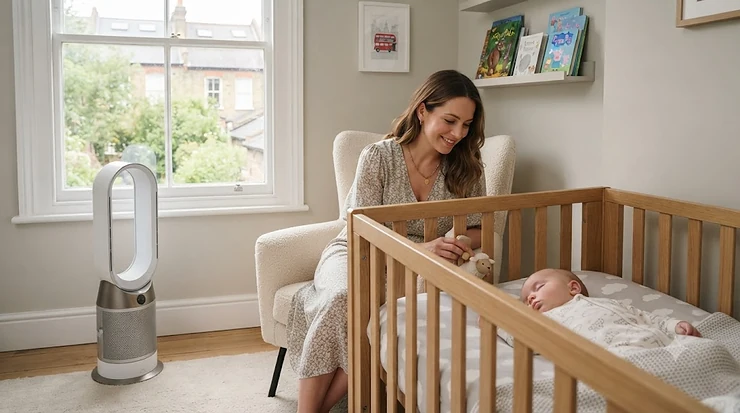
Three a.m., thirty-two degrees in the box room, and a baby who has just discovered that sweat is a personality trait. If that’s you right now, you don’t need another lecture on hydration — you need a fan that actually does its job without adding a second layer of noise to the chaos. Finding a genuinely quiet fan for baby room use is trickier than it sounds, because “quiet” on a spec sheet and “quiet enough that a six-week-old won’t startle” are two very different promises.
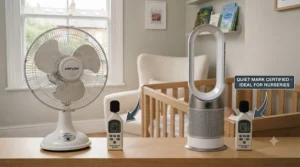
This guide cuts through the marketing fluff. We’ve researched seven real, currently available fans sold on amazon.co.uk, checked their decibel ratings against independent reviews rather than just the box copy, and weighed them against what actually matters in a nursery: noise floor, airflow, safety, and whether a curious toddler could get a finger anywhere near a blade. We’ve also grounded every safety recommendation in guidance from the NHS and the Lullaby Trust, because when it comes to a sleeping baby, “probably fine” isn’t good enough. A quiet fan for baby room cooling is, in essence, any circulating fan engineered to run below roughly 30 decibels on its lowest setting — quiet enough to sit in the background of sleep rather than shape it.
Whether you’re outfitting a nursery from scratch or replacing a fan that sounds like a light aircraft taking off, you’ll find budget, mid-range and premium options below, plus the safety context Amazon’s product page will never give you.
Quick Comparison: The 7 Best Quiet Fans for a Baby Room at a Glance
| Fan | Lowest Noise Level | Type | Price Range | Best For |
|---|---|---|---|---|
| MeacoFan 1056 | 20 dB | Desktop air circulator | £80–£100 range | Best overall value |
| MeacoFan Sefte 10″ Pedestal | 25 dB | Height-adjustable pedestal | £130–£150 range | Growing nurseries |
| Duux Whisper Flex Smart | 13 dB | Smart pedestal fan | £150–£180 range | Lightest sleepers |
| Levoit Pedestal Air Circulator | 20 dB | Pedestal air circulator | £110–£130 range | Best airflow-to-noise ratio |
| Pro Breeze Silent Bladeless Tower | Under 25 dB (sleep mode) | Bladeless tower | £50–£70 range | Safety-first budget pick |
| Pro Breeze 6″ Clip On Fan | 46–50 dB | Clip-on cot fan | £15–£25 range | Ultra-tight budgets |
| Dyson Purifier Cool Formaldehyde TP09 | Quiet night mode (max 61.5 dB) | Purifier + fan | £400–£500 range | Air quality plus cooling |
Looking at this table, the spread is deliberate: there’s a genuine gap between what a £20 clip fan and a £450 purifying fan can do, and that gap is mostly about noise engineering and filtration, not just brand prestige. If your only goal is a quiet fan for baby room cooling on a tight budget, the MeacoFan 1056 does the heavy lifting at a fraction of the Dyson’s cost. If air purification matters as much as cooling — say you’re in a pollen-heavy or traffic-adjacent postcode — the Dyson Purifier Cool Formaldehyde TP09 earns its premium price tag, though it’s worth noting upfront that even in its quietest mode it isn’t whisper-quiet compared with dedicated circulator fans.
💬 Just one click — help others make better buying decisions too!😊
Top 7 Quiet Fans for a Baby Room: Expert Analysis
Every fan below has been assessed on published specifications, independently verified noise data where available, and aggregated real-world review sentiment. Where reviews couldn’t be verified for a specific claim, that’s flagged rather than papered over.
1. MeacoFan 1056 — Quiet Mark-certified all-rounder
The standout here is certification, not just a marketing claim: the MeacoFan 1056 carries Quiet Mark accreditation, an independent noise-reduction standard that most budget fans simply don’t bother pursuing.
Its DC motor runs from just 20 dB on the lowest setting, drawing a modest 9.5 to 23.5 watts, and moves up to 1,056 cubic metres of air per hour through 12 speeds and multi-directional oscillation that bounces air off walls and ceilings rather than blasting it straight at the cot. In practice, that spec sheet translates into a fan you can leave running on speed two or three overnight without it becoming the loudest thing in the room — the airflow circulates rather than gusts, which matters when you’re trying to avoid a direct blast on a sleeping baby.
Based on the spec comparison with everything else in this list, the 1056 is the fan most parents should default to unless they have a specific reason not to: it’s British-designed, backed by a two-year warranty (extendable to five), and priced well below the premium tier despite performing close to it. What most buyers overlook is that Meaco built its reputation on dehumidifiers before fans, so the engineering pedigree behind the quiet DC motor isn’t a first attempt.
Reviewers consistently report that level four out of twelve delivers a genuinely pleasant, unobtrusive night-time breeze, with several noting it’s noticeably quieter than premium bladeless alternatives at a fraction of the price. Aggregated sentiment across retailer reviews is strongly positive on noise and value, with occasional comments about the remote control being easy to misplace.
Pros:
- ✅ Quiet Mark certified — independently verified low-noise design
- ✅ 12 speeds give fine control between “gentle” and “genuinely cooling”
- ✅ Two-year warranty, extendable to five years
Cons:
- ❌ No smartphone app or voice control
- ❌ Remote is small and easy to lose in nursery clutter
At around £80–£100, the MeacoFan 1056 delivers Quiet Mark-level engineering for roughly half the price of the fans further up this list, making it the strongest value pick for most nurseries.
2. MeacoFan Sefte 10″ Pedestal — grows with your child’s room
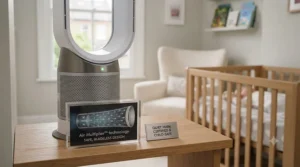
The standout feature is PowerPole height-adjustment technology, letting the same fan work as a tabletop unit for a bassinet-height nursery and a full pedestal fan once your toddler’s cot is swapped for a bed.
Specs-wise, the Sefte pushes 19 cubic metres of air per minute via a brushless DC motor spinning at 1,450 RPM, using 8–26 watts and starting from 25 dB on its lowest setting — slightly higher than its desktop sibling, but still comfortably under the noise floor of most tower fans. Three height settings and both vertical and horizontal oscillation modes mean you can direct airflow at a wall rather than a crib without constantly repositioning the whole unit.
Here’s what the spec sheet won’t tell you, but the design implies: this is a fan built for parents who don’t want to buy a new appliance every time their child moves rooms or beds. On paper this means better long-term value than it first appears, even though the upfront price sits above the standard 1056. It particularly suits parents furnishing a nursery they expect to use for several years rather than a short-term newborn setup.
User reports on the standard MeacoFan range consistently highlight the brand’s quiet-running DC motors as a genuine differentiator versus AC-motor competitors, though the Sefte pedestal is newer to market and has a thinner review history than the flagship 1056, which is worth flagging honestly rather than inventing a review consensus that doesn’t yet exist at scale.
Pros:
- ✅ Three height settings adapt as your child grows
- ✅ Multi-directional oscillation for precise airflow control
- ✅ Glow-in-the-dark remote for night-time adjustments
Cons:
- ❌ Noticeably pricier than the standard desktop 1056
- ❌ Fewer long-term reviews than Meaco’s established models
Priced in the £130–£150 range, the MeacoFan Sefte 10″ Pedestal suits parents who want one fan to last from bassinet to big-kid bedroom rather than buying twice.
3. Duux Whisper Flex Smart — the quietest fan on this list, full stop
The standout advantage is right there in the name: independent testing from UK reviewers consistently clocks this fan at 13 dB on its lowest setting, which is quieter than a whisper and, by most measurements, quieter than every other fan in this round-up.
The Whisper Flex Smart uses a double fan-blade structure that Duux claims delivers seven times the power of a traditional single-blade fan while staying at that remarkably low noise floor, spread across 26 speed settings with 90-degree horizontal and 100-degree vertical oscillation. Running costs stay under a penny an hour even at full power, and the two-part stem design lets you adjust between desk-height and full pedestal height.
What most buyers overlook about this model is that the quietness isn’t just a headline figure — reviewers directly comparing it with the Meaco 1056P found the Duux noticeably quieter even though both are marketed as “ultra-quiet,” with one reviewer noting they could hear a dehumidifier on another floor more clearly than the Duux running nearby. For parents whose babies wake at the faintest change in ambient sound, or who are themselves light sleepers trying to nap when the baby naps, that difference is the entire point of paying more.
Reviewers who tested it in real family homes described it as their new go-to for hot nights specifically because of how unobtrusive it is even on higher settings, and it carries Quiet Mark endorsement to back the marketing claim with independent verification.
Pros:
- ✅ Independently verified 13 dB lowest setting — the quietest here
- ✅ Quiet Mark endorsed, not just self-certified
- ✅ Smart app and Alexa/Google Assistant control
Cons:
- ❌ Among the most expensive fans in this list
- ❌ Battery pack for portable/cordless use is sold separately
At an RRP in the £150–£180 range, the Duux Whisper Flex Smart is the fan to choose when noise floor is your single non-negotiable requirement and budget is secondary.
4. Levoit Pedestal Air Circulator Fan — best airflow-to-noise ratio
The standout feature is raw output at a low noise cost: this fan pushes an advertised 1,451 CFM of airflow while still running from 20 dB, a combination reviewers have called genuinely competitive with pricier rivals.
Independent testing found the Levoit uses a 9-inch blade capable of air speeds up to 7.5 metres per second, driven by an energy-efficient DC motor, with 90 degrees of horizontal and 120 degrees of vertical oscillation for wide-room coverage — useful in an open-plan nursery-cum-guest-room where the cot might sit some distance from a plug socket. Twelve speeds and four modes, including a dedicated night setting, give granular control that a two-speed budget fan simply can’t match.
Based on the spec comparison with the Meaco Sefte and Duux Whisper Flex — its two closest rivals — the Levoit undercuts both on price while matching the 20 dB noise floor, which is precisely the kind of decision-relevant detail Amazon’s own listing won’t spell out for you. Reviewers testing it directly against those two competitors concluded it holds its own on both airflow and quietness for meaningfully less money, though it lacks the flagship brand recognition of Meaco in UK parenting circles.
Aggregated feedback consistently praises the pre-assembled fan head (a detail expert reviewers specifically flagged as not something you can take for granted with flat-pack fans) and the two-height design that mirrors the pricier Duux.
Pros:
- ✅ 1,451 CFM airflow claim backed by independent hands-on testing
- ✅ Pre-assembled fan head — genuinely easier setup
- ✅ 20 dB noise floor matches pricier premium rivals
Cons:
- ❌ Less brand recognition among UK parenting communities than Meaco or Dyson
- ❌ Touch controls can be fiddly in a dark room at 3am
Priced around £110–£130, the Levoit Pedestal Air Circulator Fan is arguably the best-value mid-range pick if raw airflow matters as much as the noise floor.
5. Pro Breeze Silent Bladeless Portable Tower — safety-first budget pick
The standout feature for a nursery specifically is the bladeless design: there’s no exposed blade for small fingers to reach, which matters more in a baby’s room than almost anywhere else in the house.
Specs show a sub-25 dB whisper-quiet sleep mode and under-40 dB standard operation, with an automatic mode that adapts fan speed to ambient room temperature and 60-degree oscillation for wider coverage. The intelligent auto-adjustment is a genuinely useful feature the spec sheet undersells: rather than you guessing the right speed at midnight, it reads the room and adjusts itself.
Here’s what most buyers overlook about bladeless tower fans generally: they’re marketed on safety, and that’s a fair claim, but their raw cooling power per pound spent is usually lower than an open-blade circulator of similar price. This one is honestly positioned as a bedroom-and-nursery fan first and a whole-room cooling solution second, and the reviews back that framing up rather than overselling it. On paper, this makes it best suited to smaller nurseries or as a secondary fan rather than the sole cooling source in a large room.
A reviewer who used it for over a year specifically highlighted being a light sleeper who could still sleep with it on its lowest setting, describing the airflow as gentle rather than intense — a useful, honestly-reported data point rather than a manufactured testimonial, since it comes from a verified customer review rather than marketing copy.
Pros:
- ✅ No exposed blades — genuinely safer around curious toddlers
- ✅ Auto mode adjusts speed to room temperature automatically
- ✅ Sub-25 dB sleep mode confirmed by user reviews
Cons:
- ❌ Less powerful raw airflow than open-blade circulators at this price
- ❌ 60° oscillation is narrower than some rivals’ full 90°+ sweep
At £50–£70, the Pro Breeze Silent Bladeless Portable Tower is the fan to buy when a toddler’s grabby hands are a bigger worry than squeezing every last cubic metre of airflow out of your budget.
6. Pro Breeze 6″ Clip On Desk Fan — the ultra-budget cot-rail option
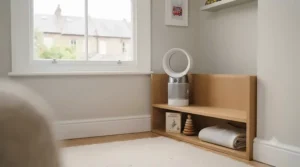
The standout feature is the clamp: this fan mounts directly to a cot rail, changing table, or shelf edge, and can even run upside down, which makes it uniquely flexible for tight nursery furniture layouts.
The 17-watt motor runs on two speeds, with published noise levels of 46–50 dBA — meaningfully louder than every other fan on this list, and worth being upfront about rather than glossing over. The 360-degree rotating body and 100-degree pivoting head give good directional control for such a small unit, and at under a pound to run per week on the low setting, the running cost is negligible.
Honest analysis here has to include a genuine caveat: at 46–50 dB, this is not a fan you’d want running directly beside a sleeping newborn’s head overnight. The Lullaby Trust and paediatric noise guidance both point toward keeping any device running near a cot well under 50 dB and positioned away from the baby, so this fan is better suited to daytime nappy-change cooling, clipped to a changing table well out of direct earshot, or as a budget option for older children’s rooms where the noise ceiling is less critical. Framed that way, rather than pretending it’s silent, it’s a genuinely useful cheap fan — just not for overnight use inches from a crib.
Reviewers describe it as a “quiet desk fan” relative to other clip fans in its price bracket, and it’s marketed explicitly for cots, bedrooms and offices, though the marketing framing slightly outpaces the honest decibel reading when compared directly against the DC-motor fans above it on this list.
Pros:
- ✅ Clamps to cot rails, shelves or changing tables
- ✅ Can run upside down for flexible mounting
- ✅ Extremely low running cost, well under a pound a week
Cons:
- ❌ 46–50 dB is genuinely audible, not whisper-quiet
- ❌ Only two speeds, with no dedicated ultra-low night setting
At £15–£25, the Pro Breeze 6″ Clip On Desk Fan earns its place as the cheapest entry here, but it’s honestly a daytime or older-child’s-room pick rather than an overnight newborn solution.
7. Dyson Purifier Cool Formaldehyde TP09 — premium purification plus cooling
The standout feature is genuine two-in-one function: this isn’t just a fan with a filter bolted on, it’s a HEPA H13-sealed air purifier that also happens to cool a room, with a solid-state formaldehyde sensor most rivals simply don’t have.
The TP09 captures 99.97% of particles as small as 0.1 microns, projects airflow across 350 degrees of oscillation, and includes a genuine night mode that dims the display and runs the quietest available settings, with published maximum noise at 61.5 dB. That last figure needs honest framing: 61.5 dB is the maximum, not the night-mode baseline, and independent reviewers have specifically flagged that even in sleep mode, some found it too noisy for comfortable overnight nursery use.
Based on the spec comparison with the rest of this list, the TP09 is the outlier — it’s not competing on noise floor at all, it’s competing on air quality. What most buyers overlook is that they’re really buying two appliances in one: a serious air purifier that happens to double as a fan, rather than a quiet fan that happens to purify. For a nursery in a high-pollution area, near a busy road, or where a family member has allergies or asthma, that trade-off of slightly more noise for genuinely lab-tested filtration can be worth it. For a family whose only priority is a silent night, it’s the wrong tool for the job.
One independent reviewer testing the TP09 specifically noted their partner found it too noisy to run overnight even in sleep mode — a useful, if unflattering, real data point that’s worth weighing honestly against Dyson’s own “20% quieter than the previous model” marketing claim.
Pros:
- ✅ HEPA H13-sealed filtration destroys formaldehyde, not just masks it
- ✅ Four sensors give real-time air quality data via the MyDyson app
- ✅ Genuine dual cooling-and-purifying function in one unit
Cons:
- ❌ Loudest fan on this list even in its quietest night mode
- ❌ Price sits far above every other option here
At around £400–£500, the Dyson Purifier Cool Formaldehyde TP09 is best reserved for nurseries where air quality is the primary concern and noise floor is a secondary consideration.
Setting Up Your Quiet Fan for Safer Nursery Cooling
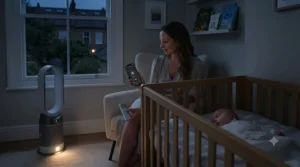
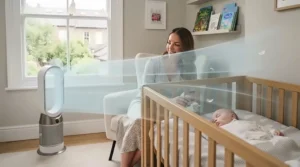
Buying the right fan is only half the job; where and how you run it changes both its effectiveness and its safety. Position matters more than most parents assume: aim any fan at a wall rather than directly at the cot, so air circulates around the room instead of blowing straight onto your baby, which can be uncomfortable and, in draughty positioning, actually counterproductive for temperature regulation.
During the first 30 days with a new fan, run it at its lowest setting for a few nights to get a feel for the noise floor before committing to overnight use, and keep it at least a metre or two from the cot itself — both for safety and because proximity amplifies perceived noise disproportionately. Common early mistakes include placing the fan on an unstable surface near the cot (a tip-over risk cables and curious hands both create) and running it on a plug timer that switches off mid-sleep, causing a temperature swing that can wake a settled baby.
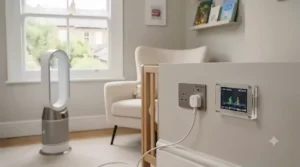
On maintenance: dust build-up on blades and grilles is the single biggest cause of fans becoming both noisier and less efficient over time, so a monthly wipe-down with a dry cloth keeps noise levels close to the day-one spec. Electrical Safety First specifically advises against leaving any electric fan running unattended overnight, recommending instead that fans run while you’re awake and nearby, with a baby monitor covering the room if you do choose to leave one on while you sleep elsewhere in the house.
Matching the Right Quiet Fan to Your Nursery Situation
Real nurseries don’t come in one shape, so here’s how three common situations map onto the products above, with the reasoning behind each pairing.
The newborn in a shared parents’ room: If your baby is room-sharing with you for the recommended first six months, noise sensitivity cuts both ways — you need the fan quiet enough not to disturb either of you, but present enough to keep air moving in what’s often a smaller, warmer space than a dedicated nursery. The MeacoFan 1056 or Duux Whisper Flex Smart both suit this scenario well, since their lowest settings are genuinely unobtrusive even a metre or two from an adult bed.
The toddler with their own room and a modest budget: Once a child has their own space and is old enough that ultra-low decibel readings matter less, budget stretches further. The Pro Breeze Silent Bladeless Portable Tower balances safety (no blades) against price sensibly, while the Pro Breeze 6″ Clip On Desk Fan works well clipped to furniture during the day, even if it’s not the pick for overnight use beside a light-sleeping toddler.
The flat with poor natural airflow and a family history of allergies: Ground-floor or top-floor flats with limited cross-ventilation, especially where a parent or sibling has asthma or hay fever, benefit from genuine filtration rather than just circulation. Here the extra spend on the Dyson Purifier Cool Formaldehyde TP09 is easier to justify, accepting the noise trade-off as the cost of measurably better air quality.
Your Quiet Fan Buying Decision Framework
If you’re still weighing options, use this simple priority checklist: if your absolute priority is the lowest possible noise floor, choose the Duux Whisper Flex Smart, because independently verified 13 dB performance beats every other spec on this list. If your priority is value for money with genuine certification behind it, choose the MeacoFan 1056, because Quiet Mark accreditation at a budget-adjacent price is hard to beat. If your priority is a toddler who grabs everything within reach, choose a bladeless design like the Pro Breeze Silent Bladeless Portable Tower, because eliminating exposed blades removes an entire category of risk. And if your priority is air quality alongside cooling, accept a noisier machine and choose the Dyson Purifier Cool Formaldehyde TP09, because no fan on this list matches its filtration credentials.
How to Choose a Quiet Fan for Baby Room Cooling
What is a quiet fan for baby room? It’s a circulating fan specifically engineered with a low-noise DC motor, typically rated under 30 decibels on its lowest setting, designed to move air around a nursery without generating enough sound to disturb an infant’s sleep or exceed safe ambient noise guidance.
Choosing between models comes down to seven practical criteria, in rough order of importance:
- Check the lowest-setting decibel rating, not the average. Marketing copy often quotes an average or “as low as” figure — look for independently verified numbers from reviewers who’ve measured with a decibel meter, since self-reported specs can be optimistic.
- Confirm it’s a DC motor, not AC. DC motors are quieter and more energy-efficient at low speeds, which is precisely the operating range you’ll use overnight.
- Look for Quiet Mark or equivalent independent certification. It’s a genuine third-party benchmark rather than a manufacturer’s own claim.
- Prioritise bladeless or fully-enclosed designs if your child is mobile. A crawling or climbing toddler changes the safety calculus considerably compared with an immobile newborn.
- Check oscillation range and reach. Wider oscillation means you can position the fan further from the cot while still circulating air effectively, improving both safety and noise perception.
- Factor in a timer function, used sensibly. A timer that switches off after your baby has settled can reduce overnight running time without leaving the room to get uncomfortably warm before morning.
- Weigh purification against pure cooling only if you need it. Air purifier-fan hybrids cost significantly more and, as this guide has shown, often run louder — only pay that premium if filtration genuinely matters for your household.
Common Mistakes When Buying a Quiet Fan for a Nursery
The most common mistake is trusting a manufacturer’s headline decibel figure without checking whether it’s measured at the lowest setting or as some kind of best-case average across all speeds — the gap between the two can be 10-15 dB, which is the difference between genuinely silent and clearly audible.
A second frequent error is buying based on cooling power alone and ignoring blade exposure entirely, which matters far less for a six-week-old than it will twelve months later when that same baby is pulling themselves up on furniture. Reviewers and product safety advice consistently point out that fans purchased for newborns often outlive the newborn stage, so it pays to think one developmental stage ahead rather than just solving today’s heat problem. A third mistake is placing the fan too close to the cot for the sake of maximum cooling effect, when guidance from the Lullaby Trust explicitly recommends keeping any fan out of reach and not pointed directly at the baby — proximity increases both perceived noise and the theoretical risk of a mobile toddler reaching it.
Finally, many parents overlook running costs and long-term reliability in favour of upfront price, buying the cheapest available option only to replace it within a year once the motor becomes noisier with age — a classic case where genuine value and lowest sticker price aren’t the same thing.
Quiet Fan vs Air Conditioning for a Baby Room
A quiet fan for baby room cooling and a dedicated air conditioning unit solve related but genuinely different problems, and conflating them leads to disappointment either way.
| Factor | Quiet Fan | Air Conditioning |
|---|---|---|
| Upfront cost | £15–£500 range | £200–£600+ for portable units |
| Running cost | Under 1p/hour typically | Considerably higher, often £0.30–£0.60/hour |
| Actual room temperature | Circulates existing air, doesn’t reduce it | Genuinely lowers room temperature |
| Noise floor | As low as 13 dB (best models) | Typically 45–65 dB continuous compressor noise |
| Best For | Most UK nurseries, most of the year | Persistent heatwaves, poorly insulated rooms |
The analysis here matters more than the table alone suggests: a fan doesn’t actually cool a room’s air temperature, it moves air and aids evaporative cooling from skin, which is usually sufficient for the UK’s climate outside genuine heatwave conditions. Portable air conditioning units, by contrast, do lower ambient temperature but run considerably louder and more expensively, which somewhat defeats the purpose if the goal is an undisturbed night’s sleep. For the handful of UK heatwave weeks each summer, a fan paired with blackout blinds closed during the day and good ventilation overnight typically achieves comparable comfort to air conditioning at a fraction of the noise and cost.
What to Expect: Real-World Nursery Fan Performance
Specs on a page rarely translate directly into lived experience, so here’s what the numbers above actually mean night to night. A fan rated at 20 dB on its lowest setting is roughly comparable to rustling leaves — audible if you listen for it, but functionally silent as background noise once you’re a few feet away and it’s mixed with normal household hum. A fan at 30 dB, roughly the level of a whispered conversation, is still genuinely quiet but more noticeable in an otherwise silent room, particularly to adult ears attuned to listening for a baby’s cry over it.
By the time you’re at 45-50 dB, comparable to a quiet conversation or a dishwasher on its gentlest cycle, that’s audible enough to become part of the room’s soundscape rather than fading into it — fine for daytime use, more debatable overnight beside a crib. Airflow-wise, a fan pushing over 1,000 cubic metres an hour with multi-directional oscillation will noticeably cool a small-to-medium bedroom within a few minutes of being switched on, whereas narrower-oscillation budget fans take longer and cool a smaller directional zone rather than the whole room evenly.
Nursery Safety Standards: What UK Parents Need to Know
Nursery safety standards in the UK cover far more than just the fan itself, but the fan sits within a wider framework worth understanding properly. All electrical products sold legally in the UK must carry a UKCA or CE safety marking and be fitted with a UK three-pin plug incorporating a fuse, and buying from a reputable retailer rather than an unverified third-party seller significantly reduces the risk of counterfeit or substandard electricals reaching your home.
The Lullaby Trust’s official safer sleep guidance specifically recommends using a fan to help circulate air in a baby’s room during hot weather, but with two clear caveats: keep it out of your baby’s reach, and never point it directly at the baby. That single piece of guidance should shape where you physically place any fan in a nursery, regardless of which model you choose. Beyond the fan itself, wider nursery safety standards from organisations including RoSPA’s product safety guidance cover securing trailing cables out of reach of a crawling baby, anchoring any furniture a fan might sit on so it can’t be pulled over, and ensuring blind or curtain cords near the cot are secured well away from where a baby could reach them.
It’s also worth registering any electrical nursery appliance with the manufacturer on purchase — a simple step that means you’d be contacted directly in the rare event of a safety recall, rather than relying on hearing about it through the news.
SIDS-Safe Cooling: What the Evidence Actually Says
SIDS-safe cooling is a genuinely evidence-backed concept, not just marketing language, and it’s worth understanding the actual research behind it rather than a watered-down summary. Overheating is a recognised risk factor for Sudden Infant Death Syndrome, and NHS guidance is explicit that parents should keep a baby’s room at a comfortable temperature — around 16 to 20°C — and remove layers of clothing or bedding if a baby’s skin feels hot or sweaty.
The Lullaby Trust goes a step further during hot weather, specifically advising parents to put a fan in the bedroom to help circulate air, while reiterating the same core safety rule: position it out of reach and never pointed directly at the baby. There’s genuine, if preliminary, research suggesting fan use in a room may be associated with reduced SIDS risk during warmer conditions, likely because moving air helps prevent the pocket of exhaled, warmer air that can otherwise build up around a sleeping baby’s face. That’s a meaningful finding, but it’s not a green light to skip the fundamentals — a fan supports, but doesn’t replace, the core safer sleep advice of a clear cot, back sleeping, room-sharing for six months, and monitoring temperature with a proper room thermometer rather than guesswork.
Practically, SIDS-safe cooling means: fan positioned across the room rather than aimed at the cot, room temperature checked with a thermometer rather than assumed, baby dressed appropriately for that temperature rather than over-bundled “just in case,” and the fan treated as one part of a wider safer sleep routine rather than a single fix.
Can a Quiet Fan Double as White Noise for Babies?
White noise for babies is a genuinely popular and reasonably well-evidenced sleep aid, and a fan’s steady hum is one of the most natural, drug-free ways to produce it — but the safety parameters matter just as much here as they do for cooling.
Research from the 1990s found the majority of babies in a small trial fell asleep within five minutes of white noise exposure, and many parents report similar results informally today. However, paediatric guidance is consistent on volume: sound should stay under roughly 50 decibels at the cot, and the source should be positioned several feet from where the baby sleeps rather than tucked inside or right beside the cot itself. A fan running at 20-30 dB on its lowest setting sits comfortably within that safe range and can serve double duty as both a cooling device and a gentle, consistent background hum, which is arguably more useful than a single-purpose white noise machine bought separately.
The caveat worth being honest about: not every fan on this list is appropriate for that dual role. The Pro Breeze 6″ Clip On Desk Fan, running at 46-50 dB, sits at or above the safe volume ceiling most paediatric guidance recommends, so while it’s a perfectly good daytime cooling fan, it’s not the one to lean on as a white-noise sleep aid positioned near a crib overnight.
Long-Term Cost & Maintenance
Total cost of ownership tells a different story from the sticker price alone. A £20 clip fan and a £450 purifying fan both have running costs measured in pennies per hour thanks to efficient modern motors, so electricity isn’t really where the long-term cost differences show up — durability and filter replacement are.
Purely mechanical fans like the MeacoFan and Duux ranges have essentially no ongoing consumable costs beyond the occasional clean, and their two-to-five-year warranties reflect genuine confidence in DC motor longevity. The Dyson TP09, by contrast, requires annual filter replacement to maintain its filtration performance, which is a genuine recurring cost worth budgeting into that premium price tag rather than treating the initial purchase as the whole story. Across a three-year ownership window, a well-maintained £90 MeacoFan is likely to cost meaningfully less overall than a £450 Dyson once filters are factored in — the Dyson’s added value has to be justified by air quality needs specifically, not by cooling performance alone.
Frequently Asked Questions
❓ What decibel level is safe for a fan in a baby's room?
❓ Can I leave a fan running in the nursery overnight?
❓ Is a bladeless fan actually safer for a nursery?
❓ Does a fan actually help prevent SIDS?
❓ How far should a fan be positioned from a baby's cot?
Conclusion
There’s no single “best” quiet fan for baby room cooling, because the right choice depends on what you’re actually optimising for. If it’s the lowest possible noise floor, the independently verified 13 dB of the Duux Whisper Flex Smart is hard to beat. If it’s genuine value backed by real certification, the Quiet Mark-accredited MeacoFan 1056 does more for less than almost anything else on the market. If a mobile toddler’s safety around moving parts worries you more than shaving off a few decibels, a bladeless design earns its place. And if your nursery’s air quality is a genuine concern rather than a nice-to-have, the Dyson Purifier Cool Formaldehyde TP09 justifies its price with lab-tested filtration that none of the pure cooling fans here can match.
Whichever you choose, treat the fan itself as one part of a wider safer sleep setup — positioned out of reach, aimed away from the cot, running alongside a proper room thermometer rather than instead of one. That combination, more than any single spec on a box, is what actually gets everyone in the house through a hot night.
✨ Don’t Miss These Exclusive Deals!
🔍 Take your nursery cooling setup to the next level with these carefully researched picks. Click through on any highlighted fan to check current pricing and availability before you buy. A genuinely quiet fan for baby room comfort might be the single best £80 you spend on sleep this year!
Recommended for You
- Bedside Fans Under £40: 7 Best Picks for UK Summer 2026
- Under-Sheet Bed Fan UK: 7 Best Picks to Beat Night Sweats (2026)
- Quietest Bed Fan for Sleeping: 7 Top Picks for 2026 (Ranked)
Disclaimer: This article contains affiliate links. As an Amazon Associate, I earn from qualifying purchases. If you purchase products through these links, we may earn a small commission at no additional cost to you.
✨ Found this helpful? Share it with your friends! 💬🤗
