
In This Article
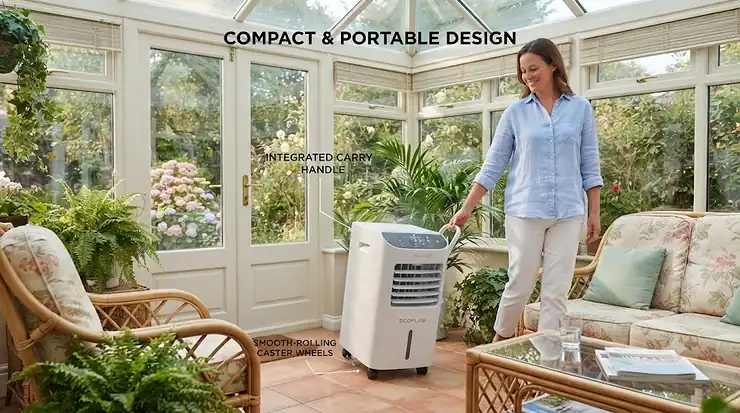
If you’ve ever stepped into your conservatory on a July afternoon and felt like you’d wandered into a greenhouse by mistake, you’re not imagining things. Glass rooms trap heat the way a car windscreen does on a sunny car park — brutally, and fast. An evaporative cooler for conservatory use works by drawing warm air across a water-soaked pad, so the air that comes out the other side is genuinely cooler, not just “moved around” like a standard fan. Unlike air conditioning, there’s no compressor, no need to seal every window, and no eye-watering electricity bill — just water, a fan motor, and physics doing the heavy lifting.
This isn’t just a comfort issue, either. Prolonged heat exposure carries real health risks for older people, babies, and anyone with an underlying condition, and the NHS specifically advises keeping living spaces cool during hot weather as one of the simplest ways to reduce that risk. The trouble is that not every evaporative cooler is built for a room with three walls of glass and a polycarbonate roof acting like a magnifying glass. Coverage area, tank size, and airflow all matter more here than in a standard bedroom or lounge. Below, we’ve researched seven genuinely available models — from compact office units to serious large-room coolers — and broken down exactly what separates a conservatory-worthy machine from one that’ll leave you sweating by 2pm.
Quick Comparison Table
| Cooler | Best For | Tank Size | Noise Level |
|---|---|---|---|
| Igenix IG9703 | Overall conservatory value | 6 litres | Moderate |
| DREO 40″ Bladeless | Quietest, bedroom-adjacent spaces | Removable | 35dB |
| Symphony Sumo 75XL | Large or open-plan conservatories | Large capacity | Higher |
| Symphony Diet 3D 12i | Small home office corners | Compact | Low-moderate |
| PELONIS 5L Tower | Bedroom-rated, space-saving | 5 litres | Low |
Reading across the table, it’s clear there’s no single “best” evaporative cooler for conservatory use — it genuinely depends on how much glass you’re fighting against and how much floor space you’re willing to sacrifice. The Igenix IG9703 earns its “overall” tag because its 6-litre tank and oscillation give it enough runway for an average-sized conservatory without needing constant refills, while the Symphony Sumo 75XL is the one to reach for if your glass room is genuinely large or open-plan. Anyone prioritising near-silent operation for a conservatory doubling as a reading nook should look straight at the DREO 40″ Bladeless.
💬 Just one click — help others make better buying decisions too!😊
Top 7 Evaporative Coolers for Conservatories: Expert Analysis
1. Igenix IG9703 Portable Air Cooler — proven all-rounder with a 6L tank
The 6-litre tank on the Igenix IG9703 Portable Air Cooler is the first thing worth noting, because in a conservatory that’s routinely warmer than the rest of the house, tank size dictates how often you’re trudging back to the kitchen sink. Its remote control, LED display, and three fan speeds with oscillation mean you can dial in airflow to sweep across a wide glazed room rather than just blasting one corner, and the seven-hour timer is genuinely useful for cooling the space down before you sit in it. Based on the spec comparison, this is the model most people should default to first: it’s not the flashiest unit here, but it’s the one with the longest UK track record, backed by close to 2,000 reviews on record — a real signal of reliability rather than marketing gloss. Reviewers consistently note that the castor wheels make it easy to shift between the conservatory during the day and the lounge in the evening, though a few mention the oscillation motor isn’t whisper-quiet on its top speed.
Pros:
- ✅ Large 6-litre tank reduces daily refilling
- ✅ Remote control and 7-hour timer for hands-off cooling
- ✅ Long UK sales history with strong review volume
Cons:
- ❌ Top fan speed noticeably louder than rivals
- ❌ No app control or smart scheduling
Expect this one to sit around the mid-£60s to mid-£70s range at most UK retailers, and for a conservatory-sized room, that’s solid value — check current price before buying, as retailers adjust seasonally.
2. Pro Breeze 7L 4in1 Evaporative Air Cooler — biggest tank of the budget tier
The Pro Breeze 7L 4in1 Evaporative Air Cooler stretches to a 7-litre tank, which in a hot conservatory translates to noticeably fewer trips with a jug. What most buyers overlook about this model is the “4-in-1” label isn’t just marketing — it genuinely functions as a fan, cooler, humidifier, and (with the ice compartment loaded) a stronger short-burst chiller, which matters on the kind of blistering afternoon where a standard evaporative pad alone won’t cut it. The remote and oscillation function let you point airflow away from delicate plants or paperwork near the glass, and it’s the most reviewed unit in this category with well over 2,700 ratings behind it — a genuinely large sample size for aggregated sentiment. A common theme in user reviews is that the ice compartment noticeably boosts performance on the very hottest days, though several buyers flag that the tank needs regular draining to avoid a stale smell if left standing.
Pros:
- ✅ 7-litre tank, largest in the budget bracket
- ✅ Ice compartment boosts cooling during heatwaves
- ✅ Very large, established UK review base
Cons:
- ❌ Tank can develop odour if water sits too long
- ❌ Bulkier footprint than tower-style rivals
Pricing typically sits in the £60-£75 range, putting it head-to-head with the Igenix on cost while offering more raw tank capacity.
3. PELONIS 5L Evaporative Air Cooler with Remote Control — bedroom-rated quiet runner
Marketed as a rated evaporative air cooler for bedroom use, the PELONIS 5L Evaporative Air Cooler with Remote Control earns its place here precisely because “bedroom-quiet” and “conservatory-friendly” overlap more than you’d think — a glass room used as a reading corner or home office in the evening benefits from the same low-noise engineering as a bedroom does. Its 5-litre tank offers up to roughly ten hours of runtime, which is generous for its size, and the sleep mode dims the display and drops fan noise for evening use. On paper, this means it’s better suited to smaller-to-medium conservatories than sprawling ones, but the trade-off is a genuinely quiet motor and a two-year warranty that beats most budget alternatives. Reviewers consistently report that the auto-swing distributes air more evenly than fixed-direction rivals, though performance does noticeably taper once humidity climbs above 65-70%, which is common on muggy UK summer days.
Pros:
- ✅ Sleep mode genuinely reduces noise overnight
- ✅ Generous 2-year warranty versus budget rivals
- ✅ Auto-swing spreads air more evenly
Cons:
- ❌ 5L tank needs daily refills in peak heat
- ❌ Effectiveness drops noticeably above ~65% humidity
Typically priced in the £55-£70 range, it’s a strong pick for anyone whose conservatory doubles as a quiet retreat rather than an entertaining space.
4. DREO 40″ Bladeless Evaporative Tower Fan — the quietest option on this list
At 35 decibels, the DREO 40″ Bladeless Evaporative Tower Fan is, on paper, the standout choice for anyone who finds standard fan-cooler hum genuinely irritating. The bladeless cross-flow design isn’t just a safety gimmick for households with small children or pets — it also changes the acoustic profile of the airflow, producing a smoother, less “whirring” sound than blade-based rivals. Here’s what to weigh: its coverage is rated for medium rooms up to roughly 30 square metres, which suits an average UK conservatory extension comfortably but may leave a large orangery-style glass room under-served. What most buyers overlook about this model is that the tank capacity isn’t heavily advertised — some listings specify a removable reservoir without a clear litre figure, so if long, unattended overnight runtime is a priority, it’s worth checking the current listing before buying. Reviewers highlight the tall, slim tower footprint as ideal for tucking against a conservatory wall without blocking the view.
Pros:
- ✅ Ultra-quiet 35dB operation, best on this list
- ✅ Bladeless design is safer around children and pets
- ✅ Slim tower footprint suits narrow conservatory corners
Cons:
- ❌ Tank capacity not clearly specified — verify before buying
- ❌ Premium price versus basic tower rivals
Sitting at around £159.99, it’s the priciest entry here, but for noise-sensitive households it’s arguably worth the premium.
5. Symphony Sumo 75XL Desert Evaporative Air Cooler — built for large, open glass rooms
If your glazed extension is genuinely large — think open-plan kitchen-diner-conservatory combinations rather than a modest bolt-on — the Symphony Sumo 75XL Desert Evaporative Air Cooler is the one worth a proper look. It’s explicitly positioned as an evaporative cooler for large room use, with high-performance cooling pads and a wide coverage footprint designed for open-plan spaces, conservatories, and even semi-outdoor areas like covered patios. Based on the spec comparison, the trade-off for that extra throw distance is a bigger physical unit and a noticeably higher noise floor than the compact tower-style options on this list — smooth-rolling castors make repositioning manageable, but this isn’t a machine you’ll want tucked in a small nook. What the spec sheet won’t tell you, but reviewers note, is that the controls are refreshingly simple for a “desert cooler”-class machine, without the fiddly multi-button panels some large-capacity rivals use.
Pros:
- ✅ Genuinely wide coverage for open-plan glass rooms
- ✅ Smooth-rolling castors ease repositioning
- ✅ Straightforward, uncomplicated control layout
Cons:
- ❌ Larger footprint than most on this list
- ❌ Noisier at full power than tower-style rivals
Expect a price somewhere in the low-to-mid £100s, which reflects the step up in raw cooling capacity over the compact models above.
6. Symphony Diet 3D 12i Evaporative Air Cooler — the compact pick for a home office corner
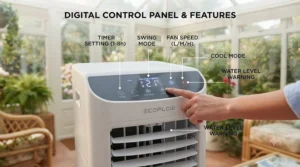
Not every glass room is a full conservatory — plenty of readers are cooling a small evaporative cooler for office nook carved out of a sunroom or garden studio, and that’s exactly where the Symphony Diet 3D 12i Evaporative Air Cooler earns its spot. Its honeycomb cooling pads are designed for efficient moisture transfer in a smaller footprint, and the “i-Pure Technology” filtration is a genuine differentiator versus basic budget units, aimed at keeping the circulated air cleaner rather than just cooler. The pop-up touchscreen and magnetic remote are small conveniences, but they add up when you’re working at a desk and don’t want to fumble with a control panel between video calls. Based on the spec comparison, this is a lesser-known alternative to the mainstream UK brands above, yet its compact design and modern control scheme make it a genuinely sensible choice for anyone cooling a single-desk space rather than an entire room.
Pros:
- ✅ Compact footprint suits small office nooks
- ✅ i-Pure filtration adds air-quality benefit
- ✅ Touchscreen and magnetic remote are genuinely convenient
Cons:
- ❌ Coverage limited versus full-size conservatory units
- ❌ Less established UK review history than rivals
Typically priced in the £90-£120 range depending on retailer, it sits as a mid-tier option built specifically for smaller glazed spaces.
7. NETTA 5L Portable Air Cooler with Remote — budget pick with genuine humidity control
The NETTA 5L Portable Air Cooler with Remote rounds out this list as the most affordable genuinely capable option, and it’s worth calling out specifically for humidity control — its dedicated humidifier setting, separate from the standard cooling mode, gives you more granular control than most budget rivals that only offer an all-or-nothing evaporative function. With three fan speeds, three operating modes, automatic oscillation, and two included ice packs, it covers the basics a conservatory needs without unnecessary extras. On paper, the 55W power draw is refreshingly low, meaning you can run it for long stretches on a sunny day without the electricity bill creeping up the way it would with a compressor-based cooler. A common thread in aggregated review sentiment is that buyers are pleasantly surprised by how much airflow it produces relative to its compact size, though — as with any evaporative unit — performance softens on the UK’s more humid, overcast summer days.
Pros:
- ✅ Dedicated humidity control mode separate from cooling
- ✅ Very low 55W power draw
- ✅ Includes two ice packs for extra chill
Cons:
- ❌ 5L tank is modest for larger conservatories
- ❌ Less effective on high-humidity, overcast days
Priced typically under £60, it’s the sensible starting point for anyone testing whether evaporative cooling suits their glass room before spending more.
Practical Usage Guide: Setting Up Your Cooler for Conservatory Success
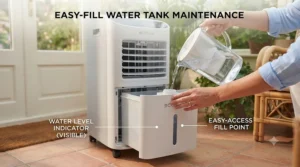
Getting genuine benefit from an evaporative cooler for conservatory use is less about the unit itself and more about where you put it. On day one, position the cooler near an open window or door rather than dead-centre in the room — evaporative cooling relies on a constant supply of fresh, dry air moving through the pad, and a sealed-up conservatory (the same mistake people make with air con) actually works against it. Fill the tank with cool tap water each morning before the room heats up, since starting cold gives the pad a head start. For the first 30 days, run the unit on a lower speed during the cooler morning hours and ramp up as the sun climbs — this trains you to read your own conservatory’s heat pattern rather than reacting once it’s already stifling. A common mistake is leaving stagnant water in the tank overnight; empty and rinse it every few days to stop algae building up on the cooling pad, which shortens its life and affects airflow. Finally, angle the airflow towards where you actually sit rather than trying to cool the whole glazed volume evenly — in a room this exposed to solar gain, direct airflow on your skin does more for comfort than a marginal drop in ambient temperature.
Real-World Scenarios: Matching the Right Cooler to Your Space
The conservatory reader. Sarah spends her evenings in a south-facing conservatory with a book, and noise matters more to her than raw cooling power — for her, a rated evaporative air cooler for bedroom-style quiet operation, like the PELONIS 5L Tower or the DREO 40″ Bladeless, makes more sense than a louder large-capacity unit, even if it means slightly less coverage.
The open-plan family. The Hendersons knocked through into a large kitchen-conservatory combination and need genuine throw distance across a big glazed footprint. An evaporative cooler for large room use, such as the Symphony Sumo 75XL, suits their situation far better than a compact tower model that would struggle to shift air across the whole space.
The remote worker. Priya set up a desk in the corner of a small garden room and just needs cool air on her hands and face during video calls — a small evaporative cooler for office use, like the Symphony Diet 3D 12i, does the job without dominating a small footprint or drawing unnecessary power all day.
Problem → Solution: Fixing Common Conservatory Heat Problems
Conservatory heat problems tend to follow predictable patterns, and most have a specific fix rather than needing a full room overhaul. If the room is uncomfortably hot but not humid, an evaporative cooler like the Igenix IG9703 or Pro Breeze 7L 4in1 works close to its full potential, since dry heat is exactly what evaporative cooling is designed for. If the room feels hot and sticky — common on overcast, humid UK days — pair your cooler with cross-ventilation (open a window on the opposite side) rather than expecting the unit alone to fix it, since trapped humid air limits how much moisture the pad can release into it. If the polycarbonate or glass roof is the main heat source, no cooler will fully compensate; Which?’s guidance on conservatories that overheat in summer points out that adding external shading, reflective glazing, or roof vents tackles the root cause rather than just the symptom. And if you’re finding the tank runs dry within a couple of hours on the hottest days, that’s simply a sign you need more tank capacity — step up from a 5-litre unit like the NETTA 5L to a 6-7 litre model such as the Igenix IG9703 or Pro Breeze 7L 4in1.
How to Choose an Evaporative Cooler for a Conservatory
- Measure your glass room first. Coverage claims vary wildly between models, so match tank size and airflow rating to your actual square metreage rather than guessing.
- Prioritise tank capacity for all-day use. A 5-litre tank might need refilling twice on a scorching afternoon; 6-7 litres buys real peace of mind.
- Check the noise rating if the room doubles as a quiet space. Anything above 45-50dB will compete with conversation or reading.
- Think about glass room cooling holistically. No cooler beats a poorly ventilated, unshaded glass box — pair it with an open window or vent.
- Weigh oscillation and throw distance. Wider glass rooms need wider airflow spread, not just raw power.
- Factor in humidity realistically. On the UK’s muggier days, expect reduced performance regardless of the model you choose.
- Check it’s a genuinely recognised technology. The UK government’s own Energy Technology List entry for evaporative air coolers confirms evaporative cooling as an officially catalogued, energy-efficient cooling category — a useful reassurance if you’re weighing it against other technologies.
Common Mistakes When Buying an Evaporative Cooler
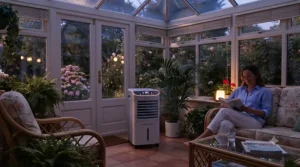
The single biggest mistake buyers make is choosing based on price alone rather than matching tank size to room size — a bargain 3-litre unit in a large conservatory will leave you constantly refilling and never quite catching up with the heat. The second is sealing the room up like you would for air conditioning; evaporative coolers need airflow through the space to work, so a closed-up conservatory actively undermines the unit’s performance. Buyers also frequently overlook noise ratings, assuming “fan-based” automatically means quiet, when oscillation motors and higher fan speeds can be surprisingly loud on cheaper models. Finally, plenty of shoppers assume evaporative cooling will match air conditioning’s raw cooling power — it won’t, and expecting AC-level performance from an evaporative unit is the fastest route to disappointment.
Evaporative Cooler vs Air Conditioning for Glass Rooms
| Factor | Evaporative Cooler | Portable Air Conditioning |
|---|---|---|
| Best For | Dry-heat glass room cooling on a budget | Consistent cooling regardless of humidity |
| Running Cost | Low — no compressor | Higher, often 3-4x the electricity draw |
| Ventilation Need | Requires open windows/doors | Needs sealed room, exhaust hose |
| Humidity Effect | Adds moisture to the air | Removes moisture from the air |
The analysis here matters more for a conservatory than almost any other room, because glass rooms are already prone to trapping humidity on muggy days — an evaporative cooler adding more moisture can occasionally work against comfort, whereas portable air con actively dehumidifies as it cools. That said, air conditioning’s running costs and the hassle of venting a hose through a glass panel make it a much bigger commitment; for most UK summers, where genuinely tropical humidity is rare, an evaporative cooler for conservatory use remains the more practical, lower-cost first step.
What to Expect: Real-World Performance in a Conservatory
On paper, evaporative coolers can drop air temperature by several degrees, but in a conservatory specifically, expect that figure to be more modest than in a standard room — the sheer volume of solar heat pouring through the glass means you’re fighting a constant heat source rather than cooling a sealed space once. Realistically, on a hot, dry day, you should feel a genuine, noticeable drop in temperature directly in the airflow path, even if the room’s overall ambient temperature only shifts by a couple of degrees. On the UK’s more humid, overcast summer days — which are common outside genuine heatwaves — don’t be surprised if the cooling effect feels closer to “a nice breeze” than “properly cold air.” That’s not a fault with any specific unit; it’s simply the physics of evaporative cooling interacting with UK weather patterns, and it’s worth setting expectations accordingly before you buy.
Humidity Control: Why It Matters More in a Conservatory
Humidity control deserves its own space here because conservatories behave differently to the rest of the house. Glass rooms already trap moisture from plants, cooking smells drifting through from an adjoining kitchen, or simply condensation on cooler evenings — and because evaporative coolers work by adding moisture to the air as they cool it, that combination can occasionally tip a conservatory from “pleasantly cool” into “a bit clammy” if you’re not paying attention. Models with a dedicated humidity control setting, like the NETTA 5L Portable Air Cooler, let you dial back the moisture output on days when the room already feels sticky, switching more towards a pure-fan mode instead. The practical habit worth building is simple: crack a window whenever the cooler is running, regardless of which model you own, since ventilation is what carries excess humidity back out rather than letting it recirculate around a glazed, largely sealed space.
Long-Term Cost & Maintenance
Running costs for evaporative coolers are genuinely modest — most draw well under 100W on standard settings, which at typical UK electricity rates works out to pennies per hour rather than the pounds-per-hour some portable air conditioners can rack up. Over a full summer of regular use, the electricity difference between an evaporative cooler and a compressor-based air conditioner can easily run into tens of pounds, making the lower upfront price of most evaporative units even more compelling. Maintenance costs are similarly low: expect to occasionally replace a cooling pad (typically an inexpensive part) every season or two, alongside routine tank cleaning to prevent limescale or algae buildup, especially in hard-water areas common across much of the UK.
| Cost Factor | Evaporative Cooler | Portable AC |
|---|---|---|
| Typical Power Draw | 55-150W | 800-1,500W |
| Annual Running Cost (moderate use) | Low (single-figure £s per week) | Noticeably higher |
| Replacement Parts | Cooling pad (inexpensive) | Filters, sometimes refrigerant service |
Looking at the numbers, the ongoing cost gap between the two technologies is the real story — even a premium evaporative cooler like the DREO 40″ Bladeless will likely cost less to run over a summer than a budget portable air conditioner. For most conservatory owners without genuinely extreme heat or humidity, that running-cost advantage alone justifies starting with evaporative cooling before considering the bigger investment of air con.
Safety & Building Regulations for Glass Rooms
If you’re planning a new conservatory build rather than cooling an existing one, it’s worth knowing that England’s building regulations now specifically address overheating. Approved Document O, the government’s overheating mitigation guidance, sets out requirements to limit unwanted solar gain and ensure adequate heat removal in new residential rooms — though it’s worth noting this only applies to conservatories built as part of a new residential building, not to existing conservatories added afterwards, according to official guidance on Approved Document O overheating requirements. For everyday safety, keep any evaporative cooler’s water tank topped up with clean water rather than letting it sit stagnant for days, since standing water can encourage bacterial growth in warm, humid glass rooms. Always route the power cable away from foot traffic and, if children or pets share the space, favour bladeless designs like the DREO 40″ Bladeless for reduced contact risk.

FAQ
❓ Does an evaporative cooler actually work in a UK conservatory?
❓ What size evaporative cooler do I need for a conservatory?
❓ Can I leave an evaporative cooler running in a conservatory overnight?
❓ Do evaporative coolers increase humidity in a conservatory?
❓ Is an evaporative cooler cheaper to run than air conditioning?
Conclusion
Choosing the right evaporative cooler for conservatory use really comes down to matching the machine to your specific glass room — its size, how much sun it catches, and whether quiet operation or raw coverage matters more to you. Budget-conscious buyers testing the waters will get genuine value from the NETTA 5L or Igenix IG9703, while anyone battling a large open-plan glazed space should lean towards the Symphony Sumo 75XL. Noise-sensitive households have a clear winner in the DREO 40″ Bladeless, and compact home-office corners are well served by the Symphony Diet 3D 12i. None of these units will turn your conservatory into a walk-in fridge, but paired with sensible ventilation and realistic expectations about UK humidity, any one of them will make those sun-trap afternoons genuinely bearable again.
Recommended for You
- Evaporative Cooler: 7 Proven Picks For UK Heatwaves (2026)
- USB-C Cooling Device For Laptop: 7 Best Picks Ranked (2026)
- USB-C Desk Fan: 7 Best Picks For UK Desks in 2026
Disclaimer: This article contains affiliate links. As an Amazon Associate, I earn from qualifying purchases. If you purchase products through these links, we may earn a small commission at no additional cost to you.
✨ Found this helpful? Share it with your friends! 💬🤗
