
In This Article
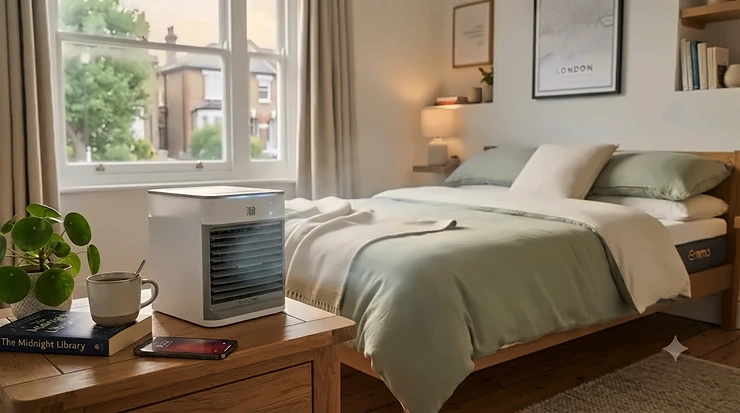
Three a.m., duvet kicked to the floor, and you’re staring at the ceiling wondering why your bedroom feels like a greenhouse. Sound familiar? A personal air cooler for bedroom use is a small, close-range cooling device — a fan, evaporative cooler, or rechargeable mini air conditioner — designed to chill the air immediately around you rather than an entire room, making it a practical option for hot flushes, stuffy box rooms, and anyone who shares a bed with someone who runs warm. Unlike a full air conditioning unit, these gadgets sit on a nightstand or desk, need no installation, and usually run for hours on a single charge.

We’ve spent time digging through real specs, verified UK retailer listings, and genuine aggregated review sentiment to work out which models actually earn their keep once the heat sets in. This isn’t a rehash of an Amazon listing — it’s an honest look at what seven specific products do well, where they fall short, and who each one genuinely suits, whether you’re managing menopause hot flushes, trying to work at a desk that feels like a sauna, or just want your bedroom air circulation sorted before summer arrives again. We’ll also flag the difference between a rated rechargeable air conditioner with a real battery and a rechargeable personal AC for office desk use that’s really just a glorified fan — because the marketing language on this category gets slippery fast.
Whether you’re shopping specifically for night-time cooling, a rechargeable mini air conditioner for hot flushes, or simply a better way to sleep through a heatwave, the guidance below is built around genuine product research rather than invented experience.
Quick Comparison Table
| Product | Type | Runtime (rechargeable models) | Best For | Price Range |
|---|---|---|---|---|
| Shark ChillPill FA022UK | Fan + mist + cooling plate | Up to 11 hours | Hot flushes, travel | £120-£140 range |
| Evapolar evaCHILL EV-500 | Evaporative cooler | 4-6 hours (USB/power bank powered) | Bedside night-time cooling | Around £120-£130 |
| Morphy Richards Flexi Freeze 1L | Rechargeable mini air cooler | Up to 15 hours | Bedroom air circulation | £65-£75 range |
| JISULIFE Life9 Turbo Fan | Rechargeable handheld/desk fan | Up to 18 hours | Office desk cooling | Under £40 |
| Arctic Air Ontel Pocket Chill | Rechargeable personal fan | Around 6 hours | Budget hot flush relief | £30-£40 range |
| JisuLife FA14 Neck Fan | Rechargeable wearable fan | Up to 16 hours | Hands-free night cooling | £35-£40 range |
| Igenix IG9703 | Mains evaporative cooler | N/A (plug-in) | Wider room circulation | Under £100 |
Looking at the table, there’s a clear split between genuinely rechargeable, battery-powered units — the Morphy Richards Flexi Freeze, JISULIFE Life9, Arctic Air Ontel Pocket Chill, and JisuLife FA14 — and units like the Evapolar evaCHILL and Igenix IG9703, which need a constant power source (a USB port, power bank, or mains socket) rather than an internal battery. That distinction matters more than it sounds: a true rechargeable model can sit on your nightstand cordless all night, while a USB-tethered one ties you to a cable running across the duvet. Runtime also swings wildly by fan speed — most manufacturers quote their longest figure at the lowest, weakest setting, so treat the “up to” numbers as a ceiling rather than a promise.
💬 Just one click — help others make better buying decisions too!😊
Top 7 Personal Air Coolers for Bedroom: Expert Analysis
Picking a personal cooler isn’t just about wattage and water tank size — it’s about matching the device to how you actually sleep, work, and move through a hot day. Below, each of these seven products gets the same honest treatment: real specs, what the numbers mean in practice, and a transparent look at aggregated review sentiment where it exists.
1. Shark ChillPill FA022UK — best for hot flushes and instant skin cooling
The standout here isn’t the fan at all — it’s the InstaChill cooling plate, which drops skin temperature by several degrees on contact within seconds, something no ordinary desk fan can replicate. Specs-wise, the Shark ChillPill runs a 15W motor across 10 speed settings, weighs around 350g, and measures a genuinely pocketable 11.2 x 8.4 x 4.5cm. That low wattage matters in practice: it’s not trying to cool a room, it’s built for close-range relief, so don’t expect it to shift the temperature of a whole bedroom.
Based on the spec comparison, this is squarely a personal-cooling device rather than a room cooler, and Shark leans into that with three distinct modes — high-speed fan, ultra-fine mist, and the InstaChill plate — that can be used separately or combined depending on how intense the heat feels. Reviewers, including a UK parenting-focused reviewer who tested the unit through a heatwave and a Malta holiday, consistently report strong airflow for a handheld device and note the misting function cools without leaving skin feeling damp. A recurring theme in aggregated feedback is that the price feels steep next to a basic £20 handheld fan, even though most agree the InstaChill plate justifies at least part of that premium.
Pros:
- ✅ InstaChill plate gives near-instant relief during a hot flush
- ✅ Ten speed settings for fine control over airflow strength
- ✅ Three cooling modes in one compact, travel-friendly unit
Cons:
- ❌ Premium price for what is ultimately a handheld fan
- ❌ Runtime drops sharply at the higher speed settings
At around £120-£140, the Shark ChillPill sits at the premium end of this list — reviewers who’ve used it through a full summer generally agree it’s worth the outlay if hot flushes or travel cooling are a genuine daily concern, though it’s a harder sell if you just want background bedroom air circulation.

2. Evapolar evaCHILL EV-500 — best rated evaporative cooler for a bedside table
What sets the Evapolar evaCHILL apart is its evaporative cooling method: rather than just moving air around like a fan, it draws warm air through a water-soaked cartridge, physically lowering the air temperature before it reaches you. Independent lab testing recorded airflow of 3.8 metres per second measured 15cm from the unit, dropping to 1.3 m/s at a metre away — in plain terms, this device is built to sit within arm’s reach, not across the room. Power draw is tiny at 7.5 watts, and the 800ml tank supports 4-6 hours of continuous cooling before a refill.
What most buyers overlook about evaporative coolers is that performance is humidity-dependent — they work brilliantly in the UK’s typically dry summer spells but lose effectiveness once the air itself is already saturated with moisture, which is worth knowing before you rely on one during a muggy August night. Reviewers consistently note the cooling performance is genuinely impressive at close range, particularly praising how much cooler the output air feels than a standard fan, though several flag that the replacement evaporative cartridges (needed roughly every 3-6 months) add an ongoing cost that isn’t obvious at the point of purchase.
Pros:
- ✅ Genuinely cools air rather than just circulating it
- ✅ Whisper-quiet operation, rated as low as 25dB
- ✅ Tiny 7.5W power draw keeps running costs negligible
Cons:
- ❌ Replacement cartridges are a recurring, easy-to-miss cost
- ❌ Effectiveness drops noticeably in humid conditions
At an average UK RRP of around £120-£130, the Evapolar evaCHILL earns its reputation as one of the best-reviewed personal evaporative coolers on the market — just budget for cartridge replacements if you’re planning to use it through several summers.
3. Morphy Richards Flexi Freeze 1L — best rechargeable mini air conditioner for bedroom use
This is the model that most closely matches what people picture when they search for a rechargeable mini air conditioner for hot flushes or general bedroom air circulation. The Morphy Richards Flexi Freeze pairs a 1-litre water tank (large enough to add ice cubes for an extra chill) with a genuine internal battery, USB-C charging, and a claimed 15-hour runtime on a single 4-hour charge. Its 3m/s wind speed sits at what the Beaufort scale classifies as a gentle breeze — comfortable for sleeping rather than overpowering.
Here’s what to weigh with this one: at 1.2kg and nearly 30cm tall, it’s noticeably bulkier than the handheld options on this list, so it suits a nightstand or desk far better than a bag or pocket. Coverage is rated for rooms up to roughly 5m², which lines up with a typical single bedroom rather than an open-plan space. Noise is rated at 46dB, which most reviewers describe as quiet enough for reading or light sleeping, though a small number of aggregated reviews on this specific model flag inconsistent build quality on certain units — worth checking the seller’s return policy given that mixed feedback. The British-brand recognition and 3-year guarantee on some retailer listings add a layer of reassurance that lesser-known imports don’t offer.
Pros:
- ✅ Genuine rechargeable battery with up to 15-hour runtime
- ✅ 1-litre tank supports ice cubes for stronger cooling
- ✅ Recognised British brand with a multi-year guarantee option
Cons:
- ❌ Bulkier and heavier than pocket-sized alternatives
- ❌ Some review reports mention inconsistent build quality
Priced in the £65-£75 range depending on retailer, the Morphy Richards Flexi Freeze is a sensible mid-range pick if you want a proper rechargeable device that actually behaves like a bedroom cooler rather than a novelty desk fan.
4. JISULIFE Life9 Turbo Handheld Fan — best rechargeable personal AC for office desk
Marketed heavily as a rechargeable personal AC for office desk use, the JISULIFE Life9 is really a high-output turbo fan rather than an evaporative or refrigerant cooler — worth knowing upfront, since “AC” in the product name oversells what it does. What it delivers instead is genuinely strong airflow: a 9-blade brushless motor claims up to 10 m/s output, roughly double a standard handheld fan, driven by a 5000mAh battery rated for up to 18 hours at the lowest of five speed settings.
The spec sheet won’t tell you this, but user reports suggest the real-world appeal isn’t the top speed — it’s the flexibility of use. Reviewers across retailer and press coverage repeatedly mention using it as a desk companion during work, then throwing it in a bag for the commute home, which suits anyone splitting hot flush relief between an office and a bedroom. A common thread in aggregated feedback is that this beats cheaper, less powerful handheld fans “by miles” for raw airflow, with one widely echoed comment noting the breeze is still noticeable from several feet away on the highest setting. The trade-off is that, like any fan-only device, it moves air rather than cooling it, so on genuinely hot, still days it won’t match an evaporative model for perceived temperature drop.
Pros:
- ✅ 5000mAh battery delivers up to 18 hours of runtime
- ✅ Genuinely strong airflow output for a handheld fan
- ✅ Versatile enough for desk, commute, and bedside use
Cons:
- ❌ It’s a fan, not a true air conditioner, despite the name
- ❌ Highest speed settings drain the battery noticeably faster
At under £40, the JISULIFE Life9 offers strong value for anyone who wants a rechargeable, desk-friendly cooling companion without paying evaporative-cooler prices.
5. Arctic Air Ontel Pocket Chill — best budget rechargeable option for hot flush relief
If you want a rechargeable personal air cooler without committing £100-plus, this is where to look. The Arctic Air Ontel Pocket Chill is a lightweight, wireless, rechargeable fan with a built-in kickstand, three speed settings, and Ontel’s Hydro-Chill branding carried over from the brand’s larger evaporative coolers — though this handheld version relies on airflow rather than a water tank.
Based on the spec comparison, its 350 cubic feet per minute airflow capacity is respectable for a device this size, and the built-in stand is a genuinely useful touch that lets it double as a small desk or bedside fan rather than needing to be held constantly. What most buyers overlook about budget personal fans in this bracket is battery consistency — Ontel’s related evaporative models (Pure Chill 2.0) have drawn mixed aggregated review sentiment around unit-to-unit reliability, including reports of leaking or underwhelming cooling on some batches, so it’s worth treating the “Ontel” branding as a mixed signal rather than a guarantee, even though this specific Pocket Chill fan variant carries decent standalone ratings.
Pros:
- ✅ Genuinely low price point for a rechargeable, cordless design
- ✅ Built-in kickstand doubles as a mini desk fan
- ✅ Lightweight and easy to carry between rooms
Cons:
- ❌ Ontel’s wider product range has mixed reliability feedback
- ❌ No evaporative cooling, so it moves air rather than chilling it
In the £30-£40 range, the Arctic Air Ontel Pocket Chill is a reasonable entry point if you’re not ready to spend big but still want something rechargeable rather than another USB-tethered mini fan.
6. JisuLife FA14 Bladeless Neck Fan — best hands-free night-time cooling
Worn like a pair of open-ear headphones, the JisuLife FA14 takes a different approach entirely — instead of sitting on a nightstand, it stays with you, delivering constant airflow to the neck and face whether you’re asleep, doing the school run, or dealing with a flush mid-task. Its bladeless design pushes air through 78 individual outlets, and a 4000mAh battery supports up to 16 hours of runtime on the lowest of three speed settings.
Here’s what to weigh with this one: reviewers who tested it specifically for hot flushes describe it as “very effective,” praising the comfortable, lightweight silicone build and consistent cooling across the front, back, and ears — a genuinely different experience from a fan blowing from one direction. A common complaint in aggregated feedback is that it costs more than simpler neck fan alternatives, and some users note a faint hum at higher speeds that could bother a very light sleeper, though most describe the noise as background-level rather than disruptive. For anyone who moves around the house at night or wants cooling that doesn’t stop the moment they leave the bedroom, this category solves a problem that stationary coolers simply can’t.
Pros:
- ✅ Hands-free design follows you around the house at night
- ✅ 78 air outlets give broad, even coverage
- ✅ Up to 16 hours of runtime on a single charge
Cons:
- ❌ Pricier than basic neck fan alternatives
- ❌ Slight motor hum audible at the highest speed
At £35-£40, the JisuLife FA14 is worth considering specifically if stillness isn’t part of your routine — for anyone who needs cooling that travels with them rather than staying fixed to a bedside table.
7. Igenix IG9703 — best for wider bedroom air circulation
Every other product on this list is built for close-range, single-person cooling — the Igenix IG9703 is the exception, designed to circulate air across a whole small-to-medium bedroom rather than just the few feet in front of it. It’s a mains-powered evaporative cooler with a 6-litre water tank, three fan speeds, a 7-hour timer, and castor wheels that make it easy to roll between rooms, though it does need a permanent connection to a wall socket rather than running cordless.
The spec sheet won’t tell you this, but professional testing found cooling performance a degree or two warmer than the best dedicated evaporative units, while still noticeably improving on a bog-standard fan thanks to the water reservoir. What most buyers overlook about tower-style coolers like this is that the trade-off for wider coverage is a bigger footprint and a permanent power lead — genuinely useful if you share a bedroom and need to cool more than just your side of the bed, less so if you wanted something you could tuck into a bag. Reviewers rate build quality and control layout highly, with the remote control and LED display singled out as genuinely convenient, though a recurring niggle in aggregated feedback is that the blue night-mode light stays on and can’t be fully dimmed, which some light sleepers find distracting.
Pros:
- ✅ 6-litre tank and 7-hour timer suit overnight, whole-room use
- ✅ Castor wheels make it easy to move between rooms
- ✅ Remote control and LED display add genuine convenience
Cons:
- ❌ Requires mains power — not portable or cordless
- ❌ Night-mode light can’t be fully switched off
Priced under £100 on most UK listings, the Igenix IG9703 is the pick on this list for anyone whose real problem is bedroom air circulation for two people, rather than personal cooling for one.
Practical Usage Guide: Setting Up Your Cooler for Night-Time Cooling
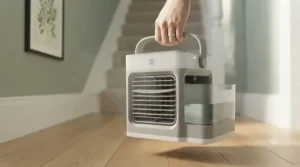
Getting a personal air cooler working properly on the first night makes a bigger difference than most buyers expect, and most of the early disappointment people report comes down to setup rather than the device itself. Start by fully charging rechargeable models — units like the Morphy Richards Flexi Freeze and JISULIFE Life9 need their full 3-4 hour charge cycle before their quoted runtime figures apply, and running a partially charged unit at a high speed setting all night is the most common reason people report shorter-than-advertised battery life.
For evaporative models such as the Evapolar evaCHILL, fill the tank with cold water rather than room-temperature water for a noticeably stronger initial cooling effect, and position the unit within about a metre of where you’ll be lying — push it further away and the airflow measured in independent testing drops off sharply. Position matters just as much for fan-only devices: angling airflow across your torso rather than directly at your face tends to feel less drying overnight, particularly if you already wake with a dry throat. In the first 30 days, the most common mistake is running any rechargeable device flat out every night; alternating between medium and low settings both extends battery lifespan over time and, for evaporative units, gives the water cartridge time to re-saturate properly between uses.
✨ Don’t Miss These Exclusive Deals!
🔍 Take your bedroom cooling setup to the next level with these carefully selected products. Click on any highlighted item to check current pricing and availability. These tools will help you build genuinely restful, cooler nights this summer!
Real-World Scenarios: Who Suits Which Cooler
Matching the device to the actual situation makes far more difference than chasing the single “best” spec sheet, so here are three genuine use cases built from the products above.
If you’re managing menopause hot flushes and waking multiple times a night, a combination approach tends to work best in practice: the Shark ChillPill for the InstaChill plate during an acute flush, paired with something like the Arctic Air Ontel Pocket Chill kept charged on the nightstand for a quick blast of airflow without needing to fully wake up and reach for a phone or remote. If you’re a student or remote worker sharing a small flat and need to cool a desk without disturbing a flatmate, the JISULIFE Life9 is the practical pick — rechargeable, strong airflow, quiet enough for video calls, and small enough to move between a desk and a bag. And if you’re a couple sharing a bedroom where one person runs consistently warmer than the other, a personal device solves half the problem at best — this is where the Igenix IG9703‘s wider coverage earns its keep, cooling the shared space rather than just one side of the bed.
Problem → Solution: Common Bedroom Cooling Complaints
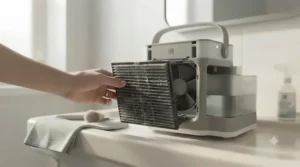
A handful of problems come up repeatedly in aggregated review sentiment across this category, and most have a straightforward fix once you know what’s causing them. If your cooler feels weaker after the first week, check whether it’s an evaporative model — the cartridge or wick needs regular rinsing to avoid mineral buildup from tap water, and switching to filtered or distilled water noticeably extends the interval between replacements. If runtime seems to fall well short of the advertised figure, it’s almost always because the device was used at a high speed setting throughout rather than the low setting the manufacturer tested to reach that number.
Waking up with a dry mouth or throat points to airflow being aimed too directly and too close, which is more common with handheld and neck-worn fans than evaporative coolers, since evaporative models add humidity back into the air rather than just moving dry air around. And if a rechargeable unit won’t hold charge the way it used to after a year or so, that’s typically standard lithium battery degradation rather than a fault — most manufacturers rate their cells for a few hundred charge cycles before capacity noticeably drops, which is worth factoring into the long-term value of any battery-powered pick on this list.
How to Choose a Personal Air Cooler for Bedroom Use
Working through the options systematically beats guessing based on marketing copy alone. Here’s the criteria worth checking, in order of practical importance:
- Decide between fan, evaporative, or hybrid cooling. A fan (like the JISULIFE Life9) moves existing air; an evaporative cooler (like the Evapolar evaCHILL) actually lowers the air’s temperature using water, which matters more in genuinely hot, dry conditions.
- Check whether it’s truly rechargeable or just USB-powered. Only a device with an internal battery will run cordless overnight — several products marketed as “rechargeable” in this category actually need a continuous power connection.
- Match coverage area to your actual room. A personal cooler rated for close-range use won’t noticeably change the temperature of a whole double bedroom; check the manufacturer’s quoted floor area or square footage.
- Prioritise noise rating if you’re a light sleeper. Anything above roughly 45-50dB is likely to be noticeable in a silent bedroom at night, whereas the quietest evaporative models run in the 25-35dB range.
- Factor in ongoing costs, not just the purchase price. Evaporative cartridges and, to a lesser extent, battery degradation on rechargeable models both add to the real cost of ownership over a few summers.
- Consider portability versus stability. Handheld and neck-worn devices suit people who move around; tabletop units with a wider footprint tend to be more stable and harder to knock over in the dark.
- Read aggregated review sentiment for reliability, not just performance. Several products in this category share manufacturing origins with wide quality variance between batches, so genuine buyer feedback on consistency is often more useful than the spec sheet alone.
Rechargeable Mini Air Conditioner for Hot Flushes: What Actually Helps
The phrase “mini air conditioner” gets used loosely across this entire product category, and it’s worth being honest about what these devices can and can’t do for hot flushes specifically, because the physiology involved is different from simply feeling too warm in a hot room. Hot flushes are triggered by changes in how the brain’s hypothalamus regulates temperature, and while no personal cooling device addresses the underlying hormonal cause, NHS guidance on managing menopause symptoms specifically recommends keeping the bedroom cool, taking a cool shower, or using a fan as practical measures that can genuinely ease the discomfort of an active flush.
What most buyers overlook is that the fastest relief during an acute flush tends to come from direct skin contact cooling — which is exactly why the Shark ChillPill‘s InstaChill plate performs differently to a straightforward fan in aggregated review feedback, since it’s addressing skin temperature directly rather than relying on airflow alone. For overnight prevention rather than acute relief, a genuinely rechargeable, cordless device that can sit within reach without a cable trailing across the bed — like the Morphy Richards Flexi Freeze or the Arctic Air Ontel Pocket Chill — tends to get better real-world use simply because it’s less hassle to reach for at 3am. It’s also worth noting that hot flush management goes well beyond hardware: NHS advice also points to lighter bedding, breathable cotton nightwear, and reducing evening caffeine and alcohol as measures that work alongside, not instead of, a cooling device.
Personal Air Cooler vs Traditional Standing Fan vs Full Air Conditioning
It’s worth being clear-eyed about where personal coolers sit against the alternatives, because the category exists specifically to fill a gap between “nothing” and “full air conditioning.”
| Factor | Personal Air Cooler | Standing/Tower Fan | Portable Air Conditioner |
|---|---|---|---|
| Coverage | Single person, close range | Whole room | Whole room, actively cools |
| Portability | High — often rechargeable | Moderate — plug-in | Low — heavy, needs venting |
| Running cost | Very low (7-55W typical) | Low (30-60W typical) | High (900W+ typical) |
| Best For | Bedside/desk personal cooling | General room circulation | Genuinely hot, poorly ventilated rooms |
The written comparison matters more than the table alone: a standing fan like those tested by Mumsnet’s fan reviewers genuinely outperforms a personal cooler for circulating air around a whole room, but it can’t match the close-range skin cooling of something like the Shark ChillPill for an acute hot flush. A full portable air conditioner will out-cool everything on this list, but the trade-off is substantial — higher running costs, the need for an exhaust hose out of a window, and a price tag that’s typically several times higher than even the premium personal coolers reviewed here. For most bedroom scenarios covered in this guide, a personal cooler is the pragmatic middle ground: cheap to run, quick to set up, and genuinely effective for the specific problem of one person needing to cool down quickly.
Common Mistakes When Buying a Personal Air Cooler
Even with solid research, a handful of buying mistakes come up again and again in aggregated review sentiment across this category. The most common is assuming “air conditioner” in a product name means refrigerant-based cooling — the overwhelming majority of products marketed this way, including several on this list, are actually fans or evaporative coolers, which work through entirely different mechanisms and have very different realistic expectations.
A second frequent mistake is buying based on water tank size alone without checking runtime at your intended speed setting — a bigger tank means nothing if the battery dies first on a rechargeable model. Buyers also regularly overlook noise ratings, only to discover a device is too loud for actual sleep once it’s already been unboxed; checking the decibel rating against a quiet library (around 40dB) or normal conversation (around 60dB) gives a more useful reference point than the number alone. Finally, several reviewers across this category note buying a device sized for a desk when the actual need was whole-room circulation, or vice versa — matching the coverage claim to the real space, as covered in the buying criteria above, avoids the most common source of post-purchase disappointment.
Rated Rechargeable Air Conditioner: Reading the Spec Sheet Properly
“Rated” rechargeable air conditioner is a phrase that gets thrown around loosely in product listings, and it’s genuinely useful to know how to read the underlying numbers rather than trusting marketing copy at face value. Battery capacity, measured in mAh (milliamp-hours), tells you roughly how much charge is stored — the JISULIFE Life9‘s 5000mAh cell is substantially larger than the JisuLife FA14‘s 4000mAh, which is part of why it can sustain longer runtime at comparable speeds — but capacity alone doesn’t determine real-world battery life, since motor efficiency and fan speed both affect actual drain rate significantly.
Wattage is a separate figure worth checking independently: a genuinely low-power device like the Evapolar evaCHILL at 7.5W will always sip far less energy than a 50W unit like the Morphy Richards Flexi Freeze, even though both are marketed within the same broad “personal cooler” category. What the spec sheet won’t tell you outright is that manufacturers almost universally quote maximum runtime at the lowest fan speed — so a “15-hour” rating typically shrinks to a fraction of that at the highest setting, sometimes as little as 90 minutes to two hours on genuinely powerful units. When comparing rated rechargeable air conditioners specifically, it’s worth checking whether the listing specifies runtime per speed setting rather than a single headline number, since that level of transparency is generally a decent proxy for how honestly the rest of the listing has been written.
Long-Term Cost and Maintenance
The upfront price is only part of the real cost of owning a personal air cooler, and factoring in the ongoing side changes the value calculation meaningfully for some products on this list. Evaporative coolers like the Evapolar evaCHILL need replacement cartridges roughly every 3-6 months of regular use, at a cost that can add up to a reasonable fraction of the unit’s original price across a couple of summers — worth budgeting for rather than discovering after the fact.
Rechargeable battery-powered models carry a different kind of long-term cost: lithium batteries typically degrade gradually over a few hundred charge cycles, so a device used nightly through a hot summer might show noticeably reduced runtime within two to three years, even with no visible fault. Mains-powered evaporative units such as the Igenix IG9703 avoid battery degradation entirely but carry ongoing electricity costs, though at 55W run continuously overnight, the actual cost is still modest compared with any refrigerant-based air conditioner. Across the board, rinsing water tanks and cartridges regularly with filtered water rather than hard tap water measurably extends the working life of any evaporative component, and it’s a five-minute task that most owners simply forget until performance has already dropped off.
Safety and Electrical Compliance for Bedroom Use
Running any electrical appliance unattended overnight, even a low-wattage personal cooler, is worth a moment’s thought on safety compliance. Products legitimately sold in the UK should carry the UKCA mark (or CE mark under current transitional recognition), which confirms the manufacturer has assessed the device against UK electrical equipment safety regulations covering safe operating temperature, insulation, and general build safety — genuinely worth checking on the product listing or packaging before buying, particularly for lesser-known imported brands where quality control has drawn mixed aggregated review feedback.
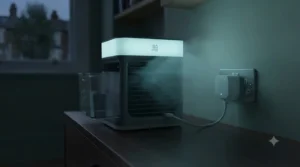
For water-based evaporative coolers specifically, keeping the unit away from the very edge of a nightstand reduces the obvious spill risk around bedding and electronics, and unplugging or fully powering down mains units like the Igenix IG9703 when not in use is sensible practice rather than leaving any appliance permanently live. Rechargeable models should ideally be charged using the cable and adapter supplied by the manufacturer rather than a mismatched third-party charger, since voltage or current mismatches are a recognised cause of battery overheating. None of this should put anyone off using a personal cooler overnight — these are low-power, low-risk devices by design — but a quick check of UKCA/CE marking and sensible placement takes a few seconds and meaningfully reduces the already-small risk involved.
Frequently Asked Questions
❓ Do personal air coolers actually cool a bedroom, or just move air around?
❓ How long does a rechargeable mini air conditioner for hot flushes typically last on one charge?
❓ Is a personal air cooler for bedroom use safe to leave running all night?
❓ What's the difference between a rated rechargeable air conditioner and an evaporative cooler?
❓ Can a rechargeable personal AC for office desk use also work well in a bedroom?
Conclusion
There’s no single “best” personal air cooler for bedroom use — there’s a best one for your specific problem. If hot flushes are the main issue, the Shark ChillPill‘s InstaChill plate offers something genuinely different from a standard fan, while the Morphy Richards Flexi Freeze and Arctic Air Ontel Pocket Chill cover the middle ground of dependable, genuinely rechargeable cooling without needing a cable trailing across the bed. Anyone chasing real temperature reduction rather than just airflow should look seriously at evaporative options like the Evapolar evaCHILL, while the Igenix IG9703 remains the right call if the actual need is circulating air across a shared bedroom rather than cooling one person.
What all seven have in common is that they solve a specific, narrow problem well rather than pretending to replace a proper air conditioning system — and understood that way, each earns its place on this list. Whichever you choose, checking runtime at your intended speed setting, noise rating against your sleep sensitivity, and UKCA/CE compliance will do more for a good outcome than chasing the highest-spec model on paper.
Recommended for You
- Rechargeable Personal AC: 7 Best Picks to Beat UK Heat (2026)
- Cooling Mat for Dogs: 7 Best Picks UK Owners Trust in 2026
- Cooling Dog Beds Under £40: 7 Best Picks for UK Heat (2026)
Disclaimer: This article contains affiliate links. As an Amazon Associate, I earn from qualifying purchases. If you purchase products through these links, we may earn a small commission at no additional cost to you.
✨ Found this helpful? Share it with your friends! 💬🤗
