
In This Article
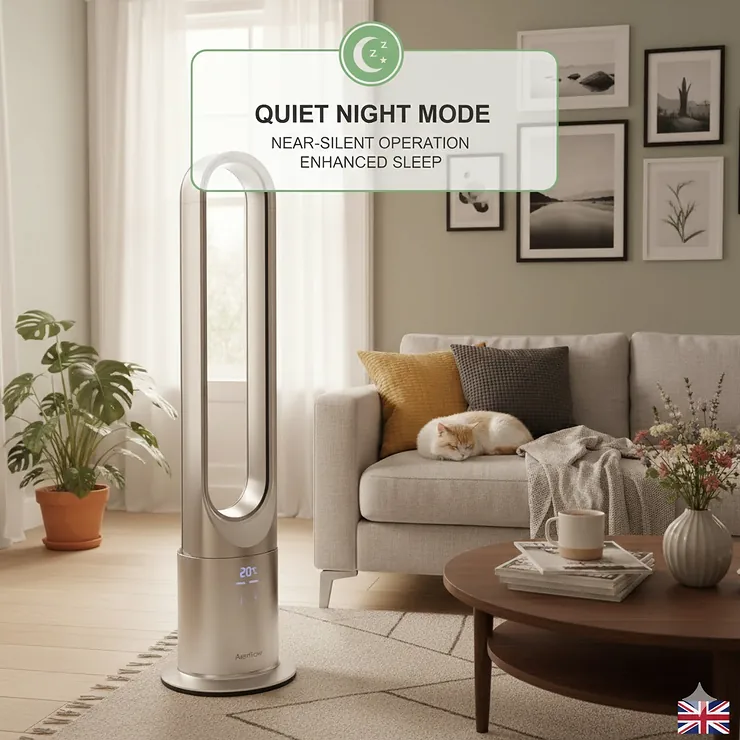
Picture this: it’s a sweltering July afternoon in London, and you’re desperately seeking relief from the heat. You’ve got young children playing nearby, and the thought of traditional fan blades spinning at high speed makes you nervous. This is precisely where a bladeless fan becomes an absolute game-changer for modern UK households.
When James Dyson first introduced the Air Multiplier technology back in 2009, many people scratched their heads at the concept. How could a fan work without visible blades? Fast forward to 2026, and these innovative cooling devices have become increasingly popular across Britain, particularly among families prioritising safety and those living in smaller flats where space and noise levels matter. According to Which? consumer research, bladeless fan sales in the UK have increased by over 40% in recent years as prices have become more accessible. The technology has evolved remarkably, with brands like Dreo, PureMate, and LEVOIT now offering surprisingly affordable alternatives to premium options, making this technology accessible to nearly every budget.
What makes these fans particularly brilliant for UK homes is their ability to deliver powerful cooling without the buffeting sensation of traditional fans, their whisper-quiet operation perfect for our compact living spaces, and their child-safe design that eliminates worry about curious little fingers. Whether you’re working from your bedroom-office hybrid or trying to sleep through a rare British heatwave, there’s a model that’ll suit your specific needs. Let’s explore the best options available in 2026 and help you find the perfect cooling companion for your home.
Quick Comparison Table
| Fan Model | Height | Noise Level | Price Range | Best For |
|---|---|---|---|---|
| Dreo Cruiser TF518 | 107cm (42″) | 25-48 dB | £76-99 | Power & versatility |
| LEVOIT Smart 42″ | 107cm (42″) | 25 dB | £100-170 | Tech enthusiasts |
| PureMate 47″ with Air Purifier | 119cm (47″) | 43-56 dB | £85-110 | Air quality conscious |
| Dreo Nomad One | 91cm (36″) | 28 dB | £67-99 | Compact spaces |
| PureMate 43″ | 109cm (43″) | 43-53 dB | £50-70 | Budget buyers |
| LEVOIT Classic 36″ | 91cm (36″) | 28 dB | £70-110 | Bedrooms |
| PureMate 13″ Desktop | 33cm (13″) | 40-45 dB | £20-30 | Personal cooling |
💬 Just one click – help others make better buying decisions too!😊
✨ Don’t Miss These Exclusive Deals!
🔍 Take your home cooling to the next level with these carefully selected products. Click on any highlighted item to check current pricing and availability on Amazon.co.uk. These fans will help you create comfortable living spaces your family will love!
Top 7 Bladeless Fans: Expert Analysis
1. Dreo Cruiser TF518 – The Performance Champion
If raw cooling power is what you’re after, the Dreo Cruiser TF518 stands head and shoulders above the competition. This impressive 107cm (42-inch) tower has recently been upgraded with 9 speed levels (up from 6) and a boosted airflow of 28 feet per second, making it one of the most powerful bladeless fans currently available in the UK.
Key Specifications:
- 9 adjustable speed settings with 4 operational modes
- 90-degree oscillation coverage
- 12-hour programmable timer
- Upgraded DC motor for enhanced efficiency
UK buyers particularly appreciate its remarkably quiet operation, starting at just 25 dB on the lowest setting—that’s quieter than a whisper. The LED display shows room temperature, current settings, and timer status at a glance, though it thoughtfully dims automatically in sleep mode. Customer reviews on Amazon.co.uk consistently praise its ability to cool large rooms effectively whilst remaining nearly silent. At £76-99, it represents exceptional value for the power and features on offer, making it the top choice for families seeking professional-grade cooling without Dyson’s premium pricing.
Pros:
✅ Exceptionally powerful airflow reaches across large rooms
✅ Whisper-quiet operation perfect for bedrooms
✅ Energy-efficient DC motor reduces electricity costs
Cons:
❌ Slightly taller footprint may not suit very low ceilings
❌ LED display brightness bothers some light-sensitive sleepers
2. LEVOIT Smart 42-Inch Tower Fan – The Tech Lover’s Choice
For those who embrace smart home technology, the LEVOIT Smart 42-Inch transforms basic cooling into an automated, app-controlled experience. This fan integrates seamlessly with Amazon Alexa and Google Home, allowing voice commands like “Alexa, set the fan to sleep mode” or “Hey Google, increase fan speed to level 5.”
Key Specifications:
- Works with Amazon Alexa and Google Home
- Brushless DC motor with 12 customisable speeds
- VeSync app for remote control and scheduling
- 24-hour timer with 4 operational modes
The brushless DC motor delivers impressive 26 feet per second velocity whilst maintaining a mere 25 dB noise level—perfect for light sleepers. UK customers rave about the ability to schedule cooling before arriving home from work, ensuring rooms are comfortable upon arrival. Priced between £100-170, it’s admittedly a premium investment, but the convenience and energy savings quickly justify the cost for tech-savvy households.
Pros:
✅ Comprehensive app control from anywhere
✅ Voice command compatibility with major assistants
✅ Precise temperature sensing for automatic adjustments
Cons:
❌ Higher price point than non-smart alternatives
❌ Requires stable WiFi connection for smart features
3. PureMate 47-Inch with Air Purifier – The Dual-Purpose Marvel
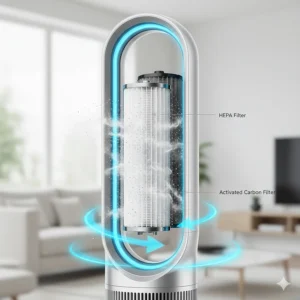
Why settle for just cooling when you can purify simultaneously? The PureMate 47-Inch with Air Purifier combines bladeless fan technology with HEPA filtration, making it particularly valuable for allergy sufferers and urban dwellers concerned about air quality. This UK-based brand has created a genuinely useful all-season solution.
Key Specifications:
- Integrated HEPA filter removes 99.97% of particles
- 12 speed settings with 4 wind modes
- Energy-efficient 28W DC motor
- Filter replacement indicator
Operating between 43-56 dB depending on speed, it’s slightly louder than some competitors but still comfortable for most situations. The HEPA filter effectively captures dust, pollen, and pet dander—a real blessing during British hay fever season. According to Asthma + Lung UK, maintaining good indoor air quality is crucial for the 5.4 million people in the UK living with asthma, and fans with built-in air purification can significantly reduce airborne triggers. UK buyers appreciate the filter replacement reminder, ensuring optimal performance year-round. At £85-110, it’s excellent value considering you’re essentially getting two appliances in one.
Pros:
✅ Simultaneous cooling and air purification
✅ Filter replacement alerts prevent performance degradation
✅ Energy-efficient DC motor keeps running costs low
Cons:
❌ Replacement filters add ongoing maintenance cost
❌ Slightly noisier than pure cooling models
4. Dreo Nomad One – The Compact Powerhouse
Don’t let its 91cm (36-inch) stature fool you—the Dreo Nomad One punches well above its weight class. This compact tower delivers 25 feet per second velocity whilst maintaining an impressively quiet 28 dB operation, making it ideal for smaller UK flats, bedrooms, or home offices where space comes at a premium.
Key Specifications:
- 4 speeds with 4 distinct modes (Normal, Natural, Sleep, Auto)
- 90-degree oscillation for wide coverage
- 8-hour timer with automatic shut-off
- Removable rear grille for easy cleaning
The algorithmic impeller design leverages the Coandă effect to minimise noise—brilliant engineering that UK buyers consistently praise in reviews. The auto mode uses a built-in sensor to adjust speed based on room temperature, providing set-and-forget convenience. Priced at £67-99, it represents outstanding value for smaller spaces, delivering big-fan performance in a compact footprint that won’t dominate your room.
Pros:
✅ Perfect size for smaller UK homes and flats
✅ Auto mode adjusts to ambient temperature
✅ Removable parts make cleaning straightforward
Cons:
❌ Shorter height may not cool entire large rooms effectively
❌ 8-hour timer shorter than some competitors’ 12-hour options
5. PureMate 43-Inch Tower Fan – The Budget-Friendly Winner
If you’re seeking bladeless fan technology without breaking the bank, the PureMate 43-Inch delivers remarkable value. This straightforward model eschews fancy features in favour of reliable, effective cooling at a price point that makes bladeless fans accessible to virtually any UK household.
Key Specifications:
- 3 speed settings with LED display
- 70-degree oscillation coverage
- 12-hour timer in 1-hour increments
- Remote control with batteries included
Operating at 43-53 dB, it’s notably louder than premium models but still perfectly acceptable for daytime use and many people’s bedrooms. UK buyers consistently mention its easy assembly—just four screws to attach the base—and the generous 1.5-metre power cable that provides placement flexibility. At just £50-70, it’s an absolute steal for families wanting child-safe cooling without the premium price tag.
Pros:
✅ Exceptionally affordable entry to bladeless technology
✅ Simple operation perfect for elderly users
✅ Includes remote control at budget price
Cons:
❌ Louder operation than premium alternatives
❌ Basic plastic construction feels less substantial

6. LEVOIT Classic 36-Inch – The Bedroom Specialist
Specifically engineered for bedroom use, the LEVOIT Classic 36-Inch prioritises whisper-quiet operation and sleep-friendly features above all else. This model has become incredibly popular across UK Amazon reviews, with buyers consistently praising its ability to keep bedrooms comfortable without disturbing light sleepers.
Key Specifications:
- 5 speed settings with 4 operational modes
- 28 dB ultra-quiet operation
- Built-in temperature sensor for auto mode
- 12-hour timer with gradual speed reduction
The sleep mode gradually decreases speed every 30 minutes, mimicking natural cooling as you fall deeper into sleep—a thoughtful touch that demonstrates LEVOIT’s understanding of sleep science. UK buyers particularly appreciate the display auto-off feature, eliminating light pollution in dark bedrooms. Priced at £70-110 depending on sales, it strikes an excellent balance between features and affordability for dedicated bedroom use.
Pros:
✅ Exceptionally quiet operation preserves sleep quality
✅ Auto mode responds intelligently to temperature changes
✅ Display automatically dims in sleep mode
Cons
: ❌ 36-inch height may not effectively cool very large bedrooms
❌ Basic aesthetic design won’t suit all décor preferences
7. PureMate 13-Inch Desktop Fan – The Personal Cooler
Sometimes you just need targeted cooling at your desk or bedside table, and the PureMate 13-Inch Desktop delivers exactly that in an adorably compact package. This diminutive model proves bladeless technology works brilliantly at smaller scales, perfect for personal spaces in UK homes and offices.
Key Specifications:
- 3 adjustable speed settings
- 70-degree oscillation
- 20W energy-efficient motor
- Twist-control operation (no remote)
At just 33cm tall, it fits comfortably on any desk without obstructing your view or taking valuable workspace. The 20W motor makes it incredibly economical—you can run it all day without worry about electricity costs. UK buyers mention it’s louder than larger models (40-45 dB) due to the compact design, but the noise is consistent rather than buffeting, making it less distracting during work. At £20-30, it’s an absolute bargain for personal cooling, proving bladeless fans needn’t be expensive.
Pros:
✅ Incredibly affordable personal cooling solution
✅ Fits perfectly on desks and bedside tables
✅ Minimal energy consumption
Cons:
❌ Limited cooling area suitable only for personal use
❌ No remote control (manual twist dial only)
What Is a Bladeless Fan? Understanding the Technology
Despite the name, a bladeless fan doesn’t truly lack blades—it simply hides them ingeniously inside the base. This revolutionary design, pioneered by >Sir James Dyson in 2009 uses what’s called “Air Multiplier” technology to create smooth, consistent airflow without exposed spinning blades.
Here’s how the magic happens: a brushless electric motor in the base draws air through small vents, similar to how a vacuum cleaner operates in reverse. This air is then forced up through the hollow ring or tower at high pressure. As it exits through a narrow slit around the rim, the fast-moving air creates a low-pressure zone that pulls surrounding air along with it—a phenomenon known as inducement and entrainment. This process amplifies the original airflow by up to 15 times, creating a powerful yet smooth breeze.
The airfoil-shaped ramp over which the air travels is crucial to the technology’s success. Angled typically between 7 and 20 degrees (usually around 15 degrees for optimal performance), this ramp accelerates the air whilst simultaneously drawing in surrounding air from behind and around the fan. The result is a consistent stream of air that feels more natural than the choppy, buffeting sensation from traditional bladed fans. It’s remarkably similar to feeling a steady breeze on a spring day rather than standing in front of a propeller.
Key Benefits of Bladeless Fans
Enhanced Safety for Families
The most compelling advantage of bladeless fans is undoubtedly safety. With no accessible spinning blades, there’s zero risk of curious toddlers poking fingers through grilles or playful pets getting injured. This peace of mind is invaluable for UK families with young children—you can place the fan anywhere without constant supervision. The entire design eliminates the traditional fan’s most significant hazard, making bedrooms, playrooms, and nurseries genuinely safer spaces.
Whisper-Quiet Operation
Traditional fans create noise through two mechanisms: the motor itself and the blades chopping through air. Bladeless models dramatically reduce both sources. The motor sits enclosed in the base with sound-dampening materials, whilst the smooth airflow eliminates the characteristic whooshing and buffeting sounds. Premium models operate as quietly as 20-28 dB—quieter than a whisper and comparable to rustling leaves. This makes them perfect for British homes where bedrooms often double as home offices.
Effortless Cleaning and Maintenance
Anyone who’s cleaned a traditional fan knows the tedious process of unscrewing grilles, wiping dozens of blade surfaces, and reassembling everything. Bladeless fans revolutionise this chore. Most models require only a quick wipe with a damp cloth across the smooth surfaces. Some, like the Dreo models, feature removable rear panels that allow access to the internal impeller for deeper cleaning. You’ll spend minutes rather than half an hour on maintenance.
Improved Air Quality and Consistency
Traditional bladed fans chop air into discrete “slices,” creating an uneven, buffeting sensation that can actually be uncomfortable during extended exposure. The continuous airflow from bladeless models feels more natural and less drying on skin and eyes. This makes them particularly suitable for overnight use in bedrooms. Additionally, models with integrated air purification (like the PureMate 47-inch) actively improve air quality whilst cooling, removing allergens, dust, and pollutants. Research from University College London has shown that improved indoor air circulation can reduce airborne particle concentration by up to 30%, contributing to better respiratory health—particularly important for asthma sufferers and allergy-prone individuals common in the UK.
Energy Efficiency
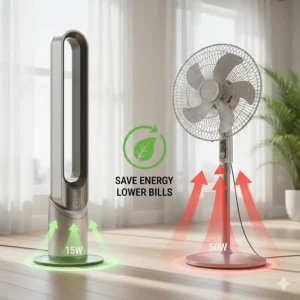
Modern bladeless fans, particularly those with brushless DC motors, consume significantly less electricity than their traditional counterparts. Most models draw between 20-45 watts—comparable to a single LED light bulb. According to the Energy Saving Trust fans are one of the most cost-effective cooling solutions for UK homes, using up to 98% less energy than portable air conditioning units. When combined with precise speed controls and smart features like auto mode and timers, they help UK households reduce cooling costs during summer months. Some users report leaving them running 24/7 without noticing significant electricity bill increases.
How to Choose the Perfect Bladeless Fan for Your UK Home
1. Assess Your Space Requirements
Measure the room where you’ll primarily use the fan. Compact 36-inch models suit bedrooms up to approximately 15 square metres, whilst 42-47 inch towers effectively cool larger living rooms of 25-30 square metres. Consider ceiling height too—taller fans generally project air further and more effectively in high-ceilinged Victorian or Edwardian homes common across Britain.
2. Prioritise Noise Levels for Your Situation
If you’re a light sleeper or need the fan for a bedroom, prioritise models operating at 30 dB or below. For living areas, family rooms, or home offices where some background noise is acceptable, fans operating at 40-50 dB will still provide comfortable cooling. Check multiple customer reviews on Amazon.co.uk specifically mentioning noise, as manufacturer specifications sometimes understate real-world sound levels.
3. Consider Smart Features vs. Budget
Smart fans with app control and voice assistant compatibility cost £30-70 more than basic models, but they offer genuine convenience—scheduling cooling before arriving home, adjusting settings without getting up, and integration with existing smart home ecosystems. If you already use Alexa or Google Home extensively, the premium is worthwhile. Otherwise, a remote control provides sufficient convenience for most UK households.
4. Evaluate Additional Features
Air purification capabilities add £20-40 to the price but provide year-round value, particularly for allergy sufferers or those living near busy roads. Timer functions (essential for overnight use and energy conservation) should offer at least 8-hour programming, with 12 hours being ideal. Oscillation is crucial—70-90 degrees is standard, with wider being better for large rooms. Temperature sensors enable automatic speed adjustment, though they’re not essential.
5. Check UK Compliance and Warranty
Ensure the fan carries CE or UKCA marking (post-Brexit UK Conformity Assessed standard), confirming it meets British safety and electromagnetic compatibility regulations. Look for at least a 1-year manufacturer warranty, with 2 years being preferable. Reputable brands like Dreo, LEVOIT, and PureMate typically offer responsive UK customer service through Amazon, making warranty claims straightforward if issues arise.
Price Range Breakdown: Finding Your Budget Sweet Spot
Understanding what you’ll get at different price points helps you make an informed decision aligned with your budget and requirements.
Budget Range (£20-40)
These entry-level models typically offer basic cooling functionality without bells and whistles. Expect 3-4 speed settings, manual or basic remote control, and simpler construction materials. Brands like PureMate dominate this space with desktop and compact tower models. Noise levels range from 40-50 dB—acceptable but not whisper-quiet. Perfect for students, rental properties, or testing bladeless technology before investing in premium models. Warranties typically cover 1 year, and build quality varies significantly between brands.
Mid-Range (£50-85)
This sweet spot delivers excellent value, combining reliable performance with useful features. Expect 4-6 speed settings, remote controls with timer functions, improved build quality, and quieter operation (30-45 dB). Models like the PureMate 43-inch and Dreo Nomad One excel here, offering near-premium performance at accessible prices. Warranties typically extend to 1-2 years, and customer service is generally responsive. These represent the best choice for most UK households seeking quality without overspending.
Premium Range (£100-170)
Top-tier models justify their cost with exceptional features: whisper-quiet operation (20-30 dB), smart home integration, app control, air purification capabilities, brushless DC motors, and superior build quality. Brands like LEVOIT and high-end Dreo models dominate this category. Expect comprehensive warranties (2 years minimum), excellent customer service, and longevity exceeding 7-8 years with proper care. Ideal for tech enthusiasts, those with noise sensitivity, or anyone viewing the fan as a long-term investment in home comfort.
Bladeless Fans vs. Traditional Fans: Making the Right Choice
| Feature | Bladeless Fans | Traditional Fans |
|---|---|---|
| Safety | Completely child and pet safe | Requires protective grilles |
| Noise Level | 20-56 dB (whisper to moderate) | 40-70 dB (moderate to loud) |
| Airflow Quality | Smooth, consistent breeze | Choppy, buffeting sensation |
| Cleaning | Quick wipe with cloth | Disassembly required |
| Energy Use | 20-45W (very efficient) | 40-75W (standard) |
| Price Range | £20-170 | £15-80 |
| Aesthetics | Modern, sleek design | Functional, traditional look |
| Durability | 5-8 years typical | 3-5 years typical |
Bladeless Fans for Specific UK Room Types
Bedroom Optimisation
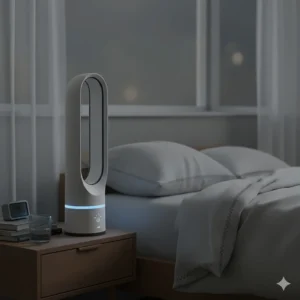
Bedrooms require the quietest models available—prioritise fans operating at 30 dB or below on their typical overnight settings. The LEVOIT Classic 36-inch and Dreo models excel here with sleep modes that gradually reduce speed throughout the night, mimicking natural temperature drops. Position the fan 2-3 metres from your bed at a 45-degree angle rather than directly facing you—this prevents excessive air movement on exposed skin whilst maintaining room circulation. Use timer functions to switch off 2-3 hours after falling asleep, conserving energy whilst still providing comfort during the warmest hours.
Living Room and Open-Plan Spaces
Larger areas benefit from 42-47 inch tower models with powerful velocity (26-28 feet per second minimum) and wide oscillation (90 degrees ideal). The Dreo Cruiser TF518 and PureMate 47-inch models provide sufficient coverage for typical UK living rooms of 20-30 square metres. Position centrally if possible, ensuring oscillation sweeps across seating areas. Multi-speed settings allow adjustment based on occupancy—lower speeds for quiet evenings, higher for daytime cooling when noise is less critical.
Home Office Environments
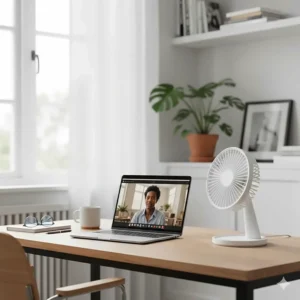
Working from home demands a balance between cooling and concentration. Desktop models like the PureMate 13-inch work brilliantly for solo spaces, whilst 36-inch towers suit larger home offices or shared spaces. Quiet operation (below 35 dB) prevents disruption during video calls—test the fan during a recorded call before important meetings. Position fans to create air circulation without blowing papers around; angled placement works better than direct positioning. The consistent airflow from bladeless models proves less distracting than the buffeting from traditional fans during extended focus work.
Optimal Placement Strategies for Maximum Cooling
Where you position your bladeless fan dramatically affects its cooling effectiveness. Follow these evidence-based strategies for optimal results in British homes.
The Cross-Ventilation Method
Position your fan near an open window on one side of the room, facing inward to draw cool outdoor air inside. Open a window on the opposite side to create a through-draught. This technique works brilliantly during cooler morning and evening hours, refreshing stale indoor air whilst creating powerful circulation. Particularly effective in Victorian and Edwardian terraces where front-to-back airflow is possible.
Corner Positioning for Whole-Room Coverage
Place your fan in a corner at a 45-degree angle, allowing the oscillation to sweep across two walls. This positioning maximises coverage in square or rectangular rooms, ensuring air reaches all areas effectively. Elevating the fan slightly (on a small table or shelf) improves circulation in rooms with high ceilings common in older UK properties.
The Indirect Cooling Technique
Rather than pointing the fan directly at yourself, position it to blow against a wall approximately 2-3 metres away. The air bounces back, creating gentler, more evenly distributed cooling without the uncomfortable direct-blast sensation. This method proves particularly comfortable for overnight use, providing circulation without excessive movement on exposed skin.
Window Positioning for Hot Days
During peak heat, close windows and curtains, positioning your fan centrally to circulate trapped cooler air. Point the fan towards the ceiling on higher speeds—hot air rises, and this technique helps break up thermal layering, distributing cooler floor-level air throughout the space. Particularly effective in loft conversions and top-floor flats where heat accumulation is problematic.
Nurseries and Children’s Rooms
Safety is paramount here, making bladeless fans the obvious choice. Opt for models with child locks (preventing setting changes) and timer functions (ensuring they don’t run unnecessarily overnight). The smooth, consistent airflow prevents the startling sensation of traditional fan buffeting that can disturb light-sleeping infants. Position securely out of reach—on high furniture or securely against walls—despite the blade-free safety advantage. Many parents report improved sleep quality for both children and themselves after switching to bladeless models.
Common Myths About Bladeless Fans Debunked
Myth 1: “Bladeless fans don’t actually have blades”
Reality: All “bladeless” fans contain blades—they’re simply hidden inside the base pedestal. The term “bladeless” refers to the absence of visible, exposed blades that pose safety risks. The internal impeller blade draws air through the base, whilst the airfoil-shaped outlet creates the air multiplier effect. It’s more accurate to call them “air multiplier” fans, though “bladeless” has become the common terminology.
Myth 2: “They’re just expensive gimmicks that don’t cool properly”
Reality: Whilst early models were admittedly overpriced, current bladeless fans provide cooling effectiveness comparable to traditional fans. Premium models actually outperform traditional fans in consistent airflow and coverage. Budget models (£40-70) now offer excellent value, proving the technology needn’t be expensive. UK customer reviews consistently report satisfaction with cooling performance across all price points.
Myth 3: “The technology is completely silent”
Reality: No fan is truly silent—physics dictates that moving air creates sound. However, bladeless fans are significantly quieter than traditional models, with premium units achieving remarkably low 20-28 dB operation. Budget models operate at 40-50 dB—comparable to quiet conversation. The key difference is the quality of sound: the smooth, consistent airflow from bladeless models lacks the choppy, irritating buffeting that makes traditional fans feel noisier than they measure.
Myth 4: “They consume more electricity because of the motor power required”
Reality: Modern bladeless fans, particularly those with brushless DC motors, actually consume less electricity than traditional fans providing equivalent cooling. Most draw 20-45 watts compared to 40-75 watts for traditional fans. The efficiency comes from optimised motor design and the air multiplier effect, which amplifies airflow without proportionally increasing power consumption. Over a typical British summer, a bladeless fan costs £6-12 to operate versus £12-20 for traditional models.
Myth 5: “They’re all the same, just rebranded versions”
Reality: Significant differences exist between brands and models. Motor quality, noise levels, build materials, and features vary dramatically from £20 desktop models to £170 premium units. Research specific models rather than assuming all bladeless fans are equivalent—reviews reveal substantial performance variations even within similar price points.
Top Tips for Getting the Most from Your Bladeless Fan
Create Strategic Airflow Patterns: Experiment with fan positioning to create effective air circulation rather than simply pointing it at yourself. Sometimes indirect cooling (bouncing air off walls) proves more comfortable than direct airflow.
Utilise Night Cooling: During heatwaves, run your fan at maximum during cooler night hours with windows open to flush hot air out and draw cool air in. This pre-cooling reduces indoor temperatures for the following day more effectively than running the fan constantly during peak heat.
Combine with Dehumidification: British summers often bring muggy, humid conditions that feel worse than the actual temperature. Running a dehumidifier alongside your fan (rather than simultaneously) removes moisture, making the fan’s airflow feel more refreshing. Dehumidify for 1-2 hours, then switch to the fan.
Regular Filter Maintenance (For Air Purifier Models): Don’t wait for the replacement indicator to illuminate. Check your HEPA filter monthly during heavy use, vacuuming it gently if it appears dusty but not grey. This extends filter life by 2-3 months, saving £8-12 annually on replacements.
Strategic Timer Use: Programme your fan to start 30 minutes before you typically arrive home, ensuring comfortable rooms upon arrival without wasting energy all day. Similarly, set it to switch off 2-3 hours after bedtime rather than running unnecessarily all night.
Seasonal Speed Adjustment: Don’t default to maximum settings. During mild British summers, speeds 2-3 often provide sufficient comfort with dramatically reduced noise and energy consumption. Reserve maximum speeds for genuinely hot days above 26-28°C.
The Environmental Impact of Bladeless Fans
As climate awareness grows, understanding the environmental implications of our purchases becomes increasingly important for UK consumers.
Manufacturing Considerations
Bladeless fans typically use more materials than basic traditional fans due to their more complex construction. However, their longer lifespan (5-8 years versus 3-5 years for traditional models) offsets this initial material use over time. Premium models using recyclable ABS plastic and aluminium components minimise environmental impact at end-of-life.
Energy Efficiency Advantages
The superior energy efficiency of bladeless fans, particularly DC motor models, reduces carbon emissions over their lifetime. A typical bladeless fan consuming 25W versus a 50W traditional fan saves approximately 60 kWh annually (based on 480 hours of use). At UK grid carbon intensity of 0.233 kg CO₂ per kWh, this equates to 14 kg CO₂ saved annually—modest but meaningful over the product’s lifespan. As the UK continues working towards its Net Zero emissions targets, choosing energy-efficient home appliances represents one simple way households can contribute to reducing carbon footprints whilst also lowering electricity bills.
Longevity and Waste Reduction
The more durable construction of quality bladeless fans significantly reduces electronic waste compared to cheaper traditional fans requiring frequent replacement. Choosing a £80 bladeless fan lasting 7 years proves more environmentally responsible than purchasing three £25 traditional fans over the same period, despite the higher initial material use.
Circular Economy Considerations
Several manufacturers now offer recycling programmes for end-of-life fans and replacement parts rather than complete replacements. Some brands provide motor replacement services, extending product life to 10+ years. When purchasing, prioritise brands offering UK-based customer service and replacement part availability—Dreo, LEVOIT, and PureMate all maintain accessible UK support.
Summer Peak Performance
British summers might be unpredictable, but when heatwaves strike, bladeless fans prove invaluable. The Met Office reports that UK heatwave frequency has increased significantly over the past decade, with temperatures regularly exceeding 30°C during summer months—conditions once considered exceptional. During those rare but increasingly common hot days, position your fan near open windows during cooler morning and evening hours to draw fresh air throughout your home. Close curtains and windows during peak heat (11am-4pm), using the fan to circulate the trapped cooler air. The smooth airflow from bladeless models prevents the uncomfortable skin-drying sensation that traditional fans create during prolonged use—crucial during multi-day heatwaves.
Spring and Autumn Flexibility
These transitional seasons benefit tremendously from adjustable speed settings. Morning coolness requires minimal circulation, whilst unexpected afternoon warmth needs stronger airflow. The auto mode on premium models excels here, automatically adjusting to temperature fluctuations throughout the day. This set-and-forget convenience proves particularly valuable during unpredictable British weather when temperatures might swing 15°C between morning and afternoon.
Winter Storage and Year-Round Models
For cooling-only models, proper winter storage extends longevity significantly. Clean thoroughly, particularly removing any dust from internal components, before storing in a dry location with the original packaging if available. However, models combining heating capabilities (like some Dyson alternatives) provide genuine year-round value, transforming your summer cooling investment into an all-season comfort solution. These dual-purpose models cost £30-60 more but eliminate the need for separate heaters and storage concerns.
Bladeless Fans vs. Air Conditioning: The UK Perspective
For UK homes, the air conditioning versus bladeless fan debate requires careful consideration of our unique climate and housing characteristics.
Cost Comparison
Initial Investment:
- Portable Air Conditioning Unit: £250-600
- Window AC Unit: £300-800 (plus installation)
- Bladeless Fan: £20-170
Running Costs (8 hours daily, 60 days annually):
- Air Conditioning: £96-144 (at current UK electricity rates)
- Bladeless Fan: £6-12
Installation:
- Air Conditioning: £100-300 for professional installation (recommended)
- Bladeless Fan: Zero—unbox and plug in
Practical Considerations for British Homes
Most UK homes lack the ducting infrastructure common in air-conditioned countries, making split-system AC installation expensive and potentially impractical in rental properties or listed buildings. Our relatively mild climate (rarely exceeding 30°C for extended periods) means the substantial AC investment often sits idle for 10-11 months yearly. Bladeless fans provide adequate cooling for typical British summers whilst consuming a fraction of the energy.
However, air conditioning does offer genuine temperature reduction (fans simply circulate existing air), making it superior during extreme heat events. For those experiencing increasingly frequent heatwaves or with medical conditions requiring cooler temperatures, AC might justify the investment. Many UK households find the ideal solution combines a modest bladeless fan (£50-100) for typical summers with portable AC (£300-400) reserved for exceptional heat.
Smart Features Worth Paying For (And Those That Aren’t)
Genuinely Useful Smart Capabilities
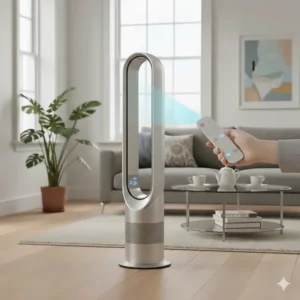
App Control and Scheduling: The ability to start your fan remotely before arriving home transforms comfort, particularly after a hot commute. Scheduling prevents wasted energy by running the fan only when needed, potentially saving £5-10 annually whilst reducing motor wear. Worth the premium.
Temperature Sensing and Auto Mode: These features automatically adjust fan speed based on room temperature, optimising comfort and efficiency. During changeable British weather, auto mode eliminates constant manual adjustments. Highly valuable for set-and-forget convenience.
Voice Control (Alexa/Google Home): If you already use smart assistants extensively, voice commands provide genuine convenience—adjusting settings from bed without fumbling for remotes or phones. However, if you’re not already invested in the smart home ecosystem, this alone probably doesn’t justify the £30-50 premium. Valuable for existing smart home users, otherwise optional.
Features of Questionable Value
Coloured LED Displays: Whilst aesthetically pleasing, most UK users actually prefer minimal lighting in bedrooms. Look for models with display auto-off rather than those emphasising fancy light shows. Style preference, no functional value.
Excessive Speed Settings: Beyond 6-8 speeds, additional granularity provides minimal practical benefit. The difference between speeds 7 and 8 on a 12-speed model is rarely noticeable. Three well-calibrated speeds often prove more useful than twelve marginally different ones. Marketing feature, limited practical value.
Built-in Ionisers: The health claims around ionisation remain scientifically disputed, and these features typically add £20-30 to cost. Unless you specifically seek ionisation, HEPA filtration (proven effective) offers better value for air quality improvement. Skip unless you specifically want it.
Long-Term Value: Total Cost of Ownership
When evaluating bladeless fans, consider the complete picture over their typical 5-7 year lifespan.
Budget Model (£40 initial cost):
- Purchase: £40
- Energy (5 years, 480 hours annually): £24
- Maintenance: Minimal (£0)
- Replacement filters: N/A
- Total 5-Year Cost: £64
Mid-Range Model (£80 initial cost):
- Purchase: £80
- Energy (5 years, 480 hours annually—20% more efficient): £19
- Maintenance: Minimal (£0)
- Replacement filters: N/A
- Total 5-Year Cost: £99
Premium Model with Air Purifier (£140 initial cost):
- Purchase: £140
- Energy (5 years, 480 hours annually—30% more efficient): £17
- Maintenance: £5 annually for deep cleaning
- Replacement filters: £25 × 5 replacements = £125
- Total 5-Year Cost: £307
This analysis reveals that whilst premium models offer superior features, their total cost of ownership significantly exceeds budget alternatives. The mid-range sweet spot (£70-90) provides the best balance of features, efficiency, and overall value for most UK households. Premium models with air purification justify their cost only if you genuinely require air quality improvement—purchasing them solely for cooling proves economically inefficient.
Understanding Noise Levels in Bladeless Fans
Noise measurement can be confusing, so here’s what decibel levels actually mean in practical terms for UK homes:
20-25 dB – Quieter than a whisper. You’ll barely notice it’s running. Perfect for light sleepers and babies’ rooms. Premium models like LEVOIT Smart and Dreo Cruiser achieve this on lowest settings.
26-30 dB – Comparable to rustling leaves or quiet library. Comfortable for overnight bedroom use without disturbing sleep. Most mid-range models operate here on low-medium speeds.
31-40 dB – Similar to quiet conversation or a refrigerator hum. Acceptable for bedrooms but more noticeable. Common for budget models on low settings.
41-50 dB – Comparable to moderate rainfall or normal conversation. Suitable for living areas, offices, and daytime bedroom use. Typical for budget fans on higher speeds.
51-60 dB – Similar to an electric toothbrush or normal TV volume. Best suited for living rooms and spaces where noise isn’t critical. Some budget models reach this on maximum settings.
For reference, according to <a href=” target=”_blank”></a>, sustained noise above 40 dB in bedrooms can potentially disrupt sleep quality, particularly for sensitive individuals. The NHS recommends maintaining quiet bedroom environments for optimal sleep hygiene, making low-noise bladeless fans an excellent choice for British households prioritising rest quality.
The Science Behind Air Multiplier Technology
Understanding how bladeless fans actually work helps you appreciate why they perform differently from traditional models. The core technology, initially developed by Sir James Dyson and refined by numerous manufacturers, relies on fundamental principles of fluid dynamics and aerodynamics.
The Physics of Inducement and Entrainment
When air exits the narrow slit around a bladeless fan’s ring at high velocity, it creates a low-pressure zone immediately behind it. This pressure differential pulls surrounding air along—a phenomenon called inducement. Simultaneously, the fast-moving air entrains slower-moving surrounding air through friction and momentum transfer. Together, these processes amplify the original airflow by 15-18 times, according to research published in fluid dynamics journals.
The airfoil-shaped ramp over which air travels is critical to this amplification. Angled typically between 7-20 degrees (optimally around 15 degrees), this precisely engineered surface accelerates air whilst maintaining smooth, laminar flow rather than turbulent buffeting. This is why bladeless fans feel different from traditional fans—the air travels in a more organised, consistent stream rather than the choppy slices created by rotating blades.
Motor Technology Advances
Early bladeless fans used standard AC motors similar to those in traditional fans. Modern premium models employ brushless DC motors that offer multiple advantages: 30-40% greater energy efficiency, dramatically quieter operation (no brushes creating friction noise), longer lifespans (fewer wearing parts), and more precise speed control enabling the numerous speed settings common in current models.
The impeller design inside the base has also evolved significantly. Early designs mimicked vacuum cleaner impellers, creating considerable noise. Contemporary models use asymmetrically aligned blades—sometimes 9 or more blades positioned at carefully calculated angles—that reduce turbulence and friction, directly lowering operational noise. Some manufacturers even incorporate sound-dampening foam inside the base, further reducing motor noise transmission.
Maintaining Your Bladeless Fan for Peak Performance
Weekly Maintenance
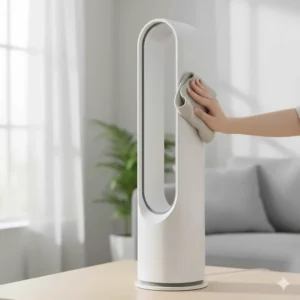
Wipe external surfaces with a slightly damp microfibre cloth to remove dust accumulation. Pay particular attention to the air outlet slit where dust tends to gather. This two-minute routine prevents dust from entering your home’s air circulation and maintains optimal airflow.
Monthly Deep Clean
For models with removable panels (like Dreo units), remove the rear grille and use a soft brush or vacuum cleaner attachment to clean the internal impeller blades. Wipe the interior surfaces carefully, avoiding electrical components. For models with air purifiers, check the HEPA filter condition—it should appear clean and white, not grey or clogged.
Seasonal Care
At the end of summer, perform a thorough clean before storing. If your fan includes a HEPA filter, consider replacing it before winter storage to ensure peak performance next season. Store the fan in its original packaging if available, or cover it with a breathable cloth (not plastic, which can trap moisture) in a dry location. Before first use in spring, inspect for any dust accumulation and clean as needed.
Filter Replacement (Air Purifier Models)
Follow manufacturer guidelines, typically every 6-12 months depending on usage and air quality. Most models include a filter replacement indicator that illuminates when replacement is necessary. Genuine replacement filters cost £15-30 and are widely available on Amazon.co.uk. Using non-genuine filters may void warranty and reduce effectiveness.
Energy Costs: What You’ll Actually Pay
Let’s calculate real-world running costs for UK households using the current average UK electricity rate of approximately £0.24 per kWh (as of January 2026):
Budget Model (40W consumption):
- Running 8 hours daily: 40W × 8 hours = 320Wh = 0.32 kWh
- Daily cost: 0.32 × £0.24 = £0.08
- Monthly cost (30 days): £2.40
- Annual cost (summer months only, 120 days): £9.60
Premium DC Motor Model (25W consumption):
- Running 8 hours daily: 25W × 8 hours = 200Wh = 0.20 kWh
- Daily cost: 0.20 × £0.24 = £0.05
- Monthly cost (30 days): £1.50
- Annual cost (summer months only, 120 days): £6.00
Even running a bladeless fan continuously during a heatwave costs less than £1 per day—significantly cheaper than air conditioning (which typically costs £2-4 daily) and comparable to leaving a single LED light bulb on. The energy efficiency of DC motor models particularly shines with extended use, potentially saving £10-15 annually compared to older AC motor traditional fans.
Troubleshooting Common Issues
Fan Produces Unusual Noise
Possible Cause: Dust accumulation on internal impeller or loose base assembly.
Solution: Clean the rear grille and impeller thoroughly. Ensure the base is firmly attached—loose connections can cause vibrations. If noise persists, contact manufacturer warranty support.
Reduced Airflow Performance
Possible Cause: Clogged air inlet vents or dirty HEPA filter (if equipped).
Solution: Vacuum the base air intake holes using a soft brush attachment. For air purifier models, check and replace the HEPA filter if it appears grey or discoloured. Airflow should return to normal immediately.
Remote Control Not Responding
Possible Cause: Dead batteries, signal obstruction, or sensor misalignment.
Solution: Replace batteries first (most use AAA). Ensure nothing blocks the sensor on the fan’s display panel. Point the remote directly at the sensor from within 6 metres. If problems persist, re-pair the remote according to manufacturer instructions.
Display Flashing or Error Codes
Possible Cause: Temperature sensor malfunction or filter replacement needed.
Solution: Consult your user manual for specific error code meanings. Most commonly, flashing indicates the HEPA filter needs replacement. Some models flash when room temperature exceeds their optimal operating range (typically above 35°C). Allow the unit to cool in a shaded area before restarting.
Oscillation Not Working
Possible Cause: Mechanical jam or disabled oscillation mode.
Solution: Ensure oscillation is enabled (many models require explicitly activating this feature). Power off the unit, wait 30 seconds, then restart—this often resets mechanical issues. If oscillation remains stuck, contact warranty support as this may indicate a motor issue requiring professional service.
Safety Considerations and UK Regulations
All bladeless fans sold legally in the UK must comply wit UK electrical safety regulations, including proper insulation, thermal protection, and electromagnetic compatibility. Look for the UKCA mark (UK Conformity Assessed) or CE marking on products, indicating compliance with safety standards.
Placement Safety
Position your fan on a stable, level surface away from curtains, bedding, and paper that could be drawn into air intakes. Maintain at least 30cm (12 inches) clearance around the base for adequate air intake. Never place the fan on soft surfaces like beds or sofas that could block ventilation holes in the base.
Electrical Safety
Use only the power adapter supplied with your fan—generic adapters may not provide correct voltage or current, potentially causing overheating or fire hazards. Inspect the power cable regularly for damage, replacing the entire unit if fraying or exposure of internal wires occurs. Never attempt to repair damaged cables yourself.
Child and Pet Considerations
Whilst bladeless fans eliminate blade injury risks, they still contain electrical components and hot motors. Teach children not to pour liquids into the fan or insert objects into air vents. Keep power cables secured to prevent tripping hazards—cable tidies or tape work well for this purpose. Consider models with child locks to prevent unauthorised setting changes.
Fire Prevention
Never cover a running fan with cloth or plastic. Ensure the air purifier filter (if equipped) is properly installed—incorrect installation can restrict airflow, causing motor overheating. If the fan emits unusual smells, particularly burning plastic odour, immediately unplug it and contact the manufacturer. Most modern units include thermal cut-off switches, but vigilance remains important.
✨ Ready to Beat the Heat?
🔍 Browse our hand-picked selection of the best bladeless fans available on Amazon.co.uk today. From budget-friendly options to premium smart models, find your perfect cooling companion. Click any highlighted product name above to check live prices and customer reviews!
Frequently Asked Questions
❓ Are bladeless fans actually more energy efficient than traditional fans?
❓ Can bladeless fans effectively cool large rooms in UK homes?
❓ How loud are bladeless fans compared to traditional models?
❓ Do bladeless fans require special maintenance or expensive filter replacements?
❓ Are bladeless fans safe to leave running overnight or when leaving home?
Conclusion: Finding Your Perfect Cooling Companion
After examining the best bladeless fans available in the UK market for 2026, one truth becomes abundantly clear: there’s never been a better time to embrace this innovative technology. Whether you’re seeking the powerful performance of the Dreo Cruiser TF518, the smart home integration of the LEVOIT Smart 42-inch, or the budget-friendly reliability of the PureMate 43-inch, there’s genuinely a model perfectly suited to your specific needs and budget.
The evolution of bladeless fan technology has been remarkable. What started as a premium product accessible only to early adopters has transformed into a diverse market offering options from £20 to £170, ensuring every UK household can enjoy the benefits of safer, quieter, and more efficient cooling. The widespread availability of quality budget options from brands like PureMate demonstrates how mainstream this technology has become.
When making your final decision, remember to prioritise the factors most relevant to your situation. Families with young children will value safety above all else. Light sleepers should focus on noise levels, particularly models operating below 30 dB. Those with allergies might find the dual-purpose air purification models worth the additional investment. And if you’re already deep into the smart home ecosystem, the convenience of app control and voice commands can genuinely enhance your daily comfort.
The British climate might not require air conditioning for most of us, but those increasingly frequent summer heatwaves make effective cooling essential for comfortable living. A quality bladeless fan provides that comfort without the noise, safety concerns, or cleaning hassles of traditional alternatives. Whether you’re cooling your home office during those sweltering work-from-home days or ensuring comfortable sleep during rare tropical nights, the right bladeless fan makes all the difference to your quality of life.
Recommended for You
- 7 Best Smart Ceiling Fan Alexa Compatible UK 2026
- 7 Best Ceiling Fan for Low Ceilings UK 2026
- 7 Best DC Motor Ceiling Fans UK 2026 – Save 70% Energy
Disclaimer: This article contains affiliate links. If you purchase products through these links, we may earn a small commission at no additional cost to you. Prices shown are approximate and may vary.
✨ Found this helpful? Share it with your mates! 💬🤗
