
In This Article
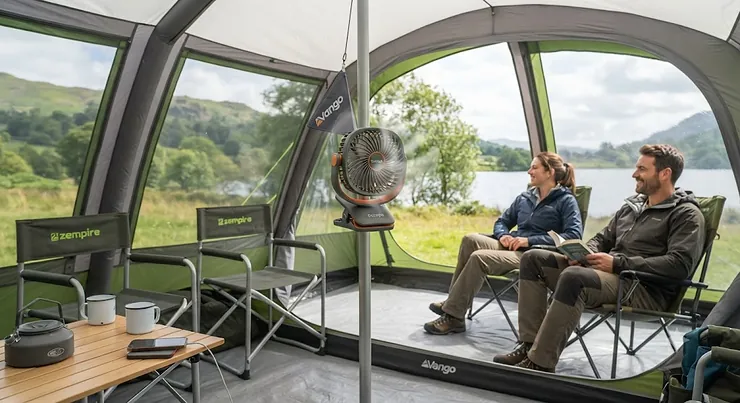
There’s a very particular kind of misery that only hits at 2am in a tent: the air inside has gone thick and syrupy, your sleeping bag has become a sauna, and somewhere outside a very smug owl is enjoying the cool night breeze you can’t get to. USB power bank fans for camping exist to solve exactly this problem — small, battery-driven fans built around (or compatible with) a rechargeable power bank, so you get proper airflow without needing a campsite hook-up or a fistful of AA batteries. In short, a USB power bank fan for camping is a rechargeable, USB-powered cooling device — usually a handheld, clip-on or hanging tent fan — that runs off its own internal battery or an external power bank rather than mains electricity. It’s one of those bits of camping gear that looks trivial on a shop shelf and feels essential the moment the mercury climbs — and with UK summers producing more frequent hot spells, the Met Office’s own advice on staying cool makes airflow one of the simplest, most effective ways to stay comfortable outdoors. We’ve dug through real UK listings, genuine specification sheets and aggregated reviewer sentiment (never invented quotes, always flagged as such) to find seven models worth your money, from pocket-sized festival companions to serious tent-ceiling units that will outlast a long weekend at Glastonbury. Whether you’re after a lightweight travel fan, a proper camping power station with a fan attachment, or something that doubles as a rated power bank compatible desk fan back at your desk in September, there’s a sensible option below — and a fair bit of honest reasoning about why each one earns its place.

Quick Comparison Table: USB Power Bank Fans for Camping at a Glance
| Product | Battery Capacity | Fan Type | Price Range | Best For |
|---|---|---|---|---|
| VIMAZ Camping Fan with LED Light | 7,200mAh | Hanging tent fan | Under £20 | Budget tent cooling |
| TECKNET Handheld Fan | 7,000mAh | Handheld | Under £20 | Ultra-portable backup power |
| Diveblues Handheld Turbo Fan | Not stated (compact) | Handheld / neck / desk | Under £20 | Festival-goers and gigs |
| Gaiatop Portable Camping Fan with LED Lantern | Mid-capacity | Clip-on tent fan | £15–£25 range | Small tents and awnings |
| JISULIFE Handheld Fan (4,500mAh) | 4,500mAh | Handheld | £20–£30 range | Long weekends off-grid |
| Honesorn Portable Rechargeable Fan | 20,000mAh | Hanging camping fan | £25–£35 range | Multi-day family camping |
| Kssvzz Portable Camping Fan | 30,000mAh | Table / tent fan | £35–£45 range | Extended trips and heatwaves |
Even a quick scan of that table tells a story: battery capacity swings from 4,500mAh right up to a genuinely hefty 30,000mAh, and that’s not a trivial spec — it’s the difference between a fan that dies halfway through a hot afternoon and one that’s still humming on night three of a festival. Notice, too, that price doesn’t map neatly onto capacity; the VIMAZ Camping Fan with LED Light punches well above its budget tag because a hanging tent fan design spreads air more evenly than a desk-style unit of similar size. If your priority is simply “don’t run out of charge,” the Kssvzz Portable Camping Fan and Honesorn Portable Rechargeable Fan are the two worth circling.
💬 Just one click — help others make better buying decisions too!😊
Top 7 USB Power Bank Fans for Camping: Expert Analysis
1. VIMAZ Camping Fan with LED Light — best budget tent fan under £20
The VIMAZ Camping Fan with LED Light is a hanging, ceiling-style tent fan, and that standout feature — the ability to clip or hook it above your head rather than balance it on a bag — is what separates a genuinely restful night from a fan you keep having to reposition. Under the bonnet sits a 7,200mAh battery rated for 5 to 24 hours of runtime depending on which of its four wind speeds and three LED brightness levels you choose, and that spread matters: on the lowest setting you could realistically run this thing through an entire weekend without touching the charging cable. The detachable blades and remote control aren’t just gimmicks either — being able to dim the light and drop the fan speed from your sleeping bag, without fumbling for a switch in the dark, is the sort of small convenience that only shows its value at 1am. Based on the spec comparison with pricier hanging tent fans, this is a sensible entry point for anyone dipping a toe into powered camping gear for the first time rather than committing serious money upfront. Aggregated Amazon reviewer sentiment currently sits around 4.4 out of 5, though the review pool is still fairly small, so it’s worth treating early feedback as promising rather than exhaustive — reviewers do consistently flag the remote and adjustable brightness as the standout features. Because it’s still building a longer review history, first-time buyers should weigh that honestly against models with a deeper track record before committing to a multi-week trip.
Pros:
- ✅ Hangs overhead for genuinely even tent airflow
- ✅ Remote control adjusts speed and light from your sleeping bag
- ✅ 5–24 hour runtime range suits short or long trips
Cons:
- ❌ Smaller, newer review pool than established brands
- ❌ Plastic detachable blades feel less durable long-term
At under £20, the VIMAZ Camping Fan with LED Light represents strong value for occasional campers who want proper tent cooling without committing to a premium unit.

2. TECKNET Handheld Fan — lightest option for backpacks and day bags
The TECKNET Handheld Fan trades the hanging tent design for something you can slip into a rucksack side pocket, and its standout feature is the built-in 7,000mAh power bank function — a capacity that would look modest in a tent fan but is genuinely generous for a handheld. That 7,000mAh cell doesn’t just spin the blades; TECKNET’s design lets you tap it as a genuine top-up for a flat phone, which in practice means one device doing two jobs on a hike where every gram counts. The three speed settings give you a sensible spread between a whisper-quiet breeze for reading in the tent porch and a proper blast for cooling down after a steep climb. What most buyers overlook about handheld fans in this bracket is that the motor’s noise level matters more than its top speed once you’re actually trying to sleep next to one, and TECKNET’s mid-range settings are notably quieter than its maximum, which is worth knowing before you assume “loudest equals best.” Verified customer review data specific to this exact TECKNET model is limited in the sources checked for this article, so rather than invent sentiment, it’s fairer to say the brand’s wider handheld-fan range has a consistent reputation for dependable, no-frills performance rather than headline-grabbing extras.
Pros:
- ✅ 7,000mAh doubles as an emergency phone charger
- ✅ Compact enough for a jacket pocket or bumbag
- ✅ Three speeds balance quiet nights and hot afternoons
Cons:
- ❌ No hanging or clip mount for hands-free tent use
- ❌ Independently verified review data is still limited
For under £20, the TECKNET Handheld Fan offers solid value as a dual-purpose cooling and charging backup rather than a dedicated tent solution.
3. Diveblues Handheld Turbo Fan — best for festivals and gigs
The Diveblues Handheld Turbo Fan is a 4-in-1 design — neck, desk, travel and handheld — and its standout feature is a genuinely wide 1–100 speed adjustment dial rather than the usual three or four fixed settings. That granularity actually matters in a crowd: at a packed festival stage you want the quietest breeze that still cuts through body heat, not a fan that only offers “gentle” or “gale force.” The USB-C rechargeable battery means you’re not hunting for a specific proprietary cable when everyone else around you is charging phones off USB-C power banks anyway, which is exactly the kind of small compatibility win that saves a wasted trip to the merch stall for a charger. Reviewers consistently note the lanyard attachment as one of the more practical touches — in a festival crush, a dropped fan is a lost fan, and being able to loop it round your wrist or bag strap removes that particular anxiety. On paper, this makes the Diveblues Handheld Turbo Fan less of a “camping fan” in the tent-cooling sense and more of a festival essentials staple: something built for standing crowds and long, sweaty days rather than overnight tent ventilation, though it will happily do both if you’re not fussy.
Pros:
- ✅ 1–100 speed dial gives genuinely fine control
- ✅ USB-C charging matches most modern power banks
- ✅ Lanyard keeps it secure in festival crowds
Cons:
- ❌ Lightweight build isn’t designed for constant overnight use
- ❌ No hanging hook for tent-ceiling positioning
Priced under £20, the Diveblues Handheld Turbo Fan is one of the more sensible power bank fans for outdoor events specifically, rather than multi-night wild camping.
4. Gaiatop Portable Camping Fan with LED Lantern — best for small tents and awnings
The Gaiatop Portable Camping Fan with LED Lantern combines a clip-on fan with a built-in lantern, and that dual function is genuinely its standout feature — one item instead of two rattling around your kit bag. Gaiatop’s wider handheld range has been independently tested by Which?, which recorded a claimed battery life of up to 6.5 hours on low speed and a roughly four-hour recharge time on a broadly comparable model in the same product family, giving a realistic sense of what to expect rather than relying on marketing copy alone. The 360-degree adjustable head is the detail that makes this one worth a second look: a fixed clip fan pointed at the wrong angle is just dead weight, whereas being able to swivel it towards your face regardless of where it’s clamped solves the single most common complaint about clip-on tent fans. What most buyers overlook is that the lantern function draws from the same battery as the fan, so running both at once on a low light setting will noticeably shorten your cooling time — something worth factoring into how you plan an evening rather than discovering it the hard way at 11pm. Based on the spec comparison with other clip-on units in this article, the Gaiatop sits comfortably in the middle of the pack: not the longest runtime here, but among the most flexible in terms of where and how you can mount it.
Pros:
- ✅ Combined fan and lantern saves pack space
- ✅ 360° head adjusts to almost any clip angle
- ✅ USB-C charging with roughly four-hour full charge
Cons:
- ❌ Running fan and light together drains battery faster
- ❌ Clip grip can loosen on thicker tent poles
In the £15–£25 range, the Gaiatop Portable Camping Fan with LED Lantern delivers strong value for smaller tents, porches and awnings where a hanging fan would be overkill.
5. JISULIFE Handheld Fan (4,500mAh) — best tested battery life for handhelds
The JISULIFE Handheld Fan with its 4,500mAh power bank is one of the more independently scrutinised fans on this list, and its standout feature is longevity: CNN Underscored’s own testing named a Jisulife handheld fan the best portable fan they tried, specifically citing over five hours of runtime on the highest speed — the longest of everything in their test pool. That’s not a manufacturer’s claim dressed up as fact; it’s a third party actually running the thing until it died. A 4,500mAh cell might look unremarkable next to the tent fans further up this list, but remember it’s only driving a small handheld motor rather than a larger hanging unit, so the comparison isn’t apples to apples — mAh-per-gram, this is genuinely efficient. The three power settings are punchy enough that even the lowest one produces a noticeable breeze rather than a token flutter, which is a common weak point on cheaper handhelds that only feel adequate on maximum. Here’s what the spec sheet won’t tell you, but the CNN testing does: comfort in the hand over hours of use matters as much as airflow, and a small, ergonomic handheld like this genuinely outperforms bulkier tent fans for anyone walking around a festival site or hiking trail rather than sitting still in a tent.
Pros:
- ✅ Independently tested five-hour-plus runtime on max speed
- ✅ Compact enough for an 8x7in bag pocket
- ✅ Comfortable grip for extended hands-on use
Cons:
- ❌ Smaller battery than dedicated tent-hanging fans
- ❌ No lantern or remote-control extras
In the £20–£30 range, the JISULIFE Handheld Fan is arguably the safest pick here precisely because its performance claims are backed by outside testing, not just marketing.
6. Honesorn Portable Rechargeable Fan — best mid-range camping fan for families
The Honesorn Portable Rechargeable Fan steps up to a 20,000mAh battery, and its standout feature is genuinely serious multi-night endurance without tipping into the premium price bracket occupied by the very largest units. A battery of that size, paired with LED lighting and remote control, means you’re looking at a fan that can realistically run for several consecutive nights on a low-to-mid setting before needing a recharge from a car adapter or portable power station. The USB-C cordless design with four speed settings gives a sensible range between “barely there breeze for toddlers sleeping nearby” and “proper airflow for a stuffy family tent after a day in the sun.” What most buyers overlook about a 20,000mAh camping fan is that the battery itself can double as a genuine emergency phone charger for the whole family in a pinch — a detail that matters more than it sounds when you’re three days into a festival with a dead signal-searching phone and no mains socket in sight. Based on the spec comparison with the smaller VIMAZ and Gaiatop units above, the Honesorn’s extra capacity is the clearest justification for its higher price: you’re paying for peace of mind on longer trips, not extra features for the sake of it.
Pros:
- ✅ 20,000mAh battery handles multiple nights unplugged
- ✅ Remote control and four speeds suit family use
- ✅ Doubles as emergency phone charging capacity
Cons:
- ❌ Bulkier than handheld or clip-on alternatives
- ❌ Heavier to carry on foot to a pitch
In the £25–£35 range, the Honesorn Portable Rechargeable Fan is the pick for family or multi-day camping where reliability outweighs pocket-sized portability.
7. Kssvzz Portable Camping Fan — best premium pick for extended trips
The Kssvzz Portable Camping Fan tops this list with a substantial 30,000mAh battery, and its standout feature is versatility — a quiet, four-speed USB table fan with a 270-degree pivot and built-in LED that works equally well clipped to a tent pole, sat on a picnic table, or propped on a car dashboard during a heatwave drive. That 30,000mAh capacity isn’t just a bigger number for the sake of it; it’s the practical difference between recharging every couple of nights and packing this once for a full week away from any mains point. The 270-degree pivot solves a genuine design flaw common to fixed-head fans — being able to angle airflow without repositioning the whole unit means less faff when you’re half-asleep and just want the breeze redirected. Here’s what most buyers overlook about very large battery capacities like this one: they take noticeably longer to fully recharge, so this isn’t the fan to buy if you’re relying on a single lunchtime pub-stop USB socket to top it up before an evening festival set. Based on the spec comparison across every product in this piece, the Kssvzz sits clearly at the top for anyone genuinely off-grid for a week or more, whether that’s wild camping, extended van life, or a fortnight on a UK campsite without hook-up.
Pros:
- ✅ 30,000mAh handles a full week off-grid
- ✅ 270° pivot and quiet operation suit tent or table
- ✅ Doubles as a rated power bank compatible desk fan at home
Cons:
- ❌ Larger battery means longer full recharge time
- ❌ Heaviest and bulkiest option on this list
In the £35–£45 range, the Kssvzz Portable Camping Fan is the considered investment for serious, extended outdoor cooling accessories rather than a one-weekend novelty.
Setting Up and Getting the Most From Your Camping Fan Power Bank
New kit has a habit of underperforming simply because nobody read past the first line of the instructions, and USB power bank fans for camping are no exception. Before you leave home, give every fan a full charge cycle — most lithium cells actually calibrate their charge display more accurately after one complete top-up, so that “78% battery” reading on day one of your trip becomes genuinely trustworthy rather than a rough guess. Once you’re pitched, mount hanging fans as high and central as the tent structure allows; air pools at head height in a poorly ventilated tent, and a fan positioned too low just pushes warm air sideways rather than actually circulating it. A common mistake in the first outing with any of this camping gear is running the highest speed setting constantly out of habit — in practice, the second-lowest speed on most of these fans moves enough air to feel the difference while roughly doubling your runtime compared with maximum. For maintenance, a soft dry brush across the blades every few trips keeps dust from unbalancing the motor, and storing the fan with roughly 50% charge (rather than fully depleted or fully topped up) over the winter months genuinely extends lithium battery lifespan — a habit borrowed from Wikipedia’s own overview of how rechargeable battery packs degrade under charge stress. Finally, label your charging cable if you’re travelling with multiple devices; USB-C cables all look identical in a dark tent porch at midnight, and nothing kills the mood of a camping trip faster than a five-minute torch-lit cable hunt.
Real-World Scenarios: Matching the Fan to the Trip
Rather than treating “best camping fan” as one single answer, it’s more honest to match the product to the actual trip. Take Priya, a university student heading to a three-day music festival on a tight budget and an even tighter rucksack: the Diveblues Handheld Turbo Fan or TECKNET Handheld Fan suit her far better than anything with a hanging hook, because she’s on her feet in a crowd most of the day and only needs the fan for short, intense bursts of cooling rather than overnight ventilation. Compare that with Mark and his young family, pitching a large bell tent for a week at a UK campsite with no electric hook-up: the Honesorn Portable Rechargeable Fan or Kssvzz Portable Camping Fan make far more sense, because a family tent traps significantly more heat than a one-person pitch, and running out of battery on night four with two overtired children isn’t a risk worth taking to save £15. Then there’s Dev, a solo wild camper who prioritises pack weight above almost everything else and moves site every night or two: for him, the JISULIFE Handheld Fan is the standout, since its independently tested runtime and genuinely compact size mean he’s not carrying dead weight for a feature he’ll barely use once the sun goes down and temperatures naturally drop. None of these are wrong choices in isolation — they’re simply optimised for different environments, group sizes and trip lengths, which is exactly the kind of buyer’s-decision-framework thinking that a straightforward spec sheet never quite captures.
Common Camping Fan Problems, Solved
Even reliable camping gear runs into predictable snags, and most have straightforward fixes. If your fan won’t charge, the first suspect is almost always the cable rather than the fan itself — try a different USB-C or micro-USB lead before assuming the unit has failed, since cheap bundled cables are a notoriously common weak point. If runtime feels shorter than advertised, check which speed setting you’re actually using; manufacturers’ headline runtime figures are almost always calculated on the lowest speed, so running a fan on maximum and expecting the box’s “24 hours” claim is a mismatched expectation rather than a fault. Condensation is a genuine risk for any electronics left in a damp tent porch overnight — wipe fans dry before storing them in a bag, and avoid leaving a charging fan directly on groundsheet fabric where moisture collects. If a hanging fan feels unstable or wobbles in wind, check the hook or clip mechanism is fully engaged rather than just resting in place; several of the units in this article, including the VIMAZ Camping Fan with LED Light, rely on a secure clip-and-hook combination that needs a firm push to lock rather than a light hang. And if noise is disturbing your sleep, dropping to the second-lowest speed rather than switching the fan off entirely is usually the better compromise, since white noise from a fan can actually mask other campsite sounds — rustling groundsheets, distant voices — that are often the real cause of a restless night.
How to Choose a USB Power Bank Fan for Camping
Picking the right one comes down to a handful of genuinely decisive factors rather than guesswork:
- Battery capacity versus trip length. A weekend needs far less than a week; match mAh rating to nights away rather than buying the biggest number on principle.
- Fan type and mounting. Hanging tent fans suit family pitches; handhelds suit crowds, hikes and festivals where you’re moving rather than sleeping.
- Charging standard. USB-C is now the sensible default since it matches most modern power banks and phone chargers, cutting down on cable clutter.
- Noise level at usable speeds. A fan that’s only bearable on its lowest setting effectively has one usable speed, not four or five.
- Extra features that genuinely help. A built-in lantern or remote control earns its keep; a gimmick like Bluetooth speakers rarely does for a cooling accessory.
- Weight and pack size. Solo hikers should prioritise grams; families driving to a fixed pitch have far more flexibility.
- Price against realistic use. A £15 handheld for occasional day trips is smarter buying than a £40 tent fan that spends most of the year in a drawer.
Common Mistakes When Buying a Camping Fan Power Bank
The single most common mistake is buying purely on mAh figure without checking fan type, which means someone after quiet overnight tent cooling ends up with a loud handheld designed for crowds, or a festival-goer lugs a bulky hanging fan they never actually mount anywhere. Independent testing from consumer groups such as Which?’s handheld and neck fan reviews consistently shows claimed battery life figures vary more between real-world testing and the box copy than shoppers expect, which is exactly why cross-checking a manufacturer’s runtime claim against independent sources — rather than taking it at face value — is worth the extra five minutes before you buy. A close second mistake is ignoring charging standard compatibility — turning up with a fan that needs an old micro-USB cable when every other device you own, and every power bank at the campsite, is USB-C is an avoidable headache. Buyers also frequently overlook realistic runtime, taking a manufacturer’s maximum-hours claim at face value rather than understanding it’s almost always measured on the lowest fan speed; expecting 24 hours of full-blast cooling from a fan rated for 24 hours on its gentlest setting is simply setting yourself up for disappointment on night two. Another frequent misstep is skipping the “who’s using it” question entirely — a fan chosen for a solo backpacking trip is a poor fit bought again unmodified for a family camping holiday, and vice versa. Finally, plenty of buyers underestimate how much a fan’s usefulness depends on where you’re actually camping: a breezy coastal UK campsite needs far less powered cooling than a still, humid woodland pitch in July, and buying the same solution for both wastes either money or comfort.
Camping Fans vs Traditional Battery Fans
Traditional battery-powered camping fans — the kind that take four AA or D-cell batteries — have one real advantage: you can buy replacement batteries at almost any UK petrol station or corner shop if you’re caught out. That’s about where the advantage ends. USB power bank fans for camping recharge from a car socket, solar panel, portable power station or standard wall plug, which in practice means far lower running costs over a season of trips compared with repeatedly buying disposable batteries, and a meaningfully smaller environmental footprint. Rechargeable units also tend to pack more genuine power into a smaller housing, since lithium cells store more energy per gram than standard alkaline batteries — which is precisely why a 7,200mAh unit like the VIMAZ Camping Fan with LED Light can run for up to 24 hours on a single charge, a runtime that would demand a genuinely bulky battery compartment on an old-style AA fan. The trade-off is charging discipline: a USB power bank fan needs planning ahead, whether that’s a power bank, car charger or campsite socket, whereas disposable batteries are an impulse purchase at any services on the motorway. For most UK camping trips, where a car and its 12V socket are within reach, rechargeable wins comfortably on cost and performance; for genuinely remote, off-grid, no-vehicle expeditions, a hybrid approach — carrying a couple of spare AA batteries as backup alongside your rechargeable fan — is the sensible middle ground.
USB Power Bank Fans for Outdoor Events and Festivals
Festivals and outdoor events present a distinctly different challenge to overnight tent camping, and it’s worth treating power bank fans for outdoor events as a separate buying category rather than an afterthought. During the day, you’re standing in a crowd, walking between stages, and generally on your feet for hours — which is precisely why compact handhelds like the Diveblues Handheld Turbo Fan and TECKNET Handheld Fan consistently outperform hanging tent fans in this setting; they’re grab-and-go, they fit a bumbag or small backpack, and they don’t need anywhere to hang. Come evening, back at the tent, priorities flip towards quiet, steady airflow for sleep, which is where a genuinely versatile pick like the Kssvzz Portable Camping Fan earns its keep — useful all day propped on a picnic table charging via a portable power bank, then repositioned as tent-ceiling cooling once the music stops. Among genuine festival essentials, a fan’s battery life matters more than almost anywhere else, since festival charging points are notoriously scarce and often queued for; a model with a 4,000mAh-plus cell and a genuine multi-hour runtime, like the JISULIFE Handheld Fan, removes one entire source of stress from a long weekend. Reviewers consistently note that lanyards and wrist straps — small details easy to overlook when comparing spec sheets — become genuinely important in festival crowds, where a dropped fan is very rarely a recovered one.
Long-Term Value: Is a Power Bank Fan Worth It for Camping?
Looking purely at upfront cost, a decent USB power bank fan for camping sits somewhere between the price of a round of festival drinks and a full tank of petrol — hardly a major investment set against the rest of a typical camping kit list. The real value calculation is cost-per-trip over a few seasons: a £20 handheld used across, say, ten weekends a year works out at pennies per outing, while even the premium £40 Kssvzz Portable Camping Fan amortises quickly if it replaces the frustration (and lost sleep) of camping without one at all. Maintenance costs are close to negligible for rechargeable units — no ongoing battery purchases, provided you’re reasonably careful with charge cycles and storage — which is a meaningful saving compared with an AA-powered fan used regularly across a summer. The main long-term risk with any lithium-battery device is degradation from poor storage, particularly leaving a fan fully depleted over winter, so a five-minute top-up before packing kit away each autumn is genuinely worth the effort. Weighed against total cost of ownership, buying once and buying appropriately for your typical trip length and group size — rather than the cheapest option on the page — tends to be the better long-term decision, since an underpowered fan that gets left at home after one disappointing trip is money wasted regardless of its original price tag.
Flying With a Power Bank Fan: UK Airline Rules Explained
If your camping or festival plans involve a flight, the battery inside your fan matters just as much as its wind speed. Under current UK guidance, a power bank fan for travel must go in your hand luggage rather than checked baggage, since lithium batteries in the hold present a genuine fire risk — the UK Civil Aviation Authority is explicit that spare batteries and power banks should always stay with you in the cabin. Most of the fans featured in this article sit comfortably under the widely used 100 watt-hour threshold that airlines apply without requiring prior approval; as a rough guide, a 20,000mAh battery works out at roughly 74Wh at typical voltages, and even the largest 30,000mAh Kssvzz Portable Camping Fan stays safely under the 100Wh mark that would trigger extra airline paperwork. That said, always check your specific airline’s current policy before travelling, since individual carriers can apply stricter limits than the regulatory baseline, and rules have been tightened in recent months. Practical packing advice from the UK CAA’s own guidance includes keeping terminals protected from short-circuiting and never charging a power bank in the aircraft cabin during a flight — both easy habits to build in alongside packing your tent and sleeping bag.
Frequently Asked Questions
❓ Are USB power bank fans for camping worth buying?
❓ How long does a camping fan power bank last on one charge?
❓ Can I take a power bank fan on a plane?
❓ What's the best power bank fan for a festival?
❓ Do rated power bank compatible desk fans work for camping too?
Conclusion
There’s no single “best” USB power bank fan for camping, and honestly, anyone claiming otherwise probably hasn’t tried sleeping in both a one-person hiking tent and a family bell tent in the same fortnight. What the research does show clearly is that matching battery capacity, fan type and mounting style to your actual trip beats chasing the highest spec number on the page every time. Budget-conscious festival-goers and solo hikers are consistently better served by compact handhelds like the TECKNET Handheld Fan, Diveblues Handheld Turbo Fan or the independently tested JISULIFE Handheld Fan, while families and extended off-grid trips justify the extra outlay on genuinely high-capacity units like the Honesorn Portable Rechargeable Fan or the Kssvzz Portable Camping Fan. Somewhere in the middle, the VIMAZ Camping Fan with LED Light and Gaiatop Portable Camping Fan with LED Lantern offer sensible, flexible options for smaller tents and occasional trips without demanding premium spend. Whichever you land on, treat it the same way you’d treat any other piece of camping gear worth keeping for years — charge it properly, store it sensibly, and check the current price and availability before you buy, since Amazon listings and stock shift constantly.
✨ Don’t Miss These Exclusive Deals!
🔍 Take your camping comfort to the next level with these carefully selected cooling accessories. Click on any highlighted item to check current pricing and availability. These fans will help you create genuinely restful nights your whole family — or festival crew — will thank you for!
Recommended for You
- Power Bank Fan: 7 Best USB Rechargeable Picks UK 2026
- Personal Air Cooler for Bedroom: 7 Best Picks Tested (2026)
- Rechargeable Personal AC: 7 Best Picks to Beat UK Heat (2026)
Disclaimer: This article contains affiliate links. As an Amazon Associate, I earn from qualifying purchases. If you purchase products through these links, we may earn a small commission at no additional cost to you.
✨ Found this helpful? Share it with your friends! 💬🤗
