
In This Article
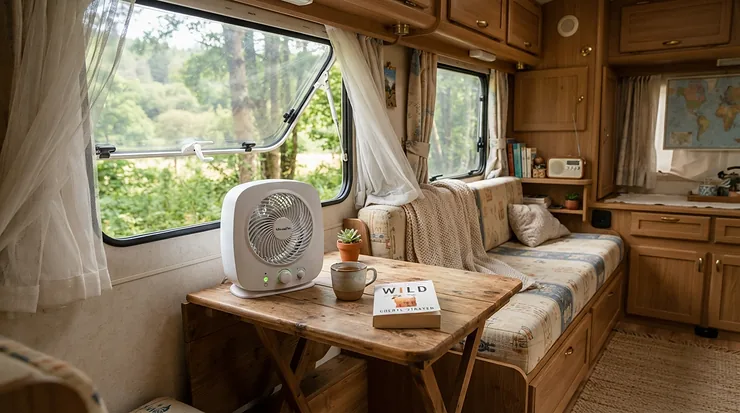
A motorhome parked in July sunshine is basically a greenhouse with a kettle and a bed. Big windows, a thin roof and a compact interior trap solar heat until the cabin feels warmer than the campsite outside. That’s why rated motorhome cooling solutions have moved from “nice luxury” to “sensible kit” for anyone planning serious motorhome touring between June and September.

It isn’t only about comfort, either. The NHS heatwave guidance names dehydration, overheating and heat exhaustion as the main risks in hot spells. It also flags older people, babies and young children as more vulnerable. Those are exactly the people who often share a motorhome. Sleeping at 30°C isn’t a rite of passage. It’s a health consideration.
So here’s the plan. I’ve researched seven real products, from a pocket-money evaporative cooler to a roof-mounted air conditioner. I used published specifications, UK retailer listings and published editorial and owner commentary. I haven’t tested any of them myself, and I won’t pretend otherwise. Where I couldn’t verify a pool of owner reviews, I say so rather than invent one.
Along the way you’ll find cooling gadgets for motorhomes, a frank look at what works as a cooling solution for small caravan owners, and the motorhome cooling accessories that earn their space. Whether you’re planning summer road trips to Cornwall or a long haul to the Dordogne, you’ll leave knowing what to buy, what to skip and why.
Quick Comparison: Rated Motorhome Cooling Solutions at a Glance
Here’s the whole field on one screen. Prices are ranges seen at the time of research and will vary, so check current price before buying.
| Product | Type | Power source | Price range | Best For |
|---|---|---|---|---|
| Quest Bolivia 4L | Evaporative cooler | Mains (about 80W) | £80–£90 | Tight budgets, dry-weather spot cooling |
| Fiamma Turbo Kit | Rooflight fan | 12V or batteries | Around £100 | Cheap airflow through an existing hatch |
| MaxxFan Deluxe | Roof vent fan | 12V | £300–£360 (plus fitting) | Heavy-duty ventilation, off-grid touring |
| Transcool E3 | Evaporative cooler | 12V, 24V or 240V | £300–£340 | Cooling the bed area off-grid |
| EcoFlow Wave 3 | Portable air conditioner | Mains or add-on battery | £700–£800 (unit only) | Off-grid air con in smaller vehicles |
| Truma Saphir Compact | Under-seat air conditioner | Mains hook-up | £1,400–£1,600 (plus fitting) | Small to medium motorhomes and caravans |
| Dometic FreshJet FJZ7 2600 | Roof air conditioner | Mains hook-up | £2,600–£2,800 (plus fitting) | Larger vehicles, southern-Europe heat |
Look at the pattern: price climbs as your dependence on a power source climbs. The first four options suit wild camping or light hook-up use. The last three want a pitch with electricity, with EcoFlow Wave 3 straddling the gap if you add its battery. If you only camp a few weekends each summer, the cheaper end gives you most of the comfort for a fraction of the outlay.
💬 Just one click — help others make better buying decisions too!😊
Top 7 Rated Motorhome Cooling Solutions: Expert Analysis
I’ve ordered these from budget to premium. The specs and prices come from retailer listings and Caravan Guard’s 2026 gear guide, which covers much of the current UK range. Every spec below is followed by what it means in practice, because a number on its own is just decoration.
1. Quest Bolivia 4L — the pocket-money evaporative cooler
This is the cheapest way in this round-up to get something cooler than ambient air moving past your face. At 26 x 24 x 57cm and 3.8kg before filling, the Quest Bolivia 4L draws roughly 80W, so it’s a campsite-hook-up tool rather than a wild-camping one. The four-litre tank, three fan speeds, remote and 0–7.5-hour timer mean you can set it for the night and forget it. The castors let you wheel it from galley to bed.
Here’s what the spec sheet won’t shout: evaporative coolers can only chill air as far as humidity allows. In a dry, sunny spell the effect is noticeable. In muggy, drizzly British heat you’ll mostly get a damp breeze. On paper it suits a campervan or small caravan, where it only has a few cubic metres to treat.
I couldn’t verify a robust pool of owner reviews for this model, so I won’t summarise one. What is documented is a reader comment under Caravan Guard’s guide warning that water-pad cooling will be limited in humid conditions. That’s a sensible caution.
Pros:
- ✅ Very low running draw compared with air conditioning
- ✅ Light, wheeled and easy to stow
- ✅ Timer and remote suit overnight use
Cons:
- ❌ Weak performance in humid weather
- ❌ Needs mains, so no wild camping
Price: around £80–£90 at the time of research. As a low-risk first purchase or a supplement on dry days, it’s good value.

2. Fiamma Turbo Kit — turns an existing rooflight into an extractor
The clever bit is what it doesn’t need: no drilling. The Fiamma Turbo Kit slots into an existing rooflight, typically apertures from 40 x 40cm up to 50 x 70cm. Its 24cm reversible fan hangs from telescopic arms that adjust between 36 and 48cm.
It runs on a 12V cable or eight 1.5V batteries, has two speeds and weighs 1.3kg. In practice, reversibility is the point. Set it to extract at the highest point of the vehicle while a low window feeds cooler air in, and you create cross-ventilation. Heat rises, so pulling it out through the roof does real work in the evening.
It is not a cooler, though. It moves air; it doesn’t chill it. A motorhome blogger on Wandering Bird points to this as a way to get roof-fan performance without cutting into the roof. That’s a sensible angle for renters and leasers.
I couldn’t verify a meaningful pool of owner reviews for this model. Treat it as a well-specified, no-frills ventilator rather than a miracle.
Pros:
- ✅ No roof cutting for installation
- ✅ Reversible for intake or extraction
- ✅ Runs on 12V or batteries
Cons:
- ❌ Moves air without cooling it
- ❌ Only two speed settings
Price: around £100. It’s a very good-value upgrade for anyone with an existing rooflight.
3. MaxxFan Deluxe — the thermostat-driven roof vent that works in the rain
Think of it as a roof vent that thinks for itself. The MaxxFan Deluxe fits a standard 400 x 400mm opening, runs on 12V and uses a 12-inch, ten-blade fan. One UK retailer quotes airflow of up to 900 cubic feet a minute. It has a remote, a thermostat “auto” mode, a ceiling-fan mode with the lid closed, a rain cover and a removable insect screen.
In practice, that rain cover is gold. You can leave it venting on a wet night without a soggy duvet. The thermostat means it opens and runs when the cabin warms, which suits an off-grid battery bank better than an air conditioner ever could. The retailer notes it may be too noisy for bedrooms at higher speeds.
Reviewer-style sentiment is mixed on the fitting rather than the fan. One buyer’s listing comment calls it straightforward to fit but says the old surround and blind no longer matched. A motorhome forum thread cites a £600 fitting quote, so budget for installation.
Pros:
- ✅ Rain cover allows venting in wet weather
- ✅ Thermostat and remote control
- ✅ 12V suits off-grid touring
Cons:
- ❌ Fitting can add several hundred pounds
- ❌ Can be noisy at high speed
Price: £300–£360, excluding fitting. It’s excellent value if you’re serious about airflow.
4. Transcool E3 — evaporative cooling that runs on 12V
Where the Quest Bolivia 4L needs a hook-up, the Transcool E3 doesn’t. It runs on 12V, 24V or 240V, with four directional vents and a 1.8-litre tank that a motorhome travel blogger says gives over eight hours on low. UK retail listings quote around 240 cubic feet per minute and a low-battery cut-off, which stops it draining your leisure battery flat. The maker also claims air up to 50% cooler at the vent with ice water. That’s a marketing claim relative to ambient air, so treat it as a best case.
What does that mean in practice? It’s a spot cooler for the bed or driver’s seat, not a whole-van chiller. Point it at yourself, fill it with cold water and ice, and the effect is genuine, particularly in dry heat.
The Wandering Bird blogger says she has used one for years. She reports it helps on really hot days but takes time to work, and that it needs help from shade and closed blinds. That candour is worth more than any brochure.
Pros:
- ✅ Runs on 12V, 24V or mains
- ✅ Low-battery cut-off protects your leisure battery
- ✅ Four directional vents for spot cooling
Cons:
- ❌ Limited effect in humid air
- ❌ Needs regular water and ice
Price: £300–£340. Good value for off-grid summer road trips.
5. EcoFlow Wave 3 — portable air con that can run on battery
This is the one that changes the off-grid maths. The EcoFlow Wave 3 offers 1,800W (6,100 BTU) cooling and 2,000W heating. It measures 519 x 297 x 336mm and weighs around 15–16kg depending on the listing. The unit has no built-in battery: you add a 1,024Wh pack for wireless use, or run it from mains.
The rated cooling power is about 690W on AC. Against a 1,024Wh battery, that’s roughly 90 minutes flat-out. That’s why the maker quotes 2–8 hours, with the top figure in eco mode. Treat the battery as a bridge for a few hours rather than all night.
Editorial opinion splits usefully. A UK regional-press review calls it one of the more appealing off-grid options, though it notes the battery nearly doubles the price. A European retailer’s test verdict calls the performance “decent but not spectacular” and the weight a barrier to frequent moving. You’ll also need to duct the hot exhaust out of a window or vent.
Pros:
- ✅ Real air conditioning, with a battery option
- ✅ Heats as well as cools
- ✅ App control and sleep mode
Cons:
- ❌ Battery roughly doubles the outlay
- ❌ Heavy for frequent relocation
Price: around £700–£800 for the unit, with the battery bundle well above £1,000. Check current price, as listings vary.
6. Truma Saphir Compact — under-seat air con for smaller vehicles
By comparison, the Truma Saphir Compact goes where the weight is least troublesome: low down. The main unit typically stows in a seat base at floor level. It delivers 1,800W cooling, weighs exactly 20kg (unit only) and measures 56 x 40 x 29cm. Truma says it works on most campsite hook-ups from 3 amps minimum, and it carries a five-year warranty when fitted by an authorised agent.
In practice, floor-level mounting avoids the roof-strength question that comes with rooftop units, and the ducted outlets spread air around the cabin. It also dehumidifies, which matters on muggy nights. It can be programmed up to 15 hours ahead and syncs with Truma’s CP Plus panel if you already have Truma heating.
I couldn’t verify a sizeable pool of owner reviews for this exact model. The nearest evidence is a Caravan Guard reader who had a Truma unit fitted and called it a game-changer in a European heatwave, while noting you must get used to the noise. A different reader warned that many air-con units are too heavy for caravan payloads.
Pros:
- ✅ Low-mounted, so no roof-strength worries
- ✅ Dehumidifies as it cools
- ✅ Five-year warranty with agent fitting
Cons:
- ❌ Needs a hook-up and professional fitting
- ❌ Takes up under-seat storage
Price: around £1,400–£1,600 including a ducting kit, excluding fitting.
7. Dometic FreshJet FJZ7 2600 — the 2026 flagship for big-heat touring
This is the premium end of the market, and it shows. The Dometic FreshJet FJZ7 2600 offers 2,600W cooling with inverter compressor and heat-pump technology. It has Wi-Fi control, a 43dB sound rating and a net weight of 31.1kg. It uses R32 refrigerant, which is efficient but mildly flammable. It measures 75.2 x 22.5 x 70.2cm and is designed to replace a typical 40 x 40cm rooflight.
Its adaptive power mode, with low-fuse protection, is the headline feature for UK campsites. It should adapt to the supply available instead of tripping your hook-up. A SmartECO function works with Dometic’s Tempra battery to manage consumption.
It launched for the 2026 season, so independent owner reviews are thin, and I can’t honestly summarise any. Before buying, check roof strength with your dealer, as Caravan Guard advises, and account for the weight in your payload.
Pros:
- ✅ Strongest cooling output here
- ✅ Adaptive power reduces hook-up tripping
- ✅ Wi-Fi app control and heat-pump heating
Cons:
- ❌ Heaviest unit in this list
- ❌ Highest purchase and fitting cost
Price: around £2,600–£2,800, plus fitting. It’s worth it only if you regularly tour hot regions.
How to Cool Your Motorhome Properly: A Practical Usage Guide
Even the best-rated kit works better with a routine. The Swift Group’s 2026 heatwave guide makes a point I’d underline: airflow, shade and screens do most of the heavy lifting before any machine switches on.
The morning-to-midnight routine
- Park smart. Keep your largest window away from afternoon sun, use natural shade, and face north or east if you can.
- Screen early. External silver screens stop heat before it passes through glass, so they beat internal ones.
- Vent in the right order. Open high vents first, then lower windows, so hot air is pulled upward.
- Cook outside. A BBQ or no-cook lunch keeps the cabin cooler.
- Night flush. When the outside air drops, run a roof fan or the MaxxFan Deluxe to purge stored heat.
Common mistakes in the first 30 days
Don’t run an evaporative cooler like the Transcool E3 with every window sealed. Humidity will build, and the cooling effect collapses. Don’t mount a heavy unit without checking payload. And don’t forget fridge ventilation: absorption fridges struggle when airflow behind them is poor.
Finally, pre-cool the cabin in the morning before the heat peaks. Chilling a cool van is far easier than rescuing a hot one, and it makes summer road trips noticeably calmer.

Real-World Scenarios: Matching Cooling Gadgets for Motorhomes to Your Touring Style
Specs only matter once they meet a real use case. Here are three profiles, each matched with a sensible setup. These are illustrative scenarios built from published specs, not testimonials.
The weekend couple. They have a 6.5m motorhome, UK hook-up sites, about twelve nights a year, and a budget of £250. A Fiamma Turbo Kit for cross-ventilation plus a Quest Bolivia 4L for dry-weather bedtime comfort lands at roughly £180–£190. It’s enough for British summers without touching the roof.
The off-grid retirees with a dog. They tour three months a year and rely on solar and a leisure battery. A MaxxFan Deluxe handles ventilation, and a Transcool E3 gives spot cooling by the bed. Together that’s roughly £600–£700 before fitting. Add shade discipline, because Swift warns pets above 25°C can be at risk and must never be left unattended in a hot motorhome.
The family of four doing summer road trips to southern Europe. They have a 7m vehicle, hook-up most nights and six weeks a year. Air conditioning pays off here. A Truma Saphir Compact suits a smaller layout, while the Dometic FreshJet FJZ7 2600 suits a larger one. Spread over, say, 250 nights across ten summers, the Dometic works out at roughly £11 a night before fitting. The Truma comes to around £6. That’s illustrative arithmetic, not a quote.
What Are Rated Motorhome Cooling Solutions?
Rated motorhome cooling solutions are products that reviewers, retailers or owners have assessed for lowering or managing habitation temperatures in a leisure vehicle. They include roof fans, evaporative coolers, portable air conditioners and fixed air-con units, each suited to different budgets, power supplies and vehicle sizes.
There are four main families. Fans move air without cooling it. Evaporative coolers chill air using water, but depend on humidity. Portable air conditioners cool and dehumidify, but need venting. Fixed air-con units are the most powerful and the most expensive.
“Rated” is the key word. Gear guides, owner comments and retailer specifications all give clues, but none tells the whole story. I’d treat them as three overlapping witnesses and weigh them together.
How to Choose Rated Motorhome Cooling Solutions
Picking the right option starts with your habits, not the brochure. Work through these steps in order:
- Define your power supply. Hook-up every night points to air con; off-grid points to 12V fans and evaporative coolers. This single question rules out half the market.
- Check your payload. A typical air-con unit weighs over 20kg, according to Caravan Guard. Subtract that before you subtract anything else.
- Measure your openings. Roof vents and rooflight kits depend on aperture size, commonly 40 x 40cm.
- Match the cooler to your climate. Evaporative cooling suits dry heat; muggy UK weather favours fans and air con.
- Count your sleepers. More people and pets mean more heat to shift.
- Weigh noise. If you sleep lightly, check the decibel rating, such as the 43dB quoted for the Dometic FreshJet FJZ7 2600.
- Budget for fitting. Professional installation can add hundreds of pounds, so include it from the start.
If you remember only one thing, remember step one. Power supply is the real fork in the road when comparing rated motorhome cooling solutions.
Cooling Solution for Small Caravan: What Actually Works
A cooling solution for small caravan owners faces one stubborn problem: payload. A commenter on Caravan Guard’s guide put it bluntly, noting that most air-con units weigh 27kg or more, which comes straight off your carrying capacity. That’s the lens to use.
The lightest effective option is airflow. The Fiamma Turbo Kit weighs 1.3kg and the Quest Bolivia 4L 3.8kg empty, so both are caravan-friendly. If you want true air conditioning, the Truma Saphir Compact weighs 20kg for the unit alone. The EcoFlow Wave 3 is around 15–16kg but can be stowed outside the van when travelling. Caravan Guard also lists the Quest Ice Chill, a portable split-style unit at 25.4kg that can be placed outside to reduce internal noise.
For a cooling solution for small caravan use, my honest recommendation is to start with shade, screens and a rooflight fan. Only move to air conditioning if you tour in southern Europe or sleep badly above 25°C. A small caravan heats and cools quickly, so ventilation discipline pays off faster than in a large motorhome.
Cooling Gadgets for Motorhomes vs Air Conditioning
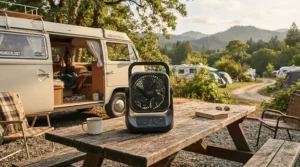
Cooling gadgets for motorhomes, meaning fans and evaporative units, cost far less than air conditioning. They also draw less power and weigh less. Air conditioning cools more reliably but wants mains, weight and often professional fitting. Which is better depends on your touring.
| Option | Typical cost | Power need | Cooling effect | Best For |
|---|---|---|---|---|
| Fans (MaxxFan Deluxe, Fiamma Turbo Kit) | £100–£360 | 12V, low draw | Moves air, no chilling | Ventilation, night flushing |
| Evaporative (Quest Bolivia 4L, Transcool E3) | £80–£340 | Low-draw 12V or mains | Chills in dry air | Spot cooling, dry weather |
| Portable air con (EcoFlow Wave 3) | £700–£800+ | Mains or battery | Strong, dehumidifies | Off-grid, small vehicles |
| Fixed air con (Truma Saphir Compact, Dometic FreshJet FJZ7 2600) | £1,400–£2,800 | Mains hook-up | Strongest cooling | Regular hot-climate touring |
The table shows the cost-versus-capability ladder clearly. Fans are the cheapest, but they only help when the outside air is cooler than the inside. Evaporative units cool, but humidity limits them. For heat above 30°C that won’t quit overnight, air conditioning is the only category that reliably brings the temperature down.
I’d call this a “layered” decision. Buy ventilation first, add a spot cooler if you’re off-grid, and keep air con for the trips that truly need it.
Motorhome Cooling Accessories That Actually Matter (And Those That Don’t)
Motorhome cooling accessories are where people waste the most money. Some deliver more cooling per pound than any appliance. Others are ornamental.
Worth buying
- External silver screens. Swift explains that external screens beat internal ones because they stop solar gain before it reaches the glass. This is the best-value accessory by a wide margin.
- Lightweight bedding. Cotton sheets, mesh seat covers and removable thermal mats help you sleep without adding any power draw.
- Cooling mats for pets. Caravan Guard’s summer tips highlight these, alongside cooling sprays for skin.
- A keep-it-clean habit. A dirty roof absorbs more heat, so a quick wash is a genuine cooling measure.
Usually not worth it
- Tiny USB desk fans as whole-van coolers. A travel blogger who has tried many describes some as rubbish and others as excellent. Use them for personal airflow, not cabin cooling.
- Gimmicky “mini air conditioners”. Many personal gadgets are small evaporative units, which carry the same humidity limits as a Quest Bolivia 4L with a fraction of the capacity.
The test is simple: does it stop heat entering, move heat out, or cool you directly? If it does none of those, leave it on the shelf. The best motorhome cooling accessories are usually the dull, passive ones.
Safety, Payload and Insurance on Motorhome Touring
Motorhome touring in hot weather brings a few practical obligations that rarely feature on product pages.
Payload and height
Check your remaining payload before fitting anything heavy. Caravan Guard notes a typical air-con unit weighs over 20kg, and that roof-mounted units may need dealer confirmation that your roof can take the load. Rooftop units also add height, which one motorhome blogger notes can matter for European toll bands above 3.05m.
Insurance
Fixed air conditioning should be added to your sums insured, according to Caravan Guard’s gear guide. A separate Caravan Guard guide to keeping cool classes removable units as non-fixed motorhome equipment. Ring your insurer before you buy, not after.
Electrics, refrigerant and warranty
Check your hook-up amperage. The Truma Saphir Compact needs at least 3 amps, while the Truma Aventa Comfort draws 4.2 amps and the Isabella Isacool up to 4.1 amps. Many UK sites offer more, but some offer less. Also note that R32 refrigerant, used in the Dometic FreshJet FJZ7 2600, is mildly flammable. Finally, modifications done outside a professional fitter may affect warranties, so keep the paperwork.

FAQ
❓ How much does it cost to fit air conditioning to a motorhome in the UK?
❓ Can a leisure battery run motorhome air con overnight?
❓ Do evaporative coolers work in humid British weather?
❓ Will adding cooling kit affect my motorhome insurance?
❓ Is a rooftop fan worth fitting if I already have a rooflight?
Conclusion
After weighing the evidence, one idea stands out: the best motorhome cooling isn’t a single gadget. It’s a layered plan. Shade and screens come first, airflow second, spot cooling third and air conditioning last. Rated motorhome cooling solutions earn their place when they match your power supply, payload and touring habits, not when they carry the biggest number on the box.
If you’re on a tight budget, start with the Fiamma Turbo Kit and the Quest Bolivia 4L. If you tour off-grid, the MaxxFan Deluxe and Transcool E3 form a sensible pair, with the EcoFlow Wave 3 as a bolder step up. For regular hot-climate summer road trips, the Truma Saphir Compact and Dometic FreshJet FJZ7 2600 offer proper air conditioning, provided your payload and wallet can carry them.
Whichever route you choose, check current prices and availability, ask your insurer about additions, and remember the NHS advice on hot weather. A cooler cabin makes for better sleep, better driving and a far better holiday.
✨ Ready to Cool Down Your Next Trip?
🔍 Take your motorhome touring to the next level with these carefully selected options. Click any highlighted product to check current pricing and availability. A little planning now means calmer, cooler summer road trips all season long!
Recommended for You
- Caravan Cooling Fan: 7 Best Picks To Beat The Heat (2026)
- Solar Powered Fan For Off Grid Camping: 7 Smart Picks (2026)
- Solar Camping Fan: 7 Best Picks & Honest Verdicts (UK 2026)
Disclaimer: This article contains affiliate links. As an Amazon Associate, I earn from qualifying purchases. If you purchase products through these links, we may earn a small commission at no additional cost to you.
✨ Found this helpful? Share it with your friends! 💬🤗
