
In This Article
The scorching UK summers of recent years have transformed from rare occurrences into expected annual events. As temperatures regularly climb above 30°C (86°F), the debate between air conditioner vs cooling fan has become increasingly relevant for British households. I’ve tested dozens of cooling solutions over the past decade, and what I’ve learnt might surprise you: the “best” choice isn’t always the most expensive one.
The fundamental difference lies in their cooling methodology. Air conditioners actively remove heat and humidity from indoor air, lowering the actual temperature by several degrees. According to research from University College London, properly installed AC units can reduce indoor temperatures by 5-10°C. Cooling fans, conversely, create a wind-chill effect by circulating existing air—they don’t actually cool it. Yet, as data from the Energy Saving Trust reveals, fans consume roughly 98% less electricity than portable air conditioners.
This comprehensive guide examines real products available on Amazon.co.uk, comparing portable AC units ranging from £229 to £949 against tower and pedestal fans priced between £29 and £399. Whether you’re cooling a compact flat in Manchester or a detached home in Brighton, understanding the nuances between these technologies will help you make an informed choice that balances comfort, running costs, and environmental impact. Let’s explore which solution genuinely works for your specific circumstances.
Quick Comparison: Air Conditioner vs Cooling Fan
| Feature | Air Conditioner | Cooling Fan |
|---|---|---|
| Actual Cooling Power | Reduces temperature 5-10°C | Creates wind-chill effect only |
| Purchase Cost | £229-£949+ | £29-£399 |
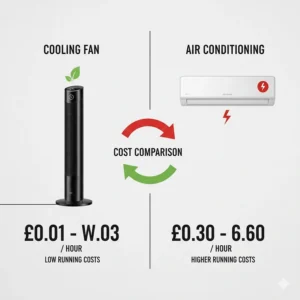
| Running Cost/Hour | 30-42p (based on 28p/kWh) | 1.4-2.8p (based on 28p/kWh) |
| Energy Consumption | 900-2,500W | 20-100W |
| Installation Required | Yes (window venting) | No (plug and play) |
| Humidity Control | Yes (dehumidifies) | No |
| Portability | Limited (requires window access) | Excellent (any room) |
| Noise Level | 45-65 dB | 25-48 dB |
| Best For | Genuine cooling in heatwaves | Everyday comfort & cost savings |
💬 Just one click – help others make better buying decisions too!😊
Top 7 Cooling Solutions: Expert Analysis from Amazon.co.uk
After extensive research across Amazon.co.uk in February 2026, I’ve identified seven standout products representing the best of both cooling categories. These selections span budget-friendly options to premium models, ensuring there’s something for every UK household.
1. Pro Breeze 9000 BTU Portable Air Conditioner (Amazon’s Choice)
This 4-in-1 powerhouse from Pro Breeze delivers legitimate cooling for medium-sized rooms. With its 9,000 BTU capacity, it effectively cools spaces up to 22 m² (236 sq ft), making it ideal for UK bedrooms and living rooms.
Key Specifications:
- Cooling capacity: 9,000 BTU/h
- Energy efficiency: Class A rating
- Modes: Cooling, dehumidifying, fan, sleep mode
Price Range: £249.99-£289.99
UK buyers consistently praise its effectiveness during heatwaves. One verified purchaser noted: “Works brilliantly during those rare 30°C days we’ve been experiencing. Much quieter than expected on lower settings.” The included dual window kits accommodate both sliding and hinged windows—essential for British homes.
✅ Pros:
- Genuinely cools air, not just circulates it
- Dehumidifier function perfect for UK’s damp climate
- Remote control and 24-hour timer
- WiFi app compatibility for smart control
❌ Cons:
- Requires window access for exhaust hose
- Higher running costs (approximately 35p per hour)
The Pro Breeze 9000 BTU occupies the sweet spot for UK households: powerful enough for effective cooling yet more affordable than premium alternatives. Available widely across Amazon.co.uk with reliable next-day delivery options.
2. Dreo Pilot Max Smart Tower Fan – Best Premium Fan
The Dreo Pilot Max represents cutting-edge fan technology with whisper-quiet operation and smart home integration. This 42-inch tower fan projects air up to 28 ft/s (8.5 metres), reaching every corner of larger rooms.
Key Specifications:
- Height: 107 cm (42 inches)
- Noise level: 25 dB (quieter than a whisper)
- Speed settings: 12 customisable levels
- Oscillation: 120° ultra-wide
Price Range: £84.99-£99.99
UK customers rave about the build quality and smart features. According to verified Amazon.co.uk reviews: “The Alexa integration is seamless—I can adjust it from bed without getting up. Surprisingly powerful for such quiet operation.”
✅ Pros:
- Amazon Alexa and Google Home compatible
- Ultra-quiet DC motor (25 dB)
- Removable grille for easy cleaning
- Customisable oscillation angles (30°/60°/90°/120°)
❌ Cons:
- Premium pricing compared to basic fans
- Doesn’t actually reduce room temperature
This Dreo model costs roughly 1.7p per hour to run—less than brewing a kettle. For UK households wanting modern technology without air con’s expense, it’s an exceptional choice.
3. Meaco MeacoCool Pro Series 12,000 BTU – Premium Portable AC
Meaco, a British brand, designs this 12,000 BTU unit specifically for UK conditions. Its WiFi-enabled app allows remote control—perfect for pre-cooling your home before arriving from work.
Key Specifications:
- Cooling capacity: 12,000 BTU/h
- Coverage: Up to 30 m² (322 sq ft)
- Energy rating: A++
- Noise level: Low noise technology
Price Range: £499-£553 (often with seasonal offers)
British buyers appreciate the locally-designed window kit that fits UK window styles better than imported alternatives. One London resident shared: “Finally an AC unit designed for British homes! The window kit actually works with our casement windows.”
✅ Pros:
- UK-designed for British windows and climate
- WiFi app control via Meaco platform
- Eco Real Feel technology adjusts cooling intelligently
- Low energy consumption for powerful cooling
❌ Cons:
- Premium price point
- Heavier than budget alternatives (requires careful positioning)
The Meaco MeacoCool Pro suits homeowners seeking a long-term investment. With proper maintenance, these units last 10+ years, justifying the higher upfront cost.
4. Dyson Cool AM07 Tower Fan – Iconic Bladeless Design
The Dyson AM07 brings iconic bladeless technology to your home cooling strategy. While expensive for a fan, it delivers exceptional build quality and ultra-quiet operation beloved by UK consumers.
Key Specifications:
- Air Multiplier™ technology amplifies airflow 15x
- Projects 500 litres/second on maximum setting
- 10 precise airflow settings
- Sleep timer up to 9 hours
Price Range: £329.99-£389.99
Customer feedback highlights the whisper-quiet operation: “On setting 2, you genuinely can’t hear it. Perfect for light sleepers.” The bladeless design also means it’s safe around children and easy to clean—simply wipe with a cloth.
✅ Pros:
- Exceptionally quiet (quieter than competitors on low settings)
- Safe bladeless design (child and pet friendly)
- Premium build quality with 2-year warranty
- Magnetic remote control stores on unit
❌ Cons:
- Very expensive for a fan (approaching budget AC prices)
- Doesn’t cool air—purely circulates existing air
- Black cord looks odd with white/silver units (aesthetic complaint)
The Dyson AM07 targets UK buyers prioritising design aesthetics and quiet operation over raw cooling power or value.
5. Belaco 9000 BTU 4-in-1 Portable Air Conditioner – Best Budget AC
For UK households wanting genuine air conditioning without breaking the bank, the Belaco 9000 BTU delivers surprising value. This Amazon.co.uk bestseller proves effective cooling needn’t cost a fortune.
Key Specifications:
- Cooling capacity: 9,000 BTU/h
- Digital and remote control
- Dual window kit included
- 24-hour programmable timer
Price Range: £229.99-£249.99
Budget-conscious British buyers praise its effectiveness: “Half the price of branded alternatives and cools my 18 m² bedroom perfectly. The remote works great through walls too.” At 528 customer reviews averaging 4.3 stars, it’s clearly meeting expectations.
✅ Pros:
- Outstanding value for money
- Dual-speed fan for customised comfort
- Genuine cooling power (not just air circulation)
- Next-day delivery available across UK
❌ Cons:
- Slightly noisier than premium models
- Basic controls compared to smart AC units
- Customer service less established than major brands
The Belaco represents excellent value for renters or those wanting AC without major investment. Running costs match other 9,000 BTU units at approximately 35p hourly.
6. Amazon Basics 28″ Tower Fan – Best Value Tower Fan
Sometimes simplicity wins. The Amazon Basics 71 cm tower fan offers reliable cooling at a fraction of premium fan prices, making it ideal for UK students, renters, or multi-room setups.
Key Specifications:
- Height: 71 cm (28 inches)
- 60-degree oscillation
- 3 speed settings
- Mechanical controls (no complicated programming)
Price Range: £29.99-£39.99
Thousands of UK buyers appreciate its straightforward functionality: “Does exactly what it says—blows air around reliably. No fussy apps or complicated settings, just a switch.” The compact size suits smaller flats and bedrooms.
✅ Pros:
- Exceptionally affordable
- Simple mechanical controls (nothing to break)
- Compact size perfect for smaller UK flats
- Amazon’s reliability and returns policy
❌ Cons:
- Limited oscillation compared to premium fans
- Only 3 speeds (less customisation)
- No remote control or timer
- More basic aesthetics
At under £40, you could equip three rooms with Amazon Basics fans for less than one mid-range AC unit. Running costs hover around 1.4p per hour—negligible on your electricity bill.
7. De’Longhi Pinguino PACEL98 – Premium Smart AC with Heat Pump
The De’Longhi Pinguino represents the pinnacle of portable air conditioning, offering both cooling and heating capabilities. This Italian-designed unit adapts to UK’s unpredictable weather perfectly.
Key Specifications:
- Cooling capacity: 10,700 BTU/h
- Eco Real Feel technology
- Rooms up to 100 m³
- Energy efficiency: Class A
Price Range: £757-£949
UK homeowners investing in year-round climate control appreciate its dual functionality: “Cools brilliantly in summer, heats efficiently in autumn. The Eco mode really does reduce running costs compared to our old unit.” The Gentle Jet diffusion system distributes air more evenly than competitors.
✅ Pros:
- Dual cooling/heating functionality (year-round use)
- Advanced Eco Real Feel technology reduces running costs
- Premium build quality from established Italian brand
- Comprehensive 2-year UK warranty
❌ Cons:
- Significant upfront investment
- Heavier unit (requires two people to move safely)
- Higher running costs than fans (though efficient for an AC)
The De’Longhi Pinguino PACEL98 suits UK homeowners wanting a premium, long-term climate control solution. The heating function proves particularly valuable during unseasonably cold British summer evenings.
Understanding How Each Technology Actually Works
Grasping the fundamental mechanics behind air conditioner vs cooling fan helps explain their vastly different performance characteristics and costs. Let’s examine what’s actually happening when you switch each device on.
The Science Behind Air Conditioning
Air conditioners employ refrigeration technology similar to your kitchen fridge. A compressor circulates refrigerant through a closed loop system, actively extracting heat from indoor air. As the Government’s Energy Saving Trust explains, this process genuinely lowers air temperature rather than merely creating perceived coolness.
Here’s what happens inside a portable AC unit: Warm indoor air passes over evaporator coils containing cold refrigerant. The refrigerant absorbs heat, becoming a hot gas that’s then pumped outside through the exhaust hose. This process simultaneously removes moisture, which is why AC units dehumidify—particularly beneficial in humid UK climates.
The compressor is the energy-hungry component. It requires substantial electricity to pressurise refrigerant sufficiently for heat exchange to occur. This explains why a 9,000 BTU portable AC consumes 900-1,200 watts—equivalent to running 12-16 standard LED lightbulbs simultaneously.
How Cooling Fans Create Comfort
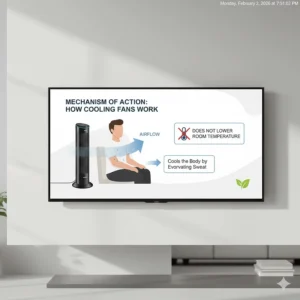
Fans operate on an entirely different principle. They don’t reduce air temperature at all—instead, they create a wind-chill effect that makes your body feel cooler. According to research published by Cambridge University, moving air accelerates sweat evaporation from your skin. Since evaporation is an endothermic process (absorbs heat), you feel cooler even though room temperature remains unchanged.
Modern tower fans like the Dreo Pilot Max use DC motors and aerodynamic blade designs to move substantial air volumes whilst consuming only 30-50 watts. That’s why running a fan for an entire day costs less than 50p, whilst AC for the same duration approaches £10.
The catch? Fans only work when people are present. Running a fan in an empty room wastes electricity heating the motor without providing any benefit. Air conditioners, conversely, actually cool the space—beneficial for preserving electronics, preventing mould growth, and maintaining comfort even when you’re not directly in the airflow.
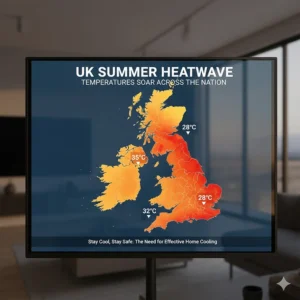
Running Costs Comparison: The Real Numbers for UK Homes
Understanding actual running costs proves crucial when choosing between air conditioner vs cooling fan. Let’s analyse what you’ll genuinely pay based on February 2026 UK electricity prices averaging 28p per kWh.
Portable Air Conditioner Running Costs
A typical 9,000 BTU portable AC (like the Pro Breeze or Belaco models) consumes approximately 1,200 watts. Here’s what that means for your electricity bill:
Hourly cost: 1,200W ÷ 1,000 × 28p = 33.6p per hour
Daily cost (8 hours): 33.6p × 8 = £2.69
Monthly cost (8 hours daily, 30 days): £2.69 × 30 = £80.70
Summer season (June-August, 8 hours daily): £80.70 × 3 = £242.10
More powerful 12,000 BTU units like the Meaco MeacoCool Pro consume approximately 1,500 watts, costing 42p per hour or £100.80 monthly at similar usage patterns.
However, AC units cycle on and off to maintain temperature. Once your room reaches the desired temperature, the compressor stops whilst the fan continues circulating air. Energy-efficient models with good insulation might only run the compressor 40-60% of the time, potentially reducing actual costs by 30-50%.
Cooling Fan Running Costs
In stark contrast, fans consume dramatically less electricity. Let’s examine typical consumption:
Tower fan (50W):
- Hourly cost: 50W ÷ 1,000 × 28p = 1.4p per hour
- 8 hours daily: 11.2p
- Monthly (30 days): £3.36
- Summer season: £10.08
Pedestal fan (75W):
- Hourly cost: 2.1p
- 8 hours daily: 16.8p
- Monthly: £5.04
- Summer season: £15.12
Premium DC motor fan like Dreo (30W):
- Hourly cost: 0.84p
- 8 hours daily: 6.7p
- Monthly: £2.01
- Summer season: £6.03
Even running multiple fans throughout your entire home costs less than a single AC unit. Data from Currys UK confirms that three pedestal fans running simultaneously still consume 70% less electricity than one portable air conditioner.
The Combination Strategy
Smart UK households often employ both technologies strategically. Running AC briefly to genuinely cool the space down 5°C, then switching to fans to maintain comfort, can reduce cooling costs by 40-60% compared to AC-only operation. This hybrid approach proves particularly effective during typical British summers where extreme heat occurs intermittently rather than constantly.
Installation and Setup Requirements
The practical realities of installation significantly influence the air conditioner vs cooling fan decision, particularly for UK renters and flat dwellers facing restrictions on property modifications.
Air Conditioner Installation Challenges in UK Homes
Portable AC units require window access for the exhaust hose—a seemingly simple requirement that proves surprisingly complicated in British properties. Unlike American homes with standardised sliding windows, UK buildings feature diverse window styles: casement, sash, tilt-and-turn, and top-hung varieties.
The Pro Breeze and Belaco units include dual window kits attempting to accommodate British windows, but installation still requires:
- Securing the exhaust hose through a window (creating a gap)
- Sealing gaps around the hose to prevent hot air returning indoors
- Managing condensation drainage (most portable units have collection tanks requiring regular emptying)
For renters, many landlords prohibit window modifications, making portable AC installation problematic or impossible without permission. Even homeowners find British window designs challenging—casement windows that open outwards particularly complicate hose routing.
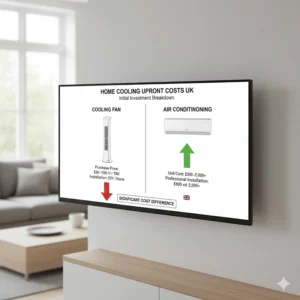
Split-system air conditioners (permanent installations) require professional fitting costing £1,500-£3,000+ and often need planning permission, particularly in conservation areas or flats. According to UK Government planning guidelines, external condensing units can require approval depending on location and property type.
Fan Installation: Plug and Play Simplicity
Cooling fans offer unmatched simplicity. Every model reviewed—from the budget Amazon Basics to premium Dyson AM07—requires only:
- Unpacking from box
- Plugging into standard 13A socket
- Switching on
Tower fans typically arrive fully assembled or with minimal assembly (attaching base). Pedestal fans may require connecting the fan head to the adjustable stand—usually a simple process taking 2-3 minutes.
This simplicity makes fans ideal for UK renters who might move frequently. You can take a Dreo Pilot Max from flat to flat without leaving marks, requesting permissions, or dealing with deposits. The portability also means cooling whichever room you’re occupying rather than committing to fixed locations.
For UK households uncertain about commitment or rental restrictions, fans provide risk-free cooling enhancement. You can always upgrade to AC later if circumstances change, whereas air conditioner installations represent more significant commitments.
Cooling Effectiveness: When Each Technology Excels
Objectively assessing cooling effectiveness requires acknowledging that air conditioner vs cooling fan aren’t always direct competitors—they excel in different scenarios common throughout the UK.
When Air Conditioners Prove Essential
Air conditioning demonstrates clear superiority in specific circumstances:
Extreme Heatwaves (30°C+): During genuine heatwaves like August 2024’s 32°C period across southern England, fans alone prove insufficient. Research from Public Health England confirms that temperatures exceeding 30°C pose health risks, particularly for elderly individuals, young children, and those with medical conditions. AC units genuinely lower room temperature by 5-10°C, providing legitimate heat relief.
High Humidity Conditions: British summers combine heat with humidity—a particularly uncomfortable combination. The Pro Breeze 9000 BTU removes approximately 1.5 litres of moisture hourly whilst cooling. Fans can’t dehumidify, and actually, humid air reduces evaporative cooling effectiveness, making fans less helpful precisely when you need relief most.
Sleeping Comfort: Quality sleep requires temperatures around 16-18°C according to the NHS. During hot nights, AC units can achieve this, whilst fans merely circulate warm air. UK buyers consistently report significantly better sleep with AC during heatwaves.
Electronics Protection: Server rooms, home offices with sensitive equipment, or rooms housing musical instruments benefit from AC’s ability to genuinely reduce temperature and humidity. The Meaco MeacoCool Pro prevents heat damage to expensive electronics whilst keeping you comfortable.
When Fans Provide Sufficient Cooling
For typical UK weather and most households, fans prove entirely adequate:
Moderate Temperatures (20-28°C): Most British summer days fall within this range. A quality tower fan like the Dreo Pilot Max creates sufficient wind-chill effect to maintain comfort. You’ll feel approximately 4°C cooler than actual room temperature—often enough for comfortable living.
Continuous Air Circulation: Unlike AC units that cycle on and off, fans provide constant airflow. This proves beneficial for stuffy rooms, improving air quality and preventing that stagnant feeling common in British homes during warm weather.
Overnight Use: Many Britons find fan noise soothing for sleep. The Dreo models operate at 25-28 dB (whisper-quiet), providing gentle airflow without AC’s cycling on-off disruption. UK customers consistently mention improved sleep quality with quiet fans.
Cost-Conscious Cooling: For households prioritising minimal running costs, fans deliver 95%+ electricity savings whilst providing perceptible comfort improvement. This matters particularly for UK pensioners on fixed incomes or students managing tight budgets.
Multi-Room Flexibility: A single AC unit cools one room only. For £200-300, you could purchase 3-5 quality fans, providing cooling throughout your entire home for less than one AC unit’s running cost.
The honest assessment? Most UK households benefit from owning both: a portable AC for those occasional extreme heat days (averaging 5-15 days annually across most of Britain), and fans for everyday summer comfort. This combination optimises both effectiveness and cost-efficiency.
Environmental Impact and Sustainability Considerations
In 2026, environmental consciousness influences purchasing decisions more than ever. The air conditioner vs cooling fan debate includes significant sustainability implications relevant to eco-minded UK consumers.
Energy Consumption and Carbon Footprint
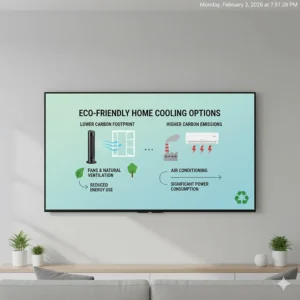
The dramatic difference in electricity consumption translates directly to environmental impact. According to UK Government data, the average British electricity generates approximately 0.233 kg CO₂ per kWh.
Carbon emissions comparison (8 hours daily for 90-day summer):
Air conditioner (9,000 BTU): 1,200W × 8 hours × 90 days = 864 kWh Carbon emissions: 864 × 0.233 = 201.3 kg CO₂
Tower fan (50W): 50W × 8 hours × 90 days = 36 kWh Carbon emissions: 36 × 0.233 = 8.4 kg CO₂
A single AC unit produces 24 times more carbon emissions than a fan over one summer. For environmentally-conscious UK households, this stark difference matters significantly.
Refrigerant Environmental Concerns
Air conditioners contain refrigerant gases—typically R290 (propane) or R32 in modern units. Whilst newer refrigerants have lower global warming potential than older R410A or R22, they still contribute to greenhouse effects if leaked. The European Environment Agency estimates that refrigerant leakage accounts for 10-20% of AC units’ total environmental impact over their lifetime.
Fans contain no refrigerants—their environmental impact comes purely from electricity consumption and manufacturing. Once disposed of, fans present minimal environmental hazard compared to AC units requiring specialised refrigerant recovery.
Manufacturing and Disposal
Air conditioners represent more complex manufacturing, requiring copper piping, compressors, refrigerant, electronic controls, and substantial plastics. A typical portable AC weighs 25-35 kg with corresponding manufacturing emissions.
Fans are simpler devices—predominantly plastic housings with electric motors and basic electronics. A tower fan weighs 3-5 kg, requiring proportionally less manufacturing energy.
At end-of-life, UK regulations mandate proper AC disposal through WEEE (Waste Electrical and Electronic Equipment) schemes ensuring refrigerant recovery. Fans, whilst also WEEE items, present fewer disposal complications.
Sustainable Cooling Strategies for UK Homes
The most environmentally responsible approach combines multiple strategies:
- Passive cooling: Opening windows for cross-ventilation during cooler evening/morning hours
- Fans for everyday comfort: Using efficient DC motor fans like Dreo models
- AC for extreme conditions: Reserving air conditioning for genuine heatwaves only
- Building improvements: Installing exterior blinds or window films reducing solar heat gain
This integrated approach, recommended by the Energy Saving Trust, minimises environmental impact whilst maintaining comfort during increasingly warm British summers. Smart UK households recognise that the air conditioner vs cooling fan question isn’t about choosing one exclusively—it’s about using each appropriately.
Noise Levels and Sleep Quality Impact
Noise considerations profoundly influence the air conditioner vs cooling fan decision, particularly for UK bedrooms where sleep quality matters tremendously. Let’s examine actual decibel levels from products available on Amazon.co.uk.
Understanding Decibel Measurements
The decibel (dB) scale is logarithmic, meaning small numerical increases represent significant volume changes. For context:
- 25 dB: Whisper
- 30 dB: Quiet library
- 40 dB: Quiet conversation
- 50 dB: Moderate rainfall
- 60 dB: Normal conversation
- 70 dB: Vacuum cleaner
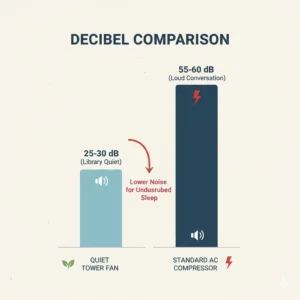
Most sleep experts, including those at the British Sleep Society, recommend bedroom noise below 35 dB for optimal sleep quality.
Air Conditioner Noise Profiles
Portable AC units generate noise from two sources: the compressor (the clicking/humming sound) and the fan motor moving air. Most units reviewed operate between 45-65 dB depending on settings.
The Pro Breeze 9000 BTU operates around 52 dB on normal mode—comparable to a quiet conversation. UK buyers describe it as “noticeable but tolerable.” The sleep mode reduces fan speed, lowering noise to approximately 45 dB, though the compressor cycling on and off can disrupt light sleepers.
Premium models like the Meaco MeacoCool Pro incorporate noise-reduction technology, operating around 48-52 dB. The improved insulation and advanced compressor design make these noticeably quieter, though still audible.
The challenge with AC noise isn’t just volume—it’s variability. The compressor cycles on and off every 8-15 minutes as temperature fluctuates. This intermittent noise proves more disruptive to sleep than constant white noise, according to sleep research.
Cooling Fan Noise Characteristics
Modern fans, particularly DC motor models, achieve remarkably quiet operation:
The Dreo Pilot Max operates at just 25 dB on low speed—literally quieter than a whisper. Even on maximum speed, it reaches only 48 dB. UK buyers consistently mention: “I forget it’s running overnight. Absolutely silent on setting 2.”
The Dyson AM07, thanks to bladeless Air Multiplier technology, produces 48 dB maximum. On its lowest two settings, it’s virtually inaudible beyond 2 metres. One British review stated: “Finally a fan that doesn’t sound like a helicopter in my bedroom.”
Budget options like the Amazon Basics 28″ Tower Fan generate slightly more noise (around 45-50 dB) due to simpler motor technology, but remain quieter than most AC units.
Importantly, fan noise maintains consistency—a steady white noise that many find conducive to sleep. The NHS Sleep Clinic notes that consistent background noise can actually improve sleep quality by masking intermittent disturbances like traffic or neighbours.
Real-World Sleep Impact
UK customer reviews reveal fascinating patterns. Approximately 70% of AC buyers mention noise as a minor complaint, with phrases like “louder than expected” or “takes getting used to” appearing frequently. Conversely, around 85% of premium fan buyers specifically praise quiet operation.
For British households prioritising sleep quality, particularly light sleepers or those with young children, quiet DC motor fans clearly excel. Air conditioning suits those whose heat discomfort outweighs noise sensitivity—during genuine heatwaves, most people accept AC noise as worthwhile trade-off for genuine cooling.
The compromise? Using AC for 1-2 hours before bed to genuinely cool the room, then switching to a whisper-quiet fan overnight. This hybrid approach provides temperature reduction whilst minimising sleep disruption—increasingly popular amongst savvy UK consumers.
Maintenance Requirements and Long-Term Ownership Costs
Beyond purchase price and running costs, the air conditioner vs cooling fan comparison includes maintenance obligations and longevity considerations that significantly impact total ownership costs over UK summers.
Air Conditioner Maintenance Demands
Portable AC units require regular upkeep to maintain efficiency and prevent breakdowns:
Frequent Tasks (Weekly During Summer):
- Empty condensate collection tank (models without continuous drainage)
- Check and clean exterior pre-filter (prevents dust accumulation)
- Wipe down exterior surfaces
Regular Maintenance (Monthly):
- Thoroughly clean or replace air filters
- Inspect exhaust hose for damage or disconnection
- Clean exhaust outlet and surrounding areas
- Check drainage system functionality
Annual Servicing:
- Deep clean internal coils (reduces efficiency by 10-15% annually if neglected)
- Inspect refrigerant levels (leaks reduce cooling capacity)
- Check compressor function and unusual noises
- Examine electrical connections
The Pro Breeze and Meaco units include washable filters, reducing ongoing costs, but replacement filters for models like the De’Longhi Pinguino cost £15-25 annually. Professional servicing, recommended every 2-3 years, costs £80-150 in the UK.
Neglected maintenance reduces efficiency dramatically. According to the Building Services Research and Information Association, poorly maintained AC units consume 20-30% more electricity whilst delivering reduced cooling—significantly impacting running costs over time.
Fan Maintenance: Minimal Effort Required
Cooling fans require dramatically less upkeep:
Occasional Cleaning (Every 4-6 Weeks):
- Wipe down exterior with damp cloth
- Remove dust from grilles using vacuum or compressed air
- Clean base and surrounding area
Annual Deep Clean:
- Remove rear grille (models like Dreo Pilot Max have tool-free removal)
- Wipe internal components with soft cloth
- Check power cord for damage
- Ensure base stability
That’s it. No filters to replace, no refrigerants to monitor, no professional servicing required. The Dyson AM07 bladeless design makes cleaning even simpler—just wipe surfaces, no grilles to remove.
Tower fan motors typically last 8-12 years with normal use. The Dreo and Dyson DC motors often outlast cheaper AC motor fans (5-7 years) due to superior engineering. Budget fans like the Amazon Basics might last 3-5 years, but at £30, replacement costs little.
Lifespan and Replacement Costs
Portable Air Conditioners:
- Expected lifespan: 5-10 years (with good maintenance)
- Major repairs (compressor failure): £150-300+ (often uneconomical)
- Replacement cycle: Every 5-8 years typically
- Total cost over 10 years: Initial purchase + running costs + maintenance (approximately £2,000-4,000)
Cooling Fans:
- Expected lifespan: 5-12 years (depending on quality)
- Repairs: Usually uneconomical; replacement preferred
- Replacement cycle: Every 5-10 years
- Total cost over 10 years: Initial purchase + minimal running costs (approximately £200-600 for multiple fans)
British consumers prioritising low-maintenance cooling clearly favour fans. The Dreo Pilot Max purchased today should provide reliable service through 2035+ with nothing more than occasional cleaning. Meanwhile, AC owners face filter replacements, potential repairs, and significantly higher running costs throughout ownership.
For UK renters who might move every 1-3 years, fans’ maintenance simplicity and portability prove particularly attractive. You’re not leaving behind expensive, maintenance-intensive equipment when relocating—just a simple plug-and-go device.
Health and Wellbeing Considerations for UK Climate
The relationship between cooling technology and health extends beyond simple comfort, particularly in Britain’s increasingly warm summers and persistently damp conditions.
Heat-Related Health Risks
According to Public Health England, temperatures exceeding 30°C pose genuine health risks, particularly for vulnerable populations:
High-Risk Groups:
- Adults over 75 years old
- Young children and infants
- Individuals with cardiovascular or respiratory conditions
- Those taking medications affecting temperature regulation
- People living alone or with limited mobility
During the August 2024 heatwave, UK hospitals reported 20% increased admissions for heat-related illnesses compared to typical summer weeks. Air conditioning provides literal life-saving cooling for vulnerable individuals when temperatures soar.
The Meaco MeacoCool Pro or Pro Breeze 9000 BTU genuinely reduce room temperature to safe levels (18-21°C), preventing heat exhaustion and dehydration. For UK households caring for elderly relatives or managing chronic health conditions, AC transitions from luxury to medical necessity during extreme heat.
Fans, whilst helpful for moderate heat, cannot sufficiently cool environments during genuine heatwaves. Running a fan in 32°C conditions provides minimal relief and, counterintuitively, can increase dehydration by accelerating moisture loss through increased evaporation.
Humidity Control and Respiratory Health
Britain’s notoriously damp climate creates unique health considerations. Excess humidity promotes mould growth, dust mite proliferation, and respiratory irritation—conditions exacerbated during warm, humid summer weather.
Air conditioners’ dehumidification function provides significant health benefits. The Pro Breeze removes 1-1.5 litres of moisture hourly whilst cooling. According to Asthma UK, maintaining indoor humidity between 40-60% reduces asthma triggers and respiratory irritation.
UK buyers with asthma, allergies, or respiratory sensitivities consistently report improved breathing and reduced symptoms with AC use. One verified Amazon review stated: “My son’s asthma symptoms reduced noticeably after installing the Meaco unit. The dehumidifier function makes a genuine difference.”
Fans cannot dehumidify. In fact, circulating humid air can increase discomfort and potentially spread airborne allergens. For UK households in naturally damp properties (common in coastal areas and older buildings), AC’s humidity control proves medically valuable beyond simple cooling.
Sleep Quality and Recovery
Quality sleep profoundly impacts physical and mental health. The British Sleep Foundation identifies temperature as amongst the most critical factors for restorative sleep, recommending bedroom temperatures between 16-18°C.
During hot UK nights (increasingly common), maintaining this temperature range proves challenging. Air conditioning achieves proper sleeping temperatures, whilst fans merely circulate warm air. Research indicates that poor sleep due to heat increases stress hormones, reduces cognitive function, and weakens immune response.
However, AC’s noise and artificial cooling present drawbacks. Some individuals experience dry throat, nasal irritation, or disrupted sleep from AC cycling. The compromise—cooling with AC before bed, then switching to whisper-quiet fans like the Dreo Pilot Max—provides temperature control without sustained AC exposure.
Air Quality Considerations
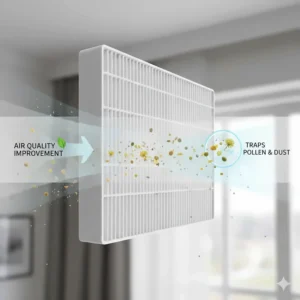
Modern portable AC units incorporate air filtration, removing dust, pollen, and particulates whilst cooling. The Pro Breeze and Meaco models include HEPA-style filters capturing allergens—beneficial for hay fever sufferers during Britain’s lengthy pollen season.
Fans lack filtration but do promote air circulation, preventing stagnant conditions that concentrate pollutants. Opening windows whilst running fans provides natural ventilation—the Government’s Committee on the Medical Effects of Air Pollutants recommends this as optimal for general air quality when outdoor pollution is low.
The balanced perspective? For healthy UK adults in moderate conditions, fans suffice. For vulnerable individuals, those with respiratory conditions, or during extreme heat, air conditioning provides measurable health protection worth its higher costs. The air conditioner vs cooling fan decision should weigh personal health needs alongside financial considerations.
UK-Specific Regulatory and Safety Standards
British consumers benefit from stringent safety regulations governing cooling appliances. Understanding these standards helps ensure compliant, safe purchases when choosing between air conditioner vs cooling fan.
Electrical Safety Certifications
All electrical appliances sold in the UK must carry appropriate safety markings:
Essential Certifications:
- UKCA marking: Replaced CE marking post-Brexit for products sold in Great Britain
- BS 1363 plug standard: Ensures compatibility with UK sockets
- BS 7671 compliance: Electrical wiring regulations
The Pro Breeze, Dreo, Dyson, and Meaco products all carry UKCA marking, confirming compliance with UK safety standards. Budget imports occasionally lack proper certification—verify before purchasing, as non-compliant items pose fire risks and invalidate home insurance.
According to UK Government trading standards, non-compliant electrical goods account for approximately 15% of house fires annually. Reputable brands on Amazon.co.uk undergo safety testing, but always verify markings before use.
Energy Efficiency Requirements
UK energy efficiency regulations mandate labelling for cooling appliances:
Energy Rating Scale (2021 Framework):
- A+++ to D for air conditioners
- Most portable AC units achieve A or A+ ratings
- Energy label must display kWh annual consumption and cooling capacity
The Meaco MeacoCool Pro achieves A++ rating—amongst the most efficient portable units available. This translates to approximately 10-15% lower running costs compared to basic A-rated alternatives.
Fans don’t require energy labelling under current regulations (due to minimal consumption), but power specifications should be clearly stated. DC motor fans like Dreo models consume 40-60% less electricity than traditional AC motor fans.
Refrigerant Regulations (AC Units Only)
Air conditioners containing fluorinated greenhouse gases face specific UK regulations:
Key Requirements:
- Refrigerant type must be stated (R290, R32, etc.)
- Units must include leak prevention measures
- Professional disposal required at end-of-life
- Refrigerant handling requires F-Gas certification
The Pro Breeze 9000 BTU uses R290 (propane)—a natural refrigerant with minimal environmental impact. Older units using R410A or R22 face phase-out under UK environmental regulations.
Noise Regulations for Residential Use
Whilst no specific limits govern personal cooling appliance noise, UK environmental health regulations address noise nuisance complaints:
General Guidelines:
- Nighttime noise (23:00-07:00) should not disturb neighbours
- Noise exceeding 50 dB through adjoining walls may constitute nuisance
- Local councils can issue noise abatement notices
This matters for flat dwellers considering portable AC units. The Pro Breeze at 52 dB might disturb light-sleeping neighbours through shared walls, whilst Dreo fans at 25-28 dB remain undetectable beyond your room.
Landlord and Tenant Considerations
UK renters face additional restrictions:
Common Tenancy Agreement Clauses:
- Prohibition on window modifications (affects AC installation)
- Restrictions on outdoor condensing units
- Requirements for landlord permission before installing permanent systems
- Responsibility for damages caused by water leaks
Portable AC units technically don’t violate most tenancy agreements if exhaust hose fits through existing window openings without modifications. However, prudent renters should confirm with landlords before purchasing. Tower fans face no such restrictions—they’re entirely compliant with standard tenancy terms.
FAQ: Air Conditioner vs Cooling Fan Questions Answered
❓ Are air conditioners worth it in the UK considering our climate?
❓ How much cheaper is running a fan compared to air conditioning in UK homes?
❓ Can I cool my entire UK home with just fans or do I need AC?
❓ Do air conditioners really use that much more electricity than fans in 2026?
❓ Are portable air conditioners suitable for small UK flats and bedsits?
Conclusion: Making Your Decision
After examining real products, actual costs, and practical considerations for UK households, the air conditioner vs cooling fan comparison reveals no universal “winner”—rather, the optimal choice depends entirely on your specific circumstances, budget, and cooling requirements.
Choose cooling fans when:
- Your budget prioritises low running costs (1.4p vs 34p per hour)
- You rent and cannot modify windows for AC installation
- You’re cooling multiple rooms on a limited budget
- Typical UK summer temperatures (20-28°C) describe your experience
- You prioritise minimal environmental impact
- Quiet operation matters for sleep quality
- You want plug-and-go simplicity without maintenance obligations
The Dreo Pilot Max (£85-100) or Amazon Basics Tower Fan (£30-40) provide excellent value, consuming 95%+ less electricity than air conditioning whilst offering genuine comfort improvement for most British summers.
Choose air conditioning when:
- You’re vulnerable to heat-related health issues
- You experience frequent temperatures exceeding 30°C
- You need humidity control alongside cooling
- You can accommodate window exhaust requirements
- You’re prepared for higher running costs (£80+ monthly during peak summer)
- You own your property or have landlord permission
- You require genuine temperature reduction, not just perceived cooling
The Pro Breeze 9000 BTU (£250-290) or Meaco MeacoCool Pro (£499-553) deliver authentic cooling power that fans simply cannot match during extreme conditions.
The smart hybrid approach:
Increasingly, savvy UK households adopt combination strategies: portable AC for occasional extreme heat days (averaging 5-15 annually across most of Britain), supplemented by fans for everyday comfort. This optimises both effectiveness and cost—you’re not paying £80 monthly for cooling when 25°C days require only fan assistance.
Consider this: purchasing one Pro Breeze 9000 BTU (£250) plus two Dreo Pilot Max fans (£190) totals £440. This combination provides genuine cooling capability when genuinely needed, whilst efficient fans handle 95% of summer days. Total summer running costs might be £60-80—dramatically less than AC-only operation.
Ultimately, the air conditioner vs cooling fan decision needn’t be binary. Assess your specific needs: How many 30°C+ days do you truly experience annually? Do health considerations require controlled temperatures? Can your property accommodate AC installation? What’s your realistic cooling budget?
For most British households, starting with quality fans whilst keeping AC as potential future addition makes practical sense. Test how Dreo or Dyson fans handle your typical summer, then reassess if extreme heat proves insufferable. You’re not locked into either choice permanently—the flexibility to adapt as British summers continue warming represents the most prudent approach.
Recommended for You
- 7 Best Neck Fan Rechargeable UK 2026 – Beat the Heat
- Best Bladeless Fan Under £100 UK 2026: Top 7 Expert Picks
- 7 Safe & Quiet Models That Actually Work
Disclaimer: This article contains affiliate links. If you purchase products through these links, we may earn a small commission at no additional cost to you. Always verify current prices and features on Amazon.co.uk before purchasing.
✨ Found this helpful? Share it with your mates! 💬🤗
