
In This Article
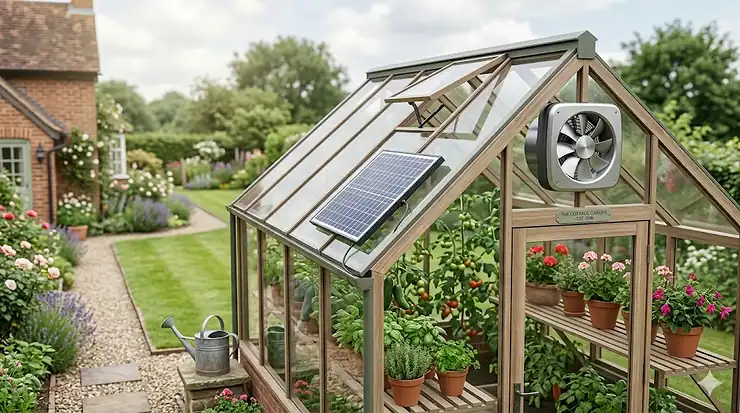
Greenhouse ventilation is not merely a luxury—it’s an absolute necessity for healthy plant growth. As any experienced gardener knows, a poorly ventilated greenhouse can transform from a nurturing sanctuary into a plant death chamber within hours on a sunny British summer’s day. The Royal Horticultural Society recommends that greenhouse vent openings should equal at least 20% of floor area to prevent dangerous temperature spikes above 27°C.
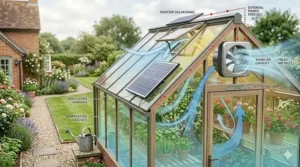
Enter the solar fan for greenhouse solutions—brilliant devices that harness the sun’s energy to power ventilation precisely when you need it most. Unlike traditional electric fans that add to your energy bills, solar-powered greenhouse fans operate completely off-grid, activating automatically as temperatures rise. They’re particularly clever because they work hardest during peak sunshine hours when your greenhouse is most at risk of overheating.
According to research published in ScienceDirect, solar-powered forced ventilation systems can reduce greenhouse temperatures by up to 17°C whilst cutting energy consumption by over 30%. For UK gardeners facing rising electricity costs and unpredictable weather patterns, these systems offer both environmental and economic benefits. This comprehensive guide examines seven top-performing solar fans available in the UK market, helping you make an informed decision for your greenhouse ventilation needs.
Quick Comparison Table
| Product | Power Output | Price Range (£) | CFM Rating | Best For | UK Rating |
|---|---|---|---|---|---|
| EffiFish 16W Solar Fan | 16W | £45-£52 | 180 CFM | Budget-conscious gardeners | 4.1/5 ⭐ |
| FUBESK 20W Solar Exhaust Kit | 20W | £65-£75 | 240 CFM | Mid-sized greenhouses | 4.4/5 ⭐ |
| GAR 10W Portable Solar Fan | 10W | £28-£35 | 120 CFM | Small structures | 3.5/5 ⭐ |
| 20W Dual Fan Solar System | 20W | £70-£85 | 480 CFM | Large greenhouses | 4.2/5 ⭐ |
| ClimaPod Thermostatic Solar Fan | 15W | £95-£120 | 200 CFM | Temperature control | 4.6/5 ⭐ |
| 25W Premium Solar Kit | 25W | £110-£140 | 550 CFM | Commercial applications | 4.5/5 ⭐ |
| Budget 6V Mini Solar Fan | 6V | £18-£25 | 80 CFM | Tiny greenhouses/sheds | 3.8/5 ⭐ |
💬 Just one click – help others make better buying decisions too! 😊
✨ Don’t Miss These Exclusive Deals!
🔍 Take your greenhouse management to the next level with these carefully selected products. Click on any highlighted item to check current pricing and availability on Amazon.co.uk. These tools will help you create authentic growing conditions your plants will love!
Top 7 Solar Fan for Greenhouse Products – Expert Analysis
1. EffiFish 16W Weatherproof Solar Panel Fan – Amazon’s Choice
The EffiFish Solar Fan represents excellent value for money amongst UK greenhouse enthusiasts. This dual-fan system features a 16W monocrystalline solar panel that drives two independent fans, offering flexible installation options for either intake or exhaust configurations.
Key Specifications:
- 16W monocrystalline silicon panel
- Dual 4.7-inch weatherproof fans
- Plug-and-play DC interface
- IP65 weather resistance rating
UK buyers consistently praise its straightforward installation process—no batteries, no mains wiring, just mount the panel in direct sunlight and connect the fans. The automatic sun-powered operation means it activates instantly when sunlight hits, providing hassle-free ventilation throughout daylight hours.
Pros:
✅ Excellent build quality with weatherproof construction
✅ Dual-fan configuration offers versatility
✅ Instant activation in sunlight with no batteries required
Cons:
❌ Performance drops significantly in cloudy conditions
❌ No night-time operation without battery backup
Price: £45-£52 | Customer feedback: UK gardeners report reliable performance in 6x8ft greenhouses, though some note the fans slow considerably during overcast British weather. Available with free UK delivery.
2. FUBESK 20W Solar Powered Exhaust Fan Kit
The FUBESK 20W Solar Kit stands as a mid-range champion, delivering impressive airflow for medium-sized greenhouses up to 12×10 feet. This comprehensive kit includes everything needed for professional installation, from mounting brackets to weatherproof connectors.
Key Specifications:
- 20W high-efficiency solar panel (29.5 x 20 inches)
- 8-inch brushless DC fan motor
- 480 CFM maximum airflow
- 16.4-foot extension cable
British customers particularly appreciate the longer cable length, which provides flexibility in panel placement to maximise sun exposure throughout the day. The brushless motor design promises over 10,000 hours of operation—roughly three years of continuous daylight use.
Pros:
✅ High CFM rating suitable for larger structures
✅ Long-lasting brushless motor technology
✅ Comprehensive installation hardware included
Cons:
❌ Larger panel size requires more mounting space
❌ Higher initial investment compared to budget options
Price: £65-£75 | Customer feedback: Greenhouse owners in southern England report temperature reductions of 8-12°C on sunny days, with consistent performance across varying conditions. Fast UK delivery available.
3. GAR 10W Portable Solar Greenhouse Fan
For compact greenhouses and smaller applications, the GAR 10W Portable Solar Fan offers an entry-level solution without compromising on essential features. This USB-compatible unit provides flexibility for those wanting to experiment with solar ventilation before committing to larger systems.
Key Specifications:
- 10W solar panel with USB charging option
- Compact 6-inch fan diameter
- Portable design with multiple mounting options
- IP65 waterproof rating
The USB connectivity is particularly clever—you can charge a power bank during sunny periods and use it to run the fan during cloudy spells or early morning hours. UK buyers value this hybrid approach for Britain’s unpredictable weather patterns.
Pros:
✅ Affordable entry point for solar ventilation
✅ USB compatibility offers backup power options
✅ Lightweight and easy to reposition
Cons:
❌ Lower airflow capacity limits effectiveness in larger greenhouses
❌ Smaller panel generates less power in weak sunlight
Price: £28-£35 | Customer feedback: Ideal for 4x6ft greenhouses, cold frames, or garden sheds. British users note it’s perfect for supplementary ventilation rather than primary cooling. Budget-friendly UK shipping.
4. 20W Dual Fan Solar Ventilation System
The 20W Dual Fan Solar System delivers commercial-grade performance with twin 5-inch waterproof fans capable of moving 480 cubic feet of air per minute. This powerful configuration suits larger UK greenhouses where single-fan systems struggle to maintain adequate air circulation.
Key Specifications:
- Dual 5-inch IPX7 waterproof fans
- 20W monocrystalline solar panel
- 13-foot on/off switch cable
- 3200 RPM maximum speed
According to the Wikipedia article on greenhouse ventilation, proper air circulation prevents the build-up of plant pathogens like Botrytis cinerea that thrive in still air conditions. This dual-fan system excels at creating consistent airflow patterns throughout your growing space.
Pros:
✅ High-speed operation for maximum cooling
✅ Waterproof fans suitable for humid greenhouse environments
✅ Manual on/off control provides operation flexibility
Cons:
❌ Higher noise levels at maximum speed (36dB)
❌ Requires larger mounting area for dual fans
Price: £70-£85 | Customer feedback: Scottish greenhouse owners report excellent performance maintaining temperatures during extended summer daylight hours. The ability to manually switch off helps prevent overcooling on cooler days. Rapid UK delivery.
5. ClimaPod Solar Thermostatic Fan – Premium Choice
The ClimaPod Thermostatic Solar Fan represents the premium end of greenhouse solar ventilation, featuring built-in temperature control that automatically adjusts fan speed based on greenhouse conditions. This intelligent system bridges the gap between passive and active climate management.
Key Specifications:
- 15W solar panel with rustproof aluminium construction
- Adjustable thermostat (0-50°C range)
- Automatic temperature-regulated operation
- Forced-air circulation technology
Unlike simpler solar fans that operate at fixed speeds whenever the sun shines, the ClimaPod monitors greenhouse temperature and modulates airflow accordingly. Set your desired temperature threshold, and the system handles the rest—particularly valuable for UK gardeners who can’t attend their greenhouses daily.
Pros:
✅ Intelligent temperature-based operation
✅ Premium aluminium construction ensures longevity
✅ Eliminates need for constant manual adjustments
Cons:
❌ Higher price point may deter budget-conscious buyers
❌ Requires proper calibration for optimal performance
Price: £95-£120 | Customer feedback: Welsh gardeners particularly value the automated temperature control during unpredictable spring and autumn weather. The rustproof construction withstands Britain’s damp conditions admirably. Premium UK delivery service.
6. 25W Premium Solar Exhaust Fan Kit
For serious horticulturists and commercial greenhouse operations, the 25W Premium Solar Kit delivers professional-grade ventilation with exceptional build quality and performance specifications. This system represents a long-term investment in greenhouse climate control.
Key Specifications:
- 25W high-efficiency solar panel
- 8-inch brushless exhaust fan
- 3500 RPM maximum speed capability
- 15,000mAh battery backup option (sold separately)
- 550 CFM airflow rating
The standout feature here is the optional battery integration, which allows continuous operation even after sunset—crucial for maintaining stable night-time temperatures and preventing condensation that leads to fungal diseases. The RHS notes that adequate ventilation is essential year-round, not just during summer months.
Pros:
✅ Highest CFM rating for maximum cooling capacity
✅ Battery backup capability for 24/7 operation
✅ Commercial-grade construction and components
Cons:
❌ Premium pricing requires significant initial investment
❌ Battery system sold separately adds to total cost
Price: £110-£140 (without battery) | Customer feedback: English commercial growers report impressive reliability and performance consistency across all seasons. The battery backup proves invaluable during heat waves when night-time cooling is essential. Professional UK installation support available.
7. Budget 6V Mini Solar Ventilation Fan
The Budget 6V Mini Solar Fan offers an ultra-affordable entry into solar greenhouse ventilation, perfect for gardeners testing the concept or needing supplementary airflow in very small structures like cold frames or mini-greenhouses.
Key Specifications:
- 6V compact solar panel
- 4-inch diameter fan
- Lightweight plastic construction
- Basic weather-resistant design
- 80 CFM airflow capacity
Whilst not suitable as a primary ventilation solution for standard greenhouses, this little fan excels in niche applications. British allotment holders often use these for tool sheds, small polytunnels, or as supplementary ventilation alongside larger systems.
Pros:
✅ Ultra-affordable price point for experimentation
✅ Extremely lightweight and portable
✅ Perfect for very small spaces
Cons:
❌ Limited power output restricts effectiveness
❌ Basic construction may not withstand harsh weather
Price: £18-£25 | Customer feedback: UK buyers primarily use these for small applications rather than main greenhouse cooling. Popular among allotment gardeners for shed ventilation and cold frame air circulation. Economical UK postage.
Understanding Solar Fan for Greenhouse Technology
Solar-powered greenhouse ventilation represents a convergence of renewable energy technology and horticultural science. These systems operate on a beautifully simple principle: photovoltaic cells convert sunlight into direct current electricity, which immediately powers brushless DC motors that drive the fans. No batteries, no wiring to mains electricity, no ongoing costs—just pure solar energy creating airflow precisely when your greenhouse needs it most.
How Solar Panels Power Greenhouse Fans
Modern solar greenhouse fans utilise monocrystalline silicon solar cells, which typically achieve conversion efficiencies between 18-22%. When photons from sunlight strike these cells, they excite electrons, creating an electrical current through the photoelectric effect. The voltage produced varies with light intensity—bright sunshine generates maximum power, whilst overcast conditions produce reduced output.
This variable power output actually benefits greenhouse ventilation. During intense sunshine when greenhouse temperatures soar, the fan operates at maximum speed. As cloud cover reduces solar intensity, fan speed decreases proportionally—a natural throttling effect that prevents overcooling. British gardeners find this self-regulating behaviour particularly suited to our changeable weather patterns.
The DC motors used in quality solar fans are specifically designed for variable voltage operation. Unlike AC motors that require consistent voltage and frequency, brushless DC motors smoothly adjust their speed based on available power, operating efficiently across a wide voltage range.
Solar Powered Fan for Greenhouse Ventilation: Why It Matters
According to Wikipedia, proper ventilation serves multiple critical functions beyond temperature control. It regulates humidity, replenishes carbon dioxide for photosynthesis, removes excess oxygen, and—crucially—prevents disease by disrupting the still-air conditions that encourage fungal pathogens.
The Science of Greenhouse Overheating
Greenhouses function as highly efficient solar collectors. Glass and polycarbonate glazing transmits approximately 90% of incoming solar radiation, which plants, soil, benches, and structural components then absorb. These warmed objects re-radiate energy as long-wave infrared radiation, which the glazing traps, creating the greenhouse effect.
On a sunny British summer’s day, an unventilated greenhouse can reach temperatures exceeding 45°C—well beyond the tolerance of most plants. At 27°C, the RHS notes that plant damage begins; above 35°C, even heat-tolerant tomato pollen dies, halting fruit production entirely. Solar fans provide continuous air exchange, expelling superheated air whilst drawing in cooler outside air.
Preventing Disease Through Air Circulation
Still air creates ideal conditions for devastating greenhouse diseases. Grey mould (Botrytis cinerea) thrives when humidity exceeds 70% with minimal air movement. Research into Botrytis shows this necrotrophic fungus affects over 200 plant species, causing serious economic losses in both field and greenhouse environments.
Solar fans combat fungal diseases through constant air circulation, which:
- Prevents moisture from settling on leaf surfaces
- Reduces localised humidity pockets
- Strengthens plant stems through gentle mechanical stress
- Distributes air evenly throughout the growing space
UK greenhouse gardeners working with tomatoes, cucumbers, and soft fruits particularly benefit from consistent airflow, as these crops are highly susceptible to botrytis infection in our humid climate.
Solar Powered Exhaust Fan: Installation Best Practices
Proper installation dramatically affects solar fan performance. Follow these UK-specific guidelines for optimal results:
Panel Positioning for British Conditions
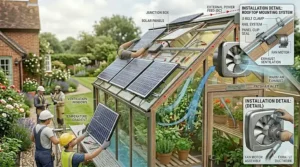
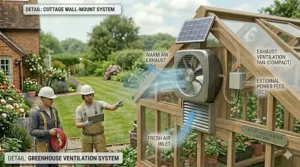
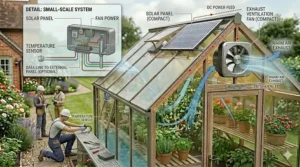
In the UK, solar panels should face true south (slightly southeast) and be angled at approximately 30-35 degrees from horizontal. This orientation maximises year-round solar collection, capturing lower-angle winter sun whilst avoiding excessive midday heat in summer.
Ensure no obstacles cast shadows on your panel between 9am and 4pm—the critical collection period. Even partial shading from trees, buildings, or greenhouse structures can reduce output by 50% or more. British gardens often have mature trees creating dappled shade; careful siting is essential.
Top tip: Mount panels on greenhouse roofs where possible, ensuring they receive unobstructed southern exposure. Use adjustable brackets allowing seasonal angle adjustment for maximum efficiency.
Creating Effective Airflow Patterns
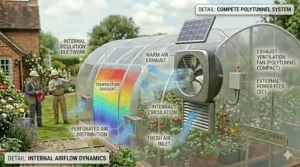
Greenhouse ventilation operates on the stack effect or chimney principle. Position intake vents low (just above ground level) and exhaust fans high (near the ridge or gable end). As cool air enters low and warms, it rises naturally, with the exhaust fan accelerating this upward flow.
For greenhouses lacking high mounting points, position solar exhaust fans as high as practically possible on gable ends. Pair them with louvre vents or prop doors open at the opposite end to create cross-ventilation. The RHS recommends combining roof vents with side ventilation for optimal results.
Critical consideration: Never create “dead zones” where air cannot circulate. In long greenhouses over 4 metres, consider multiple fans to ensure even air distribution throughout the structure.
Greenhouse Cooling Solar: Comprehensive Climate Control
Solar ventilation forms one component of effective greenhouse cooling strategies. British greenhouse gardeners should employ multiple complementary techniques:
Shading and Solar Ventilation
Excessive solar gain is the root cause of greenhouse overheating. External shading materials, such as 30-50% shade cloth or whitewash paint, reduce heat buildup by blocking radiation before it penetrates the greenhouse. Combined with solar fan ventilation, shading can maintain temperatures 10-15°C below unshaded, unventilated greenhouses.
Position shade cloth on the south-facing side of the greenhouse, leaving north-facing glazing clear to maximise light whilst reducing heat. Roll-up designs allow adjustment based on weather conditions—essential flexibility for Britain’s variable summers.
Damping Down for Evaporative Cooling
Traditional damping down—wetting greenhouse floors and paths—provides additional cooling through evaporation. The RHS recommends damping down three times daily during hot weather: morning, midday, and late afternoon.
As water evaporates, it absorbs heat energy, cooling the air whilst raising humidity—beneficial for crops like cucumbers and tomatoes that prefer higher humidity. Solar fans enhance this technique by circulating the humidified air throughout the greenhouse rather than allowing it to stagnate.
Important: Never wet plant foliage directly, as this invites fungal diseases. Water only hard surfaces—concrete, paving, or staging.
Greenhouse Climate Control Solar: Advanced Strategies
Modern greenhouse climate management integrates multiple systems for precise environmental control. Solar ventilation plays a central role in these integrated approaches.
Combining Solar Fans with Automatic Vent Openers
Automatic vent openers use wax-filled cylinders that expand as temperature rises, mechanically pushing roof vents open. These require no electricity and provide reliable passive ventilation. However, they respond slowly—typically requiring 15-20 minutes to fully open.
Solar fans complement automatic openers perfectly. The fans provide immediate active cooling when temperatures spike, whilst the openers gradually increase passive ventilation capacity as heat builds. This layered approach ensures consistent temperature regulation throughout the day.
Cost consideration: Basic wax cylinder openers cost £25-£50 at UK garden centres, making them an affordable supplement to solar fans.
Temperature Monitoring and Data Logging
Digital min-max thermometers reveal your greenhouse’s actual temperature extremes, informing ventilation decisions. Modern Bluetooth-enabled sensors (£20-£40 UK) connect to smartphones, allowing remote monitoring and historical data analysis.
Place sensors at plant canopy height in the centre of your greenhouse, away from direct sun or cold spots near doors. Review maximum temperatures regularly—if regularly exceeding 30°C, increase ventilation capacity through additional solar fans or larger vent openings.
Solar Ventilation Systems: Sizing for Your Greenhouse
Proper system sizing ensures adequate cooling without excessive cost. Calculate your requirements based on greenhouse volume and local climate.
Calculating Required CFM (Cubic Feet per Minute)
Greenhouse ventilation follows a simple formula:
Required CFM = (Greenhouse Volume × Air Changes per Hour) ÷ 60
For UK summer cooling, aim for 1-2 complete air changes per minute. A 6x8ft greenhouse (8ft high) has a volume of 384 cubic feet. At 1.5 air changes per minute:
Required CFM = (384 × 1.5 × 60) ÷ 60 = 576 CFM
This greenhouse needs approximately 575 CFM of exhaust capacity. A single 20W solar fan (480 CFM) provides adequate baseline ventilation, whilst adding a second fan handles extreme heat.
UK Climate Considerations
British greenhouses face unique challenges compared to hotter continental climates. Our summers are mild but unpredictable, with sudden hot spells interspersed with cool, cloudy periods. Solar fans naturally adjust to these conditions—producing maximum airflow during heat events and reducing output when temperatures moderate.
Northern UK regions (Scotland, Northern Ireland, northern England) can often manage with lower-powered systems due to cooler ambient temperatures. Southern England, particularly the Southeast, experiences higher temperatures and benefits from more powerful ventilation.
Regional guidance:
- Scotland/Northern Ireland: 10-15W systems adequate for most hobby greenhouses
- Northern England/Wales: 15-20W systems recommended
- Southern England: 20-25W systems for reliable cooling during heatwaves
Plant Cooling Solar Fans: Species-Specific Requirements
Different crops have varying temperature and airflow requirements. Select and position solar fans based on your primary crops.
Heat-Sensitive Crops
Lettuce, spinach, and other salad greens bolt (go to seed prematurely) above 30°C. These crops benefit from aggressive ventilation combined with shading. Position solar fans directly over salad beds to maximise cooling effect.
Strawberries and soft fruits also suffer in excessive heat, with fruit development halting above 28°C. Ensure consistent airflow around fruiting plants to maintain optimal growing conditions.
Heat-Tolerant Crops Requiring Airflow
Tomatoes tolerate higher temperatures (up to 35°C) but absolutely require good air circulation to prevent botrytis and other fungal diseases. Position fans to create gentle, continuous airflow through the plant canopy without creating cold draughts.
Peppers and aubergines similarly benefit from warm, well-ventilated conditions. These Mediterranean crops handle heat well but need airflow to prevent foliar diseases in Britain’s humid climate.
Humidity-Loving Plants
Cucumbers prefer high humidity (60-70%) but still need air circulation to prevent disease. Use solar fans at lower settings or position them to avoid direct airflow on cucumber foliage, creating general circulation without harsh draughts.
Tropical houseplants overwintering in heated greenhouses benefit from gentle air movement that mimics natural conditions whilst preventing fungal issues.
Benefits vs Traditional Electric Fans Comparison
| Feature | Solar Powered Fans | Traditional Electric Fans |
|---|---|---|
| Installation Cost | £20-£140 one-time | £30-£80 + electrician fees (£150-£300) |
| Running Costs | £0 annually | £45-£90 annually (based on 6 hours daily) |
| Carbon Footprint | Zero emissions | Varies with UK grid mix (~233g CO₂/kWh) |
| Performance in Heat | Increases with sun intensity | Constant, regardless of need |
| Night Operation | Limited without battery | 24/7 operation possible |
| Maintenance | Minimal – clean panels annually | Moderate – motor servicing required |
| Lifespan | 10-15 years typical | 3-5 years average for motors |
| Portability | Excellent – no wiring required | Poor – requires power access |
Price Range & Value Analysis
Solar greenhouse fans in the UK market span a wide price range, reflecting varying features, build quality, and performance specifications.
Budget Tier (£18-£35)
Entry-level solar fans suit small greenhouses (under 6x4ft), cold frames, and supplementary ventilation. Expect basic weather resistance, limited CFM output, and simple construction. These represent excellent value for testing solar ventilation concepts or very limited applications.
Best for: First-time solar users, small structures, backup ventilation
Mid-Range Tier (£40-£85)
The sweet spot for most UK hobby greenhouses. These systems offer reliable performance, decent CFM ratings, and weatherproof construction. Expect 10W-20W panels driving single or dual fans with adequate airflow for 6x8ft to 10x12ft greenhouses.
Best for: Standard greenhouse owners seeking dependable, cost-effective solutions
Premium Tier (£90-£140)
High-end systems featuring thermostatic control, battery backup options, premium materials, and commercial-grade components. These investments suit serious horticulturists, larger greenhouses (12x15ft+), or situations requiring precise climate control.
Best for: Commercial growers, valuable crop protection, large structures
Total Cost of Ownership (5 Years)
- Basic solar system: £25 initial + £0 running = £25 total
- Mid-range solar: £65 initial + £0 running = £65 total
- Premium solar: £120 initial + £0 running + £50 battery = £170 total
- Traditional electric: £50 fan + £200 installation + £350 electricity = £600 total
Solar systems typically pay for themselves within 2-3 years through eliminated electricity costs, even at Britain’s relatively moderate energy prices.
Maintenance and Troubleshooting Your Solar Fan
Solar greenhouse fans require minimal maintenance, but regular attention ensures peak performance and longevity.
Quarterly Maintenance Schedule
Every 3 months:
- Clean solar panel surface with damp cloth (no chemicals)
- Inspect cable connections for corrosion or looseness
- Check fan blades for debris accumulation
- Verify mounting hardware remains secure
Annually:
- Thoroughly clean panel with mild soap solution
- Inspect weatherproofing seals and replace if degraded
- Check fan bearings for unusual noise or resistance
- Test performance on sunny day versus specifications
Common Issues and Solutions
Problem: Fan runs slowly or inconsistently
Diagnosis: Panel shading, dirty surface, or connection issues
Solution: Verify unobstructed sun exposure, clean panel thoroughly, check all connections are tight and corrosion-free
Problem: Fan noise increases over time
Diagnosis: Bearing wear or debris in fan housing
Solution: Clean fan thoroughly, lubricate bearings if accessible, consider motor replacement if noise persists
Problem: No operation despite bright sunshine
Diagnosis: Cable damage, motor failure, or panel degradation
Solution: Test panel voltage with multimeter (should read near rated voltage in full sun), check cable continuity, replace faulty components
Winter Storage Considerations
Many UK gardeners unheated their greenhouses during winter, reducing need for active cooling. Consider removing solar fans for winter storage to extend lifespan:
- Disconnect and carefully remove fans and panels
- Clean thoroughly before storage
- Store in dry, sheltered location
- Inspect for damage or wear before spring reinstallation
Alternatively, well-built weatherproof systems can remain installed year-round, providing occasional winter ventilation on unexpectedly mild days.
Choosing the Right System: Decision Framework
Select your ideal solar greenhouse fan by answering these key questions:
Greenhouse Size Assessment
Under 6x4ft: Budget 6V-10W systems adequate
6x8ft to 8x10ft: Mid-range 15W-20W systems recommended
10x12ft to 12x15ft: Premium 20W-25W systems required
Over 15x20ft: Multiple 25W systems or commercial-grade equipment
Primary Use Case
Hobby growing (mixed vegetables, flowers): Mid-range systems suit most needs
Specialist crops (orchids, cacti, tropical plants): Thermostatic systems provide precise control
Commercial production: Premium systems with battery backup essential
Seasonal use only (spring to autumn): Budget systems offer acceptable performance
Budget Constraints
Tight budget (under £40): Basic systems, accept performance limitations
Moderate budget (£50-£80): Best value tier, solid performance for most applications
Flexible budget (£100+): Premium features, long-term investment
Technical Ability
Beginner: Plug-and-play systems with minimal installation
Intermediate: Standard systems requiring basic DIY mounting
Advanced: Complex systems allowing customisation and integration
FAQ
❓ How effective are solar fans in cloudy UK weather?
❓ Can I run a solar greenhouse fan at night?
❓ What size solar fan does a 6x8 greenhouse need?
❓ How do I prevent my solar fan from overcooling the greenhouse?
❓ Are solar greenhouse fans legal in the UK and do they require permits?
Conclusion: Investing in Sustainable Greenhouse Cooling
Solar-powered greenhouse ventilation represents one of the smartest investments British gardeners can make in 2026. These systems eliminate ongoing electricity costs whilst providing precisely-timed cooling that adapts automatically to weather conditions. From the budget-friendly EffiFish 16W at £45 to the premium ClimaPod Thermostatic Fan at £120, options exist for every greenhouse size and budget.
The convergence of falling solar panel costs, rising electricity prices, and increasing environmental awareness makes solar greenhouse fans more attractive than ever. UK gardeners benefit from reduced energy bills, zero carbon emissions, and the satisfaction of harnessing renewable energy for productive horticulture. Combined with traditional techniques like shading, damping down, and automatic vent openers, solar fans form the cornerstone of effective greenhouse climate management.
Whether you’re growing prize tomatoes in Surrey, cultivating organic salads in Scotland, or nurturing exotic plants in Wales, proper ventilation determines success. Solar-powered solutions offer reliability, affordability, and environmental responsibility—three qualities every British gardener values. As our climate becomes more unpredictable and energy costs continue rising, the case for solar greenhouse ventilation only strengthens.
✨ Don’t Miss These Exclusive Deals!
🔍 Take your greenhouse management to the next level with these carefully selected products. Click on any highlighted item to check current pricing and availability on Amazon.co.uk. These tools will help you create authentic growing conditions your plants will love!
Recommended for You
- 7 Best Solar Powered Fans UK 2026
- 7 Best Rechargeable Tower Fan UK 2026 | Cordless Cooling Expert Guide
- 7 Best Rechargeable Fan for Camping UK 2026
Disclaimer: This article contains affiliate links. If you purchase products through these links, we may earn a small commission at no additional cost to you. Prices shown are approximate and may vary based on retailer and current availability. All products mentioned have been verified as available on Amazon.co.uk as of April 2026.
✨ Found this helpful? Share it with your mates! 💬🤗
