

In This Article
Britain is damp. That’s not a complaint — it’s just geography. But when your bathroom produces another steam cloud after a hot shower, and the nearest external wall is three metres away, cracking a window is a bit like bailing out a sinking ship with a teaspoon. Enter the inline bathroom extractor fan: one of the most underrated upgrades you can make to a British home, and one that quietly gets on with its job while tucked away in your loft where nobody has to look at it.
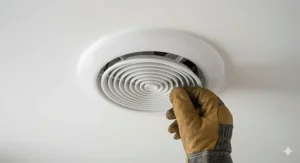
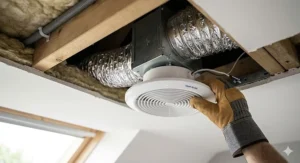
Unlike a standard axial wall fan — that white plastic disc bolted directly above the shower that hums like a tired bumblebee — an inline bathroom extractor fan sits inside the duct run itself, typically in a ceiling void or loft space above the room. The only thing visible in your bathroom is a sleek flush grille. The motor, the noise, the mechanical bits: all hidden away. The result is significantly quieter extraction, considerably more power, and the freedom to position your ceiling vent anywhere you like — even directly above a shower, which Zone 1 regulations would normally prohibit for a standard wall-mounted unit.
According to UK Building Regulations Approved Document F, bathrooms require a minimum intermittent extraction rate of 15 litres per second — a standard most axial fans barely scrape past, and one that a good inline fan handles with ease. What’s more, the NHS has repeatedly flagged damp and mould as genuine health risks, particularly for households with young children, elderly residents, or anyone with respiratory conditions. Proper ventilation isn’t a luxury. It’s just sensible.
So whether you’re in a terraced house in Leeds with a bathroom that’s nowhere near an outside wall, a new-build flat in Bristol struggling with condensation, or a Victorian semi in Edinburgh where the bathroom ceiling has seen better decades — this guide will help you find the right inline bathroom extractor fan for your situation.
Quick Comparison: Top 7 Inline Bathroom Extractor Fans at a Glance
| Product | Airflow | Noise | Key Feature | Best For | Price Range |
|---|---|---|---|---|---|
| Manrose MF100T | 245 m³/hr | 24 dB(A) | 3-speed, timer, ball bearings | Most buyers | £40–£60 |
| Fantronix 100mm Timer | 187 m³/hr | 21 dB(A) | Quietest on market | Noise-sensitive homes | £30–£45 |
| Devola DVILF100T | 187 m³/hr | 27 dB(A) | Made in Britain, 2-speed | Quality-conscious buyers | £45–£65 |
| Vent-Axia ACM100T | 245 m³/hr | ~25 dB(A) | Premium steel build, 3-speed | Long duct runs, new builds | £70–£100 |
| Anesty 4″ Inline Fan | 220 m³/hr | ~30 dB(A) | Budget-friendly, timer | First-time buyers | £25–£40 |
| FanGoFast 100mm | 185 m³/hr | ~28 dB(A) | Speed controller included | DIY installs | £30–£45 |
| Devola DVILF100 (Standard) | 187 m³/hr | 27 dB(A) | Flame-retardant body, Made in UK | Budget, no timer needed | £35–£50 |
What does this table actually tell us? The Manrose MF100T edges ahead on raw airflow — 245 m³/hr puts it in a different league for larger bathrooms or longer duct runs. But if noise is your primary concern, the Fantronix’s 21 dB(A) is whisper-quiet in a way that has to be experienced to be believed: quieter than a library, roughly on par with rustling leaves. Budget buyers should note that the Anesty delivers solid performance at a noticeably lower price, though the slightly higher noise level may be a trade-off worth considering in a terraced house where the loft sits directly above a bedroom.
💬 Just one click — help others make better buying decisions too! 😊
✨ Don’t Miss These Exclusive Deals!
🔍 Take your bathroom ventilation to the next level with these carefully selected products. Click on any highlighted item to check current pricing and availability on Amazon.co.uk. These picks will help you find exactly what you need — whether you’re after whisper-quiet performance, Made-in-Britain build quality, or simple budget-friendly extraction.
Top 7 Inline Bathroom Extractor Fans: Expert Analysis
1. Manrose MF100T In-Line Mixed Flow Extractor Fan with Timer
The Manrose MF100T is the fan you keep seeing recommended everywhere — and rather annoyingly for its competitors, the reputation is entirely warranted. It delivers 245 m³/hr of airflow (or 68 litres per second) through a mixed-flow impeller design, which is the engineering reason it punches so far above its weight: mixed-flow fans combine the pressure-building properties of a centrifugal fan with the volume-moving ability of an axial fan, making them far more effective on longer or more convoluted duct runs than a standard wall unit.
Running at a maximum of 24 dB(A), it’s genuinely quiet. Three speed settings are selectable via an internal dip switch on installation — set it low for a smaller bathroom, crank it up for a steamy family ensuite. The built-in run-on timer activates via the room light switch and continues to run for an adjustable period after the light is turned off, meaning the fan doesn’t give up five seconds after your morning shower.
Critically for a British climate — where bathroom walls regularly collect condensation from October through to April — the ball-bearing motor is rated for a minimum of 30,000 hours, or three years. That’s a meaningful warranty, not a promotional footnote. UK buyers have consistently praised its power-to-noise ratio, with multiple Amazon reviewers comparing it favourably to more expensive units.
Who is this for? Essentially everyone. The MF100T is the benchmark by which other inline fans are measured. If you have a standard 100mm duct system and don’t have an unusual installation constraint, this is probably your answer.
✅ Three selectable speeds
✅ 3-year warranty / 30,000-hour motor
✅ Light-switch timer operation
❌ Requires three-wire connection (permanent live, switched live, neutral) — not always available in older properties
❌ Physical dimensions are substantial; tight loft spaces may be a challenge
Price range: around £40–£60 on Amazon.co.uk — outstanding value for a fan that’ll likely outlast several bathroom renovations.

2. Fantronix 100mm Inline Bathroom Extractor Fan with Run-On Timer
The Fantronix 100mm inline fan has a secret weapon: at 21 dB(A), it is categorically the quietest inline extractor fan available on Amazon.co.uk at this price point. To put that in context, 21 dB(A) is roughly the sound level of a very quiet recording studio. Your bathroom will have more ambient noise just from a dripping tap. If you have a bedroom directly adjacent to your loft space, or a young baby who sleeps at inconvenient hours, this is the fan you want.
It comes ready-wired with a UK-standard 3-pin plug for loft installations, which simplifies things considerably for anyone who’d rather not involve an electrician simply to change a run-on timer setting. The spigot accommodates standard 100mm flexible ducting, and the compact footprint (246 mm × 190 mm × 167 mm) makes it suitable for loft spaces that tighter competitors can’t fit into.
The run-on timer operates via the light switch — on when the light’s on, off after your preset delay — which is straightforward but does mean you’re limited to that single control method. There’s no humidity sensor option here, unlike some premium units.
UK buyers who live in semi-detached or terraced properties — where the loft is shared or thin-walled — have given it particularly strong reviews, noting that even on maximum extraction they can’t hear it from the bedroom below.
✅ Quietest inline fan in this price category (21 dB(A))
✅ Comes with UK plug — easy loft installation
✅ Compact form factor for tight ceiling voids
❌ No humidity sensor option
❌ Lower maximum airflow than Manrose MF100T
Price range: around £30–£45 on Amazon.co.uk — superb value for the noise performance on offer.
3. Devola DVILF100T In-Line Mixed Flow Extractor Fan with Timer
There’s something satisfying about buying British, particularly when the product is genuinely good. The Devola DVILF100T is manufactured in Britain and delivers 187 m³/hr across two speed settings — 27 dB(A) on low, 36 dB(A) on high. The low speed is perfectly acceptable for daily use; the high setting comes into its own for post-shower purging or during a bathroom renovation when dust and fumes need shifting quickly.
The motor is powered by German ball bearings — a detail that sounds marketing-adjacent until you consider that bearing quality is essentially what determines the working life of any fan motor. The casing is fabricated from low-flammable polypropylene, which means it meets the fire safety requirements of UK Building Regulations Parts F and L without needing any additional thermal cut-out bodgery.
An IPX4 rating is included as standard, meaning the unit can handle water splashes from any direction — relevant if your duct run travels near any pipework or if you’re fitting in a steamy roof void rather than a dry loft. The removable central section is a practical touch that the Devola design team clearly included after speaking to actual installation engineers: cleaning the impeller without dismantling the entire duct run is rather useful after twelve months of bathroom humidity.
Perfect for buyers who prioritise British manufacture, regulatory compliance, and build quality over the lowest possible price point.
✅ Made in Britain
✅ Meets Building Regulations Parts F and L
✅ Removable central section for maintenance
❌ Lower maximum airflow than Manrose at 187 m³/hr
❌ 36 dB(A) on high is noticeable
Price range: around £45–£65 on Amazon.co.uk — a fair premium for UK manufacture and two-speed versatility.
4. Vent-Axia ACM100T In-Line Mixed Flow Fan with Timer
Vent-Axia is one of those British ventilation brands that has been around long enough to have fitted fans in buildings that have subsequently been demolished and rebuilt. The ACM100T is their 100mm inline offering, and it’s built to a commercial standard that most domestic fans can only aspire to.
The galvanised steel casing is the immediate differentiator. Where competing fans use polypropylene or ABS plastics, the ACM100T is fabricated from steel — heavier, yes, but significantly more durable in environments where heat fluctuations and UV exposure might degrade polymer bodies over time. It delivers roughly 2.5 times the pressure of a conventional axial fan, three speed settings selectable at installation, and operates within a -5°C to +50°C ambient temperature range. That last specification matters if your loft space doesn’t have insulation: in a Scottish winter, an uninsulated loft can drop well below freezing.
The fan motor includes Class B insulation and Standard Thermal Overload Protection (S.T.O.P.), which prevents the motor from burning out if airflow is ever restricted — the sort of professional-grade protection you’d expect in a commercial installation, included as standard in a domestic product.
This is the correct choice for a new build requiring absolute compliance, a long and convoluted duct run, or a property owner who simply wants to fit and forget for a decade.
✅ Commercial-grade galvanised steel construction
✅ Operates in extreme temperature ranges
✅ S.T.O.P. motor protection
❌ Premium price tag
❌ Heavier than polymer alternatives — loft fixings must be adequate
Price range: around £70–£100 on Amazon.co.uk — expensive, but the Vent-Axia genuinely earns it.
5. Anesty 4 Inch Inline Extractor Fan with Timer
The Anesty delivers a respectable 220 m³/hr at 35W — numbers that hold their own against fans costing twice as much. It comes with a built-in adjustable run-on timer and fits standard 100mm ducting. The assembly can be disassembled for cleaning, which puts it ahead of some budget competitors that essentially become disposable once the impeller blades accumulate fluff and grease after a year of service.
The all-copper DC motor is one specification worth paying attention to: copper windings are moisture and oxidation resistant, which is precisely what you want in a device that spends its life extracting humid air from a bathroom in a wet British climate. Will it last as long as a Manrose or Vent-Axia? Probably not. But for a rental property, a short-term fix, or a bathroom that sees relatively light use, it does everything asked of it at a price that doesn’t require a second mortgage.
UK buyers on Amazon have noted it’s straightforward to install and genuinely powerful for its size, though the noise level at maximum speed is the expected trade-off for this price category.
✅ Disassembles for cleaning
✅ All-copper DC motor
✅ Good airflow-to-price ratio
❌ Louder than mid-range competitors
❌ Limited warranty vs. established UK brands
Price range: around £25–£40 on Amazon.co.uk — the most budget-friendly genuinely useful option on this list.
6. FanGoFast 100mm Inline Extractor Fan with Adjustable Speed Controller
Most inline fans require you to set the speed at installation via internal dip switches and then leave them alone. The FanGoFast takes a different approach: it ships with an external adjustable speed controller, meaning you can dial in the extraction rate from outside the loft without disturbing the installation. This is genuinely handy during commissioning, during seasonal changes when a bathroom sees heavier use, or whenever a duct modification changes the system’s performance characteristics.
At 185 m³/hr with a UK-standard 3-pin plug and a clean black finish option (unusual in this category, where white dominates), it’s particularly well-suited to design-conscious bathrooms where someone has given thought to the visible grille and wants the hardware to at least look considered. The speed controller included in the box means there’s less reliance on hard-wired timer circuitry — useful for anyone renting or in a property where modifying the wiring is either impractical or inadvisable.
✅ External speed controller included
✅ Available in black (rare in this category)
✅ UK plug for simple installation
❌ No built-in timer function
❌ Slightly lower airflow ceiling than MF100T
Price range: around £30–£45 on Amazon.co.uk — excellent for DIY installs or rental properties.
7. Devola DVILF100 Standard (No Timer) — Made in Britain
The timer-free sibling of the DVILF100T is worth its own mention because it occupies a specific and sensible niche: bathrooms where the extraction is wired to run continuously, or where a separate external controller or humidistat is already part of the system. Not every installation needs a built-in timer, and paying for one you don’t use is mildly irritating.
Specifications are identical to the DVILF100T — 187 m³/hr, 27/36 dB(A) two-speed, made in Britain, low-flammable polypropylene casing, IPX4 rating — but without the timer circuitry, it’s simpler and slightly cheaper. For anyone integrating this fan into a smart home system, or pairing it with a separate humidistat controller to comply with continuous ventilation requirements in a new build under Building Regulations Approved Document F, the clean simplicity of the standard model is an advantage rather than a compromise.
✅ Made in Britain
✅ Lower price than timer model
✅ Ideal for continuous or externally controlled systems
❌ No built-in timer
❌ Same 36 dB(A) high-speed noise as DVILF100T
Price range: around £35–£50 on Amazon.co.uk — the sensible choice if you’re controlling the system externally.
How to Install an Inline Bathroom Extractor Fan: A Practical UK Guide
Installation of an inline fan is, refreshingly, more logical than terrifying — though it does need to be carried out by a qualified electrician to comply with Part P of the UK Building Regulations, which governs electrical work in bathrooms and kitchens. DIY wiring in a bathroom is not just inadvisable; it can invalidate your home insurance and will almost certainly cause issues when you sell the property.
Here’s how the process works, so you know what to expect:
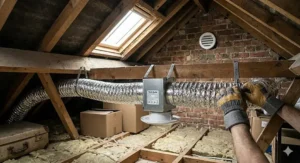
Step 1 — Plan your duct run. The inline fan sits in the loft or ceiling void, ideally as close to the external wall as practical. Every 90-degree bend in the ducting adds roughly the equivalent resistance of 1.5 metres of straight duct — keep the run short and bends minimal. Use rigid ducting where possible; flexible aluminium ducting is convenient but significantly increases resistance over longer runs.
Step 2 — Position your inlet grille. This is the visible part inside the bathroom — a flush-mounted ceiling grille. Because the fan motor is remote, the grille can sit directly above the shower or bath if that’s where the steam is worst, regardless of IP zone restrictions. The motor itself, positioned in the loft, stays safely out of any hazardous zone.
Step 3 — Connect the fan electrically. Most inline fans require a permanent live, switched live, and neutral connection (plus earth) for timer functionality. Your electrician will run this from the bathroom light circuit. If you’re using the standard (no-timer) model, the wiring is simpler.
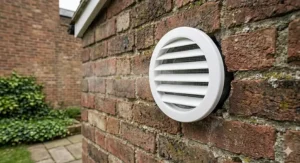
Step 4 — Terminate externally. The duct exits the property via a louvred or mushroom vent, typically under the eaves. Use a quality external grille with a flyscreen — British insects do find their way into ducting, particularly during summer months, and the result is unpleasant.
Step 5 — Commission and set the timer. Most timer models allow you to set the run-on delay (typically 2–20 minutes) via an internal pot. Set it longer rather than shorter — a bathroom that runs the fan for 15 minutes after a shower dries out far more effectively than one that cuts off at 5 minutes, saving your ceiling plasterwork over the long term.
A note on duct insulation: in an uninsulated loft, condensation can form inside the duct during winter. Insulating the duct run with standard 25mm foam duct insulation is cheap insurance against this — and is particularly relevant in northern England and Scotland where loft temperatures regularly drop below 0°C between December and February.
Real-World Scenarios: Which Fan Suits Your Situation?
British homes are wonderfully varied in their bathroom ventilation challenges. Here are three realistic UK scenarios, with honest recommendations for each.
Scenario 1 — The Leeds Terraced House. A 1930s back-to-back with a first-floor bathroom that has no external wall. Duct run is approximately 4 metres to the nearest eaves exit, with two 45-degree bends. The bedroom ceiling is immediately below the loft floor, so noise is a significant concern. Recommendation: Fantronix 100mm inline fan. The 21 dB(A) noise level means the fan is inaudible from the bedroom below, and 187 m³/hr is comfortably adequate for a standard 4m² bathroom at moderate use.
Scenario 2 — The New-Build Flat in Bristol. A three-bedroom apartment built in 2021, requiring full Part F compliance. The ensuite bathroom generates significant steam (one long-distance runner and one daily bather in residence). The building management expects documentation of compliance. Recommendation: Vent-Axia ACM100T. The galvanised steel construction, commercial-grade motor protection, and provenance of a decades-old British ventilation brand will satisfy any building control officer. The premium cost is well justified against the regulatory peace of mind.
Scenario 3 — The Edinburgh Victorian Semi. A bathroom with an existing 100mm duct that runs five metres to the eaves, through an uninsulated loft where temperatures can drop to -8°C in January. The existing axial fan struggles to pull sufficient air against the duct resistance, resulting in persistent condensation on the ceiling. Recommendation: Manrose MF100T. The three-speed setting and 245 m³/hr maximum output overcome the higher resistance on the longer duct run. Operating down to low temperatures with ball-bearing motor reliability, it will handle a Scottish winter without complaint.
Inline Fan vs. Standard Axial Fan: What the Spec Sheet Won’t Tell You
| Feature | Inline Fan | Standard Axial Fan |
|---|---|---|
| Airflow capacity | 185–300+ m³/hr typical | 70–120 m³/hr typical |
| Noise level | 21–30 dB(A) | 30–45 dB(A) |
| Position in bathroom | Hidden in loft/ceiling void | Visible on wall or ceiling |
| Zone restrictions | Motor remote from IP zones | Must comply with IP zone rules |
| Duct run suitability | Excellent for 3m+ runs | Poor beyond 1.5m |
| Installation complexity | Higher (requires loft access) | Lower (direct wall install) |
| Price | £30–£100 | £20–£60 |
| Best for | Long duct runs, noise-sensitive homes | Simple installations, external walls |
The headline from this comparison: inline fans deliver roughly three times the airflow of a standard axial fan while typically producing less noise — a combination that seems almost implausible until you understand that the noise reduction comes simply from moving the motor away from the living space. The downside, of course, is that you need a ceiling void or loft to install into. If your bathroom is on the ground floor of a property with a concrete slab above it, an inline fan isn’t an option.
According to Wikipedia’s overview of mixed-flow fans, mixed-flow impeller design achieves higher static pressure than axial types at similar flow rates — which is the technical reason inline fans handle longer duct runs so much more effectively than their wall-mounted counterparts.
UK Regulations, Safety Standards & What You Actually Need to Know
Ventilation regulation in the UK is less alarming than it sounds once you understand what it’s actually asking for. Approved Document F of the UK Building Regulations sets out the minimum requirements:
- Bathrooms with WC: 15 litres per second (54 m³/hr) intermittent extract, or 8 l/s continuous with boost capability
- Bathrooms without WC: 15 l/s intermittent
Every inline fan on this list exceeds those figures with substantial headroom. But regulations are only part of the picture. Here’s what else matters:
IP Ratings and Bathroom Zones. The motor of an inline fan — being located in the loft rather than the bathroom — does not need to comply with IP zone restrictions in the same way a wall-mounted fan does. The ceiling grille does, however, and should be rated at least IPX4 (protection against water splashes). Most quality inline fan kits specify this.
Part P Electrical Safety. All electrical work in a bathroom must be carried out by a qualified electrician or notified to your local Building Control. This isn’t optional. As noted by the Health and Safety Executive, unqualified electrical work in wet areas is a significant safety risk and can affect both home insurance and mortgage surveys.
BS 5250:2021. This British Standard governs the management of moisture in buildings and underpins much of the practical guidance around bathroom ventilation. Meeting Part F minimum rates is a legal requirement; understanding BS 5250 tells you what actually works in practice — particularly relevant in British homes where construction tends toward lower air permeability than buildings in drier climates.
UKCA Marking. Post-Brexit, UK-sold electrical products should carry UKCA marking (replacing the old CE marking) confirming conformity with UK safety standards. Established brands such as Manrose, Vent-Axia, and Devola all carry appropriate certification. Cheaper imports from less well-known sources may not — worth checking before purchase.
How to Choose the Right Inline Bathroom Extractor Fan: 6 Practical Steps
- Measure your duct run. Every additional metre of duct and every bend reduces effective airflow. For a run longer than 3 metres or with more than two bends, choose a fan rated at least 220 m³/hr.
- Check your loft space. Inline fans need to be accessible for maintenance. If your loft is boarded and tight, consider the Fantronix’s compact dimensions before committing to the larger Manrose or Vent-Axia footprint.
- Assess your noise requirements. If a bedroom sits directly below the loft, spend the extra on the Fantronix 21 dB(A) or Manrose 24 dB(A). For a detached property with a deep loft, the extra decibels of a budget option are less consequential.
- Decide on control method. Light-switch timers suit most households. Continuous ventilation (required in some new builds) needs either a continuous-rated fan or a humidistat/MVHR integration. Smart home users may prefer a fan with no built-in timer, controlled externally.
- Confirm your wiring. Timer functionality requires three wires at the fan position (permanent live, switched live, neutral). Some older properties only have two. Know what you have before specifying a timer model.
- Consider longevity. A fan you replace in four years costs more than a fan that lasts twelve. The Manrose three-year warranty, Vent-Axia steel build, and Devola British manufacture all represent considered long-term investments in a British climate that will stress any mechanical ventilation system.
✨ Ready to Upgrade Your Bathroom Ventilation?
🔍 Don’t let another winter of bathroom condensation and ceiling mould make the decision for you. Click on any highlighted product above to check current pricing and availability on Amazon.co.uk — many are Prime-eligible for next-day delivery. Your future self, with a dry ceiling and a mould-free grout line, will be quietly appreciative.
Common Mistakes When Buying an Inline Bathroom Extractor Fan
Choosing by price alone. A fan that costs £18 from a seller you’ve never heard of may seem tempting, but without verifiable UKCA marking or any meaningful warranty, you’re essentially installing an untested electrical device in a moisture-rich environment. The marginal saving is rarely worth it.
Ignoring duct resistance. This is the single most common installation error. A fan rated at 245 m³/hr in free air might deliver only 150 m³/hr by the time the airflow has negotiated five metres of flexible ducting and three bends. Use the fan’s performance curve (available in technical datasheets from any reputable manufacturer’s website) to verify performance at your specific static pressure.
Fitting flexible ducting for the entire run. Flexible aluminium ducting is convenient, but every metre of flex adds significantly more resistance than rigid duct. Use rigid ducting for the bulk of the run and flexible sections only for the final connections at either end.
Assuming bigger is always better. A 150mm (6″) inline fan in a small bathroom en suite isn’t a smart upgrade — it’s a drain on electricity and, at higher speeds, considerably noisier than a correctly sized 100mm unit. Match the fan to the room, not to an instinct about power.
Forgetting to insulate the duct in the loft. Condensation inside the duct causes water to back up into the fan motor or drip through the ceiling grille. A £8 roll of duct insulation prevents a problem that some homeowners spend years blaming on a “bad fan.”
Buying a non-timer model for a bathroom with no windows. Under Building Regulations, a windowless bathroom requires a fan with an overrun timer (or humidity control). Check your room before you specify.
Frequently Asked Questions
❓ Can I install an inline bathroom extractor fan myself in the UK?
❓ What extraction rate do I need to meet UK Building Regulations?
❓ How quiet is an inline bathroom extractor fan compared to a standard fan?
❓ Do inline extractor fans work in lofts that get very cold in winter?
❓ Can I use an inline fan to ventilate more than one bathroom at once?
Conclusion: The Right Fan Makes All the Difference
An inline bathroom extractor fan is one of those home improvements that you never really think about until you have one — and then wonder how you managed without it. Quiet, powerful, invisible, and genuinely effective at protecting your bathroom ceiling, walls, and structural fabric from the relentless British tendency toward moisture, the best inline fans deliver a quality of extraction that no wall-mounted unit can match.
For most UK buyers, the Manrose MF100T remains the benchmark: powerful, quiet, reliably warranted, and excellent value in the £40–£60 range. If noise is paramount, spend a little less on the Fantronix and enjoy the 21 dB(A) silence. For new builds demanding regulatory rigour, the Vent-Axia ACM100T justifies its premium. And if Made-in-Britain matters to you — which frankly it ought to, given the support it provides to domestic manufacturing — the Devola DVILF100T is a considered, quality choice.
Whatever you choose, choose correctly. A well-specified and properly installed inline fan will protect your bathroom for a decade. A poorly chosen one will be sitting in a skip before the first condensation season ends.
✨ Still Not Sure Which One?
🔍 Use our comparison table above and the six-step buyer’s guide to narrow it down. Then click through to Amazon.co.uk to check current pricing, Prime availability, and the latest UK customer reviews. A decision this straightforward shouldn’t take longer than five minutes.
Recommended for You
- Best Bathroom Ceiling Extractor Fan UK 2026: 7 Top Picks
- 7 Best Bathroom Fan with Humidity Sensor UK 2026 — Stop Mould Before It Starts
- Best Quiet Bathroom Extractor Fans UK 2026: 7 Top Picks
Disclaimer: This article contains affiliate links. As an Amazon Associate, I earn from qualifying purchases. If you purchase products through these links, we may earn a small commission at no additional cost to you.
✨ Found this helpful? Share it with your mates! 💬🤗
