
In This Article
There’s a very British kind of denial that goes: “It’ll be fine. I’ll just leave the window cracked.” And then, three months later, you’re scrubbing black patches off your ceiling with a mix of bleach, regret, and the grim suspicion that you really should have sorted this in February.
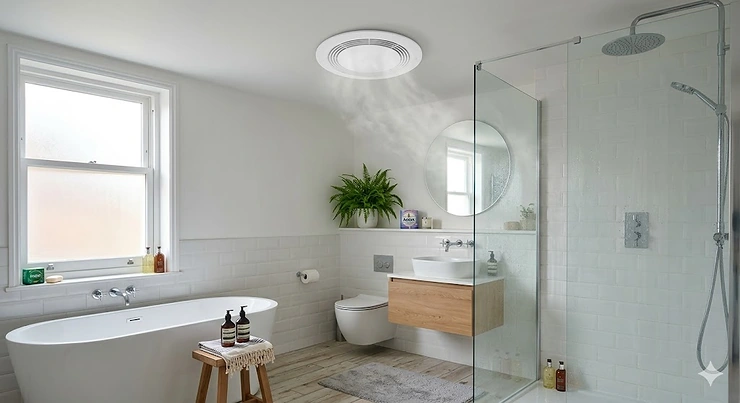
A bathroom extractor fan isn’t glamorous. It won’t make your bathroom look like a spa in a glossy interiors magazine. But in a country where the air outside is already at 80% humidity on a good Tuesday, proper bathroom ventilation fan isn’t optional — it’s the difference between a bathroom and a petri dish.
In short: a bathroom extractor fan is a mechanically driven ventilation device that removes steam, moisture, and odours from your bathroom by drawing air out through ducting to the exterior. The best ones do this so quietly you forget they’re running. The worst ones sound like a hovercraft launching from your loft.
This guide cuts through the noise (sometimes literally) to bring you seven genuinely excellent options available on Amazon.co.uk right now — from tight-budget basics to whisper-quiet premium units — along with everything you need to choose wisely, install correctly, and avoid the mistakes most people make. Let’s crack on.
Quick Comparison: Best Bathroom Extractor Fans at a Glance
| Model | Type | Noise Level | Extraction Rate | Best For | Price Range |
|---|---|---|---|---|---|
| Vent-Axia Silent (446659B) | Axial | ~25 dB | 26 l/s | Bedrooms, en-suites | £55–£70 |
| Xpelair Simply Silent C4TS | Axial + Timer + Humidistat | 23 dB | 22 l/s | Rental properties, families | £35–£50 |
| Envirovent Silent 100 | Axial | ~28 dB | 90 m³/h | Contemporary bathrooms | £40–£55 |
| Airflow iCON 15 | Axial (modular) | 26 dB | 53 m³/h | Tech-savvy homeowners | £60–£85 |
| Manrose XF100S | Axial | 37 dB | 22 l/s | Budget installs, rentals | £15–£25 |
| Vent-Axia Lo-Carbon Revive | dMEV (continuous) | ~25 dB | 6–22 l/s | Eco-builds, airtight homes | £70–£95 |
| VENTS Silenta 100 | Axial | ~30 dB | 97 m³/h | Small bathrooms, en-suites | £20–£35 |
The table above tells an interesting story. Notice how the price jump from budget to mid-range (roughly £20 to £50) nets you a massive leap in quietness — from 37 dB down to 23 dB. That’s not a marginal improvement; 37 dB sounds like a distant conversation, while 23 dB is closer to rustling leaves. If your bathroom shares a wall with a bedroom, that difference matters enormously. The Vent-Axia Lo-Carbon Revive stands apart from the rest: it’s a continuous low-level unit (dMEV) rather than an intermittent fan, which suits newer, more airtight homes better — but more on that when we get to the regulations section.
💬 Just one click — help others make better buying decisions too! 😊
✨ Don’t Miss These Exclusive Deals!
🔍 Take your bathroom ventilation to the next level with these carefully selected products. Click on any highlighted item to check current pricing and availability on Amazon.co.uk. These picks will help you find exactly what you need!
Top 7 Bathroom Extractor Fans: Expert Analysis
1. Vent-Axia Silent (446659B) — Best Overall
Vent-Axia has been making ventilation products in the UK since 1936, and the Silent range is arguably their finest hour. The 446659B operates at around 25 dB — genuinely impressive for an axial fan — and delivers an extraction rate of 26 litres per second, comfortably exceeding the 15 l/s minimum required by Building Regulations Approved Document F for bathrooms with a bath or shower.
What most UK buyers overlook about this model is how it handles backdraught. The integrated backdraught shutter prevents cold air sneaking back in when the fan’s off — a feature you’ll appreciate keenly during a February morning in Manchester or Edinburgh. It runs on 230V with a standard UK Type G plug configuration and carries UKCA marking for post-Brexit compliance.
This fan is ideal for anyone whose bathroom sits adjacent to a bedroom, or for families with light-sleeper children who’d wake at the sound of a standard fan. UK reviewers consistently praise its build quality and the near-silent running even after years of use. It isn’t the cheapest option, but it’s the one you won’t need to replace in 18 months.
✅ Near-silent 25 dB operation
✅ Exceeds Part F extraction requirements
✅ Backdraught shutter included
❌ No built-in humidistat or timer (sold separately)
❌ Premium price point
Price range: £55–£70 — excellent value for long-term, hassle-free performance.

2. Xpelair Simply Silent C4TS — Best with Timer & Humidistat
Don’t underestimate the Xpelair Simply Silent C4TS simply because it’s more modestly priced. At 23 dB, it’s actually the quietest fan in this entire roundup — a remarkable achievement at this price point. The “TS” suffix means it includes both a timer function and a humidity sensor (humidistat), and this combination is quietly transformative.
Here’s why the humidistat matters in British conditions: our bathrooms generate steam in concentrated bursts, particularly during the seven-minute showers that seem to be a national sport. A basic fan tied to your light switch stops the moment you flick it off — leaving residual moisture to settle on your ceiling tiles. The humidistat keeps the Xpelair running until actual moisture levels drop to a safe threshold, typically another 10–20 minutes after the shower ends. That’s not a luxury feature; it’s what prevents the mould.
The extraction rate of 22 l/s meets Part F requirements and the 100mm spigot fits standard UK ducting without any adaptors. Landlords in particular take note: the automatic humidity-triggered operation means tenants don’t need to remember anything, which substantially reduces your damp-and-mould liability — a concern increasingly relevant under Awaab’s Law, which came into force for social housing and is influencing wider property standards.
✅ Quietest fan tested at 23 dB
✅ Built-in timer AND humidistat
✅ Excellent value for features offered
❌ Plastic housing feels slightly less premium than Vent-Axia
❌ Humidistat sensitivity can’t be user-adjusted
Price range: £35–£50 — the best all-round value in the mid-range.
3. Envirovent Silent 100 (SILENT100) — Best for Contemporary Interiors
EnviroVent’s Silent 100 has earned a dedicated following among UK bathroom designers and self-builders, and it’s not hard to see why. The sleek, low-profile cover sits flush against wall or ceiling with a distinctly European aesthetic that doesn’t scream “extraction appliance.” In smaller bathrooms — the kind of compact wet rooms increasingly common in UK city flats — visual discretion genuinely counts.
Performance-wise, it shifts around 90 m³/h (roughly 25 l/s), and the 28 dB noise level is low enough to be masked by a running shower. EnviroVent is a British company — based in Harrogate, Yorkshire — and their products are engineered specifically for UK housing stock, meaning the ducting dimensions, volt ratings, and installation assumptions all reflect what you’ll actually find in a British semi-detached or Victorian terrace rather than a German new-build.
UK reviewers highlight how straightforward the installation is, particularly the wide-opening cover that provides excellent wiring access. A point worth noting: EnviroVent offer a UK-based customer helpline, which matters more than you might think when you’re halfway through an installation on a Sunday afternoon.
✅ Attractive, unobtrusive design
✅ 28 dB — genuinely quiet
✅ UK-manufactured, excellent domestic support
❌ Slightly lower extraction rate than Vent-Axia Silent
❌ No humidistat on base model
Price range: £40–£55 — a smart choice when aesthetics are a priority.
4. Airflow iCON 15 — Best Modular Fan
The Airflow iCON 15 is the Swiss Army knife of bathroom extractor fans. Its genius lies in a modular design: you buy the base unit and then snap on whichever control module suits your bathroom — timer, humidistat, PIR presence sensor, or simple on/off. It’s a particularly clever approach if you’re equipping multiple properties or if your needs might evolve (renting a property out in future, for instance, when automatic controls become essential).
At 26 dB and a 53 m³/h extraction rate, the iCON 15 sits comfortably in the “quiet and capable” bracket. The cover options — white, chrome, and a slimline fascia — mean it’s versatile enough for both a modern wet room and a more traditional bathroom. Airflow is another British brand (based in Doncaster), so spare parts are readily available through UK merchants.
The modular aspect does introduce one practical consideration: the control modules are sold separately, which means the initial price on Amazon.co.uk looks very reasonable until you factor in the sensor. Budget accordingly. That said, the ability to retrofit a humidistat without replacing the entire fan unit is genuinely useful.
✅ Modular — add controls without replacing unit
✅ Multiple cover styles available
✅ Strong UK parts availability
❌ Control modules sold separately — budget carefully
❌ Slightly lower extraction rate than some competitors
Price range: £60–£85 with control module — justified by long-term flexibility.
5. Manrose XF100S — Best Budget Option
Right, let’s be honest about the Manrose XF100S: it’s noisy. At 37 dB, it’s the loudest fan in this roundup by a considerable margin. But here’s the thing — sometimes noise isn’t actually a problem. In a downstairs cloakroom. In a laundry room. In a rental property where tenants actively need reminding that the fan is running. In contexts like these, the Manrose is a solid, reliable, genuinely affordable workhorse.
The extraction rate of 22 l/s meets Part F compliance, the ABS thermoplastic housing is durable enough to withstand a busy family bathroom, and installation is about as simple as extractor fan installation gets — the light-switch-triggered operation means just two wires to connect. UK electricians and tradespeople regularly recommend it for straightforward jobs where cost is the overriding factor.
What you must not do is install it in a bathroom adjacent to a bedroom and expect comfortable nights. The spec sheet won’t tell you this, but the noise profile of the XF100S carries through standard partition walls better than quieter fans. Save it for the contexts where it belongs.
✅ Very affordable entry price
✅ Simple installation (light switch operation)
✅ Durable ABS construction
❌ 37 dB is noticeably loud
❌ No timer or humidistat option
Price range: £15–£25 — unbeatable for budget-conscious or secondary installations.
6. Vent-Axia Lo-Carbon Revive — Best for Eco & New-Build Homes
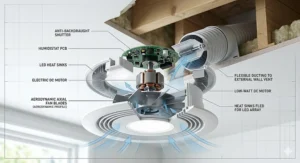
The Lo-Carbon Revive is a fundamentally different beast to the other fans here — it’s a dMEV (decentralised Mechanical Extract Ventilation) unit designed for continuous low-level operation, not the burst-and-stop approach of a standard intermittent fan. The EC motor (electronically commutated) cuts energy consumption by up to 80% compared to conventional AC motors; run it continuously for a year and the electricity cost is genuinely negligible.
Why does this matter? The updated Approved Document F, with a 2026 edition now published, increasingly steers new builds and deep retrofits toward continuous low-level ventilation strategies rather than intermittent extraction, particularly in more airtight dwellings. If you’re renovating a loft conversion, installing in a passive house, or your property has been re-insulated and draught-proofed to modern standards, the Lo-Carbon Revive is the appropriate tool. In a draughty Victorian terrace, an intermittent fan remains perfectly compliant and more cost-effective to buy.
The fan boosts automatically when it detects humidity, so you still get that powerful extraction during a shower. UK self-builders and eco-renovators consistently rate it highly.
✅ EC motor — ultra-low running costs
✅ Continuous + boost mode (Part F compliant for airtight dwellings)
✅ Future-proofed for tighter building regulations
❌ Higher upfront cost
❌ Overkill (and underpowered) for older draughty homes
Price range: £70–£95 — the right investment if your home is modern or well-insulated.
7. VENTS Silenta 100 — Best Compact Budget-Friendly Option
VENTS is a Ukrainian-founded European brand with strong UK distribution, and the Silenta 100 punches above its weight for the price. At around 97 m³/h extraction rate, it moves considerably more air than its modest price suggests, and the light switch activation makes installation genuinely straightforward. The 157 × 159 mm outer dimensions make it one of the more compact covers available — useful in small en-suites where wall tiles leave little room for error.
Noise sits at around 30 dB, which is acceptable for most bathrooms, and the 99mm spigot diameter connects to standard UK ducting without adaptors. Available on Amazon.co.uk with Prime delivery, it’s a pragmatic choice for anyone who needs a competent, compliant extractor fan without the premium price tag but wants slightly better noise performance than the Manrose.
✅ High extraction rate for the price
✅ Compact dimensions for small spaces
✅ Available with Prime next-day delivery
❌ Build quality doesn’t match British brands like Vent-Axia
❌ Limited accessories/controls available
Price range: £20–£35 — strong value for a secondary or en-suite installation.
Installing & Maintaining Your Bathroom Extractor Fan: A Practical UK Guide
Getting the Installation Right
The single most common installation mistake in UK bathrooms — and it’s painfully common — is incorrect ducting. Running ducting with excessive bends, insufficient falls, or the wrong diameter will strangle airflow regardless of how good your fan is. Most 100mm axial fans are designed for duct runs of up to 3 metres with no more than two 90-degree bends. Beyond that, you’re fighting physics, and the fan will lose meaningful extraction capacity.
In terms of positioning, Approved Document F is clear: extract ventilation terminals should be installed “as high as practicable in the room” and “a maximum of 400mm below the ceiling.” In practice, this usually means ceiling mounting or a high wall position — not above the door where the lowest, coldest air collects.
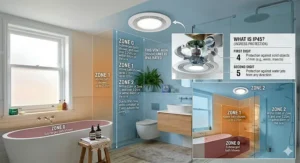
UK electrical zones matter enormously. Zone 1 (directly above the bath or shower to 2.25m height) requires SELV (Separated Extra Low Voltage) fans — the Vent-Axia Lo-Carbon Revive SELV version and Airflow iCON 30 are designed for this. Standard mains-voltage fans (the majority in this guide) are suitable for Zone 2 (60cm outside the bath rim, or above 2.25m over Zone 1) and outside zones. When in doubt, consult a Part P registered electrician — bathroom electrical work is notifiable work in England and Wales.
Maintenance Schedule
Unlike your boiler, a bathroom extractor fan requires almost no maintenance — but “almost” is doing some heavy lifting there. Every 3–6 months, remove the cover grille and wipe down the fan blades with a dry cloth. Dust accumulation on the impeller is the primary cause of premature motor failure and reduced airflow. For fans with humidity sensors, a quick clean of the sensor port prevents false readings. That’s genuinely about it.
Real-World Scenarios: Which Fan for Which British Home?
The London flat-sharer (Zones 1–3, compact en-suite): You’re in a conversion flat in Hackney, your bathroom is roughly 3.5 m², and the wall you share with the next flat is about as acoustically impressive as a sheet of cardboard. The Xpelair Simply Silent C4TS is your fan. It’s the quietest option at 23 dB, the humidistat means it keeps running after your housemates have shuffled off to work, and the timer prevents arguments about whose fault the damp patch is.
The family home in the Manchester suburbs (main bathroom, heavy use): A standard semi-detached with a family of four means a bathroom that sees eight or more showers daily in winter. Volume and reliability matter here. The Vent-Axia Silent (446659B) handles continuous heavy use without complaining, its 26 l/s extraction manages even the steamiest teenage shower session, and it’s quiet enough not to wake the baby in the adjacent nursery at 6am.
The eco self-builder in Herefordshire (new-build, airtight): New-build with MVHR throughout, but a standalone bathroom that needs its own dedicated extract — the Vent-Axia Lo-Carbon Revive is the correct technical choice here. It integrates with an airtight building envelope, its EC motor aligns with your energy targets, and it meets the continuous ventilation requirements increasingly expected of well-insulated properties.
The landlord with three rental properties in Birmingham: Buy seven Xpelair C4TS units and never think about it again. The humidity sensor means tenants don’t need to be reminded to use the fan (they won’t be), and the combination of competitive pricing and solid reliability makes the maths straightforward.
How to Choose a Bathroom Extractor Fan in the UK: 7 Key Criteria
Choosing the right bathroom ventilation fan is less complicated than the spec sheets suggest — if you know which five numbers actually matter and which are marketing noise.
1. Extraction rate (l/s or m³/h): The legal minimum for a bathroom with a bath or shower is 15 l/s (54 m³/h) under Approved Document F. Don’t buy anything below this. Bigger bathrooms or longer duct runs warrant going higher — 20–26 l/s is the sweet spot for a standard UK bathroom.
2. Noise level (dB): Below 25 dB is genuinely quiet. 25–30 dB is noticeable but tolerable. Above 35 dB is intrusive in a bedroom-adjacent bathroom. Take this number seriously.
3. Controls — timer, humidistat, or basic? Basic (light switch) is fine for cloakrooms and utility rooms. A timer is useful anywhere. A humidistat is the smart choice for family bathrooms and rental properties. PIR sensors work brilliantly in shared houses.
4. IP rating: Zone 1 requires IPX5 minimum; Zone 2 requires IPX4 minimum. Outside zones, standard fans are fine. Check the zone your installation point falls in.
5. Duct diameter: 100mm is standard for residential bathrooms. If your existing ducting is 100mm, almost any fan in this guide will fit. Larger bathrooms with long duct runs may benefit from 125mm.
6. UKCA or BS marking: Post-Brexit, UKCA marking is the relevant conformity standard for Great Britain (Northern Ireland retains CE marking under the Windsor Framework). The fans in this guide are all compliant — but if you’re buying from a lesser-known brand, check.
7. Energy efficiency: The EC motor in the Vent-Axia Lo-Carbon Revive uses around 2W on continuous; a standard axial fan uses 8–15W when running. Over five years of operation, this adds up meaningfully on your electricity bill.
Common Mistakes British Buyers Make (And How to Avoid Them)
Buying on noise rating alone without checking extraction rate. Some ultra-quiet fans achieve their silence by simply moving less air. Always verify the l/s figure meets 15 l/s minimum — a silent fan that doesn’t meet Part F compliance is worse than no fan at all, because it gives a false sense of security while moisture quietly destroys your ceiling.
Ignoring ducting length. A premium fan running through 5 metres of 100mm flexible ducting with three bends will underperform a budget fan with a short, straight duct run. Fan performance ratings are measured in ideal conditions; real-world installations are rarely ideal.
Buying a US-specification fan. This sounds laughably obvious until you’ve seen the Amazon listings. Some fans sold on Amazon UK marketplaces are shipped from EU or US warehouses and carry 110V or 220V/60Hz ratings incompatible with UK 230V/50Hz supply. Always confirm 230V/50Hz compatibility and a UK Type G plug or wiring configuration.
Neglecting bathroom zones for IP ratings. Installing a standard IPX2 fan above a shower tray is both unsafe and potentially invalidates your home insurance. This is the one area where cutting corners has direct safety consequences. According to NHS guidance on home safety, electrical faults in bathrooms remain a leading cause of domestic accidents in the UK.
Forgetting to notify building control. New fan installations (not like-for-like replacements) may require notification to your local authority building control under Part F and Part P of the Building Regulations. It’s rarely a complex process, but skipping it can complicate home sales and insurance claims.
UK Regulations & What They Actually Mean for You
Bathroom ventilation in England and Wales is governed by Approved Document F of the Building Regulations, which has a new 2026 edition now published. The headlines for homeowners: bathrooms with a bath or shower must provide intermittent extract ventilation at a minimum of 15 l/s, fans must be installed as high as practicable and within 400mm of the ceiling, and in rooms without openable windows, the fan must run for at least 15 minutes after the room is vacated.
Scotland operates under separate Scottish Building Standards, which carry similar requirements but differ in detail — Scottish homeowners should check Scottish Government Technical Handbooks rather than Approved Document F.
Northern Ireland operates its own Technical Booklets, again with broadly similar but distinct requirements. The Windsor Framework means Northern Irish consumers can continue using CE-marked products alongside UKCA-marked ones — useful context if you’re buying European brands.
The practical upshot of all this: any fan achieving 15 l/s or above, installed at high level, with appropriate IP rating for its zone, will satisfy UK regulations in the vast majority of domestic situations. All seven fans in this guide meet that threshold.
Features That Actually Matter (And the Ones That Don’t)
Actually matters:
- Extraction rate (hard minimum: 15 l/s)
- Noise level if bedroom-adjacent
- Humidistat if in rental or family use
- IP rating relative to bathroom zone
- Backdraught shutter (prevents cold draughts in winter — hugely underrated)
Sounds impressive, rarely relevant for most homes:
- App connectivity / smart home integration — nice if you have a whole-house automation system; an expensive irrelevance otherwise
- Energy ratings beyond a certain point — the difference between a 6W and a 9W fan is roughly £1.50 per year
- “Designer” covers — they look nice in the showroom and exactly like a standard cover once installed
Marketing noise to tune out:
- “Patented technology” claims on ultra-cheap models
- 5-year warranties from brands with no UK support presence
- Extremely high m³/h claims that aren’t accompanied by noise level figures (fast usually means loud)
✨ Don’t Miss These Exclusive Deals!
🔍 Ready to banish bathroom damp for good? Click any highlighted product above to check current pricing and availability on Amazon.co.uk — Prime members get free next-day delivery on most of these picks!

Frequently Asked Questions
❓ Do I legally need a bathroom extractor fan in the UK?
❓ What extraction rate do I need for a UK bathroom extractor fan?
❓ How do I stop my bathroom extractor fan from making the room cold?
❓ Can I install a bathroom extractor fan myself in the UK?
❓ Are bathroom extractor fans noisy? What's a good dB rating?
Conclusion: Stop Ignoring Your Bathroom Ceiling
Mould is not a lifestyle aesthetic. Damp in UK bathrooms costs homeowners an estimated hundreds of millions of pounds annually in remediation, redecorating, and — in the worst cases — structural repairs. The right bathroom extractor fan won’t solve all of that, but it will solve most of it. Quietly. Automatically. Possibly without you noticing it’s even doing anything until the day you visit a friend’s bathroom and realise you haven’t had to scrub a ceiling in three years.
For most UK buyers, the Xpelair Simply Silent C4TS remains the single best value recommendation: it’s the quietest in its class, includes both timer and humidistat, and costs a fraction of the premium options. If silence is paramount and budget allows, the Vent-Axia Silent 446659B is the one to buy. Eco-builders and new-build homeowners should take a serious look at the Vent-Axia Lo-Carbon Revive for its continuous EC motor operation and future-proof compliance posture.
Whatever you choose, check that it meets 15 l/s extraction, confirm the appropriate IP rating for your installation zone, and please — please — fit a backdraught shutter. Your February self will thank you.
✨ Don’t Miss These Exclusive Deals!
🔍 Ready to upgrade your bathroom ventilation? Click any highlighted product in this guide to check current pricing and availability on Amazon.co.uk. Amazon Prime members enjoy free next-day delivery — your drier, fresher bathroom is one click away.
Recommended for You
- Best Wall Mounted Conservatory Fan UK 2026: Top 7 Picks
- 7 Best Portable Conservatory Fan UK 2026
- Best Oscillating Fan for Conservatory: 7 Top UK Picks 2026
Disclaimer: This article contains affiliate links. As an Amazon Associate, I earn from qualifying purchases. If you purchase products through these links, we may earn a small commission at no additional cost to you.
✨ Found this helpful? Share it with your mates! 💬🤗
