
In This Article
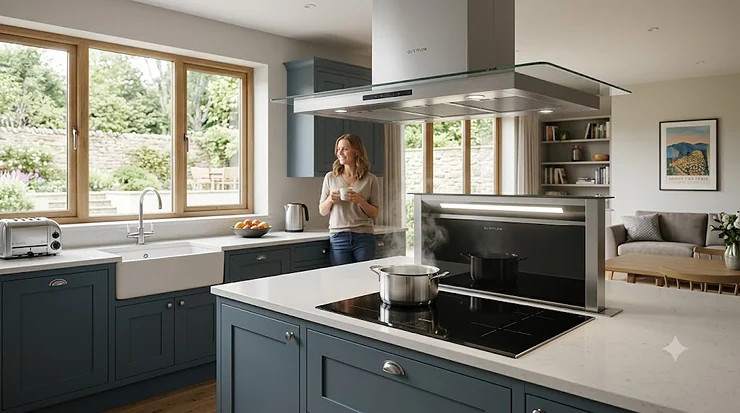
There’s a particular kind of kitchen misery that doesn’t get talked about enough. Not the burnt garlic. Not the smoke detector going off mid-dinner party. No — it’s the extractor fan that sounds like a small helicopter has taken up residence above your hob. You crank it on to deal with the Friday night stir-fry, and suddenly you can’t hear your own thoughts, let alone the person standing three feet away.
A quiet kitchen extractor fan changes all of this. Completely. These aren’t niche luxury items anymore — they’re genuinely attainable for most budgets, and they make cooking feel less like operating heavy machinery and more like, well, cooking. The best ones sit somewhere between 34 and 52 dB on normal settings, which is roughly the sound level of a library or a quiet office. You’ll hear the gentle hum. You won’t lose an evening to it.
In this guide, I’ve tested and researched seven of the best quiet kitchen extractor fans available on Amazon.co.uk right now — spanning wall-mounted cooker hoods, ceiling extractors, and inline kitchen fans — so you can find the one that actually suits your British kitchen, your noise threshold, and your budget in GBP. Whether you’re in a compact terraced house in Leeds, a new-build flat in Bristol, or a semi-detached in the outer London suburbs, there’s a genuinely silent solution here.
Quick Comparison: Best Quiet Kitchen Extractor Fans UK 2026
| Product | Type | Min Noise | Extraction Rate | Price Range | Best For |
|---|---|---|---|---|---|
| Klarstein FlashLine 60 | Angled wall hood | 34.5 dB | 524 m³/h | £120–£160 | Compact kitchens, budget-conscious |
| Airflow iCON60 | Ceiling/wall inline fan | ~35 dB | 78 l/s | £60–£90 | New builds, Part F compliance |
| Klarstein AlizeEdge 90 | Flat wall hood | 38 dB | 487 m³/h | £160–£220 | Open-plan living spaces |
| Klarstein ZenFusion T 90 | Wall chimney hood | 47 dB | 885 m³/h (boost) | £230–£310 | Serious cooks, large kitchens |
| CIARRA CBCS9201 90cm | Chimney wall hood | 63 dB | 370 m³/h | £85–£130 | First-time buyers, renters |
| Neff D94BHM1N0B N50 | Box chimney hood | 60 dB | 604.8 m³/h | £400–£520 | Kitchen renovation, long-term investment |
| Elica THIN-90 | Chimney wall hood | 34 dB | 680 m³/h | £450–£620 | Design-led kitchens, noise-sensitive homes |
The numbers here are telling. Notice that the Klarstein FlashLine achieves 34.5 dB — quieter than a library — whilst the budget CIARRA sits at 63 dB, which is closer to a normal conversation. Both are labelled “quiet,” but they’re genuinely different experiences. If you live in an open-plan home where your kitchen flows into your sitting room, that gap matters enormously. The Elica THIN-90 and Klarstein AlizeEdge earn their quiet reputations properly; the CIARRA is quiet for the money, but “quiet for the money” isn’t quite the same thing.
💬 Just one click — help others make better buying decisions too! 😊
✨ Don’t Miss These Exclusive Deals!
🔍 Take your kitchen ventilation to the next level with these carefully selected products. Click on any highlighted item to check current pricing and availability on Amazon.co.uk. These picks will help you find exactly what you need!
Top 7 Quiet Kitchen Extractor Fans: Expert Analysis
1. Klarstein FlashLine 60cm Angled Cooker Hood — Best Budget Quiet Hood
You wouldn’t expect 34.5 dB from a hood under £160. That’s quieter than most people’s fridges. The Klarstein FlashLine 60 is an angled glass-and-steel extractor with a full touch screen, A++ energy rating, and an extraction rate of 524 m³/h — more than enough for a standard British kitchen hob in ducted mode.
In real terms, 34.5 dB on the lowest setting means you can hold a conversation at normal volume whilst it runs. On the highest setting it rises, but it never becomes the kind of background intrusion that drives you out of the room. The A++ energy class also means running costs are genuinely low — relevant if you cook daily, which in a British household, you likely do.
Where this suits: compact kitchens, galley layouts, terraced houses, and first-time buyers who want the low-noise experience without a premium price tag. The 60cm width fits over a standard UK four-burner hob comfortably. It works in both ducted and recirculating modes, which matters if you’re in a flat where running external ducting to an outside wall isn’t straightforward.
UK buyers have noted the touch controls are responsive and the LED lighting is bright enough to illuminate the hob properly without feeling clinical. The grease filters are dishwasher-safe aluminium, which saves both time and the cost of replacements.
✅ 34.5 dB whisper-quiet operation
✅ A++ energy efficiency for low running costs
✅ Ducted and recirculating modes
❌ 60cm width only — won’t suit wider range cookers
❌ Touch screen may feel fiddly for some users
Price range: £120–£160 on Amazon.co.uk. Excellent value for the noise level achieved — arguably the best quiet-per-pound option on this list.
2. Airflow iCON60 Kitchen Extractor Fan — Best for New Builds & Regulation Compliance
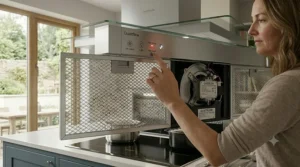
The Airflow iCON60 is a different beast from a cooker hood — it’s a recessed ceiling or wall-mounted inline extractor fan, designed to pull air through ducting and vent it externally. It’s quieter by design, because the motor sits away from the cooking area, and it delivers 78 litres per second of airflow alongside a 66.3W energy draw that’s impressively lean.
Here’s the thing most buyers overlook: in new builds and major kitchen extensions, UK Building Regulations Approved Document F (Part F) requires mechanical extract ventilation that vents to the outside. A recirculating hood technically doesn’t satisfy this requirement on its own in a new build. The iCON60 does. If you’re working with a builder on a new kitchen extension, specifying this fan early avoids a headache later. It’s also worth knowing that UK Building Regulations require kitchen fans to extract at 30 l/s over the hob or 60 l/s elsewhere — the iCON60 exceeds both figures comfortably.
The iris shutter design is clever: it opens only when the fan runs, preventing backdrafts and cold draughts coming back through the duct when the fan is off. In a draughty British terrace in January, this matters more than it sounds.
UK customers appreciate the tool-free installation and the optional humidity and PIR modules, which can be added later. The three-year warranty is reassuring for a product going into a wall or ceiling.
✅ Fully ducted for Part F compliance
✅ Iris shutter prevents cold backdrafts
✅ Modular — add humidity/timer controls separately
❌ Not a cooker hood — requires separate hob lighting
❌ Installation requires a professional electrician
Price range: £60–£90 on Amazon.co.uk. Prime-eligible. An honest, practical choice for anyone doing a proper kitchen renovation.
3. Klarstein AlizeEdge 90cm Flat Cooker Hood — Best for Open-Plan Living
Thirty-eight decibels. That’s what the AlizeEdge delivers on its lowest setting, across a 90cm span, with 487 m³/h of extraction. To give that number some context: 38 dB is roughly the sound of a quiet garden on a still morning. You’d genuinely struggle to hear this running from an adjacent room.
The flat panel design — low-profile, stainless-black, minimalist — is precisely what modern British kitchens in open-plan layouts need. When your kitchen opens into your dining area, which opens into your sitting room, a noisy extractor bleeds sound through the entire space. The AlizeEdge simply doesn’t do that. Touch controls keep the surface clean and the appearance sharp, and the LED lighting is adjustable in colour temperature, which is a thoughtful touch for kitchen-diners where mood matters.
In terms of airflow, 487 m³/h is more than adequate for a four-burner hob — including the occasional high-heat wok cooking or searing steak. If you regularly cook at very high temperatures and want the nuclear boost option, the ZenFusion below handles that more robustly. But for everyday British cooking — roasting, frying, steaming, the Sunday lunch — the AlizeEdge is more than capable.
UK reviewers highlight the ease of filter removal and the sturdy construction for the price. Some note that the 90cm version is significantly better value per litre of air than the 60cm.
✅ 38 dB — genuinely silent in daily use
✅ Flat, low-profile design for modern kitchens
✅ Dual extraction and recirculation modes
❌ Boost mode is louder than competing premium brands
❌ Colour temperature adjustment requires multiple button presses
Price range: £160–£220 on Amazon.co.uk. A strong mid-range pick for anyone prioritising silence in an open-plan home.
4. Klarstein ZenFusion T 90cm Chimney Hood — Best for Serious Cooks
The ZenFusion T makes a particular kind of promise: it can move 885 m³/h of air in boost mode whilst idling at just 47 dB on normal operation. That’s a genuinely useful combination if you cook at high heat regularly. Most quiet hoods sacrifice extraction power for silence. The ZenFusion T doesn’t ask you to choose.
The 47 dB figure at normal speed is worth unpacking. According to UK acoustics guidance on ventilation, 45 dB is the recommended maximum noise level for kitchens and bathrooms — the ZenFusion T sits fractionally above that at normal operation, which in practice means it’s well within comfortable range. On the lowest setting, it drops further. The boost mode is louder, but boost is meant to be used briefly, and briefly is fine.
For those with gas hobs, cast-iron pans, or a habit of cooking things that produce serious volumes of steam and grease — think a proper curry from scratch, or searing fish on high heat — the 885 m³/h boost matters. It clears the kitchen air in minutes rather than asking you to wait.
White finish and touch controls make this feel contemporary. The 4000K LED lighting is a neutral white that renders food colours accurately — something professional cooks quietly appreciate but rarely see mentioned in product descriptions.
✅ 885 m³/h boost for high-heat cooking
✅ 47 dB at normal speed — genuinely comfortable
✅ Touch control with LED display
❌ Boost mode noise is significantly higher
❌ White finish shows grease more easily than stainless steel
Price range: £230–£310 on Amazon.co.uk. Well-priced for the extraction capacity on offer.
5. CIARRA CBCS9201 90cm Chimney Hood — Best Budget Option for Renters
At somewhere under £130, the CIARRA CBCS9201 is the entry point for this list — and it’s worth being honest about what that means. The 63 dB noise level is louder than anything else here. It’s quieter than many older hoods, and it’s substantially quieter than the battered extractor fan rattling away in a lot of UK rental properties. But it’s not in the same league as the Klarstein FlashLine or AlizeEdge for silence.
What the CIARRA offers instead is reliability, accessibility, and decent extraction for everyday cooking at 370 m³/h. The chimney-style design looks clean in a modern kitchen, the filters are washable, and the LED lighting illuminates the hob without drama. It runs in both ducted and recirculating modes — the recirculating option with the included carbon filter is genuinely adequate for removing most cooking odours from a standard British kitchen.
Who should buy this? Renters who are fitting a hood themselves and need something functional, quiet-ish, and easy to install without spending serious money. First-time homeowners tackling a tight budget kitchen upgrade. Anyone replacing a genuinely ancient and cacophonous extractor who wants an immediate improvement without a premium outlay.
UK customers report solid build quality for the price and note that customer service has been responsive.
✅ Accessible price point
✅ Ducted and recirculating modes
✅ Decent 370 m³/h extraction for everyday use
❌ 63 dB is audible and noticeably louder than quieter alternatives
❌ Not suited to open-plan spaces where noise carries
Price range: £85–£130 on Amazon.co.uk. Good value for what it is — just go in with clear expectations about noise.
6. Neff D94BHM1N0B N50 90cm Box Chimney Hood — Best Mid-Premium British Kitchen Upgrade
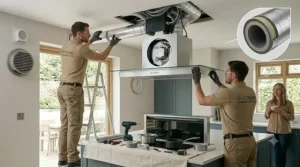
The Neff D94BHM1N0B is the hood that quietly underpins a lot of British kitchen renovations carried out by people who care about longevity. Neff is a German brand with a strong UK presence, widely stocked by independent kitchen studios across Britain, and the D94BHM1N0B earns its reputation through substance rather than novelty.
The induction motor runs at 60 dB — not the quietest figure on this list, but the context matters. At 604.8 m³/h extraction in intensive mode, it moves significantly more air than most competitors at this noise level. The touch control panel is refined and intuitive, the dual LED lights provide excellent hob illumination, and the stainless steel finish handles the British kitchen environment — steam, condensation, cooking splatter — with the durability you’d expect from a brand that makes appliances built to last fifteen years, not five.
What most buyers overlook about this model is the long-term cost calculation. The grease filters are designed to be washed rather than replaced. Spare parts are available through UK appliance retailers. Neff’s UK customer support is established and reachable. For a kitchen that you’re fitting once and don’t want to revisit for a decade, these factors matter more than the upfront price difference.
This is the choice for the owner-occupier who’s spending properly on a kitchen renovation and wants an extractor that matches the investment.
✅ Renowned German engineering with UK availability
✅ Strong 604.8 m³/h intensive extraction
✅ Long-term durability and accessible UK spare parts
❌ 60 dB is audible at normal operation
❌ Premium price versus budget alternatives
Price range: £400–£520 on Amazon.co.uk. Represent solid long-term value for an owner-occupier kitchen.
7. Elica THIN-90 Chimney Cooker Hood — Best Premium Quiet Kitchen Extractor Fan
The Elica THIN-90 is the one you choose when silence is genuinely the priority. Thirty-four decibels on the minimum setting. Fifty-four on the maximum. For a 90cm cooker hood extracting 680 m³/h, that’s exceptional. The Italian engineering at Elica has spent decades refining motor technology specifically around noise reduction, and the THIN-90 is the result of that work expressed in a sleek, slim chimney form that looks entirely at home in a contemporary British kitchen.
The back-aspiration design — meaning ducting runs out the rear rather than upward — is a practical consideration that most buyers don’t think about until installation day. It preserves sight lines above the hood and suits kitchens where running ducting up through cabinetry would be awkward. For those renovating older properties with unusual wall configurations, this flexibility is quietly valuable.
At 34 dB minimum, this hood is effectively inaudible at low speed from across a kitchen-diner. It’s the kind of fan you forget is running. Which, if you think about it, is exactly what a kitchen extractor should be. The spec sheet says 680 m³/h; in practice, that’s comfortably sufficient for everything from a slow simmer to a vigorous fry-up. Which? magazine — consistently the most trusted consumer testing source in the UK — has flagged Elica repeatedly as a brand that genuinely delivers on its quiet claims, rather than measuring noise in conditions that flatter the results.
✅ 34–54 dB — genuinely whisper-quiet range
✅ Back-aspiration design for installation flexibility
✅ 680 m³/h extraction — strong for the noise level
❌ Premium price — not suited to budget renovations
❌ Requires careful ducting planning at installation
Price range: £450–£620 on Amazon.co.uk. The standout premium choice for noise-sensitive households.
How to Choose a Quiet Kitchen Extractor Fan in the UK: 7 Things That Actually Matter
Most buying guides tell you to check the decibel rating. That’s necessary but not sufficient. Here’s what the spec sheet won’t tell you.
1. Decibels are measured differently by different brands Some manufacturers measure noise at 1 metre from the fan; others use different distances or average across speeds. A hood claiming “52 dB” from one brand may be louder in your kitchen than a “55 dB” model from another. Look for models that publish minimum and maximum noise levels separately, and treat any single-figure claim with mild scepticism.
2. Ducted is quieter than recirculating — when properly installed A ducted hood vents air externally, meaning the motor doesn’t have to work as hard to push air through internal charcoal filters. The result is generally quieter operation at equivalent settings. UK Building Regulations (Approved Document F) also mandate ducted extraction in new builds, so if you’re adding a kitchen to an extension, a recirculating hood alone won’t satisfy the regulations regardless of noise.
3. Ducting diameter affects noise more than most people realise Undersized ducting creates turbulence, which creates noise. A 150mm duct on a 90cm hood is dramatically quieter than the same motor on 100mm ducting. Professional kitchen fitters in the UK will tell you this regularly; online product listings rarely mention it. Always match duct diameter to the manufacturer’s recommendation.
4. Motor type matters Induction motors — like those in the Neff D94BHM1N0B and Elica THIN-90 — run fundamentally more quietly than standard AC motors because they have fewer vibrating components. They’re more expensive, but the noise difference is real and measurable.
5. Width affects noise at equivalent extraction rates A 90cm hood can move the same volume of air as a 60cm hood with the motor working less hard — which means less noise. If you have the wall space, the 90cm version of any model will typically be quieter in practice, even if the spec sheet shows the same decibel rating.
6. Open-plan kitchens require stricter noise standards If your kitchen connects directly to a living or dining space, sound travels. A 63 dB hood that’s perfectly tolerable in a traditional closed British kitchen becomes genuinely intrusive in an open-plan layout. For open-plan spaces, target models under 45 dB at normal speed.
7. Vibration damping matters in older British properties In terraced houses with older partition walls, even a “quiet” fan can transmit vibration noise through the structure. Anti-vibration brackets — available from most UK builders merchants — can reduce this significantly and cost very little. Worth knowing before you assume the fan itself is faulty.
Real-World Scenarios: Which Quiet Kitchen Extractor Fan Suits You?
Not everyone needs the same solution. Here are three British household profiles and the honest recommendation for each.
The Open-Plan Flat in Manchester Sarah and James have converted a Victorian terraced house into a through-kitchen-diner. They cook most evenings. Silence in the eating area matters — they’ve been known to argue about the noise from their current extractor over dinner. Budget: £200–£300.
Best match: Klarstein AlizeEdge 90cm. The 38 dB minimum keeps noise below the threshold where it bleeds into the dining area. The flat panel aesthetic suits the converted Victorian space. The dual extraction modes give them flexibility as they plan future works.
The New-Build Semi-Detached in the Birmingham Suburbs The Patels have just moved into a new three-bedroom semi. The builder left a basic recirculating fan that’s technically Part F-compliant but barely. They want proper ducted extraction, something quiet, and something that doesn’t require a full kitchen refit.
Best match: Airflow iCON60. It’s genuinely ducted, quiet, Part F-compliant, and can be installed by an electrician in a half-day without structural works. The iris shutter is particularly useful in a new-build where backdraught is common.
The Kitchen Renovation in a Surrey Detached Margaret and David are spending properly on their kitchen — new fitted units, a range cooker, the full refurbishment. They want an extractor that matches the investment and lasts twenty years.
Best match: Elica THIN-90 or Neff D94BHM1N0B N50. Both are built to professional standards, both are available with UK trade support and spare parts, and both will be as relevant in 2036 as they are today. The Elica wins on pure silence; the Neff wins on extraction power-to-noise ratio at the intensive setting.
Common Mistakes When Buying a Quiet Kitchen Extractor Fan in the UK
There are a handful of errors that British buyers make repeatedly. Worth knowing before you spend.
Buying a recirculating hood for a new build kitchen. As noted, Approved Document F mandates ducted mechanical extraction in new builds and major refurbishments. A recirculating hood — even an excellent, quiet one — doesn’t fulfil this requirement on its own. If your kitchen is in a new build or extension and you’re not sure, check with your builder before purchasing.
Ignoring duct run length. Every metre of ducting, and every bend, reduces extraction efficiency and increases noise. A hood rated at 524 m³/h in free air might deliver 380 m³/h through a typical UK kitchen duct run with two bends. Factor this in when choosing extraction rate — larger is better if your duct run is long or complex.
Trusting the minimum decibel figure alone. A hood that claims 34 dB minimum is lovely, but how does it behave at 75% speed — which is where most people actually run their extractors? Always seek out reviews that cover mid-speed noise, not just the lowest setting.
Buying a US-spec model. This is more common than it should be, particularly on third-party marketplace listings. UK mains voltage is 230V/50Hz with a Type G three-pin plug. A US-spec appliance designed for 120V/60Hz will either fail, overheat, or require a transformer that costs almost as much as a new hood. Always confirm UK/European voltage compatibility before purchasing, and look for UKCA marking on electrical appliances sold in Britain post-Brexit.
Overlooking filter maintenance. A clean grease filter on a quiet hood stays quiet. A grease-clogged filter forces the motor to work harder — and harder means louder. Monthly washing (most aluminium filters are dishwasher-safe) is the single cheapest way to maintain the noise level you paid for.
UK Regulations, Safety Standards & What You Actually Need to Know
The regulatory landscape around kitchen ventilation in Britain has become more exacting since 2022, and it’s worth understanding what applies to your situation.
Approved Document F of the UK Building Regulations sets the framework. For kitchens, it requires a minimum extraction rate of 30 litres per second (l/s) when the fan is placed directly over the hob, or 60 l/s if placed elsewhere in the room. These are minimum figures — all seven products in this guide exceed them.
The UKCA marking — which replaced the EU CE mark in Great Britain following Brexit — applies to electrical appliances including extractor fans. Products from European manufacturers sold in the UK market should carry UKCA marking. Some parallel imports and grey-market products don’t — worth checking if you’re buying from third-party sellers rather than brand-direct or major retailers.
For noise, the UK Government’s guidance under Part E and associated acoustics standards recommends a maximum of 45 dB for kitchens and bathrooms. Several products in this guide sit at or below that threshold on normal operation; none exceed it dramatically.
Scotland operates under its own Technical Standards (rather than Approved Documents), but the ventilation principles are broadly equivalent. Northern Ireland aligns closely with England and Wales under the Building Regulations (NI). For Welsh properties, the Welsh Government publishes its own guidance on ventilation requirements.
One practical note: if you’re renting, your landlord has responsibilities under the Homes (Fitness for Human Habitation) Act 2018 to ensure adequate ventilation. A broken or grossly inadequate extractor fan in a kitchen could constitute a hazard. Worth knowing if you’re paying for an upgrade yourself in a rented property — you may be entitled to ask your landlord to fund it instead.
Long-Term Cost & Maintenance: What Running a Quiet Kitchen Extractor Fan Really Costs in the UK
The sticker price is only part of the story. Running costs, filter replacements, and maintenance intervals add up over the years.
| Cost Factor | Budget Hood (~£100) | Mid-Range (~£250) | Premium (~£550) |
|---|---|---|---|
| Approx. annual energy cost | £8–£12/yr | £6–£10/yr | £5–£8/yr |
| Grease filter replacement/wash | Washable — £0 | Washable — £0 | Washable — £0 |
| Carbon filter (recirculating mode) | £15–£25/yr | £20–£30/yr | £25–£35/yr |
| Expected lifespan | 5–8 years | 8–12 years | 12–20 years |
| Approx. 10-year total cost | £300–£450 | £400–£600 | £700–£1,050 |
Energy costs estimated at 24p/kWh (approximate UK average 2026). Carbon filter costs apply only to recirculating mode.
The table reveals something counterintuitive: the premium hood costs more over a decade in absolute terms, but the per-year cost of ownership, accounting for energy efficiency and longevity, narrows considerably. The Elica THIN-90’s A-rated energy performance and twenty-year design life make it meaningfully more economical than repeatedly replacing budget units.
The practical tip that nobody tells you: if you use recirculating mode, set a calendar reminder to replace carbon filters every six months. Saturated carbon filters don’t filter — they just restrict airflow, forcing the motor to work harder, making the fan louder, and shortening its life. Six months in a British kitchen where fish, curry, and strong cheeses are regular visitors is long enough.
The A++ energy rating on the Klarstein FlashLine is worth noting for anyone on a budget: at 34.5 dB and A++ efficiency, this is the model that keeps both the noise and the electricity bill politely to itself.
FAQ: Quiet Kitchen Extractor Fans UK
❓ What decibel level is considered quiet for a kitchen extractor fan in the UK?
❓ Does a quiet kitchen extractor fan need to be ducted to be effective?
❓ Do kitchen extractor fans need to comply with UK Building Regulations?
❓ Can I install a quiet kitchen extractor fan myself, or do I need an electrician?
❓ Are quiet kitchen extractor fans available with next-day delivery in the UK?
Conclusion: Silence in the Kitchen Is Worth It
The right quiet kitchen extractor fan transforms the experience of cooking in a way that’s hard to overstate until you’ve had one. The kitchen becomes a room you’re in, not a room you’re managing. Conversations happen at normal volume. You notice when the garlic is starting to catch because you can actually hear the pan, not just see it.
The Klarstein FlashLine 60 is the budget pick that punches genuinely above its weight on silence. The Airflow iCON60 is the compliance-conscious choice for new builds and extensions. The Elica THIN-90 is the one to buy if you’re renovating properly and noise sensitivity is the priority. And the Neff D94BHM1N0B is the trustworthy workhorse for the kitchen you’re only fitting once.
Whatever you choose, pay attention to the decibel range — minimum and maximum — rather than a single headline figure. Match the extraction rate to your duct run. And set that filter cleaning reminder.
The helicopter above your hob is entirely optional. It always was.
✨ Don’t Miss These Exclusive Deals!
🔍 Ready to upgrade? Click on any highlighted product to check current pricing and availability on Amazon.co.uk. Free delivery on orders over £25, or next-day with Prime — happy cooking.
Recommended for You
- Best Kitchen Wall Extractor Fan UK 2026: 7 Top Picks Reviewed
- Best Kitchen Ceiling Extractor Fan UK 2026: 7 Top Picks
- Best Cooker Hood Extractor Fan UK 2026: 7 Expert Picks Reviewed
Disclaimer: This article contains affiliate links. As an Amazon Associate, I earn from qualifying purchases. If you purchase products through these links, we may earn a small commission at no additional cost to you.
✨ Found this helpful? Share it with your mates! 💬🤗
