
In This Article
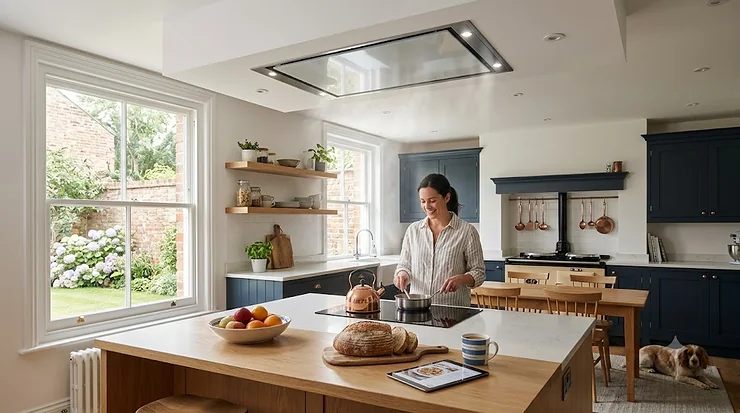
You’ve just finished cooking a full roast — the gravy’s bubbling, the fat is spitting, and a rolling fog of steam has consumed your kitchen like an unusually domesticated weather event. Sound familiar? If so, you need a kitchen ceiling extractor fan, and you probably needed one yesterday.
A kitchen ceiling extractor fan is exactly what it sounds like: a ventilation unit mounted overhead — flush to the ceiling or suspended above a kitchen island — that pulls grease, steam, cooking fumes, and humidity out of your airspace before they settle into your walls, your curtains, and your general sense of wellbeing. Unlike wall-mounted hoods that box you in, a ceiling-mounted unit keeps sightlines clear, suits open-plan living beautifully, and frankly looks rather impressive. According to Wikipedia’s overview of kitchen hood technology, extractor fans work by combining a mechanical fan with a filtration system to evacuate or recirculate airborne grease, combustion products, and steam — the three uninvited guests at every British dinner party.
The UK market in 2026 is genuinely well-stocked, ranging from no-frills 150mm axial ceiling fans for compact kitchens to statement island hoods with WiFi connectivity and motor outputs that could probably ventilate a small pub. This guide cuts through the noise — all seven products below are available on Amazon.co.uk, confirmed UK-compatible at 230V with UK plugs, and chosen to cover every budget and kitchen layout. Let’s get into it.
Quick Comparison: Kitchen Ceiling Extractor Fans at a Glance
| Product | Type | Extraction Rate | Price Range | Best For |
|---|---|---|---|---|
| Cookology CEI1100SS | Ceiling Island Hood | 760 m³/h | £300–£450 | Open-plan kitchens, design-led spaces |
| CIARRA CBCB4850 | Smart Island Hood | 700 m³/h | £200–£320 | Tech-forward households, islands |
| SIA ICH90SS | Island Hood | ~600 m³/h | £200–£350 | Mid-range island kitchens |
| Cookology CYL351BK | Cylinder Island Hood | ~450 m³/h | £150–£240 | Compact islands, style focus |
| Klarstein Island Hood | Hanging Ceiling Hood | 650 m³/h | £150–£250 | Aesthetic-first buyers, open plan |
| Airflow Maxivent 150T | Axial Ceiling Fan | 72 l/s (259 m³/h) | £50–£90 | Compact kitchens, retrofits |
| Xpelair DX150PS | Axial Ceiling Fan | 72 l/s (259 m³/h) | £25–£50 | Budget installs, rental properties |
The table above spans two quite different product categories. The island-style ceiling hoods (rows 1–5) are proper kitchen centrepieces with powerful motors suited to daily cooking over a hob or range. The axial ceiling fans (rows 6–7) are workhorses — smaller, discreet, less powerful, but perfectly adequate for smaller kitchens or secondary extraction. Your choice between them will come down to kitchen layout more than budget: if you have an island or genuinely open-plan space, go island hood; if you’ve got a standard galley or semi-open layout, an axial unit almost certainly does the job.
💬 Just one click — help others make better buying decisions too! 😊
✨ Don’t Miss These Exclusive Deals!
🔍 Take your kitchen ventilation to the next level with these carefully selected products. Click on any highlighted item to check current pricing and availability on Amazon.co.uk. These picks will help you find exactly what you need!
Top 7 Kitchen Ceiling Extractor Fans: Expert Analysis
1. Cookology CEI1100SS — 110cm Kitchen Ceiling Island Cooker Hood (Stainless Steel)
The Cookology CEI1100SS is the kind of kitchen ceiling extractor fan that makes guests stop mid-conversation and ask where you got it. At 110cm wide in brushed stainless steel, it sits flush in your ceiling with only the grille and four LED strip lights visible — discreet in the way that expensive things tend to be.
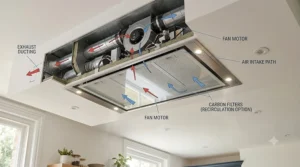
The 380W motor delivers an impressive extraction rate suited to serious cooking, and the ducting options are commendably flexible: extract outside or recirculate with optional CCF200 carbon filters if external ducting isn’t feasible in your property. That last point matters enormously in the UK, where a Victorian terrace or a new-build flat often makes external ducting an adventure in compromise. The four 2.5W LED strips provide genuinely useful task lighting — not the token glow you get on cheaper hoods.
This model is best suited to households with a kitchen island and real cooking ambitions: think family homes in leafy suburbs, newly renovated open-plan kitchens, or anyone who’s invested in a decent range cooker and needs extraction to match. UK reviewers on Amazon.co.uk frequently highlight the clean installation finish and the quality of the LED lighting.
✅ Striking flush-mount design that elevates any kitchen
✅ Dual extract/recirculate options — ideal for UK properties with complex ducting
✅ Strong LED task lighting included
❌ Professional installation strongly advised — not a weekend DIY job
❌ 110cm width requires a spacious island; won’t suit compact kitchens
Price range: £300–£450 — premium, but genuine value for a design statement that performs.
2. CIARRA CBCB4850 — 48cm Smart Island Cooker Hood, 700 m³/h
The CIARRA CBCB4850 is, in a word, clever. This 48cm ceiling island hood comes with WiFi and app control, a four-speed motor with booster mode, and a 700 m³/h extraction rate that genuinely means business when you’ve got a curry on the go. The booster mode is the sort of feature you don’t know you need until you’re standing in a cloud of chilli fumes wondering why you didn’t turn it on sooner.
The smart connectivity via the CIARRA app lets you control speed and lighting from your phone — a minor convenience that becomes a genuine luxury when your hands are covered in raw chicken. Touch controls are intuitive, the LED lighting is bright and dimmable, and the recirculating capability means installation flexibility in UK flats and terraced homes where external venting isn’t always straightforward. At 48cm, it’s compact enough for a smaller island without looking overwhelmed.
This is the fan for the tech-forward household: the buyer who already has a smart thermostat, uses a slow cooker app, and would quite like everything on one interface. UK customers consistently praise the extraction power relative to the unit’s footprint.
✅ WiFi + app control — genuinely useful, not just a marketing gimmick
✅ 700 m³/h with booster mode handles heavy cooking effortlessly
✅ Recirculating option makes installation practical in most UK homes
❌ App setup can be fiddly on first use
❌ 48cm width limits it to smaller island configurations
Price range: £200–£320 — solid mid-to-premium value with a feature set that justifies it.
3. SIA ICH90SS — 90cm Curved Glass Island Cooker Hood, Brushed Stainless Steel
The SIA ICH90SS takes a more traditional approach to island extraction: 90cm of curved glass and brushed stainless steel hanging from your ceiling above a central hob, looking like it arrived direct from a Scandinavian kitchen catalogue. SIA is a well-regarded British appliance brand, and this unit’s build quality reflects that heritage.
At around 600 m³/h extraction capacity across three speed settings, it handles everyday family cooking without drama. The curved glass design creates a dramatic focal point, and the stainless finish works equally well in modern and transitional kitchen styles. Three speeds cover simmering, regular cooking, and full splatter-and-fry modes. The ceiling-hung design means no wall brackets and no visual obstruction.
This is the pick for the household that wants genuine extraction power and a beautiful aesthetic without veering into smart-home territory. It suits kitchen renovations in semi-detached homes across Birmingham, Bristol, Leeds — anywhere the kitchen is the heart of the house and you want it to look the part.
✅ Elegant curved glass design — a real kitchen focal point
✅ Three speeds cover the full range of British cooking
✅ Trusted UK brand with good warranty support
❌ No recirculating option — external ducting required
❌ Glass panels require more careful cleaning than stainless-only hoods
Price range: £200–£350 — excellent design-to-performance ratio.
4. Cookology CYL351BK/A++ — 35cm Cylinder Island Hood, Black
If you want your kitchen ceiling extractor fan to look like a piece of industrial design rather than a household appliance, the Cookology CYL351BK is your answer. This striking cylindrical island hood in matt black descends from the ceiling in a sleek column, functioning as much as a design object as a ventilation unit. Its A++ energy rating is a genuine bonus — energy efficiency rarely looks this good.
At 35cm it’s compact by island hood standards, which actually makes it versatile: it suits smaller kitchen islands, peninsula configurations, or anywhere the standard 90–110cm slab would feel overwhelming. The extraction performance is respectable, and the LED ring lighting gives a pleasingly architectural glow over your hob.
The ideal buyer here is the design-conscious flat or apartment owner — perhaps a Shoreditch loft conversion, a Manchester new-build, or a tastefully renovated Edinburgh flat — who wants maximum visual impact within a tighter footprint. UK buyers note that the distinctive shape attracts frequent compliments from visitors.
✅ Striking cylinder design — unlike anything else in this price bracket
✅ A++ energy rated — quietly good for your electricity bills
✅ Compact footprint suits smaller islands and UK flat renovations
❌ Lower extraction rate than wider hoods — not ideal for heavy-duty cooking
❌ Replacement carbon filters must be sourced from Cookology directly
Price range: £150–£240 — outstanding design value at this price.
5. Klarstein Hanging Island Cooker Hood — 650 m³/h, Chandelier Design
Klarstein’s hanging island cooker hood is the definition of unexpected. The chandelier-inspired frame hangs from the ceiling in an almost sculptural form — this is a kitchen ceiling extractor fan that people will ask about before they even notice the worktops. At 650 m³/h with a timer function and adjustable height via steel cable, it’s impressively functional beneath the showmanship.
The three-mode extraction covers normal cooking to enthusiastic Sunday roasts, and the activated carbon filters mean external ducting isn’t required — genuinely helpful for UK homes where drilling through a party wall involves negotiations of diplomatic complexity. The adjustable hanging height is also a thoughtful feature: in a kitchen with lower ceilings (common in older British properties), you can lower the unit to improve capture efficiency without it becoming a head hazard.
Best for the open-plan design enthusiast who wants to make a genuine statement. Pair it with an induction hob and a kitchen island in a converted barn or a period property renovation, and you’ve got something rather special.
✅ Sculptural chandelier design — genuinely jaw-dropping
✅ Fully recirculating — no external ducting required
✅ Adjustable hanging height suits varied UK ceiling heights
❌ Chandelier aesthetic is divisive — very much not for minimal or traditional kitchens
❌ Fan housing can accumulate grease faster than enclosed hoods; cleaning requires patience
Price range: £150–£250 — statement-making value.
6. Airflow Maxivent 150mm Timer Extractor Fan
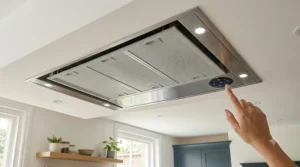
Back to earth — in the best possible way. The Airflow Maxivent 150mm Timer Fan is what you install when you want a ceiling kitchen extractor fan that works quietly, reliably, and indefinitely without asking anything more of you. Airflow is a British ventilation brand with decades of solid reputation among electricians and self-builders alike. The 72 l/s extraction rate meets Part F requirements for kitchens (more on that shortly), the auto shutter seals the duct when idle, and the adjustable run-on timer keeps extracting for a set period after you’re done cooking.
The IP45 rating means splashes and steam are handled without protest — useful in a busy kitchen where things get vigorous. The three-year warranty is also notably stronger than many competitors at this price point.
This is the sensible choice for rental properties, kitchen extensions, loft conversions, and any situation where the budget is tight but Building Regulations compliance is non-negotiable. UK electricians frequently specify it by name.
✅ Meets Part F Building Regulations minimum extraction rates
✅ IP45 rated, auto-shutter, adjustable timer — no corners cut
✅ Three-year warranty from a trusted British brand
❌ Purely functional aesthetic — not a visual feature
❌ 150mm ducting requires proper duct run; inline fan may be needed for long runs
Price range: £50–£90 — genuine quality at a genuinely sensible price.
7. Xpelair DX150PS — 6″/150mm Simply Silent Axial Fan, Pullcord
The Xpelair DX150PS has been a fixture in British kitchens and bathrooms for decades, and there’s something quietly reassuring about that. The pullcord operation is brilliantly simple — no wiring into the light circuit, no timers to programme, just a cord that turns it on and off. Twin-speed extraction (selectable at installation) gives you a slower, quieter mode for general ventilation and a faster mode when the wok is out.
At this price point, “Ghost Air Movement Technology” is marketing language for “reasonably quiet,” but in practice it does run unobtrusively. The IPX4 rating protects it from steam and splashes. It’s ceiling or wall-mountable, and installation is within reach of a competent DIYer. The 2-year guarantee is adequate if not spectacular.
Do note: recent Trustpilot reviews suggest Xpelair’s customer service quality has declined, and some batches have had reliability issues. For a rental property or a secondary kitchen space, it’s fine. For a primary family kitchen, the Airflow Maxivent above is worth the extra spend.
✅ Pullcord operation — simple, no-faff, no additional wiring
✅ Budget-friendly entry point for Part F-compliant extraction
✅ Ceiling and wall mountable — flexible installation
❌ Customer service reported as inconsistent by UK reviewers
❌ Build quality less impressive than Airflow or Vent-Axia equivalents
Price range: £25–£50 — budget pick with caveats.
How to Install Your Kitchen Ceiling Extractor Fan: A Practical Guide
Installation complexity varies enormously depending on which type you’ve chosen. Here’s what to expect for each.
For island ceiling cooker hoods (Cookology, CIARRA, SIA, Klarstein): these require ceiling joist access, a structural fixing point capable of supporting the unit’s weight (typically 8–15kg), and either an external duct run or, in recirculating models, just a power supply. Professional installation is strongly advised — not because it’s beyond a skilled DIYer, but because a ceiling-hung unit over a hob needs to be absolutely secure. An electrician to handle the wiring is sensible regardless.
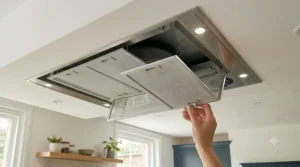
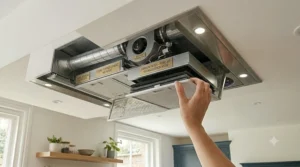
For axial ceiling fans (Airflow, Xpelair): these are considerably simpler. You’ll need a 100mm or 150mm hole in the ceiling (a hole saw does the job), a duct run to an external wall or roof, and a power connection. A competent DIYer can manage this in an afternoon. Check that your duct run is as short and straight as possible — every bend reduces extraction efficiency.
UK-specific tip: if your property has a flat roof, consult a builder before cutting any holes. And in Scotland, check with your local council — Scottish Building Standards can differ from England and Wales on ventilation requirements.
Maintenance: clean your grease filters every 4–6 weeks if you cook regularly. Carbon filters in recirculating hoods need replacing every 3–6 months depending on use — most British kitchens, with their enthusiastic Sunday roast culture, fall at the more frequent end.
The Right Kitchen Ceiling Fan for Your British Home: A Buyer’s Decision Framework
Not every kitchen is the same. Here’s how to match the right unit to your situation:
If you cook on a central island in an open-plan kitchen, you need an island hood — full stop. The Cookology CEI1100SS for maximum impact, the CIARRA CBCB4850 for smart home integration, or the Klarstein if you want to make a genuine design statement.
If you’re in a flat, apartment, or terraced house where external ducting is complex or impossible, prioritise recirculating models: the CIARRA CBCB4850, the Klarstein, or the Cookology CYL351BK all offer this option. Recirculating hoods with active carbon filters handle odours well, though they’re less efficient at removing heat and humidity than ducted extraction.
If you’re a landlord or fitting a rental kitchen, the Airflow Maxivent 150mm is the practical, reliable, Part F-compliant choice. No fuss, no smart features, solid warranty, specification-ready.
If you’re renovating a period property — Victorian terrace, Edwardian semi, converted barn — the Klarstein chandelier hood or the Cookology cylinder adds character without clashing. Both handle older ceiling heights sensibly.
Budget under £100? The Airflow Maxivent is genuinely good. Don’t cut corners on ventilation to save £30.
How to Choose a Kitchen Ceiling Extractor Fan in the UK
- Match extraction rate to your cooking style. Under UK Building Regulations Part F — the technical standard governing ventilation in new and renovated buildings — a cooker hood must extract at least 30 litres per second (l/s). Heavier cooking, larger kitchens, or gas hobs demand more. The Planning Portal guidance is clear: if you’re fitting a fan elsewhere in the ceiling (not directly over the hob), the minimum rises to 60 l/s.
- Decide: ducted or recirculating. Ducted extraction vents air outside — more effective, but requires a duct run. Recirculating filters the air and returns it — easier to install but less powerful. Many British homes, particularly flats and terraced houses, default to recirculating for practical reasons.
- Check your ceiling height. Island hoods typically hang at 65–75cm above the hob. Standard UK ceiling heights of 2.4m work fine; older properties with lower ceilings may need an adjustable model like the Klarstein.
- Consider noise. Anything rated below 45 dB(A) is considered quiet. If your kitchen is open to a living space, noise level matters more than you’d think at 7pm on a weekday.
- Verify 230V/UK plug compatibility. All seven products in this guide are confirmed UK-compatible at 230V. If buying from European marketplaces, double-check — some listings are EU 220V variants with Type C plugs. Not ideal when you’re already holding a drill.
- Think about filter maintenance costs. Grease filters are washable on all models here. Carbon filters for recirculating hoods are a recurring cost — budget around £15–£30 per year depending on your cooking frequency.
- Check UKCA/CE marking. Post-Brexit, products placed on the GB market should carry UKCA marking (or CE under transitional arrangements still in effect). This confirms product safety testing to British/European standards. All seven products in this guide comply.
Common Mistakes When Buying a Kitchen Ceiling Extractor Fan
Buying on looks alone. The Klarstein chandelier hood is beautiful. But if you’re grilling four times a week in a kitchen with poor cross-ventilation, beauty is not enough — you need extraction rate first.
Underestimating duct run length. Every 90° bend in your ductwork costs you roughly 1.5 metres of equivalent duct length in terms of efficiency. A six-metre duct run with two bends is effectively a nine-metre run. Longer runs need a more powerful fan, or a dedicated inline duct fan.
Ignoring Part F. The 2026 edition of Approved Document F — the UK government’s ventilation standard, available from gov.uk — has been updated. If you’re doing a new build or significant renovation, compliance isn’t optional. A fan that doesn’t meet minimum extraction rates will fail a Building Control inspection.
Buying a US-spec product on a grey import site. American range hoods often run at 120V/60Hz. They will not work on a UK 230V supply, and attempting to use one is a fire hazard. Stick to Amazon.co.uk for verified UK-spec stock.
Forgetting carbon filter running costs. A recirculating hood looks cheaper upfront. Factor in carbon filter replacements: heavy cooks spending £25 per set of filters every four months are spending £75 a year before electricity. Over five years, that rivals a professional ducted install.
Kitchen Ceiling Extractor Fan vs Wall-Mounted Hood: What’s Actually Better?
This comparison comes up constantly, and the honest answer is: it depends entirely on your kitchen layout.
| Factor | Ceiling Fan / Island Hood | Wall-Mounted Hood |
|---|---|---|
| Best for | Kitchen islands, open-plan | Hob against a wall |
| Sightlines | Completely clear | Hood visible above hob |
| Installation complexity | Moderate–high | Low–moderate |
| Extraction efficiency | Excellent (directly overhead) | Excellent (close to source) |
| UK suitability | Ideal for open-plan new builds | Suited to most UK kitchens |
| Price range | £150–£500+ | £80–£400+ |
| Aesthetic | Statement piece | Varies widely |
The ceiling-mounted option wins on aesthetics and sightlines without question. If you’re designing or renovating a kitchen from scratch and your hob is on an island, it’s the obvious choice. In a standard UK terraced kitchen — hob against the back wall, limited ceiling height — a wall-mounted chimney hood is more practical and typically cheaper to install properly.
What the comparison table won’t tell you: in the wet and relatively mild British climate, indoor humidity from cooking is a genuine ongoing issue in poorly ventilated homes. A well-specified ceiling fan, correctly installed, tackles this better than a wall hood positioned at the back of a galley kitchen where airflow is restricted. If damp is already a concern in your home, prioritise extraction rate over aesthetics — and consider a humidity-sensing model.
UK Building Regulations, Safety & What You Actually Need to Know
Let’s be direct about this, because it trips people up constantly.
Under Approved Document F of the UK Building Regulations — the standard that governs ventilation in dwellings in England and Wales — kitchen extraction is a legal requirement in new builds and significant renovations. The minimum rates are: 30 l/s for a cooker hood positioned directly over the hob, or 60 l/s for a ceiling fan installed elsewhere. Scotland operates under its own Scottish Building Standards, which have slightly different thresholds — worth checking with your local authority if you’re north of the border.
For context: the Airflow Maxivent and Xpelair DX150PS both deliver 72 l/s — comfortably compliant whether positioned as a hood or a general ceiling extract. The island hoods all substantially exceed the minimum requirements.
UKCA marking (the post-Brexit equivalent of CE marking) confirms a product has been assessed for electrical safety and electromagnetic compatibility. All products in this guide carry appropriate marking for the GB market. If you’re buying from a marketplace seller rather than a brand directly, check the listing carefully — some EU products sold on UK platforms still carry only CE marking, which remains accepted under current transitional arrangements but may not always be.
One important note for renters: under the Consumer Rights Act 2015, landlords have a responsibility to ensure adequate ventilation in rental properties. If your kitchen has no extraction and persistent condensation issues are causing mould, this is a potential disrepair claim — not just a ventilation conversation.
✨ Don’t Miss These Exclusive Deals!
🔍 Ready to upgrade your kitchen ventilation? Click on any highlighted product to check current pricing and availability on Amazon.co.uk. These picks cover every budget and kitchen layout — from compact terrace houses to open-plan showstoppers.
FAQ: Kitchen Ceiling Extractor Fans in the UK
❓ What extraction rate do I need for a kitchen ceiling extractor fan in the UK?
❓ Can I install a kitchen ceiling extractor fan without external ducting?
❓ Does a kitchen ceiling extractor fan need to comply with UK Building Regulations?
❓ How high should a kitchen island ceiling hood be mounted?
❓ Are kitchen ceiling extractor fans available on Amazon.co.uk with fast delivery?
Conclusion: The Right Fan for Your Kitchen
A kitchen ceiling extractor fan isn’t a glamorous purchase in the way a new range cooker or a marble worktop is. But it might be the most consequential. Good ventilation protects your walls from grease, your lungs from combustion by-products, and your home from the creeping damp that plagues under-ventilated British kitchens — particularly through the long, grey, condensation-prone months from October to March.
The Cookology CEI1100SS is our top pick for open-plan kitchens where design matters as much as performance. The CIARRA CBCB4850 is the smart choice for tech-forward households. The Airflow Maxivent 150mm Timer is the workhorse you can rely on completely. And if budget is tight, the Xpelair DX150PS gets the job done — just manage your expectations on customer service.
Whatever you choose, check it against Part F minimums, confirm UK compatibility, and don’t neglect the filters. A kitchen ceiling extractor fan is only as good as its maintenance.
✨ Don’t Miss These Exclusive Deals!
🔍 Found your perfect match? Head to Amazon.co.uk to check current pricing and availability on all seven picks above. A better-ventilated kitchen is genuinely only a few clicks away.
Recommended for You
- Best Cooker Hood Extractor Fan UK 2026: 7 Expert Picks Reviewed
- Best Kitchen Extractor Fan UK 2026: 7 Expert Picks (Reviewed)
- Best Fan for Small Bathroom UK 2026: 7 Top Picks Reviewed
Disclaimer: This article contains affiliate links. As an Amazon Associate, I earn from qualifying purchases. If you purchase products through these links, we may earn a small commission at no additional cost to you.
✨ Found this helpful? Share it with your mates! 💬🤗
