
In This Article
Let’s be honest. British cooking is a serious business — whether you’re frying up a full English on a Sunday morning, simmering a lamb curry that could wake the neighbours, or doing your best with a charred stir-fry after a long Tuesday. And every single time, your kitchen pays the price. Grease drifts onto the cabinets. Condensation creeps up the walls. A lingering cloud of what was once dinner hangs around well into Wednesday.
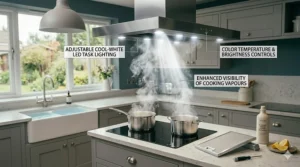
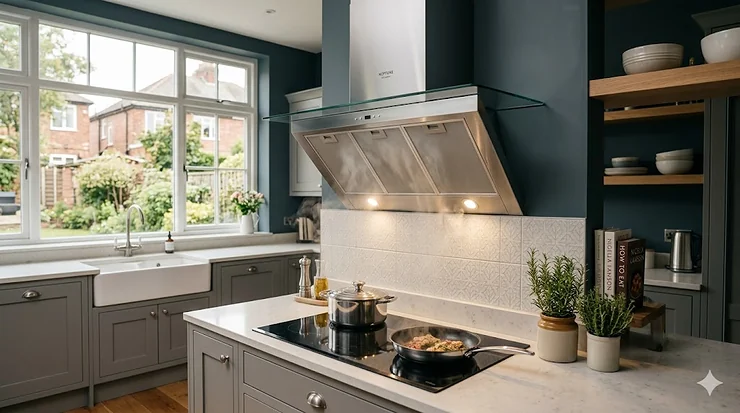
That’s precisely where a good cooker hood extractor fan earns its keep. More than just a kitchen accessory, it’s the unsung workhorse that removes steam, smoke, cooking odours, and airborne grease before they settle into every surface you own.
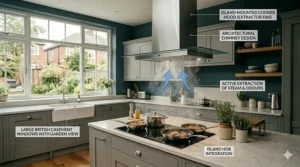
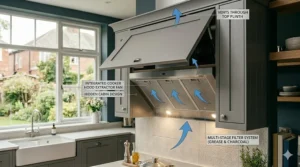
A cooker hood extractor fan — sometimes called a range hood extractor fan or integrated cooker hood fan — is a ventilation appliance mounted above your hob that draws polluted kitchen air through aluminium grease filters (and carbon filters, in recirculating models) before either expelling it outside via ducting or recirculating clean air back into the room. According to UK Building Regulations Approved Document F, a cooker hood positioned adjacent to the hob must achieve a minimum extraction rate of 30 litres per second — a benchmark that the best modern models exceed by a considerable margin.
In 2026, there’s never been a wider choice at every price point — from under £60 on Amazon.co.uk to handsome statement pieces approaching £300. The trick, as ever, is knowing which one is actually worth your money. I’ve done that homework for you. Here are seven of the best available right now, with honest commentary on what each one does brilliantly — and where it falls short.
Quick Comparison: Best Cooker Hood Extractor Fans at a Glance
| Product | Size | Extraction Rate | Energy Rating | Ventilation Mode | Price Range |
|---|---|---|---|---|---|
| CIARRA CBCB6201 | 60cm | 406 m³/h | C | Ducting & Recirculating | Under £80 |
| COMFEE’ PYRA17B-60 | 60cm | ~400 m³/h | B | Ducting & Recirculating | Around £70-£100 |
| Cookology CH600BK/A | 60cm | 450 m³/h | A | Ducting & Recirculating | Around £90-£130 |
| FIREGAS 60cm Angled | 60cm | 332 m³/h | A++ | Ducting & Recirculating | Around £100-£150 |
| Russell Hobbs RHTCH600B1B97 | 60cm | ~430 m³/h | B | Ducting & Recirculating | Around £80-£130 |
| CIARRA CBCS9102 | 90cm | 650 m³/h | A+ | Ducting & Recirculating | Around £150-£220 |
| COMFEE’ 90M77 | 90cm | ~750 m³/h | A+++ | Ducting & Recirculating | Around £200-£280 |
The table above tells an interesting story. Notice that higher extraction rates don’t always correlate with better energy ratings — the FIREGAS model actually achieves A++ efficiency with a relatively modest 332 m³/h, thanks to its brushless motor technology. Meanwhile, the COMFEE’ 90M77’s jaw-dropping A+++ rating makes it the clear long-term winner for running costs, even if the upfront price stings a little. For most UK kitchens under 15 m², anything between 350 and 500 m³/h is ample.
💬 Just one click — help others make better buying decisions too! 😊
✨Don’t Miss These Exclusive Deals!
🔍 Take your kitchen ventilation to the next level with these carefully selected cooker hoods. Click on any highlighted product name to check current pricing and availability on Amazon.co.uk. These picks will help you find exactly what you need!
Top 7 Cooker Hood Extractor Fans: Expert Analysis
1. CIARRA CBCB6201 60cm Chimney Cooker Hood — Best Budget Pick 🏆
If budget is the governing factor and you refuse to sacrifice on looks, the CIARRA CBCB6201 is where most UK buyers should start their search. It’s the brand’s entry-level 60cm chimney hood, styled in sleek black with a wall-mounted stainless steel chimney — and frankly, for the price, it punches well above its weight class.
The 406 m³/h extraction rate on maximum speed comfortably clears the Part F minimum requirement and will handle most everyday UK cooking — though if you regularly do high-heat wok cooking or Punjabi-style tarka, you’ll want to run it on full boost. Three speed settings cover light steam extraction through to full “someone’s set the chips on fire” emergency mode. Carbon filters are included for recirculating use — useful if you live in a flat where external ducting isn’t an option.
What most buyers overlook: this model is rated Energy Class C, which is perfectly acceptable but worth knowing if you’re comparing long-term running costs. It’s not a deal-breaker for occasional use, but heavy daily cooking will add up over time. UK reviewers on Amazon.co.uk have praised the quiet operation and easy installation, with several noting it replaced a noisy older hood to much relief.
✅ Affordable, stylish, easy to install
✅ Carbon filters included for ductless flats
✅ Genuinely quiet on lower settings
❌ Energy Class C — not the most efficient long-term
❌ 60cm may feel tight above wider range cookers
Price range: Under £80 — outstanding value for what you get.
2. COMFEE’ PYRA17B-60 60cm Chimney Hood — Best for Small Kitchens 🏠
The COMFEE’ PYRA17B-60 is a tidy 60cm pyramid-shaped chimney hood in all-black finish that works especially well in compact British kitchens — think terraced houses, ex-council flats, or galley-style layouts where every centimetre of space is sacred. The pyramid canopy profile is more compact overhead than a standard chimney style, which can make a real difference if your ceiling clearance is on the tight side.
With around 400 m³/h extraction and dual ventilation modes, it covers the bases. The LED lighting strip is pleasingly bright without being that surgical-theatre glare you sometimes get with budget models. What sets this apart at the price point is the combination of recirculating and ducted flexibility — you’re not locked in during installation.
COMFEE’ is the appliance arm of Midea, one of the world’s largest home appliance manufacturers, so build quality is generally more consistent than some no-name alternatives cluttering up Amazon.co.uk. UK reviewers note straightforward installation and effective steam removal when used on medium to high settings. It’s not the most powerful hood on this list, but for a two-hob cooking household in a compact kitchen, it more than holds its own.
✅ Compact profile — ideal for low or tight ceiling spaces
✅ Dual ventilation mode included
✅ Reliable brand with consistent build quality
❌ Not ideal for heavy-duty cooking or large hobs
❌ Carbon filters sold separately for recirculating mode
Price range: Around £70–£100 — fair value for the versatility.
3. Cookology CH600BK/A 60cm Chimney Cooker Hood — Best for Renters and DIY Installers 🔧
Cookology is something of a cult favourite among British DIY enthusiasts, and the Cookology CH600BK/A illustrates exactly why. It’s Energy A-rated, delivers a solid 450 m³/h extraction, and — crucially — comes with everything you need in the box, including ducting and carbon filters. No separate trips to the hardware shop on a Saturday morning. No “oh, that’s sold separately” disappointments.
The 450 m³/h output is the sweet spot for a standard UK kitchen hob — powerful enough to genuinely deal with a roast dinner’s worth of steam, but not so aggressive that it rattles the kitchen cupboard doors. Three speed settings are well-spaced and the LED lighting is clean and functional. The adjustable chimney height means it fits neatly between 73cm and 100cm ceiling heights — covering the vast majority of British kitchen installations without modification.
Renters, take note: the installation is simple enough that a competent DIYer can have this up and running in an afternoon, and take it down cleanly when moving out. UK customer feedback on Amazon.co.uk is consistently positive, with many buyers citing the inclusion of all components as the deciding factor. It’s available in both black and stainless steel — the stainless steel variant (CH600SS) costs a touch more but ages better in brighter kitchens.
✅ Everything included — no extra purchases needed
✅ Adjustable height fits most UK ceiling configurations
✅ Solid A energy rating
❌ Slightly louder on highest speed than premium competitors
❌ Control panel could be more intuitive
Price range: Around £90–£130 — excellent all-in value.
4. FIREGAS 60cm Angled Chimney Cooker Hood — Best Energy Efficiency 🌿
Here’s where things get genuinely interesting. The FIREGAS 60cm Angled Chimney Hood is the only model on this list featuring a brushless DC (BLDC) motor — and if that sounds like marketing puff, it absolutely isn’t. A brushless motor runs significantly cooler, more quietly, and more efficiently than a conventional induction motor, with a typical lifespan two to three times longer. The A++ energy rating reflects this: you’ll consume far less electricity per hour of operation than with most rivals in this price bracket.
The 332 m³/h extraction rate is the lowest on this list, which initially looks like a weakness. In practice, it means this hood is optimised for everyday home cooking rather than commercial-style high-heat sessions. The angled glass design sits at a forward tilt rather than flat against the wall — a small but meaningful benefit, as it captures steam and vapour rising from the hob more directly. UK kitchens with gas hobs in particular benefit from this geometry.
Touch-panel controls are clean and responsive, the LED lighting is warm rather than clinical, and installation follows a standard approach that most competent DIYers can manage. FIREGAS has built a quietly solid reputation in the European market, and UK buyers on Amazon.co.uk report that the low noise level — even on the higher speed settings — is the standout feature in daily use. If the electricity meter matters to you, this is your pick.
✅ A++ energy rating — lowest running costs in this bracket
✅ Brushless motor for longevity and quiet operation
✅ Stylish angled design captures steam more effectively
❌ Lower extraction rate — not ideal for heavy cooking
❌ Angled design requires slightly more clearance above hob
Price range: Around £100–£150 — worth every penny for the efficiency gains.
5. Russell Hobbs RHTCH600B1B97 T-Shaped Cooker Hood — Best Mid-Range All-Rounder 🇬🇧
Russell Hobbs is a name that’s been in British kitchens since 1952, and the Russell Hobbs RHTCH600B1B97 carries that heritage into 2026 with a T-shaped chimney hood that manages to look a good deal more expensive than it is. The T-shape design — where the canopy extends forward and to the sides in a T rather than a traditional square — improves steam capture coverage noticeably, particularly useful if your hob sits close to a wall or in a corner configuration.
Three speed settings, dual extraction and recirculation modes, dual washable aluminium grease filters, and LED lighting are all present. The washable filters are a practical detail worth highlighting: no recurring cost for replacement carbon filters if you’re ducting externally, and less faff than the “oh, I need to order more filters” situation that catches many owners out after six months.
The boost function — which kicks the fan up to maximum extraction for a short burst — is a handy touch for when you’ve misjudged the pan temperature and the kitchen is filling with smoke faster than you’d like. UK consumer trust in the Russell Hobbs brand translates to confidence in aftersales support, which matters for a fixed kitchen appliance. Reviewers consistently note easy installation and clean aesthetics.
✅ Trusted British brand with reliable aftersales
✅ T-shape design improves steam capture geometry
✅ Washable filters reduce ongoing maintenance costs
❌ Not the most powerful option for heavy-duty cooking
❌ Slightly bulkier profile than chimney-style alternatives
Price range: Around £80–£130 — solid mid-range value from a reliable name.
6. CIARRA CBCS9102 90cm WiFi Chimney Hood — Best Smart Hood 📱
Step up to the 90cm category and the CIARRA CBCS9102 is the model that makes you wonder why you ever accepted a simple on/off switch. This is a connected cooker hood extractor fan — WiFi-enabled, with full smartphone app control, a responsive touch-glass panel, and four speed settings including a booster function. You can set it running from the sofa before you’ve even walked into the kitchen. In 2026, that’s not gimmickry — it’s genuinely useful.
The 650 m³/h extraction rate is where this hood properly earns its place in larger British kitchens. Open-plan kitchen-diners — increasingly the norm in UK new builds and renovated Victorian semis — need serious airflow to prevent cooking smells from drifting into living areas. This covers that scenario comfortably. The A+ energy rating is respectable at this extraction level, and the dimmable LED lights serve double duty: focused task lighting while cooking, warm ambient light over an evening dinner table.
The 90cm width requires a larger hob installation — confirm your measurements before purchasing, as the hood should ideally be at least as wide as your hob. UK reviewers flag that installation, while manageable for a competent DIYer, benefits from a second pair of hands given the weight and width. Once up, however, the consensus is consistent: it looks stunning and performs exactly as advertised.
✅ WiFi app control — genuinely practical for connected kitchens
✅ 650 m³/h handles open-plan spaces and large hobs
✅ Dimmable LED for cooking and ambient modes
❌ 90cm width requires careful measurement before purchase
❌ Installation easier with two people
Price range: Around £150–£220 — well-priced for a smart, powerful 90cm hood.
7. COMFEE’ 90M77 Class A+++ 90cm Stainless Steel Hood — Best Premium Buy ⭐
The COMFEE’ 90M77 is the outlier on this list — the one you buy when you’ve decided the kitchen is getting a proper upgrade and you want everything to be right. The A+++ energy rating is exceptional: this is the most energy-efficient category available for cooker hoods under current EU/UK ErP regulations, meaning running costs over five to ten years will be noticeably lower than any other hood listed here. The gesture control interface — wave your hand to activate or change speeds — sounds frivolous until you’ve used it with floury hands or a spatula in each fist.
With approximately 750 m³/h at maximum extraction and 90cm width, this is engineered for larger kitchens and more serious cooking. The stainless steel finish is properly weighty and premium, not the thin-sheet stainless that flexes when you look at it sternly. Carbon filters are included, the chimney adjusts over a generous height range, and the LED lighting is warm and well-positioned.
For a UK kitchen where quality of finish matters as much as function — think an extended kitchen renovation, a new build, or simply a household that does a lot of serious cooking — this is the one to buy and not replace for a decade. It’s available on Amazon.co.uk with Prime delivery, and as a relatively heavy appliance, next-day delivery from a Prime account is worth having.
✅ A+++ energy rating — lowest possible running costs
✅ Gesture control — practical and genuinely impressive
✅ Premium stainless steel build quality built to last
❌ Higher upfront investment
❌ Gesture sensitivity can occasionally misfire near the hob
Price range: Around £200–£280 — premium price, premium performance, and the running costs justify it over time.
How to Install and Maintain Your Cooker Hood Extractor Fan: A UK Homeowner’s Guide 🔧
Installation: What to Know Before You Start
British kitchens are wonderfully individual — terraced houses, Victorian conversions, 1970s semis, and new builds all present slightly different challenges. Before buying any cooker hood extractor fan, measure three things: the hob width (your hood should be at least as wide, ideally wider), the ceiling height above the hob (most chimney hoods require between 73–100cm clearance), and whether external ducting is feasible.
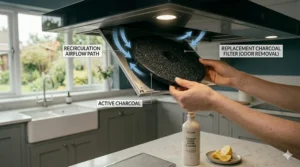
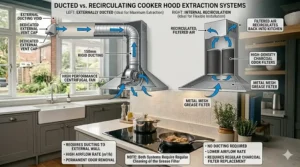
If your kitchen has an external wall nearby, ducted extraction — which actually pushes stale air outside — is far more effective than recirculating. According to Which?’s guidance on kitchen ventilation, ducted installation removes moisture and odours completely, while recirculating simply filters and returns air indoors. For flats or kitchens without external access, a recirculating hood with activated carbon filters is your only practical option — just budget for filter replacements every three to six months depending on cooking frequency.
UK Building Regulations Approved Document F requires that if you’re replacing or installing a new extractor in a new extension or renovation requiring Building Control approval, the system must meet minimum ventilation rates — 30 l/s adjacent to the hob. Check with your local authority if you’re unsure.
Maintenance Schedule for UK Conditions
British kitchens — prone to damp, frequent use, and the general enthusiasm of people who take tea and toast very seriously — benefit from a consistent maintenance routine:
- Monthly: Remove and wash aluminium grease filters in warm soapy water or the dishwasher. Clogged grease filters reduce extraction by up to 40%, which somewhat defeats the purpose.
- Every 3–6 months: Replace carbon filters if using recirculating mode. Don’t ignore this — an exhausted carbon filter stops absorbing odours entirely and simply pushes greasy air back into the kitchen.
- Annually: Wipe down internal fan blades with a damp cloth. Grease accumulation on fan blades reduces airflow and, over years, can become a fire hazard.
- UK damp awareness: If your kitchen suffers from condensation (common in older British housing stock with poor wall insulation), consider whether your hood’s extraction rate is genuinely sufficient, or whether additional background ventilation is needed.
Which Cooker Hood Extractor Fan Is Right for You? A Decision Framework 🎯
Not all British kitchens — or British cooks — are created equal. Here’s how to match yourself to the right hood:
If you live in a flat with no external ducting option: Choose a model with good carbon filter recirculating capability — the CIARRA CBCB6201 or COMFEE’ PYRA17B-60 both include carbon filters and work well in ductless installations. Prioritise extraction rate (look for 400+ m³/h) to compensate for the inherent limitations of recirculation.
If you’re in a terraced house or semi and cook frequently: The Cookology CH600BK/A or Russell Hobbs RHTCH600B1B97 both offer the complete package at a sensible price, with everything needed for a proper ducted installation. The Cookology in particular earns top marks for the completeness of what arrives in the box.
If energy bills are a concern (and whose aren’t in 2026): The FIREGAS brushless motor hood at A++ efficiency will cost you noticeably less to run than a standard motor hood over two to three years. If budget allows, the COMFEE’ 90M77 at A+++ is the ultimate long-term investment.
If you’ve got a large open-plan kitchen-diner: Don’t shortchange yourself with a 60cm hood. A 90cm model like the CIARRA CBCS9102 or COMFEE’ 90M77 provides the extraction area and airflow to actually make a difference in a large space. A 60cm hood working overtime in a big open kitchen is like trying to bail out a boat with a teacup.
If you’re renovating and want something genuinely impressive: The COMFEE’ 90M77’s gesture control and A+++ rating will still feel cutting-edge in five years. Pair it with a quality installation and your kitchen will thank you.
✨ Don’t Miss These Exclusive Deals!
🔍 Ready to upgrade your kitchen ventilation? Click on any of the highlighted product names above to check current pricing and availability on Amazon.co.uk — Prime members get free next-day delivery on eligible products. Your kitchen (and your neighbours’ nostrils) will be grateful.
How to Choose a Cooker Hood Extractor Fan in the UK: 6 Key Criteria
Choosing a cooking hood ventilation system is more nuanced than picking the prettiest one on the page. Here’s what genuinely matters:
1. Extraction rate vs kitchen size. The rule of thumb: your hood should recirculate kitchen air volume at least 10 times per hour. For a typical UK kitchen of 12–15 m², with a 2.4m ceiling, that’s roughly 290–360 m³/h minimum. Anything over 400 m³/h gives you comfortable headroom for heavy cooking days.
2. Ducted vs recirculating. As explored above, ducted beats recirculating for actual air quality every time. If external ducting is at all feasible, use it. Recirculating is a practical compromise, not an ideal.
3. Noise level. Measured in decibels (dB) — anything under 65 dB on maximum speed is considered quiet for domestic use. Research from UCL’s Institute for Environmental Design suggests chronic exposure to kitchen noise above 70 dB increases stress levels during meal preparation. Something to consider if your kitchen opens into your living space.
4. Filter maintenance cost. Carbon filters for recirculating hoods typically cost £10–£25 per set and need replacing every three to six months. Over five years, that’s potentially £120–£300 in filter costs alone. Factor this into the real purchase price.
5. Energy efficiency class. Under UK ErP regulations, cooker hoods are rated A to F for energy efficiency. Choose A-rated or above for anything that will be used daily. The difference between A and A+++ might only be a few pence per use, but across years of cooking it adds up.
6. Width relative to hob. A hood that’s the same width as your hob captures roughly 70–80% of rising steam. A hood that’s 10–15cm wider on each side captures considerably more. If you regularly use all four burners simultaneously, wider is better.
Ducted vs Recirculating: What British Kitchens Actually Need
This is the question that trips up more UK buyers than any other. The spec sheet says a hood supports both modes, so which should you actually use?
Ducted extraction — where a rigid or flexible duct carries air outside through an external wall — is the genuine solution. It removes moisture, heat, grease vapour, and odours from the kitchen entirely. In older British housing stock where rising damp and condensation are ongoing issues, proper ducted extraction makes a measurable difference to wall condition, paintwork longevity, and even mould prevention. The NHS’s guidance on indoor air quality consistently notes kitchen condensation as a key contributor to household damp problems.
Recirculating extraction pulls air through grease filters and carbon filters, then returns it into the kitchen. It’s better than nothing — significantly better — but it cannot remove moisture. Every litre of water vapour from a boiling kettle or simmering pan goes back into the room. For a modern, well-insulated UK home with good background ventilation, that’s manageable. For an older terrace with poor wall insulation and single-glazed windows, it can make a condensation problem worse rather than better.
The bottom line: duct externally wherever you possibly can. If you genuinely cannot, invest in a hood with high-quality activated carbon filters and change them more frequently than the manufacturer suggests — especially through a British autumn and winter when the temptation to keep windows closed is real.
Common Mistakes When Buying a Cooker Hood Extractor Fan in the UK
Buying too small for the hob. A 60cm hood over a 90cm range cooker is one of the most common — and most frustrating — installation mistakes. Steam will happily escape from the sides of an undersized hood and deposit itself on your ceiling. Measure first, buy second.
Ignoring noise ratings. Many buyers check extraction rate and energy class, then discover after installation that the hood sounds like a small aircraft on full speed. Check decibel ratings in product specifications — anything above 68 dB on maximum speed deserves scrutiny.
Forgetting ongoing filter costs. The recirculating carbon filter is the razor blade to the hood’s razor — the ongoing cost that can sneak up on you. Budget for it upfront.
Installing at the wrong height. Most manufacturers specify a minimum clearance of 65cm above an electric hob and 75cm above a gas hob. Installing lower can be a fire risk; installing much higher reduces effectiveness significantly.
Buying a US-voltage model. This is rarer than it used to be pre-Brexit, but worth noting: always confirm 230V/50Hz compatibility and a UK Type G plug, or a UK-compatible adaptor supplied. All products listed in this article are confirmed UK-compatible.
UK Regulations & Building Standards for Kitchen Ventilation 📋
A brief word on compliance, because this matters more than most people realise.
Under the UK Government’s Approved Document F (Ventilation), all new-build and significantly renovated kitchens must meet minimum extract ventilation rates. For a cooker hood positioned directly above the hob, the minimum is 30 litres per second (108 m³/h). All products on this list exceed this comfortably.
If you’re fitting a cooker hood as part of a kitchen extension or a renovation that requires Building Control sign-off, your installation will need to comply. In most cases, a standard domestic installation by a competent DIYer doesn’t require formal Building Control notification — but do check with your local authority, particularly in Scotland where Scottish Building Standards maintain separate requirements.
Northern Ireland buyers should note that Northern Ireland operates under its own building regulations — similar in intent to England and Wales but administered separately. If you’re in Northern Ireland, the relevant body is the Department of Finance’s Building Regulations (NI).
For products sold on Amazon.co.uk, look for the UKCA marking (which replaced the CE marking for products placed on the UK market post-Brexit). All products reviewed here are sold through UK channels with appropriate compliance.
Long-Term Cost & Maintenance in the UK: What’s the Real Price?
The sticker price on Amazon.co.uk is only the beginning of the conversation. Here’s how the true five-year cost breaks down across different types of cooker hood extractor fan:
| Cost Factor | Budget Hood (~£80) | Mid-Range Hood (~£150) | Premium Hood (~£250) |
|---|---|---|---|
| Purchase Price | ~£80 | ~£150 | ~£250 |
| Carbon Filters (5yr, recirculating) | £100–£150 | £80–£120 | £60–£100 |
| Energy Cost (5yr daily use) | ~£35–50 (Class C) | ~£25–35 (Class A) | ~£15–20 (Class A+++) |
| Estimated 5-Year Total | £215–£280 | £255–£305 | £325–£370 |
The numbers are instructive. A budget hood at Class C energy rating can close much of the gap with a mid-range model over five years when filter and energy costs are factored in. The premium A+++ model wins on running costs but still carries a higher total ownership price. The deciding factor isn’t budget — it’s how much and how often you cook. A household that genuinely uses the hob twice a day will recover the premium cost of an efficient model faster than one that cooks twice a week.
A practical note for UK buyers: carbon filter replacement sets for most major brands are available on Amazon.co.uk, usually in packs of two. Set a recurring order reminder for every six months — it’s one of those maintenance tasks that’s easy to postpone until your kitchen starts smelling permanently of last Tuesday’s fish pie.
Frequently Asked Questions ❓
❓ What size cooker hood extractor fan do I need for my kitchen?
❓ Is it better to duct a cooker hood outside or use recirculating mode in a UK home?
❓ Do I need Building Regulations approval to install a cooker hood extractor fan in the UK?
❓ How often should I replace the carbon filters in my recirculating cooker hood?
❓ Are cooker hoods on Amazon.co.uk compatible with UK electrics and plugs?
Conclusion: Fresh Air Awaits 🌬️
There’s something quietly life-improving about a kitchen that doesn’t hold onto last night’s dinner. The right cooker hood extractor fan doesn’t announce itself — it simply does its job, every day, without drama or notice. Until, of course, you experience a kitchen without one and suddenly remember exactly why you needed it.
For most UK households, the Cookology CH600BK/A represents the ideal balance of performance, completeness, and value — everything in the box, solid A energy rating, and enough extraction to handle genuine everyday British cooking. If budget is genuinely tight, the CIARRA CBCB6201 won’t let you down. If you’re investing in a proper kitchen and want to do it once, the COMFEE’ 90M77 is the one you’ll still be pleased with in 2034.
Whatever you choose — measure your hob, check your ceiling height, and decide on ducted vs recirculating before you buy. Ten minutes of planning saves a Sunday afternoon of “oh, that’s not going to work.”
✨ Ready to Find Your Perfect Hood?
🔍 Click on any of the highlighted products in this article to check current pricing and live availability on Amazon.co.uk. Prime members enjoy free next-day delivery on eligible kitchen appliances — your fresher kitchen is one click away!
Recommended for You 📚
- Best Kitchen Extractor Fan UK 2026: 7 Expert Picks (Reviewed)
- Best Fan for Small Bathroom UK 2026: 7 Top Picks Reviewed
- Best Bathroom Fan with Timer 2026: 7 Expert UK Picks Reviewed
Disclaimer: This article contains affiliate links. As an Amazon Associate, I earn from qualifying purchases. If you purchase products through these links, we may earn a small commission at no additional cost to you.
✨ Found this helpful? Share it with your mates! 💬🤗
