
In This Article
Picture a still August night in a Dorset field. The sun went down two hours ago, but your tent hasn’t noticed. The fabric is radiating the day’s heat like a storage heater, and your sleeping bag has turned into a sauna with a zip. This is where the tent fan vs clip-on fan question stops being theoretical and starts deciding whether you sleep.
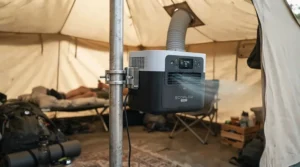
Both types promise a breeze without a mains plug, and both run off built-in batteries. Once the zips are closed, though, they behave very differently. A hanging fan circulates air from above. A clip-on grabs whatever you can find and aims at one person. Underneath the plastic, each one is a small mechanical fan, blades pushing air along an axis. So the real differences are mounting, battery, blade size and noise.
I’ve worked through independent test data, manufacturer specifications and published UK reviews to separate the useful from the glossy. This guide compares seven real products, from a feature-packed rechargeable tent fan to a feather-light clip-on. Then it shows you how to set them up, power them and use them safely. There are no invented lab results and no fake “I slept like a baby” stories, just honest analysis.
Quick Comparison Table: Tent Fan vs Clip-On Fan at a Glance
Before the deep dive, here is the whole landscape on one screen. Think of it as the map before the hike.
| Fan type | How it mounts | Strongest at | Watch out for | Best For |
|---|---|---|---|---|
| Hanging camping fan (Nitecore NEF10, Odoland Camping Fan with LED Lantern) | Ceiling loop, hook or tripod legs | Even circulation, saves floor space | Weight on thin tent loops | Couples in 2-4 person tents |
| Hybrid hang/stand fan (Claymore V600+) | Hook, adjustable legs, tripod thread | Wide speed range, long low-speed runtime | No built-in light | Light sleepers wanting quiet, tuneable airflow |
| Floor tent fan (Geek Aire Rechargeable Fan) | Stands on the groundsheet or in the porch | Most air over the longest distance | Bulk and weight | Families and bell tents |
| Clip-on fan (Koonie 10000mAh Portable Clip-On Fan, Frizcoll Portable Fan, Gaiatop Portable Clip-On Fan) | Clamp or flexible legs on bed frames, poles, chairs | Personal, aimed airflow | Needs something sturdy to grip; short high-speed runtime | Solo campers, camp beds, campervans |
Reading across the rows, the pattern is simple. Hanging and floor fans cool a space, while clip-ons cool a person. If you share a tent, a rechargeable tent fan such as the Nitecore NEF10 or Claymore V600+ usually gives more even comfort. Solo sleepers can get away with a Koonie or Frizcoll aimed squarely at the pillow, and they pay less for it.
💬 Just one click — help others make better buying decisions too!😊
Top 7 Rechargeable Tent Fans and Clip-On Fans: Expert Analysis
Every pick below is a real, currently listed product. The performance figures come from published independent testing, chiefly Outdoor Life’s 2026 test of 13 camping fans and Camping Guidance’s bought-and-tested comparison. Where I couldn’t verify detailed data or a large pool of customer reviews, I say so rather than guess.
1. Nitecore NEF10 — hangs, stands and doubles as a lantern
Few gadgets earn the word “multitool” honestly, but the Nitecore NEF10 comes close. A ring light, hanging hook, ball-head tripod and USB output all share one 10,000mAh body.
In Camping Guidance’s testing, it hit 4.2 m/s on high from a 5.25-inch blade, reaching roughly 2.4 m across a four-person tent. It was also the quietest fan in that group at about 56 dBA on high. In practice, that’s enough air to matter without a drone you’ll hear at 3 a.m. Runtime ran from roughly 9 hours on high to about 32 on low. The light offers three brightness levels, so one device replaces a separate lantern for reading.
Based on the spec comparison, this is the strongest all-in-one rechargeable tent fan on the list. The weak spot is weather: there’s no IP rating, and the tested unit stopped working after 30 minutes of heavy rain (the fan itself recovered months later). Keep it inside.
UK Amazon reviewers broadly praise the looks and quiet brushless motor. One measured real battery capacity well below the 10,000mAh claim yet still got close to nine hours on high. Another reviewer felt the stand was too short. I can’t verify an overall star rating, so check the latest reviews.
Pros:
- ✅ Hook, tripod legs and ring light in one unit
- ✅ Quiet brushless motor, about 56 dBA on high
- ✅ USB output works as an emergency phone top-up
Cons:
- ❌ No IP rating, so keep it dry
- ❌ Real battery capacity may undershoot the claim
Expect roughly £35-£55 depending on colour and seller. At that level, it’s the value pick here.
2. Claymore V600+ — the quiet all-rounder with the widest speed range
Choice is this fan’s party trick. The Claymore V600+ offers four speeds (about 2.6, 3.1, 3.8 and 4.2 m/s), so you can dial the breeze to the night rather than the other way round.
The 7,800mAh battery gave up to about 31.5 hours at the lowest speed and roughly 6 hours flat out. The 6-inch blade reached around 2.5 m in a four-person tent. At roughly 585 g, it was the lightest of the larger fans Camping Guidance tested, and it ranked first overall at 7.7 out of 10. Features include a hook, three adjustable legs, a tripod thread, a 1-4 hour sleep timer and a removable cage. Noise ranged from 46 to 60 dBA.
On paper, this one suits light sleepers. A sleep timer lets you drift off to moving air, then fall silent. The gaps are that there’s no light and no phone charging (the newer V1040 adds charging), so budget for a separate lantern.
I found one thorough independent test but couldn’t verify a large pool of UK customer reviews. Treat that as a gap, not a green light. UK stock can also be patchy, so confirm availability on amazon.co.uk.
Pros:
- ✅ Four distinct speeds plus a 1-4 hour sleep timer
- ✅ Lightest of the larger fans tested
- ✅ Hook, legs and tripod thread give flexible mounting
Cons:
- ❌ No built-in light or phone charging
- ❌ Plastic body showed slight leakage in rain testing
Expect roughly £55-£80 where in stock. It’s a premium price for a very polished tent fan.
3. Odoland Camping Fan with LED Lantern — budget USB-C lantern-fan with a ceiling hook
Two jobs for one hook is the Odoland pitch. It’s a rechargeable hanging camping fan with a three-colour lantern, USB-C fast charging and four speeds.
The headline claim is up to 40 hours. That figure almost always describes the lowest speed. A sibling Odoland listing quotes about 28 hours on low and about 9 on high, which is a more realistic expectation for any battery-powered fan. I couldn’t find independent test data for this exact USB-C model.
The older, D-cell Odoland was tested by Camping Guidance and Outdoor Life. Testers liked the hook and bright light but criticised a small 4-inch blade, 59-63 dBA noise and weak rain tolerance. That’s a different product, but it hints at the brand’s budget build tier.
So treat this as a “buy it, test it at home” fan. It suits occasional campers who want light and breeze for little outlay and aren’t hanging it from anything delicate.
Reviewer sentiment on this specific model isn’t something I could verify, so read the most recent reviews before buying.
Pros:
- ✅ Fan and lantern combined in one hanging unit
- ✅ USB-C charging, no D-cell shopping
- ✅ Low entry price for a hanging camping fan
Cons:
- ❌ Headline runtime likely applies to low speed only
- ❌ No independent testing found for this version
Expect roughly £20-£35. It’s a decent budget gamble, not a proven winner.
4. Geek Aire Rechargeable Fan — the floor-standing fan that cools a family
Size does matter in airflow. A big blade moves far more air than a small one even at a lower top speed, and the Geek Aire Rechargeable Fan proves it.
Camping Guidance tested the discontinued 10-inch version, which pushed air about 2.7 m, the best reach in its group, despite a 3.9 m/s maximum. The line now comes in 12, 16 and 20-inch sizes. A stepless knob runs from about 1.6 to 3.9 m/s. The 6,000mAh battery lasted around 29.5 hours at its lowest setting and roughly 6 on high. The metal body is IPX4-rated and shrugged off the rain test.
That makes it the best choice here for bell tents and families, though it’s heavy at about 1.75 kg. It lives on the groundsheet or porch rather than hanging. On the downside, it has no sleep timer, light or phone charging, and Outdoor Life flagged the price and lack of a handle.
Published tests agree on its strengths: durability and reach. I couldn’t verify a broad body of UK customer reviews for the current sizes.
Pros:
- ✅ Best airflow distance among the fans compared
- ✅ Metal body with IPX4 splash protection
- ✅ Stepless speed control and larger sizes available
Cons:
- ❌ Heavy and bulky to pack
- ❌ No timer, light or phone charging
Expect roughly £80-£140 depending on size. It’s expensive, but it’s the only option here that comfortably serves a whole family tent.
5. Koonie 10000mAh Portable Clip-On Fan — the clip-on with the biggest blade
Bigger blade, bigger breeze. The Koonie is an 8-inch rechargeable clip-on with a 10,000mAh battery, four speeds, 360° rotation and a sturdy clamp.
One UK reviewer compared it directly with the Nitecore NEF10. The Koonie pushed noticeably more air at top speed but lasted only about four hours, matching the seller’s claim. That’s the clip-on trade-off in one sentence. A larger blade and aimed airflow make it excellent for a person, but high-speed runtime is short.
For the tent fan vs clip-on fan decision, this is the clip-on I’d shortlist for airflow alone. Where it clamps matters. Tent poles are thin, and many clamps are designed for desk edges, so a camp-bed frame, table or chair back is a safer anchor.
It suits solo campers and campervan users who recharge from the vehicle. Because I only found one detailed review, I’d call overall customer sentiment unverified.
Pros:
- ✅ Large 8-inch blade for strong airflow
- ✅ 360° head rotation for aimed cooling
- ✅ Clamp frees up floor space
Cons:
- ❌ Roughly four hours on high between charges
- ❌ Needs a sturdy anchor point to grip
Expect roughly £20-£35. It’s good value for strong personal airflow.
6. Frizcoll Portable Fan — flexible legs that wrap around poles and chair arms
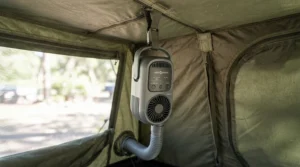
Clip-on, wrap-on, perch-on: the Frizcoll Portable Fan adapts. Usually sold as a “stroller fan”, it has bendy legs that wrap round bars and poles.
Outdoor Life measured about 4 hours on high and a reach of around 0.9 m, with USB-C charging at roughly 285 g. The tester noted it takes slightly longer to set up than a free-standing fan and doesn’t reach far, though the leg design is more versatile.
That short reach is the point. This is a personal fan for the head of your camp bed or a bed rail, not something to cool a whole tent. In the tent fan vs clip-on fan contest, it wins on versatility and loses on power.
Reviewers I found praised its simplicity, though I couldn’t verify a broad UK review base. Think of it as a cheap, packable spare for one sleeper.
Pros:
- ✅ Bendy legs grip poles, rails and chair arms
- ✅ Light at roughly 285 g
- ✅ USB-C charging and simple design
Cons:
- ❌ Reach of roughly 0.9 m suits one person
- ❌ Setup takes longer than a tripod fan
Expect roughly £15-£25. It’s a sensible budget add-on.
7. Gaiatop Portable Clip-On Fan — ultra-light budget clip-on with a question mark
Light enough to forget in your pocket, the Gaiatop Portable Clip-On Fan weighs about 230 g.
Outdoor Life measured about 2.5 hours on high with a reach of roughly 1.2 m. Its tester also struggled with charging: the fan drew very little power and cut out after about half a minute across several cables and power sources. That might be one faulty unit, but it’s a real red flag.
My take is simple. Buy the Gaiatop only if you test it thoroughly at home, inside your return window. Its biggest virtue is price, and its main risk is reliability.
I couldn’t verify a broad review base, so scan the most recent one-star reviews for charging complaints. It’s a fair backup fan if you accept the gamble.
Pros:
- ✅ Ultralight at roughly 230 g
- ✅ Cheapest fan on this list
- ✅ Clip design frees up floor space
Cons:
- ❌ Charging problems reported in one independent test
- ❌ Only about 2.5 hours on high
Expect roughly £10-£20. It’s worth buying only if you test it fully before your trip.
Specs at a Glance: All 7 Fans Compared
| Product | Power | Tested/claimed airflow | Runtime (high / low) | Weight | Indicative price | Best For |
|---|---|---|---|---|---|---|
| Nitecore NEF10 | 10,000mAh, USB-C | 4.2 m/s, about 2.4 m reach | about 9 h / about 32 h | about 650 g | £35-£55 | Couples wanting hook and light |
| Claymore V600+ | 7,800mAh, USB-C | 4.2 m/s, about 2.5 m reach | about 6 h / about 31.5 h | about 585 g | £55-£80 | Quiet, tuneable all-rounder |
| Odoland Camping Fan with LED Lantern | USB-C battery (listing claims up to 40 h) | Not independently tested | Claimed, unverified | Not verified | £20-£35 | Budget hanging fan with light |
| Geek Aire Rechargeable Fan | 6,000mAh (10-inch tested) | 3.9 m/s, about 2.7 m reach | about 6 h / about 29.5 h | about 1.75 kg | £80-£140 | Families and bell tents |
| Koonie 10000mAh Portable Clip-On Fan | 10,000mAh | Not independently tested | about 4 h on high | Not verified | £20-£35 | Strong clip-on airflow |
| Frizcoll Portable Fan | USB-C | about 0.9 m reach | about 4 h on high | about 285 g | £15-£25 | Wrap-on pole or chair use |
| Gaiatop Portable Clip-On Fan | USB-C | about 1.2 m reach | about 2.5 h on high | about 230 g | £10-£20 | Ultra-light spare |
Price bands are indicative, drawn from published price points and sampled UK listings. Check the current price before buying. The table shows how steeply capability rises with weight and cost. The Nitecore NEF10 gives the most features per pound, while the Geek Aire buys raw reach. The two cheapest clip-ons trade runtime for portability, and the Gaiatop carries the extra reliability caveat noted above.
How to Set Up a Rechargeable Tent Fan: A First-Night Practical Guide
Amazon listings tell you a fan has a hook. They don’t tell you what to hang it from. This routine avoids the classic first-night fiascos.
- Charge at home, supervised. Top up a day or two before you leave, rather than the night before in a rush.
- Test every mode on the lawn. Run each speed, the timer and any light. This is exactly how you’d catch the charging quirks flagged on the Gaiatop.
- Choose the anchor wisely. Use a ridge or ceiling loop, never a zip or thin fabric panel. Outdoor Life warns that Velcro tabs may not be secure enough, so add a carabiner and a short paracord loop.
- Aim across, not at. Skim air over your sleeping area instead of blasting your face. Open a low door vent and a high roof vent so the air has an exit.
- Use the lowest comfortable speed. Low settings are quieter and stretch a battery dramatically. The Claymore V600+ at 2.6 m/s is the obvious example.
Maintenance is simple. Wipe the blades monthly and carry a spare USB-C cable. Don’t leave lithium batteries flat for months, since Outdoor Life flags dead-battery risk in off-season storage. In the first 30 days, the common mistakes are hanging a heavy fan from a flimsy loop, leaving it in the rain, and forgetting the cable.
Real-World Scenarios: Which Fan for Which Camper
Specs only matter if they fit your life. Here are three typical profiles, matched to products with reasoning.
The couple on a Cornwall campsite. Seven nights, a four-person tent, a budget of around £50 and mild evenings. A Nitecore NEF10 hung from the ridge handles cooling plus reading light, and at roughly 2.7 m/s it ran about 32 hours in testing, so around four nights per charge. Bring it indoors if rain threatens.
The family of four in the Lake District. A six-person tent, ten nights each summer and a budget closer to £100-£140. The Geek Aire Rechargeable Fan earns its keep here. Its IPX4 rating forgives drizzle, and its reach covers sleeping pods at the far end. Hang a lighter hanging camping fan inside the family space if the kids’ end runs warm.
The solo festival-goer on a camp bed. Weekend trips, a budget under £30, and car charging. A Koonie 10000mAh Portable Clip-On Fan clamped to the bed frame gives strong, aimed air. If you’d rather save weight, the Frizcoll Portable Fan wraps round a bed rail instead.
Frequency of use changes the maths. Camping five or more weekends a year justifies a robust option like the Claymore V600+. If you camp once a summer, a budget pick is plenty.
Problem to Solution: Fixing Common Tent Fan Headaches
Problem: the fan dies at 3 a.m. Drop to a lower speed and use a sleep timer. At roughly 3 m/s, Camping Guidance measured about 15.75 hours on the Claymore V600+ and about 9.25 on the Geek Aire, so a night of eight hours is comfortable on one but tight on the other. Carry a power bank for top-ups.
Problem: the tent sags or sways. Hang from the ridge near a pole and choose a lighter fan. The Claymore is around 585 g and the Gaiatop about 230 g, versus roughly 1.75 kg for the Geek Aire.
Problem: it’s too noisy. Check the noise range, not just the top speed. The Nitecore NEF10 ran 45-56 dBA and the Claymore 46-60, while the older D-cell Odoland measured 59-63. Lower speeds are far quieter.
Problem: the clip keeps slipping. A thin strip of card or rubber under the jaws adds grip, and a camera clamp (one UK reviewer mentioned about £10-£13) widens mounting options.
Problem: still, damp air. A fan can’t create ventilation. Open vents first, then let the fan move air through them.
What Is the Tent Fan vs Clip-On Fan Difference?
A tent fan vs clip-on fan comparison is a choice between two portable cooling designs. A tent fan hangs from the ceiling or stands on legs or the floor to circulate air around the whole tent. A clip-on fan clamps to a pole, bed frame or table to blow air at one person.
That one sentence hides a lot of nuance. Tent fans, whether hanging camping fans like the Nitecore NEF10 or floor models like the Geek Aire, aim to reduce the overall feel of the space. They work best with open vents, where moving air helps sweat evaporate and mixes stale hot air. Clip-on fans, like the Koonie, aim airflow at skin, so the cooling is local and immediate.
Neither lowers the actual air temperature much. Outdoor Life notes that even a powerful fan only reduces perceived heat by roughly ten degrees, and outside conditions matter. Check overnight lows before assuming a fan will rescue a 25-degree night.
How to Choose a Rechargeable Tent Fan: 6 Steps
A good rechargeable tent fan fits your tent, your trips and your tolerance for fiddling. Work through these in order.
- Decide where it will live. Hanging suits floor-space-hungry tents. A floor fan suits families. A clip-on suits camp beds. Mounting dictates everything else.
- Match power to tent size. Camping Guidance’s airflow figures give a feel: about 2.5 m suits a four-person tent, while a smaller fan suits a two-person tent.
- Check runtime at your real speed. Headline hours usually describe the lowest setting. Look for runtime near 3 m/s, as in the figures above.
- Prefer USB-C and a simple battery. A built-in battery that charges from a power bank beats hunting for D cells.
- Count the extras that matter. A sleep timer, light and phone-charging output are handy, but only if you’d genuinely use them.
- Check weather resistance and compliance. IPX4 splash protection (like the Geek Aire) is rare. Look for UKCA or CE marking and a warranty, typically one year.
Tent Fan vs Clip-On Fan: Head-to-Head Performance
Time for the fair fight. In pure airflow, bigger blades win, so a large floor fan or the 8-inch Koonie beats a small hanging unit. In whole-tent comfort, a hanging camping fan wins because it keeps air moving in every corner. In personal cooling per pound, clip-ons win because they put air exactly where your skin is.
Heat is also a health issue, not just a comfort one. The NHS guidance on heat exhaustion and heatstroke advises moving to a cool place, drinking water and cooling the skin with water and fanning. Fans can help, but they’re a comfort tool rather than medical treatment. Heatstroke is an emergency, so call 999.
| Option | Cooling style | Ongoing cost | Drawback | Best For |
|---|---|---|---|---|
| Hanging tent fan (Nitecore NEF10) | Whole-tent circulation | Charging only | Needs a safe anchor | Couples and small groups |
| Clip-on fan (Koonie 10000mAh Portable Clip-On Fan) | Aimed personal airflow | Charging only | Short high-speed runtime | Solo sleepers |
| Mains hook-up fan | Strongest, continuous | Pitch electric charges | Tied to a hook-up pitch | Serviced pitches |
| Vents open, no fan | Natural ventilation | Free | Weak on still nights | Cool or breezy weather |
The table shows why the answer depends on the trip. For off-grid weekends, a rechargeable option wins on freedom. On hook-up pitches, a mains fan can outperform any battery model. For most UK summers, where truly hot nights are occasional, a compact fan such as the Frizcoll or Claymore is plenty.
Battery-Powered Fan Runtime: What the Numbers Really Mean
A battery-powered fan’s headline hours are a best case. Treat them like a car’s claimed miles per gallon.
Camping Guidance’s measurements show the spread. The Nitecore NEF10 ran about 32 hours at a gentle 2.7 m/s, while the Claymore V600+ managed about 15.75 hours at 3.1 m/s. The Geek Aire gave around 9.25 hours at 3.0 m/s. Running flat out, runtime collapses, as with the roughly 4 hours reported for Koonie and the 2.5 hours for Gaiatop.
Outdoor Life measured about 11 hours on high for the Wavmill 12000mAh Camping Fan, a reminder that bigger batteries don’t always mean better value. Disposable D cells last longer per set, but Camping Guidance rightly calls them expensive over time.
A practical rule: budget half the headline for an eight-hour night, and carry a power bank. A 10,000mAh bank is a sensible, light companion.
Hanging Camping Fan Placement: Getting the Airflow Right
A hanging camping fan lives or dies by where you put it. Mounted high and central, it pushes air down and across the sleeping area, mixing the hot layer that collects under the roof.
First, check the anchor. Use a ceiling loop or ridge point rather than a door panel. A heavy fan on a thin loop can pull the fabric down, and one reviewer warns that heavy models risk this in smaller tents. At about 585 g, the Claymore V600+ is a safer choice than the 1.75 kg Geek Aire, which belongs on the floor.
Second, angle it. Tilt the Nitecore NEF10‘s ball head so air skims over your bedding rather than your face. Third, give it clearance. Keep the blades away from fabric and cables.
Finally, think about cross-flow. Pair a high hanging fan with a low door vent so cooler outside air enters low and warm air leaves high. A fan with an exit route moves air. One without simply stirs it.
Tent Accessories That Make Any Fan Work Harder
The right tent accessories turn a decent fan into a great one, and most cost very little.
- Carabiners and short paracord loops add security to any hook, which matters since Outdoor Life flagged weak Velcro tabs.
- A power bank extends runtime. Choose a slim 10,000mAh model and charge it during the day.
- A camera clamp widens mounting options. One UK reviewer found them for roughly £10-£13.
- A spare USB-C cable is the cheapest insurance in camping.
- A small dry bag or mesh pouch keeps the fan, cable and bank together.
- A separate rechargeable lantern beats any fan’s built-in light. Camping Guidance recommends pairing one with the Claymore V600+.
These tent accessories cost less than one extra night’s pitch fee, yet they decide whether the fan is a hero or a headache.
Price Range and Long-Term Cost: Is a Rechargeable Tent Fan Worth It?
Cheap upfront isn’t the same as cheap overall. Disposable-battery fans cost little to buy but keep charging you for replacements. Camping Guidance flagged exactly this with the older D-cell Odoland. A rechargeable tent fan costs more at the start and pennies per charge afterwards.
Here’s a simple way to think about it. A fan bought for around £40 and used on 15 nights a year costs under £3 a night in year one, and the figure falls each season you keep it. The Nitecore NEF10 (£35-£55) stretches furthest, since its low-speed runtime of about 32 hours covers several nights. The Geek Aire (£80-£140) is the priciest, but its durability and reach suit people who camp often. At the budget end, the Gaiatop (£10-£20) costs least but carries reliability risk, so factor in a possible return.
Don’t ignore resale and longevity. Metal-bodied, splash-resistant fans last longer than light plastic ones, and a one-year warranty is the norm. Check current prices before buying, since they move.
Safety Guide: Batteries, Heat and Sleeping Next to a Fan
Fans are safe when used sensibly, and lithium batteries deserve respect. West Yorkshire Fire and Rescue Service’s battery guidance advises never charging overnight or unattended, never using swollen or damaged batteries, keeping batteries away from heat sources and direct sunlight, and recycling them properly.
For camping, that translates into a few habits. Charge fans at home or in daylight with someone present, not while you sleep. Never leave a charging fan or power bank in a hot car or in direct sun on the tent floor. Retire anything swollen or hot to the touch.
Check for UKCA or CE marking on any fan you buy, and keep blades clear of fabric, cords and fingers. In small tents with children, hang fans out of reach. Keep vents open, since a fan shouldn’t be your only airflow. Finally, remember heat illness is a real risk on very hot days, and NHS advice on cooling and hydration applies.

FAQ
❓ Can a clip-on fan cool a whole tent?
❓ How long does a rechargeable tent fan last overnight?
❓ Is a battery-powered fan safe to run in a tent overnight?
❓ Where should I hang a hanging camping fan?
❓ Can I power a tent fan from a power bank?
Conclusion
So, which wins the tent fan vs clip-on fan contest? It depends on who’s sleeping where. For shared tents, a rechargeable tent fan such as the Nitecore NEF10 or the quieter, tuneable Claymore V600+ offers whole-tent circulation, long low-speed runtime and flexible mounting. For families, the Geek Aire Rechargeable Fan moves the most air. For solo sleepers on a budget, a Koonie or Frizcoll puts a breeze exactly where you need it for a fraction of the cost.
The most important lesson is to judge fans by real runtime and sensible placement, not headline claims. Test everything at home, carry a spare cable, keep your vents open and charge safely. Do that, and even a warm night under canvas becomes comfortable.
Recommended for You
- Portable Cooler For Family Camping: 7 Proven Picks (2026)
- Camping Cooling Devices: 7 Best Picks To Beat The Heat (2026)
- Evaporative Cooler For Conservatory: 7 Best Picks (2026)
Disclaimer: This article contains affiliate links. As an Amazon Associate, I earn from qualifying purchases. If you purchase products through these links, we may earn a small commission at no additional cost to you.
✨ Found this helpful? Share it with your friends! 💬🤗
