

In This Article
There’s a very particular kind of misery reserved for a British heatwave — the one where the trains stop working, the office fan sounds like a light aircraft, and your gym session turns into a slow-motion negotiation with your own body temperature. A best cooling towel isn’t a gimmick for that moment; it’s the closest thing to portable relief you can fold into a gym bag. In short: a cooling towel is a reusable fabric strip, typically made from PVA or knitted microfibre, that you soak, wring and snap to trigger evaporative cooling against your skin, dropping its surface temperature noticeably below body heat.
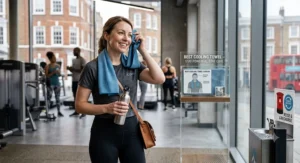
We’ve dug through real products sold on amazon.co.uk, weighed up genuine aggregated review sentiment, and cross-checked the science against sports-medicine sources, so this isn’t a rehash of seven near-identical product listings. According to a comprehensive Mumsnet review roundup, the best cooling towels share three traits — they’re lightweight, they activate fast, and they’re compact enough to live permanently in a handbag or kitbag — and that’s the bar every product below had to clear.
Whether you’re chasing a personal best on a sweltering 10K, sweating through a spin class, or just trying to survive a commute without wilting, there’s a towel here built for it. We’ll cover proper PVA versus microfibre analysis, where “instant” cooling genuinely lives up to the name, and why a £10 towel sometimes outperforms one twice the price.
Quick Comparison Table
| Product | Material | Cooling Duration (approx) | Price Range | Best For |
|---|---|---|---|---|
| Dock & Bay QuickCool | Recycled polyester, dual-layer | Up to 6 hrs (rewet as needed) | £15-£22 | Best cooling towel for running |
| Mission Enduracool Techknit | Multi-yarn performance fabric | Up to 2 hrs per soak | £15-£25 | Instant cooling relief sports |
| Frogg Toggs Chilly Pad | PVA cooling towel material | 3-4 hrs per soak | £10-£16 | Toughest, most durable pick |
| Sukeen 4-Pack | Microfibre mesh | 2-3 hrs per soak | £15-£22 | Best overall value multipack |
| YQXCC 2-Pack | Microfibre mesh | Up to 3 hrs per soak | £10-£15 | Best budget for extreme heat |
| VAKKI Cooling Towel | Microfibre | 2-3 hrs per soak | £8-£13 | Simple single-towel budget pick |
| Amazon Basics 4-Pack | Microfibre | 2 hrs per soak | £12-£18 | No-frills family/gym multipack |
A clear pattern jumps out here: PVA towels like the Frogg Toggs Chilly Pad hold their chill longer between soaks but demand a bit more care, while microfibre options trade some longevity for a softer, more forgiving feel against the skin. None of these prices are locked in — Amazon listings shift constantly, so always check the current price before buying.
💬 Just one click — help others make better buying decisions too!😊
Top 7 Best Cooling Towels: Expert Analysis
1. Dock & Bay QuickCool Cooling Towel — best cooling towel for running
Dock & Bay built its name on beach towels that dry absurdly fast, and it turns out that same obsession with fabric engineering translates brilliantly to cooling gear. The standout here is the dual-layered jadestone technology, which the brand claims cools to around 15°C — genuinely crisp against overheated skin rather than just “less warm.”
Made from 100% recycled polyester, the QuickCool activates in seconds: wet it, wring it, give it a snap, and you’re in business. What most buyers overlook about this towel is that its recycled-yarn construction isn’t just a sustainability nicety — the tighter weave also means it holds moisture more evenly than looser mesh microfibre towels, so you get a steadier cooling sensation rather than one intense blast that fades fast.
This is the pick for runners logging miles in summer heat, since a towel that stays evenly damp rather than sopping wet is far more comfortable tucked into a running belt or draped over the shoulders mid-stride. Independent testers highlighted it as one of the standout picks specifically for athletes and workouts, though a handful of reviewers noted the compact size feels slightly short for anyone with a broader frame, wishing for a larger option.
Pros:
- ✅ Genuinely crisp cooling from dual-layer jadestone tech
- ✅ Made from 100% recycled materials
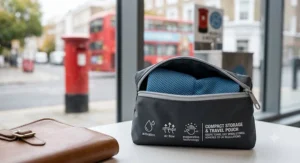
- ✅ Includes a water-resistant travel pouch
Cons:
- ❌ Runs slightly short for larger frames
- ❌ Pricier than basic microfibre multipacks
At around £15-£22, it sits mid-range — you’re paying a premium for sustainability credentials and a genuinely well-engineered fabric.

2. Mission Enduracool Techknit Cooling Towel — best for instant cooling relief sports
Mission built its reputation supplying cooling gear to professional athletes, and the Enduracool Techknit is the product that reputation rests on. The standout feature is the “radiator-like fibre construction” inside the fabric core, engineered specifically to circulate absorbed water molecules and regulate how fast they evaporate — essentially micro-managing your cooling rather than just holding onto moisture passively.
In practice, that means a genuinely rapid drop in surface temperature once you wet, wring and snap it three times to activate — reviewers consistently describe feeling a sharp, immediate chill rather than a gradual cool-down. The catch, and it’s an honest one worth flagging: several long-term users note the towel performs best in drier conditions, since very high humidity slows evaporation and blunts the cooling effect regardless of how good the fabric is.
This is the towel for anyone whose activity is genuinely intense — HIIT sessions, five-a-side football, golf in full sun — where “instant” relief between bursts of effort actually matters. Aggregated review sentiment is strongly positive on how well it holds up after repeated machine washing without stiffening, a common complaint levelled at cheaper alternatives.
Pros:
- ✅ Genuinely rapid activation and cooling sensation
- ✅ Holds up well through repeated machine washes
- ✅ Athlete-engineered, proven fabric technology
Cons:
- ❌ Performance drops noticeably in high humidity
- ❌ Smaller sizes run short for use as a full wrap
Expect to pay around £15-£25 depending on size — a fair price for a fabric genuinely built for serious training.
3. Frogg Toggs Chilly Pad — best PVA cooling towel material
If you want the original, this is it. Frogg Toggs has been making its “hyper-evaporative” PVA material since 1996, and the Chilly Pad remains the benchmark against which every microfibre imitation is measured. The standout feature is raw absorbency — this PVA cooling towel material can hold up to eight times its own weight in water, which is a genuinely different experience to the lighter, quicker-drying microfibre towels elsewhere on this list.
That heavy-duty absorbency translates into longer cooling windows between soaks — typically three to four hours depending on conditions — because there’s simply more water locked into the fabric to evaporate slowly. The trade-off, and it’s worth knowing before you buy, is texture: PVA dries to a stiff, almost cardboard-like finish, so it needs folding or rolling while still damp rather than left to dry flat, or it can crack.
This is the towel for people who want maximum staying power over convenience — outdoor labourers, festival-goers, anyone spending a full day in direct heat rather than a one-hour gym session. Long-term owners consistently praise its durability, with some reporting years of reliable use, while the most common criticism is that the stiff, dry texture takes some getting used to compared with a soft microfibre towel.
Pros:
- ✅ Exceptional water retention for extended cooling
- ✅ UPF 50+ sun protection built in
- ✅ Proven, genuinely durable material over years of use
Cons:
- ❌ Dries stiff if not folded while damp
- ❌ Less soft against skin than microfibre alternatives
Priced around £10-£16, this is genuinely excellent value for a material this durable and effective.
4. Sukeen Cooling Towel 4-Pack — best overall value multipack
Sukeen’s cooling towel has become something of a sleeper hit, and the reason is simple: it does everything reasonably well without a single glaring weakness. The standout feature isn’t one flashy spec — it’s the sheer consistency across tens of thousands of aggregated customer reviews, which is rare in a category this crowded with near-identical imports.
The microfibre mesh construction is genuinely breathable and dries quickly between uses, while remaining soft enough to wear directly against the neck without irritation — a detail cheaper towels sometimes skip. Because you get four towels in a pack, this is also a smart pick for households where more than one person needs relief at once, rather than fighting over a single towel mid-heatwave.
This suits families, golfers who want a spare in every bag, and anyone building an emergency hot-weather kit who wants redundancy built in. What most buyers overlook is that buying a multipack like this works out considerably cheaper per towel than buying four single towels separately, even before factoring in the convenience of always having a spare.
Pros:
- ✅ Excellent value across four towels
- ✅ Soft, breathable microfibre against skin
- ✅ Includes carrying pouch and carabiner clip
Cons:
- ❌ Individual towels are less durable long-term than PVA
- ❌ Cooling duration shorter than premium single towels
At around £15-£22 for the full pack, the cost per towel is genuinely hard to beat.
5. YQXCC 2-Pack Cooling Towels — best budget pick for extreme heat
YQXCC’s cooling towel earns its spot through a simple formula: bigger size, lower price, no complaints about performance. The standout feature is the generous 120 x 30cm dimension, noticeably longer than several premium competitors, which matters more than it sounds when you’re trying to wrap a towel fully around your neck and shoulders during a proper heatwave rather than just draping a small strip.
Aggregated customer sentiment consistently describes the cooling effect as genuinely noticeable and lasting around three hours before needing a re-soak, which is respectable for a microfibre towel at this price point. The mesh-pattern weave keeps it breathable and quick-drying, and the included carabiner clip means it survives being hooked onto a rucksack rather than lost in the bottom of a bag.
This is squarely the pick for anyone who wants two decent towels — one for the car, one for the gym bag — without spending premium-brand money. Reviewers who bought it during recent UK heatwaves reported genuine relief when worn indoors, though several noted the cooling effect fades faster in direct sun, which is honestly true of every evaporative towel, not a unique flaw here.
Pros:
- ✅ Generously sized at 120 x 30cm
- ✅ Strong value with two towels included
- ✅ Comes with pouch and carabiner clip
Cons:
- ❌ Cooling fades faster in direct sunlight
- ❌ Build quality less premium than branded rivals
At roughly £10-£15 for the pair, this is the towel to buy if you’re not sure how often you’ll actually use one.

6. VAKKI Cooling Towel — best minimalist budget pick
Sometimes you don’t need four towels, a travel pouch and a colour selector — you just need one towel that works, cheaply. VAKKI’s cooling towel is exactly that, and its appeal lies in its simplicity: a single, no-frills microfibre towel that does the fundamentals well without upselling you on extras you didn’t ask for.
Based on the spec comparison against pricier rivals, VAKKI sacrifices little in raw cooling performance — the core evaporative mechanism is identical to towels costing considerably more, since the underlying microfibre technology across this price bracket is broadly similar. Where budget towels typically fall down is stitching and seam durability after repeated washing, so it’s worth treating this as a solid single-season workhorse rather than a decade-long investment.
This suits first-time buyers testing whether cooling towels are even worth the hype, students on tight budgets, or anyone who just wants a spare tucked into a beach bag without much thought. Aggregated review sentiment consistently flags it as good value for the price, which is really the entire point of a budget pick.
Pros:
- ✅ Genuinely low price for a functional cooling towel
- ✅ Performs comparably to pricier single towels
- ✅ Compact and easy to pack
Cons:
- ❌ Seam durability weaker than premium options
- ❌ No travel pouch included at this price point
At around £8-£13, it’s hard to find a cheaper genuine entry point into this category.
7. Amazon Basics Gym Cooling Towels 4-Pack — best no-frills multipack
Amazon’s own-brand cooling towel doesn’t try to reinvent anything — it simply delivers the category basics reliably, in a four-pack, at a fair price. The standout feature here is exactly that lack of unnecessary flourish: no branding gimmicks, no colour-coded marketing claims, just a straightforward microfibre towel sized sensibly for neck and face use.
Because it’s an own-brand product, pricing tends to stay consistent and competitive relative to third-party sellers pushing similar specs at inflated prices. The cooling performance sits squarely in line with expectations for this fabric type — a solid two hours per soak, comfortably enough for a standard gym session or a school sports day, though not intended to rival PVA towels for sustained all-day use.
This is the pick for anyone who trusts Amazon’s own quality control over an unfamiliar third-party brand name, or who wants a reliable multipack for a family without researching seven different listings. Aggregated feedback is generally positive on consistency between units in the pack, with occasional notes that the colours run slightly different from the product photos.
Pros:
- ✅ Consistent, reliable own-brand quality
- ✅ Competitively priced for a four-pack
- ✅ Sensible sizing for everyday gym and face use
Cons:
- ❌ Colours can vary slightly from listing photos
- ❌ No standout feature beyond dependable basics
At approximately £12-£18 for four, it’s a safe, sensible choice rather than an exciting one.
Cooling Towels vs Traditional Towels & Ice Packs
| Option | Setup Time | Cooling Duration | Portability | Best For |
|---|---|---|---|---|
| Cooling towel | Seconds | 2-6 hrs (rewet) | Excellent, pocket-sized | Ongoing activity, travel, sport |
| Wet regular towel | Seconds | 20-30 mins | Good, but drips | Emergency one-off cooling |
| Ice pack | Needs freezer access | 1-2 hrs | Poor, bulky and melts | Static, localised relief |
The gap here is really about sustained versus static relief. A regular wet towel cools you fast but dries out within half an hour, leaving you back where you started, while an ice pack needs advance planning and turns to a puddle the moment it’s not in a cool bag. A proper evaporative cooling towel splits the difference nicely — genuinely portable, reactivatable in seconds with any tap water, and able to run for hours rather than minutes. For anyone moving around — running, commuting, spectating at an outdoor event — that portability advantage makes cooling towels the more practical option nine times out of ten.
Getting the Most From Your Cooling Towel
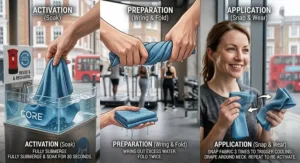
The biggest first-month mistake is treating a cooling towel like a flannel — a quick dunk under the tap rarely activates it properly. Soak it thoroughly for a full minute, wring out the excess rather than leaving it dripping, then give it two or three firm snaps to open up the fabric fibres and kickstart evaporation. Skipping the snap step is the single most common reason people report “it didn’t really work.”
Once it’s cooling, drape it across pulse points — the back of the neck, wrists, or temples — rather than bunching it into a small area, since evaporation needs airflow across the fabric’s surface to keep working. When it stops feeling cool, don’t assume it’s broken; simply re-wet, wring and snap again, and you’ll get another full cycle out of it, often repeatedly through a single day.
For maintenance, machine wash on a cold cycle with similar colours, skip the fabric softener entirely since it coats the fibres and blocks the evaporative properties that make the towel work in the first place, and air dry rather than tumble dry wherever possible to protect the material’s long-term performance. A quick optimisation trick: keep your cooling towel in a small sealed bag in the fridge before a big event — it starts noticeably colder and buys you extra minutes of relief right from the first snap.
Which Cooling Towel Suits Your Activity?
The regular runner: Someone training for a summer half marathon needs a towel that stays comfortably damp rather than dripping mid-stride, and holds its shape tucked into a running belt. The Dock & Bay QuickCool fits that brief neatly, with its dual-layer fabric offering steadier cooling than looser mesh alternatives.
The gym regular doing HIIT: Short, intense bursts of effort followed by brief rest periods reward a towel that cools fast between rounds rather than gradually over an hour. The Mission Enduracool Techknit’s rapid activation suits exactly that stop-start training rhythm.
The all-day outdoor worker or festival-goer: Someone spending eight-plus hours outside, without easy access to a tap for re-soaking, benefits most from the Frogg Toggs Chilly Pad’s extended PVA retention, buying several extra hours between activations compared with microfibre rivals.
Common Cooling Towel Problems, Solved
Problem: it stopped feeling cold after twenty minutes. This is usually just the fabric drying out faster than expected in low humidity or direct sun — solution: re-wet and snap again, and consider a PVA towel if this happens frequently in your climate.
Problem: it dried stiff and cardboard-like. This is specific to PVA towels left to dry flat rather than folded — solution: always fold or loosely roll a PVA towel while it’s still slightly damp before storing it.
Problem: it smells musty after a few uses. Bacteria thrive in fabric left damp in a closed bag — solution: wash regularly with standard detergent and let it fully air dry before storing, rather than sealing it away wet.
Problem: the cooling feels weak even freshly soaked. In very high humidity, evaporation slows dramatically regardless of fabric quality — solution: this is a genuine physical limitation of evaporative cooling, so pair the towel with shade and hydration rather than expecting it to work miracles on a muggy day.
How to Choose the Best Cooling Towel
- Match the material to your use case. PVA cooling towel material suits long, low-intensity days outdoors; microfibre suits shorter, more intense sessions where softness against skin matters more.
- Check the size against how you’ll wear it. A short towel works fine draped over the neck; a longer one, like the YQXCC, wraps more fully around shoulders for broader coverage.
- Consider how often you’ll wash it. Multipacks like Sukeen’s let you rotate towels between washes, useful if you’re using one daily through summer.
- Look at genuine review themes around durability. Aggregated feedback on seam quality and post-wash stiffness tells you far more than a star rating alone.
- Decide whether portability accessories matter to you. A travel pouch and carabiner clip, included with several picks here, genuinely help if the towel lives in a gym bag or rucksack rather than a drawer.
- Factor in your climate and typical humidity. Evaporative cooling is measurably less effective in muggy conditions, so manage expectations if you’re often out in humid weather.
- Weigh cost per towel, not just sticker price. A multipack often beats a single premium towel on value, especially for households or teams sharing kit.
Cooling Towel for Gym and Sports: What to Look For
A cooling towel gym sports bag really needs is one that survives being crammed in wet, alongside trainers and a water bottle, without falling apart. Prioritise machine-washability first — anything that can’t handle a regular wash cycle with your kit isn’t built for genuine gym use. Beyond that, look at how quickly the towel reactivates between sets, since gym sessions involve repeated short bursts of exertion rather than one continuous effort.
Size matters more than people expect here too: a towel long enough to drape fully across both shoulders offers noticeably more relief than a short one that only covers the back of the neck, particularly during circuit training or group classes where you’re moving between stations rather than sitting still. Reviewers consistently rate towels with an included carabiner clip more highly for gym use specifically, purely because it means the towel clips onto a bag rather than getting left on a bench.
Best Cooling Towel for Running: Our Picks Explained
Runners have slightly different needs to gym-goers, chiefly because the towel usually isn’t in active use during the run itself — it’s waiting at a water station, tucked in a belt, or ready at the finish line. For that reason, a towel that holds its cooling charge for longer between soaks, like the Dock & Bay QuickCool, tends to suit runners better than one needing constant reactivation.
Weight and pack size matter enormously too, since anything bulky in a running belt becomes genuinely uncomfortable over distance. On paper, the lighter microfibre options edge out PVA here for pure portability, even though PVA holds moisture longer — the trade-off is worth making for anyone racing rather than working outdoors all day. Post-race, a cooling towel draped over the shoulders while your heart rate settles is a genuinely underrated recovery trick that costs nothing beyond the towel itself.
Reusable Cooling Towel: Longevity and Care
Every product in this guide is a reusable cooling towel by design, which is precisely the appeal over single-use alternatives like disposable cooling wipes. But “reusable” doesn’t automatically mean “indestructible,” and how you treat a towel between uses genuinely determines whether it lasts one summer or five.
The two enemies of longevity are fabric softener, which coats fibres and blunts the evaporative effect over time, and prolonged storage while still damp, which invites mildew and breaks down stitching faster than regular use ever would. Rinse thoroughly after use in chlorinated pool water or sunscreen-heavy conditions, since both residues can degrade fabric performance faster than plain sweat or fresh water. Treated properly, a decent microfibre towel should comfortably survive two to three summers of regular use, while a well-cared-for PVA towel can last considerably longer given its more robust construction.
PVA Cooling Towel Material vs Microfibre: Which Wins?
This is the genuine fork in the road when choosing a cooling towel, and honestly, there isn’t a single correct answer — it depends entirely on what you value. PVA cooling towel material, essentially a synthetic sponge-like fabric, wins decisively on raw water retention and cooling duration, holding multiple times its weight in water and staying active for three to four hours per soak.
What the spec sheet won’t tell you is how different PVA feels in practice: it dries firm rather than soft, and needs specific care to avoid cracking, which some buyers find genuinely off-putting compared with the plush, familiar feel of microfibre. Microfibre towels, by contrast, feel more like a conventional soft towel against skin, dry faster when you want them to, and generally cost less to manufacture — hence their dominance in budget multipacks throughout this list.
The honest verdict: choose PVA if cooling duration and value for money over a full day outdoors matter most to you; choose microfibre if comfort, softness and quick portability for shorter sessions are the priority. Neither is objectively better — they’re simply engineered for different problems.
Instant Cooling Relief Sports: What the Science Says
The phrase “instant cooling relief sports” gets thrown around loosely in marketing, so it’s worth being precise about what’s actually happening. When a wet towel touches warm skin, heat transfers into the fabric’s moisture, which then evaporates into the surrounding air — a physical process that genuinely does lower perceived skin temperature within seconds of contact, not just a placebo sensation.
Independent research has found that cooling towels used during exercise can measurably improve how hot someone perceives themselves to be, which in turn appears linked to improved endurance and performance during hot-weather training. That said, a cooling towel manages perceived heat and comfort — it isn’t a substitute for proper hydration or heat safety during genuinely dangerous conditions. The NHS’s guidance on coping in hot weather is clear that staying hydrated, avoiding exercise during the hottest parts of the day, and cooling your whole body remain the priority during a genuine heatwave, with a cooling towel best used as one part of that strategy rather than the whole solution.
Evaporative Cooling Towel: How It Works
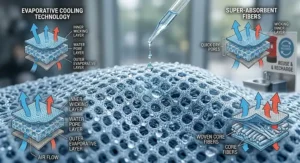
What is an evaporative cooling towel? It’s a fabric engineered to hold water within its fibres and release it slowly as vapour, a process that pulls heat energy from the fabric — and from your skin in contact with it — as the water changes state from liquid to gas.
The physics is genuinely simple once you break it down: evaporation is an endothermic process, meaning it absorbs energy rather than releasing it, and that energy comes from the nearest available heat source, which happens to be your overheated skin. Cooling towel fabrics are specifically engineered — whether PVA’s sponge-like cell structure or microfibre’s mesh weave — to maximise surface area, holding water in a way that promotes steady evaporation rather than one quick, wasteful drip-off.
This is precisely why a bone-dry towel does nothing for you, and why re-wetting a towel that’s fully dried out restores its cooling properties almost instantly — you’re simply reloading the fabric’s capacity to evaporate. It’s also why humidity matters so much: evaporation physically slows down when the surrounding air is already saturated with moisture, which the Met Office’s hot weather guidance touches on when explaining why fans and cooling aids become less effective once temperatures and humidity both climb — the honest, scientific reason cooling towels feel noticeably less effective on a muggy day than on a dry, hot one.
Common Mistakes When Buying a Cooling Towel
The most frequent mistake is buying based on brand recognition alone rather than matching material to actual use case — a premium sports-branded towel is wasted on someone who mostly wants a strip of fabric for the school run, just as a bargain microfibre towel will frustrate an all-day outdoor worker who genuinely needed PVA’s extended retention.
A second common error is ignoring size entirely, assuming all cooling towels are interchangeable — a short 60cm towel that barely reaches around your neck is a very different product from a full 120cm wrap, and the price difference often reflects that, not just branding. Finally, plenty of buyers skip checking wash care instructions until after their first cycle in the washing machine, only to discover fabric softener has already dulled their towel’s performance — checking the label first avoids an entirely avoidable disappointment.
Frequently Asked Questions
❓ How long does a cooling towel actually stay cool?
❓ Can I use a cooling towel every day without it wearing out?
❓ Is a PVA cooling towel material better than microfibre?
❓ Do cooling towels actually work in high humidity?
❓ What's the best cooling towel for running specifically?
Conclusion
A genuinely good cooling towel earns its place in a gym bag or glovebox precisely because it solves a real, physical problem with almost no downside — no batteries, no bulk, just water and fabric doing honest work. Across the seven picks in this guide, the right choice really does come down to how you’ll use it: the Dock & Bay QuickCool for runners who want sustained, steady relief, the Mission Enduracool Techknit for anyone chasing genuinely instant cooling relief sports demand between intense bursts, and the Frogg Toggs Chilly Pad if PVA cooling towel material’s extended staying power matters more to you than a soft, familiar feel.
Budget shouldn’t be a barrier here either — the YQXCC, VAKKI and Amazon Basics options all deliver the same core evaporative science at a fraction of the price, proving this is one category where spending more buys convenience and refinement rather than fundamentally different performance. Whatever you choose, remember it’s one part of staying safe in the heat, not a substitute for shade, water and common sense on a genuinely hot day — the NHS’s advice on heat exhaustion and heatstroke is worth a quick read before any serious summer training block.
Check current prices before you commit, since they shift regularly, and consider picking up a multipack if more than one person in your household is likely to be reaching for it come the next heatwave.
✨ Don’t Miss These Exclusive Deals!
🔍 Take your hot-weather kit to the next level with these carefully selected cooling towels. Click through to check current pricing and availability, and stay properly cool wherever summer takes you!
Recommended for You
- Sports Cooling Shirt 2026: 7 Picks That Beat the Heat
- Best Cooling Work Shirt for Tradesmen in 2026: 7 Top Picks
- Best Short Sleeve Cooling Shirts for Men UK 2026 – 7 Expert Picks
Disclaimer: This article contains affiliate links. As an Amazon Associate, I earn from qualifying purchases. If you purchase products through these links, we may earn a small commission at no additional cost to you.
✨ Found this helpful? Share it with your friends! 💬🤗
