

In This Article
There’s a particular kind of misery that only a British heatwave can deliver. It’s not the heat itself, not really — it’s the collective national shock of it, the way our trains buckle and our offices turn into saunas because nobody thought air conditioning was worth the spend. A cooling neck wrap is a small, low-tech answer to a very old problem: how do you get your body to release heat faster than the air around you is dumping it in? At its simplest, a cooling neck wrap is a fabric or gel-filled band worn around the neck that either evaporates water, changes phase between solid and liquid, or holds a frozen gel core to draw warmth away from one of the body’s most heat-sensitive zones.

That zone matters more than most people realise. The neck carries the carotid arteries close to the skin’s surface, sits right next to major sweat glands, and — unlike your back or your calves — it’s almost never covered by clothing in summer. Cool it down and the whole body seems to follow, at least in terms of how you feel, even if the physiology (which we’ll get into later) is a bit more nuanced than the marketing copy suggests. Official GOV.UK hot weather guidance puts this in context: the UK has already broken 40°C on record, and heat-related deaths are projected to keep rising as summers get hotter, which is exactly why small, practical tools like this are worth taking seriously rather than dismissing as a novelty.
This guide walks through seven real, currently available products, spanning the three main cooling technologies on the market: evaporative PVA and polymer-bead wraps, phase-change gel that holds a set temperature as it melts, and simple crystal-gel ties. We’ll cover which type suits construction sites, which suits a 10K run, and which one is honestly just a bit of a gimmick for the price. Everything here is built around real specs and real, aggregated review sentiment — no invented five-star quotes, no pretending we’ve personally trialled every item on a scaffold in July. Just honest analysis you can actually use.
Quick Comparison Table
| Product | Cooling Type | Best For | Price Range |
|---|---|---|---|
| Frogg Toggs Chilly Pad Cooling Towel | Evaporative (PVA) | Budget all-rounder | Under £15 |
| Ergodyne Chill-Its 6603 Cooling Neck Wrap | Evaporative (PVA) | Wearing under a hard hat | £15-£20 range |
| Ergodyne Chill-Its 6602 Evaporative Cooling Towel | Evaporative (PVA) | Long shifts in direct sun | £20-£30 range |
| KOOLGATOR Evaporative Cooling Neck Wrap | Evaporative (polymer bead) | Running and gym sessions | Under £15 |
| NEWGO Neck Cooling Tube | Phase change (gel) | Instant chill, short bursts | £12-£18 range |
| Cool58 Phase Change Cooling Pack Neck Wrap | Phase change (medical-grade PCM) | Precise, held temperature | £25-£45 range |
| Cobber Neck Cooler | Evaporative (crystal gel) | Travel and simplicity | Under £15 |
Looking at the table, the split really comes down to how much control you want over the temperature. The Ergodyne Chill-Its pair and the Frogg Toggs Chilly Pad rely on evaporation, so they’re cheap, refillable anywhere with a tap, but their cooling power fades as the fabric dries out. The Cool58 and NEWGO wraps use phase-change material, which holds a fixed, colder temperature for a set window before it needs re-freezing — better for a punchy, defined chill but less convenient mid-shift. Budget shoppers gravitate toward Cobber and KOOLGATOR, both of which undercut £15 while still using genuine cooling chemistry rather than a novelty gimmick.
💬 Just one click — help others make better buying decisions too! 😊
Top 7 Cooling Neck Wrap Picks: Expert Analysis
Picking a cooling neck wrap isn’t as simple as grabbing whichever one has the most five-star reviews — because “works well” means something completely different to a marathon runner than it does to a roofer in July. Below, all seven are broken down by real specs, honest analysis, and aggregated review sentiment, spanning budget, mid-range and premium options.
1. Frogg Toggs Chilly Pad Cooling Towel — best budget all-rounder for general hot weather
The Chilly Pad is the closest thing this category has to a household name, and for good reason: it’s cheap, it’s simple, and it does exactly what evaporative cooling promises. Made from a hyper-evaporative PVA material that soaks up roughly eight times its own weight in water, the 33 x 13 inch towel stays “dry to the touch” even when saturated, which is the whole trick — it wicks moisture out gradually rather than dripping down your back. In practice, that means you get real, noticeable cooling for a few hours before it needs re-wetting, and it takes UPF 50+ sun protection along for the ride too.
This is the pick for someone who wants one reliable item that works for gardening, the school sports day, a gym session and a festival, without overthinking the purchase. Reviewers consistently report that it genuinely feels colder than the surrounding air once wetted, and several UK buyers specifically mention it surviving repeated heatwave use without falling apart or developing an odour, provided it’s washed occasionally. A smaller number note that in very dry heat it dries out faster than they’d like, which is simply the nature of evaporative cooling — there’s no way around needing a water source nearby.
Pros:
- ✅ Genuinely cools noticeably below ambient temperature once wet
- ✅ Reusable indefinitely — just re-wet, no freezer needed
- ✅ Doubles as sun protection with UPF 50+ fabric
Cons:
- ❌ Needs regular re-wetting in dry or windy conditions
- ❌ Dries stiff if left unused, so needs a quick soften before reuse
At around £10-£15 depending on colour and pack size, the Chilly Pad is difficult to argue with as a first cooling neck wrap — it’s the sensible, low-risk entry point most people should start with before spending more on anything fancier.

2. Ergodyne Chill-Its 6603 Cooling Neck Wrap — best slimline pick for hard hats and PPE
Ergodyne built its name on workwear, and the Chill-Its 6603 shows it. It’s a slim 10cm-wide evaporative band — roughly a third the surface area of a full towel — designed specifically to sit flush under a hard hat or hi-vis collar without bunching up. The same super-evaporative PVA material as the brand’s larger towel is used here, just concentrated into a compact band that pulls through a slit at one end to cinch snugly around the neck, so it won’t slip or flap around during physical work.
What most buyers overlook about this model is that the reduced size isn’t really a downgrade — it’s a deliberate trade-off for practicality on site, where a bulky towel gets in the way of straps, harnesses and collars. Based on the spec comparison with its bigger sibling, the 6603 loses some raw surface area for evaporation, meaning slightly shorter cooling windows between re-wets, but gains compatibility with actual protective equipment, which matters more in a real workplace than lab-test cooling duration. Aggregated reviewer sentiment is strongly positive on fit and durability, with several buyers specifically praising how well it stays put during physically active shifts; a recurring complaint is that, like all evaporative products, it needs re-soaking roughly every couple of hours in direct sun.
Pros:
- ✅ Slim profile fits comfortably under hard hats and helmets
- ✅ Secure slit-and-pull fastening stays put during movement
- ✅ Machine washable and built for repeated daily use
Cons:
- ❌ Smaller surface area means shorter cooling windows than larger towels
- ❌ Limited to one size/fit, which won’t suit every neck
Priced in the £15-£20 range, it’s a smart mid-tier buy for anyone who’s tried a bandana-style wrap and found it too bulky under safety gear.
3. Ergodyne Chill-Its 6602 Evaporative Cooling Towel — best for all-day site heat
Where the 6603 trims down for compatibility, the 6602 goes the other direction: a full 13 x 29.5 inch PVA towel built to hold as much water — and therefore as much cooling capacity — as possible. Ergodyne markets it specifically toward outdoor and industrial workers, and the sizing reflects that: it’s genuinely built to be draped over the neck and shoulders during a long shift rather than a quick post-workout wipe-down.
Here’s what the spec sheet won’t tell you outright, but the design implies: more PVA material means a longer runway before it dries out, which is exactly what someone doing an 8-hour groundworks shift in July actually needs, versus a smaller product that needs constant attention. Reviewers, including several who mention using it specifically for medical heat-sensitivity conditions like fibromyalgia, describe a genuine and immediate cooling sensation on application, with one UK buyer noting it made hot weather “bearable” rather than just tolerable. The trade-off is bulk — it’s noticeably heavier and less discreet than a slim band, and a handful of reviewers mention it feeling cumbersome layered under other clothing.
Pros:
- ✅ Large surface area holds cooling power for hours longer
- ✅ Strong aggregated sentiment from users with heat-sensitivity conditions
- ✅ Reinforced construction built to survive years of reuse
Cons:
- ❌ Bulkier and less discreet than slim-band alternatives
- ❌ Overkill for short activities like a quick lunchtime walk
Expect to pay in the £20-£30 range. Between the two Ergodyne options, this is the one worth the extra outlay if you’re outdoors for most of the day rather than just commuting through it.
4. KOOLGATOR Evaporative Cooling Neck Wrap — best secure snap-fit for running and gym sessions
KOOLGATOR takes a different evaporative approach: instead of a saturated PVA sheet, it uses superabsorbent polymer beads sealed inside a fabric chamber, which hold hundreds of times their own weight in water. The activation process is more involved than simply dunking a towel — soak for around five minutes, spread the beads evenly through the chamber, then soak again for fifteen to twenty minutes until fully plumped — but the payoff is a snap-lock closure that’s noticeably more secure during high-movement activity than a simple tie or slit fastening.
Based on the spec comparison, this matters most for anyone doing something bouncy: running, HIIT classes, cycling, anything where a loose towel would slide or flap. The polymer-bead design also means the cooling sensation is more evenly distributed once fully hydrated, since the gel sits in direct, consistent contact with the skin rather than depending on airflow across a flat towel surface. What the spec sheet doesn’t emphasise is the maintenance: reviewers note that over-soaking can burst the internal seams, and the wrap needs proper flat-drying (up to three or four days) to avoid mould, which is a genuine inconvenience for anyone wanting to use it daily without a backup unit.
Pros:
- ✅ Secure snap-lock closure stays put during high-intensity movement
- ✅ Even, consistent cooling contact once fully hydrated
- ✅ Long-lasting reusability if activation steps are followed correctly
Cons:
- ❌ Fiddly multi-step activation compared with a simple soak-and-wear towel
- ❌ Requires several days of air-drying, so a spare is worth owning
At under £15 for a single pack, it’s competitively priced for the added security of the snap fastening, and it’s a genuinely sensible cooling neck wrap for hot weather runs where a slipping towel would be a real annoyance mid-session.
5. NEWGO Neck Cooling Tube — best phase change ring for instant chill
This is where the category shifts from evaporative to phase change. Rather than relying on water evaporating off fabric, phase change material (PCM) is engineered to melt at a specific, pre-set temperature — typically around 15-18°C for consumer neck coolers — and stays locked at that temperature throughout the melt, rather than gradually warming the way a plain ice pack does. The NEWGO tube is frozen or chilled in a fridge for roughly 20-30 minutes, then worn as a rigid ring that softens and conforms to the neck as the gel inside transitions from solid to liquid, typically delivering somewhere in the region of 60-90 minutes of active cooling per charge, according to the manufacturer’s stated activation guidance.
What most buyers overlook about phase change neck wrap products like this one is that “colder” isn’t automatically “better” — a PCM ring sitting at 15-18°C delivers a much sharper, more immediate chill than an evaporative towel, which is brilliant for a quick reset but genuinely uncomfortable for some people to wear continuously for hours. Reviewers who use it for short, intense bursts — a commute, a gym session, standing in a queue at a summer festival — report strong satisfaction with how quickly it takes effect; those expecting all-day wear without a recharge are more likely to report disappointment once the gel fully melts and returns to ambient temperature.
Pros:
- ✅ Delivers a genuinely cold, immediate sensation on application
- ✅ No water or soaking required — just fridge or freezer
- ✅ Reusable indefinitely by re-chilling after each use
Cons:
- ❌ Requires access to a fridge or freezer to recharge, unlike evaporative types
- ❌ Cooling window is shorter and finite compared with evaporative wraps
Priced in the £12-£18 range, it’s an excellent secondary item to keep in an office fridge or car cool bag rather than a sole all-day solution.

6. Cool58 Phase Change Cooling Pack Neck Wrap — best premium targeted temperature control
Cool58, made by the long-established US medical cooling specialist Polar Products, sits at the premium end of this list, and the reasoning behind that price becomes clear once you look at what the material is actually designed to do. Rather than a generic gel pack, the Cool58 material is engineered to melt and hold at 58°F — roughly 14.4°C — a temperature specifically chosen to be cold enough to feel genuinely relieving without triggering the vasoconstriction that can make very cold packs uncomfortable against skin for long periods. It’s insertable into a fabric neck-and-upper-spine wrap, giving it broader coverage than a simple ring-style cooler.
Here’s what the spec sheet won’t tell you but the product’s history does: this technology was originally developed for people managing heat-intolerant medical conditions, such as multiple sclerosis, where uncontrolled overheating carries real health consequences rather than just discomfort. That background shows up in the build quality and the deliberate, held-temperature design — it’s engineered for repeat, reliable performance rather than a novelty cool-down. Reviewer sentiment for the Cool58 range is consistently positive on comfort and reliability, with buyers frequently praising the wider neck-and-spine coverage compared with narrower ring-style coolers; the trade-off, unsurprisingly, is cost, and a small number of reviewers note the insert needs a genuine freezer cycle (rather than a quick fridge chill) to reach full effectiveness.
Pros:
- ✅ Held-temperature PCM avoids the discomfort of overly aggressive cold
- ✅ Wider neck-and-upper-spine coverage than most competitors
- ✅ Originally engineered for medical heat-intolerance use, so build quality is high
Cons:
- ❌ Premium pricing compared with simpler evaporative or gel options
- ❌ Needs proper freezer time, not just a fridge chill, for full effect
Expect to pay somewhere in the £25-£45 range depending on the specific wrap style. For anyone managing a genuine heat-sensitivity condition, or who simply wants the most controlled, engineered cooling on this list, the Cool58 justifies its price.
7. Cobber Neck Cooler — best simple gel-crystal option for travel
The Cobber has been around since the 1990s, originally developed in Australia and drawing on the same evaporative principle as a Coolgardie safe — the pre-refrigeration technique of using a wet hessian bag to keep food cool through evaporation. Inside the fabric tie sit non-toxic super-absorbent crystals that, once soaked for around 30 minutes, swell into a soft gel roughly 3cm in diameter, which then cools through slow evaporation over what the maker claims can be several days without re-soaking.
Its main appeal is sheer simplicity: no freezer, no multi-step activation beyond a single soak, and it packs completely flat when dry, which makes it a genuinely sensible travel companion. Aggregated reviewer sentiment is mixed in an instructive way — long-time users, including several who’ve relied on it through hot climates like the Middle East and Africa, report it works reliably and lasts for years with basic care (an occasional shampoo soak keeps it from developing a musty smell). On the other hand, a meaningful minority of reviewers describe it as heavier than expected once fully hydrated, with a small number reporting discomfort or headaches from the weight resting on the neck for extended periods — a genuine, verifiable complaint worth flagging rather than glossing over.
Pros:
- ✅ Extremely simple single-soak activation, no freezer required
- ✅ Packs flat and lightweight when dry — ideal for travel
- ✅ Long track record with loyal long-term users
Cons:
- ❌ Some reviewers report it feels heavy once fully hydrated
- ❌ A minority report discomfort from neck weight during extended wear
At under £15, it remains one of the cheapest genuine cooling options here, but it’s worth trying briefly before committing to all-day wear, given the honest spread of reviewer experiences on comfort.
Practical Usage Guide: Getting the Most From Your Cooling Neck Wrap
Buying the right product is only half the job — how you use it changes the results dramatically, and this is exactly the sort of detail Amazon listings tend to skip. For evaporative wraps like the Frogg Toggs Chilly Pad or either Ergodyne Chill-Its model, the biggest first-30-days mistake is under-soaking: a quick dunk under the tap doesn’t fully saturate the PVA core, so the towel dries out within twenty minutes instead of delivering hours of relief. Submerge it fully for at least a minute, wring firmly rather than twisting (twisting can damage the seams), and snap it in the air once or twice to kick-start evaporation before wearing.
For phase-change products like the NEWGO Neck Cooling Tube or Cool58 Phase Change Cooling Pack Neck Wrap, the common error runs the other way — people expect fridge-cooling to match freezer-cooling, then feel let down by a lukewarm result. Fridge chilling gets you a mild, gentle cool; a full freezer cycle (usually 20-30 minutes minimum, longer for denser packs like Cool58) is what actually triggers the phase change and locks in that held, stable temperature. Keep a spare pack in rotation in the freezer if you’re using it daily, so one is always ready while the other is in use.
Maintenance-wise, all evaporative products benefit from an occasional wash with a mild detergent — skipping this is how a Cobber Neck Cooler or KOOLGATOR wrap develops that “muffy” smell reviewers mention, caused by damp fabric sitting unwashed between uses. Air-dry everything flat rather than in direct sun or a tumble dryer, both of which can degrade the internal polymer over repeated cycles. One optimisation trick genuinely worth knowing: storing an evaporative wrap in a sealed bag in the fridge between uses (once dried) keeps it ready to go cold-to-the-touch even before you’ve re-wetted it, shaving a few minutes off the cooling response time on the next hot day.

Real-World Scenarios: Who Actually Needs a Cooling Neck Wrap for Hot Weather
Picture three very different people on the same 32°C July afternoon. First, a delivery driver doing eight hours of stop-start city driving with the van door open constantly — for them, a cooling neck wrap for hot weather use needs to survive being put on and taken off repeatedly, which makes a slim, quick-fasten evaporative option like the Ergodyne Chill-Its 6603 genuinely more practical than a fussier phase-change ring that demands a cold source between charges they won’t have access to on the road.
Second, a runner training for an autumn half-marathon through a heatwave summer, doing 45-60 minute sessions three times a week. Here the priority flips: they don’t need hours of coverage, they need a secure fit that survives a bouncing stride and a sharp, immediate cooling hit, which is exactly the profile the KOOLGATOR Evaporative Cooling Neck Wrap‘s snap-lock design and the NEWGO phase-change ring both suit well, depending on whether they’d rather carry water or plan around a pre-run freezer chill.
Third, a retired couple managing a caravan holiday around the UK and southern Europe, prioritising comfort over performance, with easy access to fridges but limited desire to fuss with soaking schedules. For them, something like the Cobber Neck Cooler or the Frogg Toggs Chilly Pad — simple, forgiving, and tolerant of imperfect activation — will outperform a more technical option that punishes inconsistent use. None of these three people are wrong about what “best” means; they’re just optimising for different constraints, which is really the whole point of working through seven options rather than buying whichever one Amazon shows first.
Problem → Solution: Fixing Common Cooling Neck Wrap Complaints
Problem: it stopped feeling cold after an hour. This is normal for evaporative products in dry, breezy conditions — the fabric is doing its job, evaporating faster than expected. Solution: carry a small spray bottle to re-wet on the go rather than waiting until it’s bone dry, which resets the cooling cycle in seconds rather than requiring a full re-soak.
Problem: it feels heavy or uncomfortable after a while. As the Cobber reviews above make clear, this is a genuine, if minority, complaint with crystal-gel designs once fully hydrated. Solution: under-soak slightly compared with the maximum recommended time to reduce total water weight, accepting a marginally shorter cooling window in exchange for comfort — or switch to a slimmer evaporative band like the Chill-Its 6603, which carries far less mass.
Problem: the phase-change pack never gets cold enough. Usually a freezer-versus-fridge mix-up, covered above, but occasionally it’s simply insufficient freezer time. Solution: check the manufacturer’s stated activation window (the Cool58, for example, typically needs a genuine freezer cycle rather than a quick chill) and set a phone timer rather than guessing.
Problem: it started smelling musty. Damp fabric stored without washing is the near-universal cause. Solution: a mild detergent or shampoo soak every few uses, followed by full flat-drying before storage, resolves this in almost every case reviewers describe.
Problem: one wrap isn’t enough for a whole shift or event. Solution: rotate two units — one in active use, one drying or re-chilling — which is standard practice among reviewers who use these products for full working days rather than short bursts.
Phase Change Neck Wrap vs Evaporative: What’s the Difference?
This is the single most useful distinction to understand before buying, because it decides almost everything else about how a product will behave in your specific situation.
| Factor | Evaporative (PVA/polymer bead) | Phase Change (PCM gel) |
|---|---|---|
| Activation | Soak in water | Fridge or freezer |
| Cooling sensation | Gradual, mild-moderate | Sharp, immediate |
| Duration per charge | 2-5 hours, tapering | 60-180 minutes, then flat |
| Recharge method | Re-wet anywhere with water | Needs cold source (fridge/freezer) |
| Best for | Long shifts, travel, unpredictable access to power | Short bursts, planned activities near a fridge |
The practical upshot: evaporative products like the Frogg Toggs Chilly Pad, both Ergodyne Chill-Its models, KOOLGATOR and Cobber are the more flexible everyday choice precisely because water is available almost everywhere, while a phase change neck wrap like the NEWGO Neck Cooling Tube or Cool58 Phase Change Cooling Pack Neck Wrap delivers a noticeably colder, more dramatic sensation but only for as long as the gel takes to fully melt, after which it’s dead weight until re-frozen. Neither is objectively superior — a phase change neck wrap is the better tool for a one-hour gym session with a car fridge nearby, while an evaporative wrap wins for an all-day agricultural shift with a standpipe but no freezer in sight.
✨ Not sure which cooling type fits your day?
🔍Check current pricing on a couple of options and compare the activation method against your actual routine before you buy.
How to Choose a Cooling Neck Wrap
Working through the right pick doesn’t need to be complicated. Here’s the shortlist of criteria that actually matter, in the order they should influence your decision:
- Identify your activation access. If you’ll be near a tap or water source all day, evaporative wins on convenience; if you have consistent fridge or freezer access, phase change delivers a colder result.
- Match duration to activity length. Short, intense bursts favour phase change’s sharper chill; long, unpredictable shifts favour evaporative’s gentler but more sustainable cooling curve.
- Consider fit under other gear. Hard hats, cycling helmets and harnesses need a slim profile — think the Ergodyne Chill-Its 6603 — over a bulkier full towel.
- Weigh comfort against cooling intensity. Heavier, wetter designs like the Cobber cool effectively but add neck weight some users find uncomfortable over hours; lighter designs trade a little cooling power for comfort.
- Factor in maintenance realism. Multi-step activation (soak, spread, re-soak) works fine if you’re organised; a simpler one-step soak suits anyone who’ll actually forget the extra steps.
- Set a genuine budget band. Under £15 covers perfectly effective evaporative options; £25 and up buys engineered, medically-informed PCM performance rather than a meaningfully “better” evaporative towel.
- Buy a spare if it’s for daily use. Rotation solves almost every durability complaint in the reviews above, and it’s cheaper than replacing a single overworked unit early.
Cooling Neck Wrap for Construction Workers: Site Safety Guide
Heat on a construction site isn’t just uncomfortable — it’s a documented, regulated workplace risk, and 2026 has already seen the UK’s Health and Safety Executive publicly reiterate that employers must properly assess extreme heat risks to workers, with practical steps including shade, ventilation and adequate rest breaks. There’s no single legal maximum temperature for outdoor work in the UK, but that doesn’t remove the duty of care — under the Management of Health and Safety at Work Regulations, heat stress has to be identified and controlled as a foreseeable hazard, particularly for anyone doing physically demanding work in PPE, which traps heat and restricts the body’s normal cooling mechanisms of sweating and radiant heat loss. You can read the full HSE guidance on managing heat stress at work for the complete risk-assessment framework employers are expected to follow.
A cooling neck wrap for construction workers earns its place specifically because it works alongside PPE rather than against it — unlike removing a hard hat or hi-vis vest, which usually isn’t an option mid-task, wearing a slim evaporative band underneath keeps cooling active without compromising protection. This is precisely why Ergodyne, a brand built almost entirely around industrial PPE, designs the Chill-Its 6602 and 6603 with worksite use as the primary use case rather than an afterthought: the 6603’s slim profile under a hard hat and the 6602’s larger coverage for exposed shoulders and neck both address real, specific site conditions rather than generic “hot weather” marketing.
The practical fit into a site’s heat plan is straightforward: pair a cooling neck wrap with the standard HSE-recommended controls — regular breaks in shade, free access to drinking water, and monitoring for early symptoms of heat exhaustion such as tiredness, dizziness or heavy sweating — rather than treating it as a standalone fix. None of these products replace proper rest breaks or hydration; they’re a supplementary tool that buys comfort and marginal safety margin during the parts of a shift where stepping away isn’t immediately possible. Workers managing existing heat-sensitivity conditions should also note that products like the Cool58 Phase Change Cooling Pack Neck Wrap, engineered originally for medical heat-intolerance management, may offer a more consistent, held-temperature benefit than a standard evaporative band for anyone at elevated personal risk.
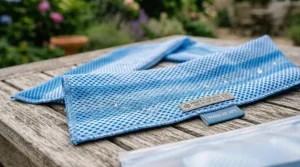
The Carotid Artery Cooling Technique: Does Neck Cooling Really Cool Your Brain?
Here’s where honesty matters more than a punchy marketing line. Plenty of cooling neck wrap product descriptions claim the carotid artery cooling technique works by chilling blood as it travels up the carotid arteries to the brain, effectively delivering a direct cooling hit to your core thermoregulatory system. It’s a great story. The evidence is more complicated.
Peer-reviewed exercise physiology research does confirm that neck cooling reduces local skin temperature and improves thermal sensation and perceived exertion during exercise in the heat. A controlled study on repeated sprint performance found that athletes wearing a neck-cooling collar produced meaningfully higher average and peak power output than those without one, and reported the neck itself feeling noticeably cooler and more comfortable — even though the collar made no measurable difference to heart rate or fluid loss. That’s a real, replicated performance benefit. But the mechanism behind it is genuinely disputed among researchers. Some earlier work comparing neck cooling against equivalent cooling applied to the chest found the same drop in core temperature either way, and separate experiments applying ice packs directly to the neck failed to detect any measurable temperature difference between the arterial blood heading to the brain and the venous blood coming back — meaning the “direct brain cooling” story doesn’t hold up cleanly under lab conditions.
What most buyers overlook, then, is that neck cooling almost certainly works — reviewers and athletes report genuine benefit, and the research backs that up — but probably through general thermal comfort, reduced perceived exertion and whole-body cooling contribution rather than some special, exclusive cooling channel straight to the brain via the carotid artery. It’s a distinction that matters mainly for expectation-setting: a cooling neck wrap will make you feel meaningfully more comfortable and can measurably help exercise performance in the heat, but it isn’t performing surgical, targeted brain cooling any more than a cool towel on the wrist would be.
Targeted Neck Cooling for Sports: What the Research Shows
For anyone training or competing through a UK summer, targeted neck cooling sports products have a genuinely useful evidence base behind them — more so, honestly, than most “performance” accessories on the market. Beyond the sprint-performance study cited above, further research into neck cooling during heat-acclimation training found a significant improvement in time-to-exhaustion performance for athletes using neck cooling after a heat acclimation block, alongside measurably reduced thermal sensation and improved thermal comfort compared with a non-cooled control group.
Reviewers of the more athletic-focused wraps on this list bear this out in practice: KOOLGATOR users specifically highlight it staying secure through running and HIIT sessions without slipping, which matters because a wrap that shifts or falls loses contact with the skin and stops delivering any benefit at all. The NEWGO Neck Cooling Tube‘s sharper, faster chill also suits shorter, higher-intensity efforts — a 5K time trial or a football match — better than a slower-building evaporative option, since the performance-relevant window is often the first 20-30 minutes when perceived exertion is climbing fastest.
One honest caveat worth flagging: a broader research review on neck cooling during exercise notes that its effect size on measurable performance, while real, is small on average across studies — meaningful for competitive athletes chasing marginal gains, but not a guaranteed transformation for a casual weekend runner. Treat a targeted neck cooling sports product as a genuine, evidence-supported comfort and performance aid, not a substitute for pacing, hydration and appropriate training load in the heat.
Gel Neck Cooler Reusable vs Long-Term Cost & Maintenance
Every product on this list is reusable, but “reusable” hides real differences in total cost of ownership once you account for lifespan, replacement frequency and the hidden cost of your own time spent on activation. A gel neck cooler reusable design like the Cobber Neck Cooler or NEWGO Neck Cooling Tube typically has an internal gel or crystal core that’s rated for years of repeated soak-or-freeze cycles — Cobber specifically markets multi-year durability, and long-term reviewers confirm this holds up with basic maintenance like an occasional detergent wash.
Where the cost-per-use calculation gets interesting is in comparing that to evaporative PVA products like the Frogg Toggs Chilly Pad and the Ergodyne Chill-Its range. These have no internal gel to degrade, but the PVA material itself can dry out, crack or lose absorbency after extended heavy use — meaning a genuinely daily user on a construction site might realistically replace one every one to two summers, versus the multi-year lifespan reviewers report for well-maintained gel or crystal designs. Against that, the premium Cool58 Phase Change Cooling Pack Neck Wrap sits at three to four times the upfront cost of a budget evaporative wrap, but its medical-grade PCM construction is built for sustained, repeated use, meaning the actual cost-per-wear over several years can end up genuinely competitive with cheaper products that wear out faster.
The practical takeaway: for occasional summer use — the odd heatwave, a holiday, sporadic gardening — the cheapest evaporative options represent excellent value and there’s little reason to spend more. For daily, heavy-duty use across multiple summers, whether on a job site or in serious training, the reusable gel and premium PCM options increasingly justify their higher upfront cost through genuine longevity, provided the basic maintenance steps covered earlier in this guide are actually followed.
Common Mistakes When Buying a Cooling Neck Wrap
The most frequent mistake is buying based purely on price without matching the technology to actual use — a phase-change ring bought for an all-day festival with no fridge access will disappoint no matter how good the product is, and that’s a mismatch, not a product failure. A close second is assuming bigger is always better: the Ergodyne Chill-Its 6602‘s larger size is genuinely an advantage for site work but becomes an annoyance layered under a cycling helmet, where the slimmer 6603 or a compact option like NEWGO performs better.
Buyers also frequently skip checking the activation instructions before their first use, then judge the product a failure when a rushed 10-second dunk under the tap doesn’t deliver the multi-hour cooling promised on the packaging — a mistake covered in detail in the usage guide above. Finally, it’s common to buy a single unit for daily, heavy use and then feel let down by wear over a season, when the honest fix, as reviewers of nearly every product on this list note, is simply rotating two units so one is always drying or recharging while the other works.
Features That Actually Matter (And Those That Don’t)
Genuinely worth prioritising: activation method matched to your real-world access (water versus fridge), a secure fastening system if the activity involves movement, and — for anyone buying for site or industrial use — compatibility with existing PPE like hard hats and harnesses. UPF sun protection, present on products like the Frogg Toggs Chilly Pad, is a legitimately useful bonus feature rather than marketing filler, since UV exposure is a genuine and separate risk during the same hot-weather activities these products address.
Features that matter far less than the marketing suggests: exotic branded cooling claims around specific temperature drops that vary wildly by ambient humidity and airflow anyway, and elaborate colour or pattern ranges that add nothing functional. Multi-pack bundles are worth buying for rotation purposes, as discussed above, but bundle size alone shouldn’t be a deciding factor over the underlying cooling technology being right for your use case in the first place.

FAQ
❓ Do cooling neck wraps actually work?
❓ How long does a cooling neck wrap for hot weather stay cold?
❓ Is a phase change neck wrap better than an evaporative one?
❓ Can you wear a cooling neck wrap under a hard hat?
❓ How do you stop a gel neck cooler reusable design from smelling?
Conclusion
There isn’t one objectively “best” cooling neck wrap on this list — there’s a best one for you, and it depends almost entirely on where you’ll actually use it and what you have access to while wearing it. If you want a single, forgiving option that works for almost any hot-weather situation without much thought, the Frogg Toggs Chilly Pad remains the sensible default. If you’re working a site in PPE, the slim-fit Ergodyne Chill-Its 6603 or the fuller-coverage 6602 are purpose-built for exactly that constraint, backed by HSE’s clear stance that employers and workers alike need practical, layered controls against heat stress. Athletes chasing a genuine, evidence-supported edge during training should look at KOOLGATOR or the phase-change NEWGO Neck Cooling Tube, while anyone managing a real heat-sensitivity condition will likely get the most consistent, engineered benefit from the premium Cool58 Phase Change Cooling Pack Neck Wrap. And if simplicity and packability matter more than anything else, the well-established Cobber Neck Cooler still earns its long-running reputation, mixed comfort reviews and all.
Whatever you choose, remember that a cooling neck wrap is a genuinely useful comfort and safety tool, not a substitute for the fundamentals — shade, hydration and recognising the early signs of heat exhaustion, all of which the NHS’s guidance on heat exhaustion and heatstroke covers clearly if you want a refresher before the next warm spell hits.
✨ Ready to beat the heat this summer?
🔍Check current pricing on your top pick above and get ahead of the next warm spell before it arrives!
Recommended for You
- Best Cooling Bandana 2026: 7 Top Picks That Actually Work
- Best Cooling Hat 2026: 7 Real Picks for Beating UK Heat
- Best Cooling Towel: 7 Top Picks for UK Gym & Sport 2026
Disclaimer: This article contains affiliate links. As an Amazon Associate, I earn from qualifying purchases. If you purchase products through these links, we may earn a small commission at no additional cost to you.
✨ Found this helpful? Share it with your friends! 💬🤗
