
In This Article
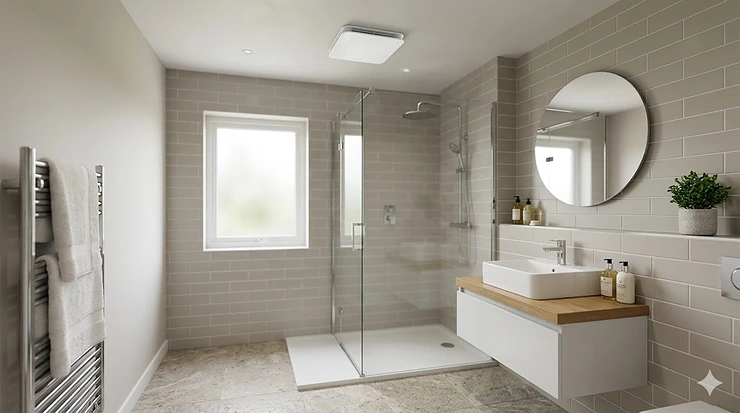
There’s a damp truth lurking above most British bathrooms: a bathroom ceiling extractor fan that’s too weak, too loud, or simply not suited to the space is worse than useless. It’s a false economy. You end up with peeling wallpaper, mould creeping along the grout lines, and that particular musty smell that no amount of reed diffusers will fix.
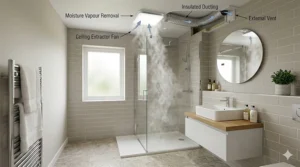
Britain isn’t famous for its Mediterranean climate, and that matters enormously here. We spend around six months of the year in damp, grey drizzle — and when the cold air outside meets the steamy interior of a freshly-used shower, condensation doesn’t so much drift as pour onto your surfaces. A properly specified bathroom ceiling extractor fan is one of the few home upgrades that genuinely earns back its purchase price in prevented damp repairs.
So what exactly is a bathroom ceiling extractor fan? Simply put: it’s a ventilation unit installed flush into (or surface-mounted on) your bathroom ceiling, designed to draw moist, stale air upward and out through ducting to the exterior of the building. Ceiling mounting is often preferred over wall fitting in modern UK homes because it pulls hot, humid air from where it naturally rises — straight up — rather than fighting the physics.
Under UK Building Regulations Approved Document F, every bathroom requires adequate mechanical ventilation capable of extracting at a minimum of 15 litres per second (intermittent) or 8 litres per second (continuous). The 2026 edition of Approved Document F, coming into force for new work from March 2027, tightens energy efficiency requirements further — so if you’re renovating now, it pays to buy ahead of the curve.
This guide covers seven of the best options currently available on Amazon.co.uk, across budget, mid-range, and premium tiers, with honest commentary on what each one is actually like to live with.
Quick Comparison Table: Top 7 Bathroom Ceiling Extractor Fans at a Glance
| Product | Type | Extraction Rate | Noise Level | Key Control | Price Range | Best For |
|---|---|---|---|---|---|---|
| Vent-Axia VASF100T | Axial | 15 l/s | ~16 dB | Timer | £30–£50 | Most UK bathrooms |
| Xpelair DX100BTS | Axial | 15–21 l/s | ~26 dB | Timer + twin speed | £20–£35 | Budget-conscious buyers |
| Airflow iCON 15 | Axial recessed | 19 l/s | <25 dB | Modular (sold separately) | £35–£55 | Flush ceiling installs |
| CubeTECH CTQF100t | Axial | 25 l/s | 32 dB | Timer | £25–£40 | Style-focused buyers |
| Vent-Axia Lo-Carbon Quadra HTP | Centrifugal | 60 l/s (high) | 50 dB (high) | Humidity + Timer + Pullcord | £65–£95 | Large bathrooms & kitchens |
| AIR 6 Cloud-100T | Axial | 26.5 l/s | ~27 dB | Timer | £40–£60 | High-performance mid-budget |
| Bosch 1500 DH | Axial | ~15 l/s | ~33 dB | Humidistat + Timer | £40–£65 | German-engineered reliability |
The table reveals a clear pattern: axial fans at the 15–19 l/s range comfortably cover most UK domestic bathrooms, while centrifugal models like the Quadra HTP are best reserved for larger or windowless rooms where Approved Document F demands higher purge rates. The budget gap between the Xpelair and the Vent-Axia Silent is genuinely small — the question isn’t whether you can afford the better fan, but whether you can afford not to have it.
💬 Just one click — help others make better buying decisions too! 😊
✨ Don’t Miss These Exclusive Deals!
🔍 Ready to clear the steam? Click any highlighted product name to check current pricing and real-time availability on Amazon.co.uk. Prices change frequently, so it’s always worth a look before you buy.
Top 7 Bathroom Ceiling Extractor Fans: Expert Analysis
1. Vent-Axia VASF100T Silent Fan with Timer (446659B) — The Nation’s Favourite for Good Reason
Vent-Axia has been making extractor fans in Britain since 1936, and the VASF100T represents the quiet, unfussy confidence of a brand that knows exactly what it’s doing. This is an axial 100mm fan rated at 15 litres per second — which hits the minimum intermittent extract rate for UK bathrooms under Approved Document F — but the spec sheet undersells it. What you actually get is a fan so beautifully unobtrusive that ceiling-mounted buyers consistently describe it as “the least ugly bathroom fan I’ve ever seen.”
The IPX5 water-resistance rating and Zone 1 certification mean it can be installed directly over a bath or shower enclosure — something many cheaper fans cannot claim. Its integrated overrun timer keeps extracting for an adjustable period after the light goes off, giving it time to finish the job properly. Variable speed is selectable at installation.
This is the fan I’d recommend to a friend buying for a standard UK semi-detached: it’s efficient, genuinely quiet in use, and a respected electrician’s choice across the country. At 230V/50Hz with a UK-compatible wiring setup, there are zero compatibility headaches.
UK buyers consistently praise the slim, flush finish. The minor grumble from some reviewers: this newer version is occasionally described as a touch noisier than the previous iteration — worth noting if you’re upgrading an older Vent-Axia and expecting an exact match.
✅ IPX5 / Zone 1 rated — suitable above baths and showers
✅ Adjustable overrun timer; up to 40,000 hours motor life
✅ Slim flush profile blends into plasterboard ceilings
❌ Slightly pricier than no-name alternatives
❌ Some reviewers note a soft hum compared to older VASF models
Around £30–£50 on Amazon.co.uk. Prime-eligible; next-day delivery available in most areas. Excellent long-term value — the motor guarantee and brand reliability make it worth every penny over a £15 unknown.
2. Xpelair DX100BTS Simply Silent Bathroom Extractor Fan — The Sensible Budget Choice
The DX100BTS is Xpelair’s flagship domestic extractor, and it earns its “Simply Silent” branding with reasonable honesty — Ghost Air Movement Technology reduces operational noise substantially for a fan in this price bracket. Two selectable speeds (delivering either 15 or 21 litres per minute, selectable at installation) give you a degree of flexibility that some pricier rivals don’t offer. The 100mm square format sits neatly in walls or ceilings, and it’s IPX4 rated for bathroom wiring zones.
Here’s the practical angle: if you’re fitting a fan in a smaller en suite or downstairs WC in a terraced house — where the duct run is short and the room is modest — you don’t necessarily need to spend more. The DX100BTS does the job cleanly, comes with a wall-fitting kit, and carries a two-year guarantee from a brand with over 60 years in UK ventilation.
What Xpelair’s spec sheet won’t tell you is that the twin-speed feature is meaningfully useful in British conditions: run it on low speed overnight in winter to continuously manage condensation without the heat loss of a full-power fan.
UK customer feedback on Amazon highlights ease of installation as a standout strength — consistently described as a job manageable by competent DIYers, though remember: any work on mains electrical circuits in a bathroom must be done by a qualified electrician or notified to your local authority under Part P of the Building Regulations.
✅ Ghost Air Movement Technology — quieter than spec suggests
✅ Twin speed selectable at install; IPX4 rated
✅ Includes wall-fitting kit; 2-year guarantee
❌ IPX4 (not IPX5) — check zone placement before installing near shower
❌ Plastic build feels less premium than glass-faced rivals
In the £20–£35 range on Amazon.co.uk. Often Prime-eligible with next-day delivery. The best-value pick for most standard UK bathrooms on a tighter budget.
3. Airflow iCON 15 Bathroom Extractor Fan — Built for Flush Ceiling Installations
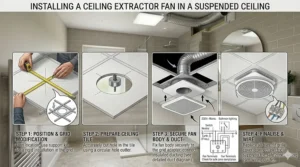
The Airflow iCON 15 occupies a clever niche: it’s engineered specifically with recessed ceiling mounting in mind, making it the go-to choice if you’re installing into a suspended ceiling or want a truly flush, near-invisible finish. The cantilever fixing lugs grip uneven surfaces, which is a quietly brilliant feature in older UK properties where nothing is ever perfectly level.
At 9.4 watts and 19 litres per second, it’s one of the most energy-efficient 100mm fans on the market — compliant with the Specific Fan Power (SFP) requirements under Approved Document F, which increasingly matter if you’re working on a new build or substantial renovation. The iris shutter is beautifully designed: it opens and closes automatically, preventing cold draughts from reversing down the duct when the fan’s off (a real nuisance in winter, particularly in draughty Victorian terrace properties).
The modular control system is the iCON 15’s party piece. The base unit is sold without controls — you then select the module you need (timer, humidistat, PIR, or pull cord), sold separately. This sounds fiddly on paper, but in practice it means you’re never paying for features you don’t need, and you can retrofit a humidistat module later if your needs change.
UK buyers in period properties and new builds alike rate this highly. The main caveat: account for the cost of the control module in your budget, as the base price doesn’t reflect the full outlay.
✅ Ultra-low energy (9.4W), SFP-compliant, iris backdraught shutter
✅ Cantilever lugs for easy recessed ceiling installation
✅ Modular controls — buy only what you need
❌ Control modules sold separately — total cost can surprise
❌ 19 l/s may feel underpowered in large, steamy family bathrooms
Base unit in the £35–£55 range; control modules additional. Available on Amazon.co.uk with Prime delivery. Best for renovation projects where a truly flush ceiling finish is the priority.
4. CubeTECH CTQF100t Smart LED Bathroom Extractor Fan — The Style-Conscious Upgrade
At first glance the CubeTECH CTQF100t looks like it belongs in a design-led new-build rather than a standard UK bathroom — and that’s rather the point. Available in stainless steel and white glass finishes, it offers airflow of 90m³/h (25 litres per second) and a rated noise level of 32 dB, which in practice is closer to a gentle hum than true silence. The slim 39mm profile and LED indicator make it genuinely attractive ceiling kit.
The 10-watt power consumption is impressively low for its extraction rate. The adjustable delay timer (two to 30 minutes) is set at installation and keeps running after the light switches off — essential for British bathrooms where morning showers before work generate serious volumes of steam that need more than 30 seconds to clear.
What most buyers overlook: the glass or stainless face wipes clean in seconds. If you’ve ever wrestled yellowing plastic louvres off an old extractor fan with a screwdriver and mild despair, you’ll understand why this matters. For bathrooms with modern tiling and minimalist aesthetics, the CubeTECH doesn’t fight the décor.
Some Amazon UK reviews flag noise levels as marginally higher than expected — real-world experiences vary, and the 32 dB figure is measured at 3 metres under controlled conditions. Worth keeping realistic expectations. This is a small business brand, which also means customer service can be more responsive than a corporate giant.
✅ High airflow (90m³/h) at only 10W — excellent efficiency ratio
✅ Glass or stainless steel finish; wipe-clean surface
✅ Adjustable timer (2–30 min); wall or ceiling mountable
❌ Some buyer reports of real-world noise exceeding the claimed spec
❌ LED feature adds little practical value; could feel gimmicky
In the £25–£40 range on Amazon.co.uk. Small business brand, Prime-eligible in many configurations. Best for style-focused buyers who also want strong airflow on a reasonable budget.
5. Vent-Axia Lo-Carbon Quadra HTP — The Heavy Hitter for Large or Windowless Rooms
Where the other fans in this list are polite, the Lo-Carbon Quadra HTP is decisive. This centrifugal fan delivers a maximum 60 litres per second at high speed — four times the minimum requirement for a standard bathroom — making it the appropriate choice for large family bathrooms, open-plan wet rooms, or any space with no external wall (where Approved Document F requires purge ventilation at 4 air changes per hour). It’s also the right tool for combined bathroom-utility rooms or larger en suites where smaller axial fans simply can’t move enough air.
Centrifugal fans work differently to axial models: rather than pushing air straight through, the impeller spins air outward, generating pressure that overcomes resistance in longer duct runs. If your duct run to the exterior is more than two metres with bends, an axial fan loses meaningful performance — the Quadra doesn’t.
The integrated humidistat, overrun timer, and pull cord give you three independent control methods, any of which can activate the boost speed. Low speed is selectable between 6, 9, and 12 l/s (continuous background ventilation); high speed between 15, 30, and 60 l/s. That breadth of adjustment makes it suitable for Building Regulations continuous ventilation strategies as well as intermittent use.
The trade-off is noise: 50 dB at high speed is audible — think of it as a firm, purposeful whoosh rather than a whisper. For a master bathroom in a house where you won’t be sleeping next to it, fine. For a compact en suite off the bedroom, perhaps not ideal.
✅ 60 l/s centrifugal power — handles long duct runs and large rooms
✅ Humidistat + timer + pull cord; continuous or intermittent modes
✅ Filterless; 5-year motor guarantee; suitable for flush or surface mounting
❌ 50 dB at high speed — not a silent fan
❌ More expensive than axial alternatives; larger footprint
In the £65–£95 range on Amazon.co.uk; Prime-eligible. A serious fan for serious ventilation challenges — best for large bathrooms, open-plan wet rooms, or any room with a long exterior duct run.
6. AIR 6 Cloud-100T Silent Bathroom Extractor Fan with Timer — The High-Performance Mid-Budget Option
The AIR 6 Cloud-100T sits in a sweet spot that many buyers miss: it delivers 26.5 litres per second (95m³/h) — well above Approved Document F minimums — at a genuinely competitive price, with an IP45 rating that covers both ceiling and wall installation. For a UK family bathroom that sees heavy morning use, this extraction rate gives you a meaningful buffer.
The Cloud-100T has earned a loyal following among UK buyers who’ve done their homework. The adjustable timer provides that essential post-shower run-on, and the 100mm ducting connection keeps it compatible with the standard duct diameter found in the vast majority of British new builds and renovation projects. White finish; clean, unfussy aesthetic.
What sets it apart from similarly-priced competition is the airflow-to-noise ratio. Achieving 26.5 l/s in a compact 100mm axial format without generating a racket takes decent engineering. It’s not quite in Vent-Axia VASF territory for whisper-quiet operation, but it’s genuinely comfortable to live with.
The Cloud-100T’s IP45 rating (versus the Vent-Axia’s IPX5) means it’s protected against water jets from any direction — adequate for ceiling installation in a bathroom but worth noting if you’re planning to mount it directly in the splash zone of a rainfall shower head.
✅ 26.5 l/s / 95m³/h — above-average airflow for the price
✅ IP45 rated; wall or ceiling mountable; adjustable timer
✅ Compact 100mm connection; good UK availability
❌ IP45 rather than IPX5 — double-check zone positioning
❌ Brand less established in UK than Vent-Axia or Xpelair
In the £40–£60 range on Amazon.co.uk. Prime-eligible. A strong performer for buyers wanting above-average extraction without stretching to the premium bracket.
7. Bosch Bathroom Extractor Fan 1500 DH (100mm) — The German-Engineered All-Rounder
Bosch needs no introduction in British homes, and the 1500 DH brings the brand’s characteristic thorough engineering to bathroom ventilation. The humidistat and overrun timer combination makes it genuinely autonomous: it detects rising humidity (from shower steam or a running bath) and activates automatically, running on after moisture levels drop. You don’t have to think about it. It simply works.
For households where someone reliably forgets to switch on the extractor fan — and in most households, someone reliably does — the humidistat is not a luxury, it’s a sanity-saver. The fan responds to the actual moisture in the air rather than the presence of a person in the room, which means it continues extracting after everyone’s left, well past the point when a light-switch-activated fan would have clicked off.
The 100mm diameter connects to standard UK domestic ducting. At around 33 dB, it’s not the quietest option in this list, but Bosch’s build quality and the brand’s after-sales support in the UK are genuine reassurances — spare parts are available on Amazon.co.uk and through electrical merchants nationwide.
UK buyers particularly appreciate the humidistat sensitivity, which can be adjusted and calibrated for different bathroom sizes and humidity baselines. This is the fan worth considering for older UK homes with persistent condensation problems, or for any bathroom where human forgetfulness has historically been the weakest link in the ventilation chain.
✅ Humidistat + timer: automatic, intelligent moisture control
✅ Bosch build quality; UK parts and service availability
✅ Standard 100mm; wall or ceiling mountable
❌ At ~33 dB, slightly noisier than the best axial rivals
❌ Priced at a premium over equivalent-spec lesser-known brands
In the £40–£65 range on Amazon.co.uk. Prime-eligible, well-stocked in UK warehouses. Best for buyers who prioritise reliability and smart, autonomous operation.
How to Install a Bathroom Ceiling Extractor Fan: A Practical Guide for UK Homes
Installing a bathroom ceiling extractor fan is not a mysterious process, but it is a notifiable electrical job. Under Part P of the UK Building Regulations, any new electrical installation or circuit modification in a bathroom must either be carried out by a registered electrician (Part P Competent Person) or notified to your local building control authority. That’s worth stating clearly before the step-by-step bit.
Step 1 — Decide your duct route. In most UK semi-detached and terraced houses, the shortest path is through the ceiling void and out through the soffit or an external wall. Longer duct runs (over 3–4 metres, especially with bends) lose airflow; if you’re dealing with this scenario, step up to a centrifugal model.
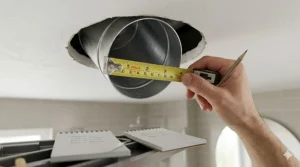
Step 2 — Cut the ceiling hole. Standard bathroom ceiling extractor fans require a 110mm core-drilled hole. Hire a core drill if you don’t own one — it’s worth it for a clean finish, particularly in plasterboard or tile.
Step 3 — Run the ducting. Use 100mm rigid or semi-rigid ducting where possible. Flexible foil ducting is easy to install but compresses and kinks easily in loft spaces, reducing airflow by more than you’d expect. Keep it as straight and short as practically possible.
Step 4 — Install an external grille or louvre. This prevents birds nesting in the duct (yes, this happens) and stops wind driving cold air back in. A gravity- or spring-loaded louvre closes when the fan’s off.
Step 5 — Connect the wiring. This is where your registered electrician earns their fee. Most bathroom ceiling extractor fans connect to the lighting circuit with a separate switched live, or directly to a fused spur.
Step 6 — Set the controls. Adjust the overrun timer at installation — 15 minutes is the regulatory minimum for rooms with no openable window, but 20 minutes is more effective after a long shower.
British damp caveat: In UK loft spaces, uninsulated duct runs can develop condensation on the outer surface in winter, which then drips back into the fan. Insulate your ducting above the ceiling — it’s a 10-minute job that prevents a year’s worth of drip marks on the fan grille.
Three UK Homes, Three Different Fans: A Real-World Buyer’s Guide
Profile 1 — The Compact Victorian Terrace in Bristol A single bathroom, roughly 4m², one external wall, a short duct run of about 1.5 metres through the external wall above the window. The shower is used twice daily by two adults. Budget: under £50.
Best match: Vent-Axia VASF100T. Short duct run means an axial fan performs perfectly here. IPX5 Zone 1 rating gives peace of mind for the shower position. The timer runs on after use; the slim profile disappears into the ceiling. The Xpelair DX100BTS would also serve this profile well at a lower price point, but the Vent-Axia’s quieter operation in a small room where the acoustic impact is noticeable makes it the better long-term choice.
Profile 2 — The New-Build Semi-Detached in Milton Keynes Master en suite, no external wall, duct run of approximately 3 metres through the ceiling void and out through the soffit. Airtight modern construction means humidity builds fast. Budget: £60–£100.
Best match: Vent-Axia Lo-Carbon Quadra HTP. The longer duct run and lack of external wall demand centrifugal performance. The humidistat responds automatically to post-shower steam, and the continuous low-speed mode satisfies the building regulations requirement for mechanical ventilation in windowless wet rooms. The extra outlay is justified by the improved extraction and Building Regulations compliance in one package.
Profile 3 — The Converted Loft Bathroom in Edinburgh Large, architect-designed bathroom in a converted loft, suspended plasterboard ceiling, long duct run, design-conscious owners who find visible fan grilles irritating. Budget: flexible, up to £80.
Best match: Airflow iCON 15 with humidity module. The cantilever fixing lugs handle the plasterboard ceiling perfectly; the recessed finish is as flush and discreet as it gets. Adding the humidity module (sold separately) means automatic operation without any manual intervention — which matters in a loft where the duct run is inevitably longer and efficient extraction is non-negotiable.
UK Regulations, IP Ratings, and What the Spec Sheet Is Actually Telling You
This is the section most buyer guides skip. It’s worth spending a minute on.
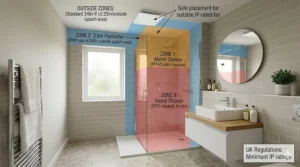
IP Ratings and Bathroom Zones UK bathrooms are divided into electrical installation zones under BS 7671 (the IET Wiring Regulations), which governs what equipment can be installed where. Zone 0 is inside the bath or shower itself; Zone 1 is directly above it (up to 2.25m from the floor); Zone 2 extends outward. Any fan installed in Zone 1 must carry at least IPX4 protection; many better models carry IPX5 or are explicitly Zone 1 certified.
Why does this matter practically? If your ceiling fan is installed above the shower head — which in a UK bathroom with a standard 2.4m ceiling it almost certainly is — you want IPX5 or explicit Zone 1 certification. The VASF100T, iCON 15, and Quadra all meet this; the Xpelair DX100BTS at IPX4 requires more careful placement.
Extraction Rate Minimums Under Approved Document F, the minimum intermittent extract rate for a bathroom is 15 litres per second. For a room with no openable window, the fan must also provide at least 4 air changes per hour for purge ventilation. For a windowless bathroom of, say, 8m³, that’s 32 litres per second minimum — well above what most basic axial fans deliver at continuous speed.
The 2026 Updates to Approved Document F The 2026 edition of Approved Document F, published this year and coming into force from March 2027, increases emphasis on Specific Fan Power (SFP) limits and energy performance of extract systems. Essentially, future building work will need to demonstrate that fans aren’t consuming more energy than necessary to achieve compliance. Fans like the Airflow iCON 15 (SFP-compliant at 0.49 W/l/s) and the Lo-Carbon Quadra range are already positioned well for this shift.
Features That Actually Matter (And Those That Don’t)
Worth paying for:
An overrun timer. Not a luxury — a fundamental. A fan that stops the moment the light switches off is fighting the physics. Steam takes time to clear; the overrun timer wins this battle quietly while you’ve already left the room.
A humidistat. If anyone in your household reliably forgets to switch the fan on, or if you have a particularly steamy bathroom with a power shower, the humidistat earns its premium several times over in prevented mould.
IPX5 / Zone 1 certification. Particularly relevant if the fan is positioned in or near the shower zone. Not all fans carry this; don’t assume.
Centrifugal motor (for duct runs over 3 metres or windowless rooms). Axial fans lose performance with resistance; centrifugal fans don’t. If your duct run is longer than a couple of metres or includes bends, this is the relevant spec.
Not worth overthinking:
LED indicators. The CubeTECH CTQF100t has one. It’s a pleasing touch but contributes nothing to air quality. Don’t let it tip a purchase decision.
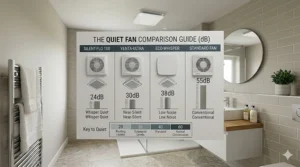
Noise claims below 20 dB. Marketing departments love these figures. They’re typically measured at 3 metres in ideal laboratory conditions. Real-world operation in a UK bathroom varies with duct length, installation quality, and wall/ceiling resonance. A fan rated at 16 dB may run at 22–25 dB in situ. The direction of the noise claim matters more than its precise number.
Colour choices beyond white. Ninety-five per cent of UK bathrooms have white ceilings. Chrome and brushed steel variants exist; most will look fine; none will transform a bathroom.
✨ Don’t Miss These Exclusive Deals!
🔍 All seven fans above are available to check right now on Amazon.co.uk. Click any highlighted product name for current pricing, customer reviews, and delivery options. Prime members typically get next-day delivery — handy if the old fan finally gave up this morning.
Long-Term Cost and Maintenance: What Ownership Actually Costs in the UK
Running costs are satisfyingly low. A 10-watt fan running for two hours a day costs approximately £0.73 per month at current UK average electricity prices (around 24p/kWh). Even a 60-watt centrifugal fan running intermittently adds less than £4 per month. The electricity cost is, frankly, trivial.
The real cost of a poor extractor fan is damp remediation. A decent mould treatment, regrouting, and repainting a damp bathroom wall in the UK runs from £200 to well over £1,000 depending on severity. The NHS has documented the health impacts of damp housing, including respiratory irritation and worsened asthma — and British homes, with their Victorian construction and modern airtightness retrofits, are particularly susceptible.
Maintenance on most modern extractor fans is genuinely minimal. Wipe the grille every few months (damp cloth; avoid bleach on plastic). Check the external grille/louvre annually — birds, insects, and wind-blown debris can partially block it, reducing performance noticeably. Filters, where fitted, typically need cleaning every six months.
Lifespan of a quality UK extractor fan (Vent-Axia, Xpelair, Airflow) is typically 7–10 years with basic maintenance. Budget, no-name models often fail within two to three years — the false economy of a £14 fan becomes clear when you factor in a second callout charge for the electrician.
Replacing a fan in an existing bathroom is generally a like-for-like swap if you’re replacing a 100mm model with another 100mm model. Keep the old fan grille until the new one arrives — a hole in the ceiling with the bathroom in use is more problematic than it sounds in British autumn.
FAQ
❓ What size extractor fan do I need for a UK bathroom ceiling?
❓ Do I need a humidistat in my bathroom extractor fan?
❓ Can I install a bathroom ceiling extractor fan myself in the UK?
❓ What IP rating do I need for a bathroom ceiling extractor fan in the UK?
❓ How do I know if my bathroom extractor fan meets UK Building Regulations?
Conclusion
Choosing a bathroom ceiling extractor fan is not the most glamorous home improvement decision you’ll ever make. It doesn’t have the drama of a new shower or the immediate satisfaction of fresh tiles. But of all the upgrades hiding in a British bathroom, this one quietly does the most work — protecting your walls, your health, and your sanity against the relentless damp of the UK climate.
For most standard UK bathrooms, the Vent-Axia VASF100T remains the benchmark: quiet, reliable, Zone 1 certified, and designed by a British brand that’s been doing this since before most of us were born. Budget-conscious buyers will find the Xpelair DX100BTS a genuinely capable alternative. For flush ceiling installs, the Airflow iCON 15 is in a class of its own. And if your bathroom is large, windowless, or served by a longer duct run, the Lo-Carbon Quadra HTP is the fan that does the heavy lifting without complaint.
Whatever you choose: buy a reputable brand, ensure your installation meets UK Building Regulations, and get a qualified electrician to do the wiring. The fan itself costs less than a decent restaurant meal. The damp-remediation bill it prevents costs considerably more.
✨ Don’t Miss These Exclusive Deals!
🔍 Ready to upgrade your bathroom ventilation? Click any highlighted product name in this article to check current pricing, ratings, and delivery options directly on Amazon.co.uk. Your ceiling — and your walls — will thank you.
Recommended for You
- 7 Best Bathroom Fan with Humidity Sensor UK 2026 — Stop Mould Before It Starts
- Best Quiet Bathroom Extractor Fans UK 2026: 7 Top Picks
- Best Bathroom Extractor Fans UK 2026: 7 Silent, Powerful Picks
Disclaimer: This article contains affiliate links. As an Amazon Associate, I earn from qualifying purchases. If you purchase products through these links, we may earn a small commission at no additional cost to you.
✨ Found this helpful? Share it with your mates! 💬🤗
