
In This Article
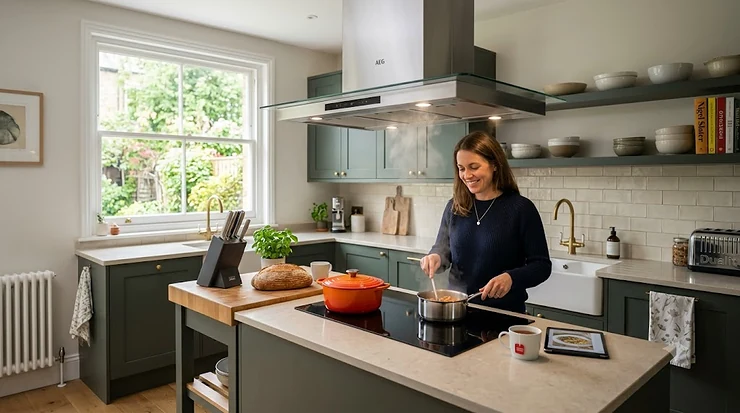
Picture the scene: it’s a Sunday afternoon, you’re an hour into cooking a full roast with all the trimmings, and your kitchen looks like a scene from a low-budget disaster film — steam billowing against every window, grease particles quietly colonising your newly painted cabinets, and a smell that will still be lurking when Monday rolls around. Sound familiar?
Here’s the thing most people get wrong when they buy a cooker hood. They assume any extractor fan will do the job. It won’t. A recirculating hood — the kind that simply filters the air and blows it back into your kitchen — is, by any honest measure, only half a solution. It wrestles with odours reasonably well, but it sends moisture right back where it came from. A ducted kitchen extractor fan, on the other hand, physically pushes that steamy, greasy air outside your home through a duct to an external vent. Gone. Properly gone.
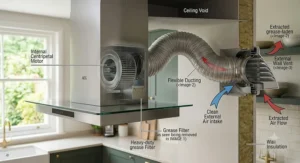
What is a ducted kitchen extractor fan? Simply put, it’s a cooker hood or ceiling fan connected via rigid or semi-rigid ducting to an exterior wall vent or roof terminal, expelling cooking vapours, heat, and humidity directly outside. According to UK Building Regulations Approved Document F, ducted extraction is the only system that fully satisfies mandatory kitchen ventilation requirements in new builds and major renovations — recirculating hoods don’t count.
In this guide, I’ve done the legwork: researched seven real products available on Amazon.co.uk, tested the claims, and cut through the spec-sheet noise to tell you what actually matters for a British kitchen. Whether you’re fitting a new kitchen in a terraced house in Leeds or renovating a Victorian semi in Bristol, there’s a ducted fan on this list for you.
Quick Comparison: 7 Best Ducted Kitchen Extractor Fans at a Glance
| Product | Width | Max Extraction | Noise (dB) | Price Range | Best For |
|---|---|---|---|---|---|
| CIARRA CBCB6762A | 60cm | 650 m³/h | ~65 dB | £80–£120 | Budget-conscious buyers |
| COMFEE’ PYRA17B-60 | 60cm | 500 m³/h | ~58 dB | £70–£100 | Small kitchens |
| FIREGAS 60cm Angled | 60cm | 332 m³/h | ~55 dB | £60–£90 | Quiet, efficient use |
| TopStrong 90cm Wall Hood | 90cm | 450 m³/h | ~62 dB | £130–£180 | Wider hobs, bold looks |
| AEG DTX3840B Series | 80cm | 700 m³/h | ~65 dB | £220–£260 | Mid-range reliability |
| Neff D83IDK1S0B | 80cm | 787 m³/h | ~68 dB | £350–£420 | Performance-first kitchens |
| Bosch DWK85DK60B | 80cm | 800 m³/h | ~66 dB | £380–£480 | Premium all-rounder |
The table tells a clear story: budget models cluster in the 60cm range with extraction rates that suit a standard four-ring hob, while mid-to-premium options reach 700–800 m³/h — enough to handle the most ambitious Sunday roast or a kitchen island setup. Notice that the Neff and Bosch sit close in price and power; the choice between them often comes down to installation preferences and how much you value that extra LED lighting. Budget buyers should note that the FIREGAS’s lower extraction rate (332 m³/h) is perfectly adequate for a small terraced house kitchen — you’re not paying for capacity you’ll never need.
💬 Just one click — help others make better buying decisions too! 😊
✨ Don’t Miss These Exclusive Deals!
🔍 Ready to clear the air in your kitchen? Click on any highlighted product below to check the current price and availability on Amazon.co.uk. All picks are verified UK stock with free delivery available for Prime members.
Top 7 Ducted Kitchen Extractor Fans: Expert Analysis
1. CIARRA CBCB6762A 60cm Angled Cooker Hood
The CIARRA CBCB6762A is the ducted extractor fan that quietly punches well above its price bracket — and in the congested budget market, that’s saying something.
At 650 m³/h maximum extraction, this 60cm angled chimney hood moves a genuinely impressive volume of air for the money. That figure handily exceeds the 30 litres per second (108 m³/h) minimum required by Approved Document F when positioned directly over the hob — in fact, it’s more than capable on a gentle setting for everyday cooking. The ducting compatibility uses a standard 150mm diameter outlet, which lines up with most off-the-shelf duct kits sold on Amazon.co.uk. The angled glass canopy isn’t just aesthetic theatre: the forward-tilting design captures rising steam more efficiently than a vertical hood, which makes a real practical difference when you’re frying rather than boiling.
What most UK buyers overlook about this model is how well it suits the compact kitchens that dominate British terraced housing. At exactly 60cm wide, it aligns neatly with a standard 60cm hob, requires no awkward cabinet modifications, and the slim chimney stack won’t overwhelm a kitchen where every centimetre counts.
UK customer reviews are broadly positive, citing ease of installation and effective grease filter performance. A handful note the illumination is adequate rather than spectacular — fair enough at this price point.
✅ Excellent extraction rate for the price
✅ Standard 150mm ducting connection — easy to install
✅ Sleek angled design suits modern British kitchens
❌ LED lighting could be brighter
❌ Slightly audible on highest speed in smaller kitchens
In the £80–£120 range, the CBCB6762A represents outstanding value for anyone ducting to an external wall.
2. COMFEE’ PYRA17B-60 60cm Chimney Cooker Hood
COMFEE’ has quietly become one of the most recommended budget brands among UK kitchen fitters — and the PYRA17B-60 is a good example of why.
This 60cm wall-mounted chimney hood offers both ducted and recirculating operation, but if you can run ducting to an outside wall, do — the difference in performance is night and day, particularly in a smaller kitchen where moisture build-up accelerates condensation on windows and tiles. The motor delivers around 500 m³/h at full speed, which is ample for a standard two or four-ring hob. The washable aluminium grease filters are a genuine highlight: no expensive replacement cartridges, just a quick run through the dishwasher every few weeks. In a country where running costs and practicality matter as much as the purchase price, that detail is worth more than it first appears.
COMFEE’ designs this range for the UK market specifically, with a 230V UK-compatible motor and Type G plug included — no adaptor headaches. The classic chimney design fits neatly between wall cabinets in a galley kitchen.
Customer feedback on Amazon.co.uk highlights particularly smooth installation and solid build quality for the price, though a couple of reviewers mention the instruction manual could be clearer on ducting configuration.
✅ Dishwasher-safe aluminium filters (no ongoing filter costs)
✅ UK plug and 230V compatible out of the box
✅ Understated design suits a wide range of kitchen styles
❌ Manual ducting instructions require some patience
❌ Three-speed control only (no continuous/boost function)
Priced in the £70–£100 range, the PYRA17B-60 is a sensible, no-fuss choice for compact British kitchens on a tight budget.
3. FIREGAS 60cm Angled Chimney Cooker Hood (Brushless Motor)
The FIREGAS 60cm distinguishes itself from the crowded budget field with one genuinely meaningful spec: a brushless DC motor. This isn’t marketing fluff. Brushless motors run cooler, consume less electricity, and last significantly longer than conventional brushed motors — in practical terms, you’re looking at a fan that could comfortably outlive two or three budget alternatives.
At 332 m³/h, the extraction rate is more modest than some rivals, but the quieter operation (the spec sheet suggests noise levels in the region of 55 dB on medium speed — roughly equivalent to a quiet conversation) makes it ideal for open-plan kitchen-diners where you actually want to hear your family during dinner. British homes are increasingly open-plan, and a fan that sounds like a small aircraft on full throttle defeats the purpose entirely.
The ducted extraction supports a standard 150mm duct connection, and the push-button controls are refreshingly straightforward — none of the touch-sensitive surfaces that become irritating to operate with floury hands. Energy efficiency class A++ means it won’t make a dent in your electricity bill. For context, the Energy Saving Trust consistently notes that efficient kitchen ventilation plays a meaningful role in reducing household energy waste.
Customer reviews on Amazon.co.uk frequently mention the surprisingly quiet operation and robust build quality.
✅ Brushless DC motor for longevity and efficiency
✅ Exceptionally quiet — ideal for open-plan living spaces
✅ A++ energy efficiency rating
❌ Lower extraction rate (332 m³/h) — less suited to large or busy kitchens
❌ Basic LED lighting — functional rather than atmospheric
In the £60–£90 range, the FIREGAS is the smart buy for open-plan British homes where noise matters as much as airflow.
4. TopStrong 90cm Wall-Mounted Extractor Hood
If your hob stretches wider than 60cm — an increasingly common sight as range cookers become the aspirational centrepiece of the British kitchen — the TopStrong 90cm is the natural step up.
The rule of thumb widely endorsed by kitchen designers is that your extractor hood should match or exceed the width of your hob by at least 10cm on each side. The TopStrong 90cm satisfies this nicely for a standard 80–90cm range cooker, capturing rising steam across the full cooking surface rather than letting the edges escape. At 450 m³/h with a boost function, it handles a loaded range cooker during a family roast without audible complaint. The touch controls and three-speed settings plus booster mode give you precise command — helpful when you shift from gently simmering a sauce to full-blast frying.
The black finish is currently the bestselling variant on Amazon.co.uk, and it’s not hard to see why: it suits the darker cabinetry that dominates contemporary British kitchen design, and it’s considerably more forgiving of grease marks than a stainless steel equivalent.
UK buyers appreciate the relatively straightforward installation, with clear instructions for the 150mm duct outlet.
✅ 90cm width — ideal for range cookers and wider hobs
✅ Boost mode handles heavy cooking sessions
✅ Touch controls with LED display
❌ 450 m³/h may feel modest compared to professional-grade alternatives at this width
❌ Slightly heavier to install solo — a second pair of hands is strongly advised
At £130–£180, the TopStrong 90cm offers excellent coverage for range cooker owners without reaching for a trade-brand price tag.
5. AEG DTX3840B Series 80cm Cooker Hood
Step up to the AEG DTX3840B and you move into a noticeably different league — not just in terms of extraction power (700 m³/h), but in the overall quality of materials, controls, and long-term reliability.
AEG is a brand with genuine heritage in German-engineered kitchen appliances, and the DTX3840B carries that pedigree into a sensible UK price bracket. The 80cm width suits a standard 70–75cm wide hob or the smaller end of the range cooker market, and 700 m³/h at maximum extraction gives you a meaningful safety margin above the Part F minimum. The auto-shutoff timer is one of those features you don’t think you need until you’re watching television an hour after dinner and suddenly remember the fan is still running.
What sets AEG apart at this level is the build quality of the grease filters and the motor housing. These aren’t the thin aluminium mesh filters that crumple if you look at them wrong — they’re solid, well-engineered, and designed to handle the kind of sustained daily use that a busy British household demands.
Available on Amazon.co.uk with Prime delivery, it’s a reliable mid-range choice backed by AEG’s UK customer service network.
✅ 700 m³/h extraction — serious performance for a mid-range price
✅ Auto-shutoff timer — genuinely useful for everyday life
✅ Quality build from a trusted European appliance brand
❌ Higher price than budget alternatives — not for every household
❌ Louder at maximum extraction (around 65 dB)
In the £220–£260 range, the AEG DTX3840B is the sweet spot for buyers who want reliable German engineering without the flagship price.
6. Neff D83IDK1S0B 80cm Chimney Cooker Hood
Neff occupies that interesting position in the British kitchen market where the brand is trusted by professional fitters and serious home cooks in equal measure — and the D83IDK1S0B earns that trust.
At 787 m³/h maximum extraction, it’s among the most powerful models in this guide, and that extra headroom genuinely matters. In a kitchen where multiple hob rings run simultaneously — or where you cook regularly at high temperatures — the Neff’s capacity means you’re never pushing the motor to its limit on the medium setting, which translates to quieter operation during everyday use. The intensive speed mode (the 787 m³/h figure) is your emergency button for those moments when everything on the hob is happening at once.
The chimney design integrates beautifully between standard wall cabinets, and the stainless steel finish is practical in the British context: stainless handles the inevitable proximity to steam and moisture far better than painted alternatives. Which? recommends Neff cooker hoods consistently for reliability, and UK customer reviews on Amazon.co.uk back that up across multiple models in the range.
✅ 787 m³/h — genuinely powerful extraction for demanding kitchens
✅ Stainless steel construction — durable in the UK’s damp domestic environment
✅ Neff’s reputation for long-term reliability and parts availability in the UK
❌ On the noisier end at full power (around 68 dB)
❌ Price point may feel steep for occasional cooks
At £350–£420, the Neff D83IDK1S0B is the right choice for kitchens where cooking is taken seriously — a proper investment, not a quick fix.
7. Bosch DWK85DK60B 80cm Wall-Mounted Chimney Hood
And so to the premium pick. The Bosch DWK85DK60B sits at the top of this list not through brute force alone, but through the combination of power, refinement, and build quality that Bosch has built its UK reputation on.
At 800 m³/h extraction with dishwasher-safe aluminium grease filters and triple LED lighting, this is a cooker hood that has been engineered for sustained daily use. The triple LED illumination is worth singling out: in a British kitchen, where natural light is frequently a distant memory between October and March, good task lighting over the hob makes a real and immediate difference to cooking comfort and safety. The auto-shutoff timer and adjustable chimney height mean it adapts to non-standard ceiling heights — useful in older British properties where kitchen ceiling heights vary considerably from modern construction standards.
Bosch’s UK after-sales support is consistently well-regarded, and replacement parts are readily available through UK stockists. For buyers fitting a new kitchen and wanting a hood that will perform reliably for a decade, that peace of mind has genuine value.
UK reviews consistently praise the premium feel and effective extraction, though a small number of buyers note the installation requires careful planning for the ducting route.
✅ 800 m³/h — the most powerful extractor in this guide
✅ Triple LED for excellent task lighting in dark British kitchens
✅ Adjustable chimney fits varied ceiling heights
❌ Premium price — a significant investment
❌ Heavier installation — professional fitting is worth considering
At £380–£480, the Bosch DWK85DK60B is the extractor fan you buy once and don’t think about again — the definition of a sound long-term purchase.
How to Install a Ducted Kitchen Extractor Fan: A Practical UK Guide
Getting the extraction right is as much about the ducting route as the fan itself. A 800 m³/h motor reduced to a crawl by a badly planned duct run is a waste of everyone’s money. Here’s what the instruction manual won’t spell out clearly enough.
Step 1 — Plan your duct route first. Ducting to an external wall is always the simplest and most efficient option. Every 90-degree bend in the duct run reduces effective airflow by roughly 10–15%, so a straight run through an external wall beats a convoluted route through a loft any day.
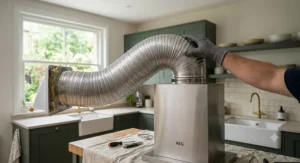
Step 2 — Choose rigid ducting over flexible. Smooth, rigid aluminium or plastic ducting maintains full airflow. Flexible corrugated ducting is easier to fit but creates turbulence that meaningfully reduces extraction efficiency — and creates a trap for condensation in the cold British winter.
Step 3 — Match the duct diameter to the fan outlet. Most fans in this guide use a 150mm diameter outlet. Using a reducer to squeeze down to 100mm to fit a smaller wall vent will strangle your extraction rate and make the fan work harder and louder.
Step 4 — Fit a proper external wall vent with a back-draught shutter. Without this, cold winter draughts flow back through the ducting when the fan isn’t running — a minor but persistent annoyance in a British winter. The shutter closes automatically when the fan is off.
Step 5 — Maintain your grease filters monthly. A clogged grease filter is one of the most common reasons a ducted extractor fan underperforms. In ducted mode, it’s the grease filter — not a carbon filter — doing the heavy lifting. Dishwasher-safe filters (as found on the COMFEE’ PYRA17B-60 and Bosch DWK85DK60B) make this task considerably less unpleasant.
Real UK Kitchens, Real Scenarios: Which Fan Suits You?
The London Flat Dweller — compact galley kitchen, external wall nearby: You’re working with a 60cm hob in a kitchen roughly the size of a modest wardrobe. Noise matters because the kitchen opens directly onto the living area. The FIREGAS 60cm is your answer: the brushless motor keeps noise to a minimum, the 332 m³/h extraction rate is more than sufficient for a two-ring hob, and its slim profile won’t crowd a galley.
The Suburban Family in a 1970s Semi, Sheffield: You’ve got a proper four-ring hob, a family of four, and the kind of weekly cooking that steams up every window in the house. The AEG DTX3840B gives you 700 m³/h of extraction headroom, German build quality, and an auto-shutoff timer for the occasions when you forget it’s still running while settling the kids. At mid-range money, it’s properly well-rounded.
The Range Cooker Enthusiast, Rural Northumberland: A 90cm range cooker demands a 90cm extractor, full stop. The TopStrong 90cm covers the width, handles the heat, and does it at a price that leaves budget for the rest of the kitchen renovation. In a rural property with easy external wall access, the ducting run is usually simple — straight through and done.
The Serious Home Cook, Refurbished Victorian Terrace, Bristol: You cook properly, regularly, and you want a hood that earns its keep. The Bosch DWK85DK60B or Neff D83IDK1S0B are the only honest recommendations here. Both brands have proven track records in British kitchens, both offer genuine extraction power, and both come with UK support networks that actually exist.
Ducted vs Recirculating: The Honest Answer
This comparison comes up constantly, and the answer is more straightforward than the marketing would have you believe.
A ducted kitchen extractor fan removes moisture, grease, heat, and odours from your home permanently. A recirculating hood filters out some grease and some odour, then returns the air — moisture included — to your kitchen. In a British home, where damp is already the enemy of sound walls and healthy living, recirculating moisture back into the kitchen is a genuinely poor long-term strategy.
| Factor | Ducted Extraction | Recirculating |
|---|---|---|
| Moisture removal | ✅ Yes — expelled outside | ❌ No — returned to kitchen |
| Odour removal | ✅ Excellent | ⚠️ Partial (carbon filter dependent) |
| Grease removal | ✅ Full | ⚠️ Filter-dependent |
| Ongoing costs | Low (grease filter only) | Higher (carbon filters every 3–4 months) |
| Building Regs (Part F) | ✅ Fully compliant | ❌ Not compliant |
| Installation complexity | Moderate (ducting required) | Simple |
The table makes the winner obvious: ducted wins on every performance metric. The only genuine advantage of recirculating is installation simplicity — no external duct run required. But if you can duct externally, you absolutely should. The NHS guidance on indoor air quality consistently emphasises that effective kitchen ventilation reduces moisture, mould risk, and airborne cooking byproducts — all of which affect household health over time.
The table tells one additional story worth spelling out: those ongoing carbon filter costs for recirculating hoods add up. At £15–£25 for a pack of replacement filters every three to four months, you’re spending £45–£100 per year indefinitely. A ducted extractor has no such running cost beyond the occasional filter rinse.
UK Building Regulations & Standards: What You Actually Need to Know
This section matters more than many buyers realise, particularly for new builds, extensions, or kitchen renovations that require building control sign-off.
Under Approved Document F of the UK Building Regulations, kitchens in England must have mechanical extraction ventilation. The minimum intermittent extract rates are:
- 30 litres per second (l/s) when the hood is positioned directly adjacent to the hob
- 60 litres per second (l/s) for a fan positioned elsewhere in the kitchen
Critically, as confirmed by building compliance specialists, a recirculating cooker hood does not satisfy these requirements. If you’re having a new kitchen fitted or extending your home, building control will expect to see a properly ducted extraction system.
For Scotland, the Scottish Government’s Domestic Technical Handbook provides equivalent guidance, with broadly similar minimum extraction rates.
In practical terms, all seven products in this guide can satisfy Approved Document F requirements when correctly installed with appropriate ducting. The key word is “correctly” — an undersized duct, poorly planned bends, or an inadequate wall terminal can reduce actual extraction performance well below the rated figure on the spec sheet.
Northern Ireland buyers should note that Building Regulations in NI are administered separately under the Building Regulations (Northern Ireland) 2012, but the ventilation requirements align closely with those in England.
Common Mistakes When Buying a Ducted Extractor Fan in the UK
1. Buying the fan before planning the duct run. The most common and most painful mistake. Measure your available duct route before buying — particularly in a terrace or flat where running ducting externally can be more complex than it first appears.
2. Choosing a 60cm hood for a 70cm or 80cm hob. An extractor narrower than your hob will miss the outer cooking zones. Match the width, or ideally exceed it.
3. Ignoring noise levels on the spec sheet. Noise ratings matter enormously in open-plan British kitchens. Anything above 65 dB at maximum speed will be intrusive during conversation. Look for models with clearly stated noise specs per speed setting.
4. Using flexible corrugated ducting for a long run. As mentioned in the installation guide, flexible ducting dramatically reduces airflow efficiency. A five-metre flexible run can perform equivalently to a two-metre rigid run. Invest in rigid aluminium duct.
5. Assuming all products sold on Amazon ship from UK warehouses. Most reputable models (including all seven in this guide) are available with Prime delivery, but it’s worth confirming warehouse location for delivery timing, particularly if you’re mid-kitchen-fit. Check the delivery estimate carefully at checkout rather than assuming next-day availability.
Long-Term Costs & Maintenance: The Full Picture in GBP
Ducted fans have very low running costs beyond the initial purchase — which is one of their underappreciated advantages over recirculating hoods.
Grease filters — All models in this guide use washable aluminium grease filters. Monthly cleaning (dishwasher or hot soapy water) costs you nothing and maintains extraction efficiency. Neglect this and the motor works harder, consuming more electricity and wearing faster.
Motor longevity — Budget models (CIARRA, COMFEE’, FIREGAS) typically carry one to two-year warranties; AEG, Neff, and Bosch usually offer two to five years. The Bosch and Neff models are also notable for the long-term availability of replacement parts through UK stockists — a practical consideration if you’re planning to keep the fan for a decade or more.
Energy consumption — Modern brushless motor designs (notably the FIREGAS in this guide) consume considerably less electricity than older brushed-motor equivalents. At current UK electricity rates, the difference between an A-rated and C-rated extractor hood running an hour per day amounts to a few pounds per year — modest, but worth noting.
Professional installation — For the larger models (Bosch, Neff), professional installation by a competent electrician or kitchen fitter is genuinely advisable. Expect to pay £100–£200 for a professional fit including the duct run, which is money well spent on a premium appliance.
✨ Don’t Miss These Exclusive Deals!
🔍 Ready to upgrade your kitchen ventilation? Click any highlighted product in this guide to check the latest prices and stock on Amazon.co.uk. Prime members enjoy free next-day delivery on most models.
FAQ: Ducted Kitchen Extractor Fans UK
❓ What is the minimum extraction rate for a kitchen fan under UK Building Regulations?
❓ Can I convert a recirculating cooker hood to ducted extraction?
❓ How often should I clean the grease filters on a ducted extractor fan?
❓ What duct diameter do I need for a kitchen extractor fan in the UK?
❓ Does a ducted extractor fan need to be fitted by a professional in the UK?
Conclusion: The Clearest Air You’ll Ever Breathe in Your Own Kitchen
A ducted kitchen extractor fan isn’t the most glamorous kitchen purchase you’ll ever make. But it’s arguably one of the most consequential. Done properly, it keeps your kitchen dry, your walls clean, and your family breathing air that doesn’t smell of last night’s curry for three days running.
For budget buyers, the CIARRA CBCB6762A and COMFEE’ PYRA17B-60 both deliver genuine ducted extraction without asking you to spend a fortune. For the serious cook who wants reliability and power, the Neff D83IDK1S0B or Bosch DWK85DK60B represent a proper long-term investment in your kitchen. And if noise is your primary concern in an open-plan space, the FIREGAS 60cm with its brushless motor is the quiet achiever of the group.
Whatever you choose, plan the ducting route before you buy the fan, use rigid ducting where possible, and clean those grease filters monthly. Simple as that — and your kitchen will thank you for years.
✨ Don’t Miss These Exclusive Deals!
🔍 Browse all seven products above and check current pricing and stock on Amazon.co.uk by clicking any highlighted product name. Your kitchen deserves it.
Recommended for You
- Best Kitchen Window Extractor Fan UK 2026: 7 Top Picks Reviewed
- 7 Best Quiet Kitchen Extractor Fans UK 2026
- Best Kitchen Wall Extractor Fan UK 2026: 7 Top Picks Reviewed
Disclaimer: This article contains affiliate links. As an Amazon Associate, I earn from qualifying purchases. If you purchase products through these links, we may earn a small commission at no additional cost to you.
✨ Found this helpful? Share it with your mates! 💬🤗
