

In This Article
There’s a particular British misery in cooking a Sunday roast — windows streaming with condensation, the smoke alarm going off despite the fact nothing is actually burning, and a lingering smell of cooking fat that clings to the curtains until at least Thursday. Sound familiar?
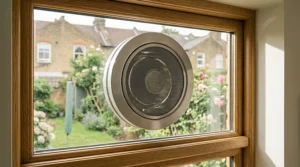
A kitchen window extractor fan is one of the most elegantly simple solutions to a deeply unglamorous problem. Rather than routing ducting through walls or investing in a full overhead canopy hood — an expensive, disruptive operation in most terraced houses and purpose-built flats — a window-mounted fan drops directly into a hole cut in your existing glazing, pushes stale, greasy, moisture-laden air straight outside, and gets on with it. No complicated ductwork. No calling in a builder. Just clean, clear air.
In practical terms, a kitchen window extractor fan works by fitting into a circular aperture in a single or double-glazed pane. Air is driven outward by an axial or centrifugal impeller, typically at between 64 and 230 cubic metres per hour depending on the size — fast enough to comply with Approved Document F of the UK Building Regulations, which mandates minimum extract rates of 30 litres per second (l/s) adjacent to a hob, or 60 l/s elsewhere in the kitchen for intermittent systems. What most people overlook is that since June 2022, those regulations were tightened: opening a window alone is no longer considered sufficient mechanical ventilation in new-build or heavily renovated kitchens. A fan is now the law in many cases, not just a nice-to-have.
This guide covers the 7 best options available on Amazon.co.uk right now, what the specs actually mean in practice for a British kitchen, and how to choose without getting lost in a fog of decibel ratings and airflow figures.
Quick Comparison: Top 7 Kitchen Window Extractor Fans at a Glance
| Product | Size | Airflow | Noise | Control | Best For |
|---|---|---|---|---|---|
| Xpelair GXC6EC | 150mm (6″) | 64 l/s | 34 dB | Pullcord | Efficiency-first buyers |
| Manrose WF150B | 150mm (6″) | 64 l/s | 40 dB | Standard | Straightforward window fit |
| Manrose XF150T | 150mm (6″) | 64 l/s | 40 dB | Timer | Building regulation compliance |
| Devola DVF100P | 100mm (4″) | ~36 l/s | 34 dB | Pullcord | Smaller kitchens, renters |
| Vent-Axia Solo Plus | 100mm (4″) | 17–25 l/s | ~32 dB | Multi-speed | Quiet performance |
| Airflow MaxiVent 150mm | 150mm (6″) | 72 l/s | 57 dB | Auto shutter | High-output extraction |
| VENTS 150 Silenta | 150mm (6″) | ~50 l/s | 29 dB | Timer option | Near-silent operation |
The table tells part of the story, but here’s the short version: the Xpelair GXC6EC is the standout balance of efficiency and performance for most UK kitchens, while the Manrose WF150B is the workhorse choice if you just want something reliable, well-priced, and purpose-designed for window fitting. The Devola DVF100P earns its place as the go-to for smaller kitchens or rental properties where a full 150mm aperture isn’t practical.
💬 Just one click — help others make better buying decisions too! 😊
✨ Don’t Miss These Exclusive Deals!
🔍 Ready to clear the steam and grease? Click any highlighted product name to check current pricing and availability on Amazon.co.uk. These picks cover every budget and kitchen size — find your perfect match below!
Top 7 Kitchen Window Extractor Fans: Expert Analysis
1. Xpelair GXC6EC 150mm Kitchen Axial Extract Fan with Pullcord
If you could build a kitchen window extractor fan specifically for the damp, energy-conscious British climate of 2026, it would look a lot like the GXC6EC. Xpelair — one of the most trusted names in UK domestic ventilation, with roots going back decades — has fitted this model with an EC (electronically commutated) motor that draws just 6.8W at full speed. For context, that’s roughly the same as an energy-saving LED bulb. Over a year of regular use, the running cost difference between this and a conventional 25W motor is genuinely noticeable on your electricity bill.
The airflow sits at a solid 64 l/s (229 m³/hr), comfortably meeting Part F requirements whether fitted adjacent to the hob or further across the kitchen. At 34 dB measured at 3 metres, it’s genuinely unobtrusive — you’ll hear it, but you won’t have to raise your voice over it. The IPX4 moisture rating handles the inevitable splashing and steam, and the integrated pullcord opens the shutters as it activates, then closes them again on shutdown to prevent cold draughts — rather important in a typical British kitchen in February. Trickle ventilation is available for background airflow when the fan isn’t running.
UK buyers particularly appreciate that this fan ships with a 5-year guarantee and complies with Part F Building Regulations. It fits a 184mm spigot hole, suitable for single or double glazing. The spec sheet won’t tell you this, but the EC motor also runs noticeably cooler and quieter as it ages compared to conventional motors — significant if you’re installing this and hoping not to think about it for the next decade.
Customer feedback from UK reviewers consistently praises quiet operation and straightforward fitting into existing holes — particularly useful when replacing a like-for-like older Xpelair model.
✅ Ultra-low 6.8W running cost
✅ 5-year guarantee
✅ Trickle vent facility
❌ Pullcord-only (no timer version in this range)
❌ Premium price bracket for its size
Price range: mid-to-upper price bracket — check current price on Amazon.co.uk
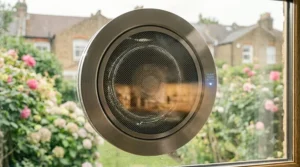
2. Manrose WF150B Window Fit Kitchen Extractor Fan 150mm
Manrose is a decidedly British brand — part of the Nvent group, manufactured with a reputation for no-nonsense reliability built over generations of UK tradespeople. The WF150B series is designed explicitly for window or wall fitting through a standard 184mm (7¼”) circular aperture, and that focus shows in how it handles installation: the circular fit panel, foam seal, and straightforward fixing arrangement mean you’re not improvising with whatever fixings came in the box.
At 230 m³/hr (64 l/s) and 25W, this is a conventional AC motor fan — more power draw than the GXC6EC, but also a lower upfront cost that many UK households will find compelling. Noise sits around 40 dB, noticeably more present than the Xpelair but well within the range of a normal kitchen conversation. For a standard open-plan kitchen-diner in a semi-detached — the bread-and-butter of British housing stock — that’s perfectly acceptable. The pullcord model (WF150BP) is the most popular, though a timer version and combined humidistat-timer models exist for those who want automatic shut-off after cooking.
This is a particularly sensible choice for anyone replacing an old 150mm window fan without wanting to change the hole size, since Manrose dimensions have remained consistent across generations. UK tradesperson reviews frequently flag the quality of the plastic housing — more durable than comparable budget alternatives — and note that grille cleaning is simple. On the downside, the shutters on some units have attracted criticism for stiff operation in cold weather, which in a British winter is, of course, most of the year.
✅ Purpose-designed for window fitting
✅ Wide range of control variants (pullcord, timer, humidistat)
✅ Proven UK brand with readily available spares
❌ Higher running cost than EC motor rivals
❌ Slightly noisier than premium alternatives
Price range: budget to mid-range — check current price on Amazon.co.uk
3. Manrose XF150T Kitchen Fan with Integral Run-On Timer 150mm
The XF150T is for the person who wants their kitchen ventilated properly — specifically, who wants the fan to keep running for a few minutes after they’ve walked away from the hob and left the kitchen smelling of garlic and ambition. The integral electronic timer is adjustable between 1 and 20 minutes, a useful range that lets you dial in the run-on period to suit how vigorously you cook. For a quick weekday stir-fry, two minutes is probably fine. For a Sunday roast at full oven temperature? You’ll want it closer to fifteen.
The specs mirror the rest of the Manrose 150mm range: 230 m³/hr, 25W, 40 dB. What the XF150T adds is relevance for anyone upgrading an older kitchen for building regulation compliance. Approved Document F is quite specific about control options, and a timer-equipped fan running on a dedicated switched live is one of the cleanest ways to demonstrate compliance without installing a humidity sensor. Moulded in high-gloss ABS thermoplastic, it cleans easily — the fan grille pulls forward with a quarter-turn for access, which you’ll want every few months in a busy kitchen.
Best suited to: households doing a kitchen renovation who need documented compliance without overcomplicated controls. It’s the safe, sensible choice that a builder will recommend and a building inspector will nod at without asking questions.
✅ Adjustable 1–20 min run-on timer
✅ Part F compliant installation
✅ Easy-clean front grille
❌ No humidistat option in base model (upgrade required)
❌ 25W conventional motor, not the most energy efficient
Price range: budget to mid-range — check current price on Amazon.co.uk
4. Devola DVF100P 100mm Axial Extractor Fan with Pullcord — Made in Britain
A 4-inch (100mm) fan might seem underpowered for a kitchen, and in a large open-plan space with a gas range it would be. But for a compact galley kitchen in a flat, a smaller terrace, or a utility-kitchen combination — the kind of housing that makes up a significant portion of the UK’s rented sector — the DVF100P is worth a very serious look. It requires a 118mm aperture rather than 184mm, which means smaller, cheaper glazing replacement or a simpler cut in an existing pane.
What sets Devola apart is the provenance: “Made in Britain” isn’t just a badge of pride here. It means readily available parts, UK-based customer support, and a motor engineered to 240V/50Hz rather than an import that may have been nominally adapted. The motor itself is German-engineered, which explains the 5-year warranty confidence. At around 34 dB and an extract rate that, while not meeting the full 30 l/s Part F kitchen threshold on its own, is genuinely adequate for smaller volumes, this is a quiet, competent unit. The pullcord suits installations where there’s no switched live available, such as older flats wired to more minimal standards.
UK renters in particular find this useful because the smaller aperture is less alarming to landlords than cutting a 184mm hole in glazed kitchen windows. The IPX34 rating handles steam and splashes. It ships with a backdraft-preventing integrated shutter. British reviewers consistently praise the build quality relative to the price point.
✅ Made in Britain — excellent UK support and parts availability
✅ Smaller 100mm aperture — less invasive installation
✅ Competitive price with 5-year warranty
❌ Extract rate may not meet Part F for larger kitchens
❌ 100mm requires smaller ducting if routing through a wall instead
Price range: budget — check current price on Amazon.co.uk
5. Vent-Axia Solo Plus P (Pullcord) Centrifugal Extract Fan
Vent-Axia is another institution of British ventilation — the company has been making fans for British homes since the 1930s, and the Solo Plus range reflects that heritage in the best possible way: serious engineering without unnecessary fuss. The key difference here is the centrifugal impeller. Where axial fans push air in a straight line (fine for direct window extraction), a centrifugal fan compresses the air and can push it through longer duct runs — up to 50 metres of 100mm ducting. If you have a kitchen where a direct window installation isn’t feasible but you need to extract to an external wall some distance away, this changes the equation entirely.
The three-speed operation (trickle at 10 l/s, medium boost at 17 l/s, high boost at 25 l/s) provides flexibility that single-speed axial fans can’t match. The highly efficient ball-bearing motor is rated at over 50% more efficient than conventional shaded-pole equivalents. At around 32 dB on trickle mode, it’s one of the quieter options in this guide. For noise-sensitive households — or anyone who has ever been told off by a partner for running a loud fan during a phone call — that matters.
The Solo Plus is designed primarily for through-wall and ducted applications rather than direct window glazing fitting, so it’s best combined with a separate window panel for glass installations. For buyers with slightly more complex setups — a kitchen extension, a utility room, a loft conversion with a kitchen — this is the fan that professional installers reach for.
✅ Centrifugal for long duct runs — highly versatile
✅ Three-speed control, extremely energy-efficient motor
✅ Near-silent trickle mode — excellent for open-plan spaces
❌ Not a direct glazing fit — may require additional panel
❌ Lower maximum airflow than 150mm axial models
Price range: mid-range — check current price on Amazon.co.uk

6. Airflow MaxiVent 150mm Extractor Fan with Auto Shutter & Pullcord
Where the Xpelair GXC6EC prioritises efficiency and the Manrose range prioritises familiarity, the Airflow MaxiVent 150mm goes all-in on raw airflow: 72 l/s (259 m³/hr), which is the highest output in this roundup and comfortably exceeds Part F requirements even for kitchens where the fan is positioned away from the hob. At 28W, it’s relatively efficient for the extraction power it delivers, though not in the same league as EC-motor options.
The automatic shutter mechanism is the headline feature: shutters open when the fan runs and close by gravity when it stops, requiring no motorised actuation and no pullcord to forget. For families with young children — or anyone who has discovered that a kitchen window with an open fan shutter is an excellent entry point for wasps in August — this is a genuine quality-of-life improvement. The IPX45 rating is a step above many competitors, making it more appropriate for installations above sinks or in utility areas prone to splashing.
The 57 dB noise level is noticeably louder than quieter rivals, and that’s the main trade-off: this is a fan you know is running. In a busy family kitchen with the radio on, you probably won’t notice. In a quiet kitchen-diner while someone’s on a video call in the adjacent living room, you absolutely will. Supplied with a 3-year warranty and available on Amazon.co.uk with Prime delivery.
✅ Highest airflow in this roundup — 72 l/s
✅ Gravity auto-shutter — no open vents left unattended
✅ IPX45 — above-average moisture protection
❌ Louder than premium alternatives at 57 dB
❌ Shorter 3-year warranty vs competitors’ 5-year offers
Price range: mid-range — check current price on Amazon.co.uk
7. VENTS Silenta 150mm Quiet Bathroom & Kitchen Extractor Fan
The VENTS brand from Ukraine has carved out a solid reputation in the UK market for delivering near-silent performance at prices that undercut the established British brands without compromising on build quality — a combination that’s earned a loyal following among UK tradespeople and self-builders. The Silenta 150mm’s standout specification is its noise level: around 29 dB, which is quieter than a library and virtually inaudible over normal kitchen noise. The secret is the rubber-mounted impeller, which isolates vibration from the housing with exceptional effectiveness.
Airflow of around 50 l/s won’t break records, but it comfortably meets Part F requirements for most kitchen configurations, and the available timer control option makes compliance documentation straightforward. The external housing is ABS plastic — lightweight, easy to wipe clean, and resistant to grease build-up. Post-Brexit, VENTS products now carry UKCA marking where required, and UK stocks are held domestically, so Prime delivery is available without delays.
This is the fan for the household that values peace above all else. If the whirr of an extractor is genuinely distracting — you work from home, you have a child who naps while you cook, or you simply have finely tuned auditory sensitivities — the Silenta earns its name.
✅ Ultra-quiet at ~29 dB — genuinely barely audible
✅ Rubber-mounted impeller — minimises vibration transfer to frame
✅ Good value for performance level
❌ Lower maximum airflow than 150mm axial alternatives
❌ Lesser-known brand — fewer UK repair specialists if needed
Price range: budget to mid-range — check current price on Amazon.co.uk
How to Install a Kitchen Window Extractor Fan Without Losing Your Mind (Or Your Glazing)
Installation is where things can go expensively wrong if you rush it. The core requirement for any kitchen window extractor fan is a circular aperture cut into the glass — typically 118mm for 100mm fans, or 184mm for 150mm fans. Standard float glass can be drilled by a glazier for around £40-£80 in most UK towns; toughened (safety) glass cannot be drilled and must be replaced with a pre-cut pane, which costs more but is legally required in certain positions under Part K of the Building Regulations.
Before you order, measure twice:
- Check your window frame’s depth. Most kitchen window extractor fans require a minimum glass depth of 4mm and a maximum of around 24mm for double glazing.
- Confirm the fan’s spigot diameter matches the aperture you’re planning. Xpelair GXC6EC and Manrose WF150B both use 184mm spigots.
- Check whether your existing window has a trickle vent — if so, a fan with its own trickle ventilation facility (like the GXC6EC) will replace that function neatly.
UK climate tip: fit a draught-excluding foam seal between the fan body and the glass on the internal side. British winters mean cold air will find any gap, and a fan installation without proper sealing will make itself known every time there’s an easterly wind.
Electrical note: all new kitchen fan installations should be on a fused, double-pole isolating switch with a 3-amp fuse, as required by UK wiring regulations. If you’re not comfortable with electrical work, a Part P registered electrician can complete the wiring element for a modest call-out charge — usually well under £100.
For deeper guidance, Which? magazine’s home improvement section provides regularly updated consumer guidance on fitting kitchen ventilation that’s worth checking before you start.

Real UK Kitchens, Real Scenarios: Which Fan Actually Fits Your Life?
Not everyone’s kitchen is the same, and the best kitchen window extractor fan for a Victorian terrace in Leeds is not necessarily the right answer for a new-build flat in Bristol.
Profile 1: The Urban Flat Dweller You rent a one-bedroom flat in Manchester or Birmingham. The kitchen is compact — perhaps 8-10 square metres — and shares a wall with the living space. Noise is a priority. The landlord is cautious about large alterations. Here, the Devola DVF100P wins comfortably: smaller aperture, lower disruption, quieter operation, and a price point that’s easy to absorb or even negotiate into a deposit deduction.
Profile 2: The Family Kitchen in a Semi-Detached Three kids, a gas hob, roasting tins every Sunday, and a kitchen that steams up within minutes of anything hitting the pan. You need serious extraction capacity and you need it to keep running after you’ve gone to sort out whatever’s happening in the living room. The Manrose XF150T with its adjustable run-on timer is the practical choice — purpose-designed for exactly this kind of use, Part F compliant, and built for years of hard service.
Profile 3: The Home Worker Who Values Silence You work from home with a kitchen two metres from your desk. Every time the fan goes on, it’s on your Teams calls. The VENTS Silenta 150mm or the Xpelair GXC6EC are your allies here — 29-34 dB means cooking and ventilating without announcing it to the entire meeting.
Profile 4: The Renovation Project You’re overhauling an older kitchen from scratch, perhaps in a 1970s bungalow in Surrey or a stone cottage in the Yorkshire Dales. You want something that will last 10+ years without maintenance drama. The Xpelair GXC6EC — EC motor, 5-year guarantee, genuine trickle vent facility — is the long-game investment that pays back over time in running costs alone.
What the Spec Sheet Won’t Tell You: Features That Actually Matter
The ventilation market is full of numbers that sound impressive and mean very little without context. Here’s a quick filter.
Airflow figures: Always check whether the stated m³/hr figure is free-air (no resistance) or at working pressure. Free-air figures are optimistic. A fan rated at 230 m³/hr free-air will deliver meaningfully less once installed in a sealed glass aperture with shutters. For a kitchen, look for fans rated at least 60–64 l/s (216–230 m³/hr free-air) to confidently meet Part F at distance.
Noise levels: dB(A) at 3 metres is the meaningful figure. Some manufacturers quote at 1 metre, which will appear approximately 10 dB quieter than the 3-metre measurement and flatters the product considerably. The GXC6EC’s 34 dB(A) at 3 metres is honest and impressive. Anything above 50 dB(A) at 3 metres will be audible as a constant background presence.
IP ratings: IPX4 means splash-proof from any direction — adequate for most kitchen positions. IPX45 (as found on the Airflow MaxiVent) adds protection from low-pressure water jets. For a fan fitted directly above a sink, the higher rating is worth seeking out.
Trickle vent facility: Often overlooked, but under the 2022 Part F update, background ventilation provision has become more important. A fan with a built-in trickle vent facility — like the GXC6EC — provides background airflow even when the fan motor isn’t running, improving air quality continuously rather than only when you remember to switch the fan on.
UK Regulations, Safety Standards & What You’re Actually Required to Do
Approved Document F — the UK Building Regulations’ ventilation standard, updated June 2022 — requires intermittent kitchen extract fans to deliver at least 30 l/s adjacent to the hob, or 60 l/s elsewhere in the kitchen. For window-mounted fans in the 150mm size class, meeting the 30 l/s adjacent-hob requirement is straightforward; meeting 60 l/s at distance requires a high-output model like the Airflow MaxiVent.
These regulations apply to new builds, extensions, and notifiable renovations. A simple like-for-like fan replacement doesn’t usually trigger a building notice requirement, but any change to the glazing itself may do. In Scotland, building standards (managed by the Scottish Government rather than MHCLG in England) are administered separately and worth checking via Building Standards Division Scotland if you’re north of the border.
One often-misunderstood point: the UKCA marking that replaced CE marking post-Brexit is relevant for electrical products sold in Great Britain. The fans in this guide — from Xpelair, Manrose, Vent-Axia, Devola, and Airflow — all carry appropriate UK compliance. For Northern Ireland, which remains aligned with EU rules under the Windsor Framework, CE marking products remain valid.
All electrical fan installation in kitchens falls under Part P of the Building Regulations (electrical safety). Unless you’re a competent DIYer confident in completing a fused spur correctly, have the wiring element signed off by a registered electrician. It’s a small cost against the inconvenience of an insurance dispute in the unlikely event of an electrical issue.
Long-Term Costs & Maintenance: What Ownership Actually Looks Like
Running costs for kitchen extractor fans are surprisingly modest. The Xpelair GXC6EC at 6.8W running two hours a day costs under £5 per year to run at current UK electricity rates. The Manrose WF150B at 25W costs around £18 per year for the same usage. Over a decade, that’s a meaningful difference — particularly relevant now that energy costs have become a genuine household concern.
Maintenance is straightforward: every 3–6 months, remove the front grille and wipe the impeller blades with a damp cloth. Grease build-up on the blades reduces airflow efficiency dramatically — a fan running at 60% capacity because of greasy blades is both louder (straining harder) and less effective. Most UK fans in this guide use a quarter-turn grille release for tool-free access.
The 184mm glass aperture fitting means the fan is, for practical purposes, the only part that wears out. When a motor eventually fails after 8–12 years of use, a new fan with the same spigot diameter drops straight in without touching the glazing.
Common Mistakes When Buying a Kitchen Window Extractor Fan in the UK
Buying the wrong size for the aperture: If you’re replacing an existing fan, measure the spigot hole in the glass — not the fan body. A 150mm fan requires a 184mm hole; a 100mm fan requires 118mm. Getting these confused means returning the fan and waiting for a replacement, which on a kitchen renovation is an unwelcome delay.
Ignoring the glazing type: Ordering a fan before confirming whether the kitchen window is toughened glass is an expensive mistake. Toughened glass — standard in many modern window installations in low positions — cannot be drilled. It must be replaced with a pre-cut pane. Budget for this before buying the fan, not after.
Choosing a US-voltage or import model: This one bites buyers on marketplace listings. If the fan listing doesn’t explicitly state 230V/50Hz, UK plug type G, or UKCA/CE marking, it may be wired for 110V US supply or require an adapter. At best this is inconvenient; at worst it’s a fire hazard. All seven products in this guide are verified UK-compatible.
Underestimating the noise impact: It’s easy to overlook noise level in the excitement of choosing a new fan. A 57 dB model will be clearly audible in an adjacent room. In an open-plan layout, that matters. If noise is a concern, the 34 dB range (GXC6EC, Devola DVF100P) is worth the additional investment.
Assuming installation is always DIY-simple: Cutting glazing and running a new electrical circuit are both jobs that can go wrong without the right tools and knowledge. Both are absolutely achievable for a competent DIYer — but be honest with yourself before you start.

Frequently Asked Questions
❓ Does a kitchen window extractor fan need a professional to install?
❓ What size kitchen window extractor fan do I need for my kitchen?
❓ Can a kitchen window extractor fan be fitted in double-glazed windows?
❓ Do kitchen extractor fans need to comply with UK Building Regulations?
❓ Is it worth buying a kitchen window extractor fan with a built-in timer?
Conclusion: Clear Air, Clear Choice
The best kitchen window extractor fan for your home depends on three things: the size of your kitchen, the complexity of your glazing, and how much noise you’re willing to tolerate for the sake of clean air. For most households in standard semi-detached or terraced houses — the backbone of British residential stock — the Xpelair GXC6EC is the considered choice: efficient, compliant, quiet, and built with a 5-year guarantee that reflects genuine confidence in the product.
If budget is the priority, the Manrose WF150B or XF150T deliver exactly what they promise at a lower upfront cost, with the timer version offering particularly clean compliance credentials. For smaller kitchens and rental situations, the Devola DVF100P is the Made-in-Britain underdog that punches above its weight.
Whatever you choose, do it properly: verify the glazing type before cutting, get the electrical connection done correctly, and clean the blades every few months. A kitchen window extractor fan is not an exciting purchase. But it’s one of those things — like decent kitchen knives, a good rubber seal on the oven door — that pays you back quietly and consistently, day after day, without fanfare.
✨ Ready to find your perfect match?
🔍 Click any highlighted product name in this guide to check current pricing, customer reviews, and delivery options on Amazon.co.uk. Prime members enjoy free next-day delivery on eligible items — your new fan could be clearing the air by tomorrow evening.
Recommended for You
- 7 Best Quiet Kitchen Extractor Fans UK 2026
- Best Kitchen Wall Extractor Fan UK 2026: 7 Top Picks Reviewed
- Best Kitchen Ceiling Extractor Fan UK 2026: 7 Top Picks
Disclaimer: This article contains affiliate links. As an Amazon Associate, I earn from qualifying purchases. If you purchase products through these links, we may earn a small commission at no additional cost to you.
✨ Found this helpful? Share it with your mates! 💬🤗
