
In This Article
Anyone who has spent ninety-plus minutes on a strip of freezing aluminium knows the real enemy of a good match isn’t the opposition — it’s your own tailbone. stadium seat cushions under £25 solve a problem that’s older than the offside rule: hard, cold, backless seating that turns the second half into an exercise in willpower. Whether you’re settling in for a Saturday league fixture, a school sports day, or a summer cricket match that somehow goes to bad light, the right cushion is the difference between “great day out” and “I can’t feel my legs.”
This guide walks through seven genuinely available products, spanning ultralight inflatable pads that cost less than a matchday pie and pint, right through to thickly padded, back-supported seats that push right up against the £25 ceiling. Every pick here is a real product you can search for on amazon.co.uk, not a fictional composite — and every recommendation is grounded in actual specifications and aggregated review themes, not invented testimonials. We’ll also cover how folding stadium seats compare with simple foam pads, what a cheap portable stadium cushion under £15 gets you (and gives up), and how to think about matchday comfort as a system rather than a single purchase.
Prices for outdoor seating gear shift constantly with stock and promotions, so every figure below is a range rather than a fixed number — always check the current price on the product page before buying.
Quick Comparison Table
| Cushion | Type | Back Support | Thickness | Price Range | Best For |
|---|---|---|---|---|---|
| ALPHA CAMP Extra Wide Padded Stadium Seat | Folding, wide seat | Yes | ~2.5″ | £20–£25 range | Wider frames, all-day comfort |
| ATEPA Self-Inflating Stadium Seat Cushion | Inflatable pad | No | ~1.5″ inflated | Under £15 | Cheapest, lightest option |
| UCOMFEEL Waterproof U-Shaped Cushion | Foam pad | No | ~2″ | £15–£20 range | Ergonomic shape, wet grounds |
| Kirvoita Portable Bleacher Seat Cushions (2-Pack) | Foam pad, twin pack | No | ~2″ | £15–£22 range | Couples and small groups |
| RedSwing Portable Stadium Seat with Back Support | Folding, tall backrest | Yes | ~2.5″ | £20–£25 range | Long fixtures, bad backs |
| HOTUT Stadium Seat Cushion | Foam pad | No | ~1.5″–2″ | Under £15 | No-frills budget pick |
| Alpcour Extra Thick Stadium Seat Cushion | Thick pad, straps | No | ~3″ | Around £25, sometimes just over | Maximum cushioning, splurge pick |
Looking at the spread above, the gap between the cheapest and priciest option isn’t really about quality — it’s about how much structure you’re paying for. The ATEPA Self-Inflating Stadium Seat Cushion and HOTUT Stadium Seat Cushion compete purely on thinness and price, while the ALPHA CAMP Extra Wide Padded Stadium Seat and RedSwing Portable Stadium Seat with Back Support justify their higher price with an actual backrest, which matters enormously for anything longer than about 45 minutes. If you only take one thing from this table, take this: buy for the length of the event you attend most often, not the shortest one.
💬💬 Just one click — help others make better buying decisions too!😊
Top 7 Stadium Seat Cushions Under £25: Expert Analysis
1. ALPHA CAMP Extra Wide Padded Stadium Seat — widest seat with proper back support
The standout here is simple: most stadium seat cushions in this price bracket sacrifice either width or back support to hit their price point, and the ALPHA CAMP Extra Wide Padded Stadium Seat refuses to pick one. Its extra-wide base is aimed squarely at anyone who’s ever perched sideways on a standard 30cm pad because their hips didn’t fit.
On the spec sheet, this is a foldable design with universal hooks and adjustable straps that clip onto most bench and bleacher styles, a padded backrest, and a side pocket for a phone or matchday programme. In practice, universal hooks matter more than they sound — a cushion that won’t stay clipped to a sloped bench is a cushion that slides forward every time the crowd surges after a goal. The wider base also means it doubles reasonably well as a two-person perch for younger kids who want to squeeze in next to you.
Based on the spec comparison with narrower folding seats in this category, this is best suited to taller or broader-framed spectators, and to anyone who’s previously found standard-width bleacher seats simply too narrow to be worth using. Reviewers consistently note that the backrest angle, rather than the seat padding itself, is what earns repeat purchases — a fixed, slightly reclined angle reduces the lower-back ache that creeps in around the hour mark of a match.
Pros:
- ✅ Genuinely wider seat base than most folding rivals
- ✅ Universal hooks fit most bench and bleacher widths
- ✅ Side pocket keeps small essentials within reach
Cons:
- ❌ Bulkier to carry than flat foam pads
- ❌ Sits near the top of the £25 bracket
Expect this one to sit around £20–£25 range at the time of research — check current price, as folding stadium seats with hooks tend to fluctuate more than flat pads. For anyone who’s outgrown a basic cushion, it’s a fair value trade.
2. ATEPA Self-Inflating Stadium Seat Cushion — lightest way to dodge a cold bench
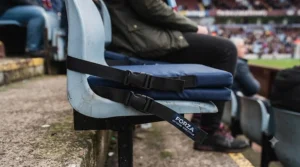
If you’re specifically hunting for a cheap portable stadium cushion under £15, this is the product this guide keeps circling back to. The ATEPA Self-Inflating Stadium Seat Cushion weighs a genuinely negligible amount — around 0.35lb — and folds down to roughly the size of a large phone, which is not something you can say about any of the padded folding seats on this list.
What most buyers overlook about self-inflating pads is that they’re not just “smaller foam” — they use trapped air plus a thin foam core, which insulates against cold metal noticeably better than solid foam of the same thickness. The dual-fabric design (soft stretch fabric on the body-facing side, tougher pongee on the ground-facing side) means one side prioritises comfort and the other prioritises durability against rough concrete steps.
The trade-off is exactly what you’d expect from the category: there’s no back support, and the cushioning is genuinely a couple of centimetres, not the 6-7cm you’ll get from foam-block cushions further down this list. Aggregated review sentiment for self-inflating stadium pads in this class tends to split cleanly along expectations — buyers who wanted “better than bare metal” are satisfied, while buyers who expected sofa-level padding are not. That’s a fair warning rather than a flaw.
Pros:
- ✅ Genuinely pocket-sized when packed away
- ✅ Insulates against cold metal better than thin foam
- ✅ Comfortably fits the under-£15 bracket
Cons:
- ❌ No back support at all
- ❌ Thinner cushioning than foam-block alternatives
Price-wise, this sits comfortably under £15 at the time of research, making it one of the few genuine bargains in the category rather than a “budget” product that’s still £20 once you add the strap and pocket. If your priority is simply “get something between me and the bench,” this earns its spot.
3. UCOMFEEL Waterproof Stadium Seat Cushion — U-shaped ergonomic design that actually fits
The UCOMFEEL Waterproof Stadium Seat Cushion takes a different angle to comfort: instead of adding a backrest, it reshapes the seat itself. The U-shaped cutout at the rear is designed to reduce direct pressure on the tailbone, which is where most bleacher discomfort actually originates rather than the lower back.
Specs worth flagging: roughly 2 inches of foam thickness, waterproof Oxford fabric outer, a zip closure so the cover can be removed and cleaned, and a carrying handle rather than a strap. In practice, the waterproof Oxford shell matters more than it sounds during a typically damp UK matchday — foam that soaks through is worse than no cushion at all, since you’re now sitting on a cold, wet sponge for the second half.
Here’s what the spec sheet won’t tell you, but the shape suggests: the U-cut design works best on flat bleacher planks rather than curved stadium seats, since the cutout needs the surface underneath to be even for the pressure-relief effect to actually register. On a standard moulded plastic stadium seat, the U-shape offers less benefit than it does on a flat wooden or metal bench.
Pros:
- ✅ U-shaped cutout targets tailbone pressure directly
- ✅ Waterproof Oxford shell with a washable, zip-off cover
- ✅ Works best value on flat bleacher-style seating
Cons:
- ❌ No back support
- ❌ Ergonomic benefit is smaller on curved plastic seats
Typical pricing sits in the £15–£20 range, and it’s often sold in single or twin-pack listings, so double-check which you’re ordering. It’s a sensible middle ground for anyone choosing between a flat pad and a full folding seat.
4. Kirvoita Portable Bleacher Seat Cushions (2-Pack) — best value for two people, one purchase
Buying two separate cushions from two different budget listings usually costs more than buying one multipack, and the Kirvoita Portable Bleacher Seat Cushions 2-pack (also sold as a 4-pack) is built specifically around that maths. Each cushion is roughly 2 inches thick, filled with high-density PU foam, and wrapped in waterproof Oxford fabric.
What most buyers overlook about multipacks in this category is the risk of inconsistent quality between units — cheaper multipacks sometimes ship with visibly different foam density between the two cushions. Based on the spec comparison with single-unit competitors at a similar per-cushion price, high-density PU foam (rather than the cheaper “loose fill” foam used in some rivals) tends to hold its shape for longer, resisting the flattening that turns a cushion into a placebo after a season of use.
This is squarely a family or couples pick: two parents at a Saturday match, two grandparents at a school sports day, or simply a spare cushion permanently living in the car boot for whoever needs it. Aggregated feedback in this product category commonly notes that the handle placement (rather than a shoulder strap) makes these easier to carry two-at-a-time than strap-based alternatives, since you can grip both handles in one hand.
Pros:
- ✅ Two cushions for less than the price of two separate purchases
- ✅ High-density foam resists flattening over time
- ✅ Handle design makes carrying a pair easy
Cons:
- ❌ No back support on either cushion
- ❌ Multipack listings can vary — check pack size before ordering
Expect a price range of roughly £15–£22 for the pack depending on whether you land on the 2-pack or 4-pack listing, which usually still keeps each individual cushion within the under-£25 brief. For households that attend matches together, this is the most efficient buy on this list.
5. RedSwing Portable Stadium Seat Cushion with Back Support — tallest backrest for full-match comfort
Of the folding, back-supported options in this list, the RedSwing Portable Stadium Seat Cushion with Back Support has the tallest backrest — roughly 17.3 inches — which is a meaningful jump over cushions that offer only a token lumbar pad. The backrest uses a buckle-adjustable design so you can set the recline angle rather than being locked into a single fixed position.
Key specs with real-world meaning: fully sponge-filled cushioning throughout (not just the seat base), dual front-and-back mesh storage pockets, and dual carrying handles with a Velcro strap for compact folded storage. The mesh pockets are a small but genuinely useful detail on a cold matchday — a flask, gloves, and a match programme all fit without needing a separate bag.
Here’s what most buyers overlook: buckle-adjustable backrests, as a category, tend to be the single most common point of long-term wear on folding stadium seats, since the buckle mechanism takes repeated stress every time you fold and unfold it. That’s not unique to this product — it’s a structural reality of any adjustable-recline design — but it’s worth choosing a firm, snap-locking buckle mechanism over a friction-only one if you plan to use this weekly through a full season.
Pros:
- ✅ Tallest backrest on this list at roughly 17.3 inches
- ✅ Adjustable recline rather than a single fixed angle
- ✅ Dual mesh pockets for matchday essentials
Cons:
- ❌ Adjustable buckles are the typical long-term wear point on this style of seat
- ❌ Bulkier folded size than flat foam pads
This tends to sit in the £20–£25 range, occasionally dipping under with promotions — check current price before ordering. For anyone who specifically struggles through the second half with lower-back discomfort, the taller backrest here is the deciding factor over shorter-backed rivals.
6. HOTUT Stadium Seat Cushion — straightforward, no-frills UK stock pick
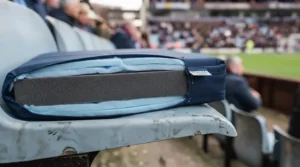
Not every cushion needs a gimmick, and the HOTUT Stadium Seat Cushion is the plainest option on this list by design: a foam pad with a waterproof cover and a basic carry handle, sold directly through UK Amazon listings. There’s no backrest, no U-cut, no inflation mechanism — just foam between you and the bench.
The specification is intentionally minimal: roughly 1.5–2 inches of foam thickness, a wipeable waterproof outer, and a compact folded size that fits into a rucksack side pocket rather than needing its own bag. What most buyers overlook about “basic” cushions like this is that simplicity is also reliability — there’s no buckle to snap, no valve to fail, no zip to jam. For someone who wants a cushion that will still work exactly the same way in five years, fewer moving parts is a genuine feature, not a lack of one.
Based on honest comparison with the more feature-rich picks on this list, this is best suited to occasional matchgoers who don’t want to think hard about the purchase — students heading to the terraces a handful of times a season, or anyone who just wants a cushion permanently stashed in a rucksack “just in case.”
Pros:
- ✅ Simple design with fewer parts to fail
- ✅ Compact enough for a rucksack side pocket
- ✅ Comfortably under £15 at typical pricing
Cons:
- ❌ Thinner padding than the multi-layer options on this list
- ❌ No back support or ergonomic shaping
Typical pricing sits under £15, making it a genuine budget anchor for this list alongside the ATEPA pick. If you’re not sure whether you’ll actually use a stadium cushion regularly, this is the low-commitment way to find out.
7. Alpcour Extra Thick Stadium Seat Cushion — the premium pick worth stretching for
Every list like this needs a splurge option, and the Alpcour Extra Thick Stadium Seat Cushion is it. At around 3 inches of foam — noticeably thicker than any other cushion here — plus bench straps, a cup holder, and a side pocket, this is the closest thing on this list to bringing an actual armchair to the ground.
Specs with real-world meaning: the roughly 21 x 15 x 3-inch pad can be used vertically or horizontally, meaning it doubles as a slightly wider seat on tight benches. The waterproof polyester shell pairs with an anti-slip rubber base, which solves a problem the flatter foam pads on this list don’t fully address — thin pads with fabric bottoms can slide on painted metal bleachers, while a rubberised base grips.
What the spec sheet won’t tell you is where this pricing sits relative to the “under £25” brief: at the time of research, this one frequently prices right at or just over the £25 mark depending on colour and promotions, so it’s the one pick on this list worth double-checking against current pricing before you commit. Reviewers consistently flag the extra thickness as the standout reason to pay more, particularly for anyone attending all-day events like cricket or athletics meets rather than a 90-minute football match.
Pros:
- ✅ Thickest cushioning of any pick on this list
- ✅ Anti-slip rubber base grips painted or metal bleachers
- ✅ Cup holder and side pocket add genuine convenience
Cons:
- ❌ Frequently prices at or just above the £25 threshold
- ❌ No back support despite the premium price
If your budget has a little flex and you’re attending long, all-day fixtures rather than quick 90-minute matches, this is the one product on this list where “just check the price” genuinely matters — it can land either side of £25 depending on when you buy.
Practical Usage Guide: Getting the Most From Your Stadium Cushion
Buying the right cushion is only half the job — how you use and store it determines whether it lasts one season or five. On first use, unfold or inflate the cushion fully before your first match rather than at the ground; this lets you spot any missing straps or faulty valves while you can still exchange the item. For hook-and-strap folding seats, attach the hooks to a similar-width bench at home first so you’re not fumbling with an unfamiliar clip system in a crowded stand five minutes before kick-off.
Maintenance is minimal but not zero. Waterproof Oxford and polyester shells should be wiped down after wet matches rather than left to dry with mud or grass stains baked in by the sun on the walk home — a damp cloth and a few minutes prevents the fabric stiffening over a season. Self-inflating pads like the ATEPA Self-Inflating Stadium Seat Cushion should be stored slightly open rather than fully compressed for long periods, since permanently squashed foam loses its recovery over time; most manufacturers recommend leaving the valve cracked open in storage between uses.
The most common first-30-days mistake isn’t a product fault — it’s storage. Cushions left folded in a hot car boot for weeks at a time break down foam and degrade adhesive on straps faster than regular outdoor use ever will. A cool, dry cupboard or under-stairs space is far better for longevity than the car, however tempting it is to leave it there “for next time.” Finally, if your cushion has a zip-off cover, wash it on a gentle cycle rather than tumble-drying — high heat is the single fastest way to shrink Oxford fabric covers out of shape.
Real-World Scenarios: Which Cushion Fits Your Matchday
Picture three fairly different fans, because the “best” cushion genuinely depends on who’s using it. First, the weekly season-ticket holder: someone attending 20-plus fixtures a year, sitting through full 90 minutes plus stoppage time in all weather. For this profile, the extra investment in a folding, back-supported option like the RedSwing Portable Stadium Seat Cushion with Back Support or the ALPHA CAMP Extra Wide Padded Stadium Seat pays for itself across a season — the backrest specifically addresses the cumulative strain of dozens of full matches, not just one.
Second, the occasional day-tripper: a parent taking two kids to a handful of school sports days or a one-off cricket match each summer. Here, the economics favour the Kirvoita Portable Bleacher Seat Cushions (2-Pack) — one purchase covers two people, there’s no backrest bulk to store for 11 months of the year, and the price stays comfortably under budget. Frequency of use is low enough that ultra-durability matters less than low upfront cost and easy storage.
Third, the minimalist traveller: someone who walks or takes public transport to matches and genuinely doesn’t want to carry bulk. For this profile, the ATEPA Self-Inflating Stadium Seat Cushion or the HOTUT Stadium Seat Cushion both fit a coat pocket or small bag, at the cost of skipping back support entirely. If you fall between these profiles — say, a fan who attends fortnightly but hates carrying anything bulky on the walk from the station — the UCOMFEEL Waterproof Stadium Seat Cushion splits the difference with genuine tailbone relief in a still-compact package.
How to Choose Stadium Seat Cushions Under £25
Picking the right cushion comes down to a short list of genuinely important criteria, in roughly this order of priority:
- Match frequency. Weekly attendees should weight back support heavily; occasional attendees can prioritise low cost and easy storage instead.
- Seat type at your usual ground. Flat wooden or metal bleacher planks suit U-shaped or hook-and-strap designs; curved plastic stadium seats suit flatter, less structured pads.
- Thickness versus portability. More foam means more comfort but also more bulk — decide honestly whether you’ll actually carry a bulky cushion on transit days, or whether it’ll simply stay in the car.
- Waterproofing. UK matchdays are rarely guaranteed dry; an untreated fabric cover that soaks through defeats the purpose of the cushion entirely.
- Attachment method. Hooks and straps stop a cushion sliding on sloped seating; a handle-only design is fine for flat bench seats but less secure on an incline.
- Group size. A single cushion works for solo attendees, but multipacks like the Kirvoita 2-pack are more cost-efficient for couples or families.
- Budget ceiling. Since this whole category sits under £25, decide in advance whether you’re aiming for the £10–£15 bracket or willing to stretch toward £25 for a backrest.
Common Mistakes When Buying Stadium Seat Cushions
The single most common mistake is buying purely on thickness without checking the attachment method — a beautifully thick cushion that has no strap or hook will simply slide off a sloped aluminium bench the moment the crowd leans forward for a corner kick. The second most common mistake is ignoring the folded size entirely; a cushion that’s brilliant at the ground becomes a nuisance if it doesn’t fit in your usual bag, and ends up left at home more often than it’s used.
A third mistake, particularly with multipacks, is assuming “2-pack” pricing automatically beats buying two single units — sometimes it does, sometimes promotional single-unit pricing undercuts the multipack, so it’s always worth comparing the effective per-cushion cost rather than trusting the pack framing. Fourth, buyers regularly skip checking whether a listing includes a backrest or not, since product photography can make a flat pad look propped up when it’s actually just leaning against something in the photo — always check the written spec, not just the thumbnail image. Finally, some buyers assume “waterproof” and “water-resistant” mean the same thing; resistant fabrics slow water absorption but will eventually soak through in sustained rain, while genuinely waterproof shells (usually stated explicitly, often Oxford weave with a coating) hold up through a full wet match.
Portable Stadium Seat Cushion vs Folding Stadium Seats vs Hard Bleacher Seating
These three options represent a genuine spectrum rather than three interchangeable terms, and it’s worth being precise about what each actually means before you buy. Hard bleacher seating — the baseline, unmodified aluminium bench or plastic moulded seat you’ll find at most UK grounds — offers zero cushioning and zero back support. According to Wikipedia’s entry on bleachers, these raised, tiered rows of benches range from simple planks to more elaborate designs, but even the more elaborate versions rarely include padding — the structure is designed for capacity and sightlines, not comfort.
A portable stadium seat cushion is the minimal fix: a flat or lightly shaped pad, with or without a handle, that sits on top of existing hard seating. It solves the cold-and-hard problem but not the lack-of-back-support problem. Folding stadium seats go a step further, adding a hinged or buckled backrest, and usually hooks or straps to anchor to the bench — effectively building a chair on top of the existing seating rather than just padding it.
| Comparison | Hard Bleacher Seating | Portable Cushion (no back) | Folding Stadium Seat (with back) |
|---|---|---|---|
| Cushioning | None | Yes | Yes |
| Back support | None | None | Yes |
| Portability | N/A | Highest | Moderate |
| Typical price | Free (built-in) | Under £15–£20 | £20–£25 |
| Best For | Short visits only | Occasional, budget-focused fans | Weekly attendees, long fixtures |
The analysis here is straightforward once you interpret the table: hard bleacher seating is genuinely fine for a short school match but becomes actively uncomfortable past about 45 minutes, which is exactly why cushions exist as a category at all. A basic portable cushion like the HOTUT Stadium Seat Cushion solves the “cold and hard” problem cheaply, but if lower-back ache is your main complaint rather than simple discomfort, only a folding stadium seat with an actual backrest — such as the RedSwing Portable Stadium Seat Cushion with Back Support — genuinely addresses it. Spending more on a flatter, thicker cushion instead of a backed one is a common way to overspend without fixing the actual problem.
What to Expect: Real-World Performance
Specs on a listing page rarely translate directly into how a cushion feels three-quarters of the way through a cold, drizzly second half, so it’s worth translating them here. A 1.5–2 inch foam pad, the thickness used by most budget picks on this list, genuinely removes the “sitting on a metal bar” sensation within the first five minutes, but by around the 60-minute mark on an unpadded plastic stadium seat, most users report the compressed foam has thinned enough that some awareness of the underlying seat returns — this is normal foam behaviour rather than a fault.
Thicker cushions, in the 2.5–3 inch range like the Alpcour Extra Thick Stadium Seat Cushion, hold their shape noticeably longer under sustained weight, which is exactly why all-day event attendees (cricket, athletics, agricultural shows) tend to prefer them over 90-minute football fans, who rarely sit long enough to notice the difference. Backrests change the calculation entirely: even a modestly padded backrest reduces the slow forward-slump that causes most matchday lower-back complaints, regardless of how thick the seat cushion itself is. In cold weather specifically, self-inflating pads like the ATEPA Self-Inflating Stadium Seat Cushion perform better than their thin profile suggests, since trapped air is a genuinely effective insulator against conducted cold from metal benches — colder than the padding thickness alone would predict.
Matchday Comfort: Cushions for Every Type of Fan
Matchday comfort isn’t a single fixed standard — it shifts depending on who’s sitting, how long for, and in what weather. For older fans or anyone managing existing back or joint discomfort, prioritising a backrest over raw thickness tends to matter more; a thin cushion with a firm, properly angled backrest often out-performs a thick cushion with no back support at all for this group. For families with young children, portability and quick setup usually beat maximum cushioning, since a five-year-old wriggling on and off a seat repeatedly cares less about foam density than you’d expect.
For students and budget-conscious regulars, the maths favours the cheapest genuinely functional option — a basic cushion under £15 used every fortnight delivers more comfort-per-pound than an occasional splurge purchase that mostly sits unused in a cupboard. And for anyone attending in a group, coordinating a shared multipack purchase, like the Kirvoita Portable Bleacher Seat Cushions, often works out both cheaper and more convenient than everyone separately researching their own single cushion. The through-line across all of these profiles is that matchday comfort scales with how honestly you assess your own attendance pattern, not with how impressive the product photography looks.
Long-Term Cost & Maintenance
Thinking in terms of total cost of ownership rather than sticker price changes which cushion looks like the best value. A £12 basic foam pad used weekly across a 38-game season works out to roughly 32p per match in its first year — genuinely excellent value, provided the foam doesn’t flatten out before the season ends. A £24 folding seat with a backrest costs double upfront but, if it lasts three to four seasons rather than one, actually undercuts the cost-per-use of a cheap pad that needs replacing annually.
The variable that actually determines this outcome is foam recovery and fabric durability, not the price tag itself. High-density PU foam, as used in the Kirvoita Portable Bleacher Seat Cushions, genuinely holds shape longer than the cheaper “loose fill” foam sometimes used in unbranded budget listings, which is worth paying a small premium for if you attend regularly. Maintenance costs are minimal across this whole category — there’s no serviceable mechanism beyond straps and buckles — but a cushion stored indoors between matches will comfortably outlast one left in a car boot through winter, effectively giving you free extra seasons of use for zero extra spend.
Safety, Regulations and Compliance Guide
Stadium seat cushions themselves aren’t heavily regulated products, but a few practical safety points are worth knowing before you buy. General consumer product regulations in Great Britain require accurate labelling of materials and fire-safety information on upholstered items sold domestically; for imported foam-filled products specifically, checking that a listing states compliance with UK flammability requirements is a reasonable due-diligence step, particularly for cheaper unbranded listings. You can review the official framework for how UK product conformity marking works via the UKCA marking guidance on GOV.UK, which explains how products sold in Great Britain demonstrate conformity with applicable safety requirements.
On the wellbeing side, prolonged sitting on unsupportive hard seating is a genuine, well-documented contributor to lower-back discomfort, and the NHS guidance on back pain notes that supportive seating and posture are practical, everyday factors worth managing rather than ignoring. That’s not medical advice specific to any individual — simply a sensible reason to take a cushion’s back support seriously if you already carry any degree of back sensitivity, rather than assuming any pad is “good enough” purely because it’s padded.
Ground-specific rules also matter: some UK stadiums restrict cushion size or bag-carrying policies during high-security fixtures, so it’s worth checking your specific club’s matchday guidance before assuming any folding seat is automatically permitted inside. Historically, seating policy in English football has been a genuinely contested regulatory area — the shift toward all-seater requirements followed the recommendations of the Taylor Report, and debates about stadium seating rules have continued in the years since, as covered in BBC Sport’s reporting on stadium seating policy. None of that affects your cushion purchase directly, but it’s a reminder that seating at UK grounds is more regulated than it might first appear.
Features That Actually Matter (And Those That Don’t)
Genuinely worth paying for: a proper backrest if you attend regularly, a waterproof (not just water-resistant) outer shell, and secure attachment via hooks or straps if your usual ground has sloped benches. These three features consistently separate cushions that get used for years from ones that quietly get left at home after a couple of uses. High-density foam is also worth the small premium over loose-fill foam, since it directly determines how long the cushion stays comfortable rather than becoming a thin, compressed pancake by February.
Less important than the marketing suggests: cup holders and side pockets are pleasant conveniences rather than genuine comfort features — nice on the Alpcour Extra Thick Stadium Seat Cushion, but not worth paying extra for on their own. Multiple recline positions on folding seats sound impressive, but most users settle on one preferred angle within the first couple of uses and never touch the adjustment again, so a simple two-position backrest is often just as useful as a six-position one for most fans. Bright colours and branded prints add zero functional value, though they do make a cushion easier to spot if you’re leaving it at your usual seat between the first and second half.
Frequently Asked Questions
❓ Are stadium seat cushions under £25 actually worth it for occasional use?
❓ What is the best cheap portable stadium cushion under £15?
❓ Do folding stadium seats fit all bench sizes?
❓ How do I clean a stadium seat cushion after a wet match?
❓ Is a cushion with back support worth the extra cost over a flat pad?
Conclusion
There’s no single “best” stadium seat cushion under £25 — there’s only the best one for how often you actually go, what kind of seating your ground uses, and how much bulk you’re willing to carry. For weekly regulars battling long matches in changeable British weather, the back-supported options — the ALPHA CAMP Extra Wide Padded Stadium Seat and the RedSwing Portable Stadium Seat Cushion with Back Support — earn their place near the top of the budget for genuine, cumulative comfort. For occasional attendees or anyone who simply wants insurance against a cold bench without much outlay, the ATEPA Self-Inflating Stadium Seat Cushion and the HOTUT Stadium Seat Cushion prove that under £15 doesn’t have to mean uncomfortable.
Whichever you choose, the underlying logic stays the same throughout this guide: match the product to your actual attendance pattern rather than to the most impressive spec sheet. A cushion that stays in the cupboard because it’s too bulky to carry helps nobody, and neither does an ultralight pad that leaves a weekly regular with an aching back by full time. Buy honestly for your own matchday, check the current price before ordering since all of these shift with stock and promotions, and you’ll get several seasons of genuinely improved comfort out of a fairly small outlay.
✨ Don’t Miss These Exclusive Deals!
🔍 Take your matchday comfort to the next level with these carefully selected picks. Click through to check current pricing and availability on amazon.co.uk before you head to your next fixture. A few pounds now could save you a very uncomfortable second half!
Recommended for You
- 7 Best Cooling Cushion for Garden Chair Picks (UK 2026 Guide)
- Cooling Cushion for Wheelchair Users: 7 Top Picks for 2026
- Cooling Car Seat Cushion 2026: 7 Best Picks for Hot Drives
Disclaimer: This article contains affiliate links. As an Amazon Associate, I earn from qualifying purchases. If you purchase products through these links, we may earn a small commission at no additional cost to you.
✨ Found this helpful? Share it with your friends! 💬🤗
