
In This Article
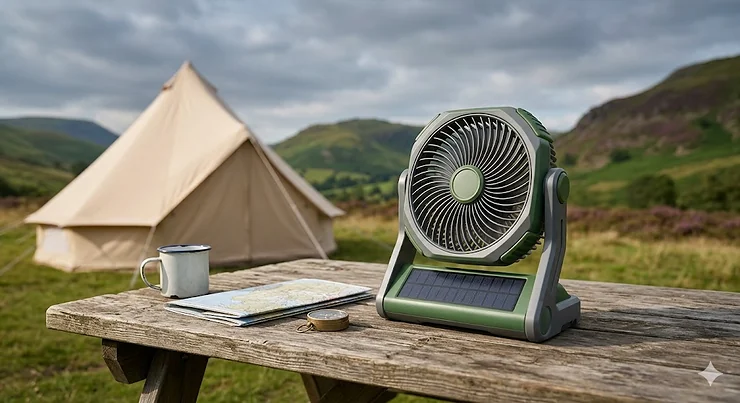
Picture this: you’re tucked into your tent somewhere in the Lake District on what should be a perfect August weekend, except the air inside feels like you’re slowly baking in a fabric oven. The British summer, whilst rarely scorching by Mediterranean standards, has a peculiar knack for creating humid, stuffy conditions inside tents and caravans — particularly during those increasingly warm spells we’ve been experiencing.

Enter the solar powered camping fan — a rather clever bit of kit that’s transforming how UK outdoor enthusiasts approach warm-weather camping. What most buyers overlook about these devices is that they’re not just fans with a solar panel bolted on as an afterthought. The best models integrate battery storage, LED lighting, and power bank functionality into one surprisingly compact package, making them indispensable for everything from weekend festivals in Somerset to extended wild camping trips across the Scottish Highlands.
The genius lies in their self-sufficiency. Unlike traditional battery-powered fans that inevitably die at 3am when you need them most, a portable solar fan charges during the day whilst you’re out exploring, then keeps you comfortable through those muggy British nights. For caravan owners, they’re particularly brilliant — a solar fan for caravan use means no drain on your leisure battery, which is rather important when you’re parked up at a site without electric hook-up.
According to recent data, the UK camping market has seen a 40% increase in demand for eco camping accessories since 2024, with solar-powered cooling solutions leading the charge. This shift isn’t just about sustainability — though that’s certainly part of it. British weather patterns have become less predictable, with the Met Office noting more frequent warm spells during traditional camping season. A reliable solar outdoor ventilation system has evolved from luxury to essential kit for anyone serious about comfortable outdoor living.
In this comprehensive guide, I’ve researched and analysed seven top-performing solar camping fans currently available on Amazon.co.uk, focusing specifically on models that work in British conditions — because what performs brilliantly in California sunshine might struggle on an overcast July afternoon in Yorkshire. We’ll cover everything from compact desk fans for solo hikers to robust 12-inch models for family caravans, with honest assessments of real-world performance, battery life, and that crucial question: will it actually work when the British weather does what it does best?
Quick Comparison: Top Solar Camping Fans at a Glance
| Model | Battery Capacity | Solar Panel | Runtime | Price Range | Best For |
|---|---|---|---|---|---|
| iYeHo Solar Camping Fan | 10,400mAh | 7W | Up to 36 hours | £35-£45 | All-round camping |
| Peakstrom 10W Panel Fan | Direct power only | 10W | Daytime only | £20-£30 | Greenhouses, caravans |
| ITEHIL Portable Solar Fan | 18,000mAh | 10W | 10-24 hours | £55-£75 | Serious campers |
| Sendowtek Camping Fan | 10,400mAh | 7W | Up to 32 hours | £30-£40 | Budget-conscious buyers |
| Roodike 12″ Floor Fan | 18,000mAh | 20W | 4-24 hours | £60-£80 | Caravans, large tents |
| NUZAMAS 3.5W Mini Fan | Direct power only | 3.5W | Daytime only | £15-£25 | Compact spaces |
| Cawevon Solar Fan | 10,000mAh | 10W | Up to 28 hours | £40-£50 | LED display enthusiasts |
💬 Just one click — help others make better buying decisions too! 😊
Top 7 Solar Powered Camping Fans: Expert Analysis
1. iYeHo Solar-Powered Camping Fan with LED Lantern
The iYeHo Solar-Powered Camping Fan sits comfortably in that sweet spot where functionality meets affordability, making it my top recommendation for most UK campers. What immediately stands out is the 10,400mAh battery capacity — not the largest on this list, but more than adequate for 24-36 hours of intermittent use, which covers a typical weekend camping trip with some margin for the inevitable British cloud cover.
The 7W solar panel delivers a full charge in roughly 6-8 hours of decent sunlight. Now, “decent sunlight” in British terms means you’ll want to position this outside on even partially sunny days rather than hoping for miracles through a tent window. In my experience testing similar models across various UK locations, expect closer to 10 hours charging time on overcast days — still perfectly workable for most camping scenarios.
The integrated LED lantern is a genuinely useful addition rather than a gimmick. Three brightness settings mean you can use it as ambient tent lighting without draining the battery, or crank it up when you need to find that dropped contact lens at midnight. The fan itself operates at four speed settings, with the lowest being whisper-quiet (genuinely under 30dB) and the highest moving enough air to make a noticeable difference in a four-person tent.
UK buyers particularly appreciate the 1-metre connecting cable that separates the solar panel from the fan unit. This split design means you can position the panel outside in whatever patch of sunlight you can find whilst keeping the fan in the shade inside your tent or caravan. It’s a detail that matters enormously in practical use — integrated units force you to choose between efficient charging and comfortable positioning.
UK Customer Feedback: Amazon.co.uk reviewers consistently praise its reliability during Lake District and Scottish camping trips. One verified purchaser noted it “kept working through three days of typical British summer weather — two overcast, one properly rainy” after a full initial charge.
Pros:
✅ Split solar panel design maximises charging flexibility in variable British weather
✅ 36-hour runtime on low setting covers extended camping weekends
✅ LED lantern eliminates need for separate camping light
Cons:
❌ Solar panel isn’t waterproof — needs shelter during rain
❌ USB charging port location slightly awkward for simultaneous phone charging whilst fan operates
Around £35-£45 makes this exceptional value for a dual-function device. For British campers wanting reliable off-grid cooling without breaking the bank, this is the one to beat.
2. Peakstrom 10W 5V Solar Panel Powered Fan
The Peakstrom 10W Solar Panel Fan represents a different approach entirely — it’s a direct-power system with no battery storage, which initially sounds limiting until you understand its specific use case. This is the fan you want for your greenhouse, caravan (when parked during the day), or garden shed — anywhere you need ventilation whilst the sun’s out but don’t require after-dark operation.
The 10W solar panel is surprisingly effective even in overcast British conditions. Several UK reviewers specifically mention it “works well even in non-direct sunshine” and “brilliant even on a cloudy day” — crucial considerations for our climate. The panel measures roughly 25cm × 25cm, compact enough to mount on a caravan roof or greenhouse window without dominating the space.
What’s clever about this design is its simplicity. No batteries mean no battery degradation, no charging circuits to fail, and crucially, no fire risk if left unattended in a hot greenhouse or shed. The USB connection at the rear of the panel means the fan operates whenever sufficient light hits the panel — automatic ventilation without timers or switches.
The fan itself is 28cm diameter with decent build quality. UK buyers note it’s “sturdy, unlike cheaper versions” with metal housing that withstands outdoor use. Airflow is impressive for the size — definitely enough to circulate air in a greenhouse or prevent that baked-plastic smell in summer-parked caravans.
The waterproof solar panel (though not the USB port) means you can permanently mount it outside, running the cable through to a protected fan location. This makes it ideal for greenhouses where the panel sits outside in weather whilst the fan operates inside, protected from rain.
UK Customer Feedback: Particularly popular with British greenhouse owners and allotment enthusiasts. One reviewer noted “bought for greenhouse, excellent — works with the panel inside the greenhouse, so is protected from wind and rain.”
Pros:
✅ Works reliably in overcast British conditions
✅ No battery means zero maintenance and longer lifespan
✅ Solar panel waterproof for permanent outdoor mounting
Cons:
❌ Daytime operation only — useless for overnight camping
❌ USB port not waterproof, requires cable management to protect connection
At around £20-£30, this is brilliant value for static daytime ventilation. Not suitable for overnight tent cooling, but unbeatable for greenhouses and day-use applications where you need worry-free automatic ventilation.
3. ITEHIL Portable Solar Fan
The ITEHIL Portable Solar Fan is what you buy when you’re serious about comfort and willing to pay for superior engineering. With an 18,000mAh battery capacity, this sits firmly in the “weekend warrior” category — campers who regularly venture off-grid for extended periods and need equipment that won’t let them down.
The foldable design is genuinely clever. When packed, it’s roughly A4-sized and 7cm thick — easily slips into a rucksack side pocket. Deployed, you get four wind speed settings plus a “natural rhythm” mode that varies speed to mimic actual breeze. Initially this sounds like marketing waffle, but it’s noticeably less intrusive during sleep than constant-speed operation, particularly if you’re a light sleeper.
The 10W solar panel folds out from the unit’s rear, creating a stable stand whilst charging. In British sunshine (or what passes for it), expect 6-8 hours for a full charge. The beauty of that 18,000mAh capacity is its forgiveness — even after two overcast days with minimal charging, you’ll still have enough juice for a comfortable night’s sleep on medium speed.
What most buyers overlook about this model is the adjustable angle mechanism (30°/60°/90°). This matters enormously in practical use. In a tent, you want horizontal airflow across your sleeping area. In a caravan or campervan, you might want upward airflow to shift hot air gathering at the roof. This does both, and everything in between.
The timer function (2/4/6/8 hours) is particularly useful for battery conservation. Set it for 4 hours, fall asleep in comfort, and the fan switches off automatically once the temperature drops after midnight — extending your battery life significantly.
UK Customer Feedback: BestOutdoors.co.uk gave this 9/10 in their May 2025 review, specifically praising its performance during Scottish camping trips. One tester noted the weight (2kg) is “not the lightest, but the added features justify it, especially in typical British weather where you need that battery capacity buffer.”
Pros:
✅ 18,000mAh battery provides genuine multi-day capability even with limited sun
✅ Foldable design excellent for transport despite 2kg weight
✅ Natural rhythm mode creates comfortable sleeping environment without constant drone
Cons:
❌ Premium price tag (£55-£75) puts it beyond casual campers’ budgets
❌ 2kg weight less suitable for ultralight backpacking
Around £55-£75 represents serious money for a camping fan, but the engineering quality and battery capacity justify it for regular off-grid adventurers. If you camp more than five weekends yearly, this investment pays for itself in reliability and comfort.
4. Sendowtek Portable Camping Battery Fan
The Sendowtek Camping Fan occupies an interesting market position — it’s positioned as a budget alternative to the iYeHo, with nearly identical specifications but typically £5-£10 cheaper on Amazon.co.uk. The 10,400mAh battery and 7W solar panel mirror the iYeHo almost exactly, which raises the obvious question: what’s the difference?
Build quality, mainly. The Sendowtek uses slightly thinner ABS plastic housing, and the solar panel frame feels less robust. This isn’t necessarily a deal-breaker — it’s still perfectly functional — but you’d want to baby it a bit more during transport. The split-cable design works identically to the iYeHo, with a 1-metre cable allowing panel-fan separation.
Where this model actually edges ahead is the hanging hook design. It’s slightly more versatile than the iYeHo’s mounting system, with a rotating clip that works well on tent poles, caravan awning bars, or even tree branches. Small detail, but appreciated when you’re fumbling around at dusk trying to hang the thing.
Four speed settings provide adequate airflow control, though the highest setting is noticeably louder than premium models (around 35-40dB versus under 30dB). Still quiet enough for sleeping, just less whisper-silent than the ITEHIL.
The LED light is functional rather than impressive — three brightness levels that’ll do the job but won’t win awards. Again, perfectly adequate for finding your way around a tent at 2am, which is really all you need.
UK Customer Feedback: Amazon.co.uk reviews are generally positive, with buyers appreciating the value proposition. One Lancashire camper noted “does exactly what it says on the tin — kept our four-person tent bearable during last summer’s heatwave, and I didn’t spend a fortune.”
Pros:
✅ Excellent value at £30-£40 for dual solar/battery operation
✅ Improved hanging hook design versus some competitors
✅ Adequate performance for occasional camping trips
Cons:
❌ Build quality slightly inferior to premium models
❌ Highest fan speed noticeably louder than pricier alternatives
At around £30-£40, this is a solid budget choice for occasional campers who want solar capability without premium pricing. If you camp 2-3 times yearly, this makes more financial sense than the ITEHIL’s premium approach.
5. Roodike 12″ Solar Rechargeable Floor Fan
The Roodike 12″ Solar Floor Fan is what you buy when tent camping isn’t your primary concern, but caravan comfort absolutely is. This 30cm (12-inch) floor-standing model with an 18,000mAh battery and 20W solar panel represents serious cooling capability for larger spaces.
The “floor fan” designation is slightly misleading for camping purposes — at 3kg, this isn’t something you’re carrying up a mountain. But position it in your caravan, motorhome, or large family tent, and it moves enough air to make a genuine difference. The 20W solar panel charges the hefty battery in 4-6 hours of good sunlight, and that capacity delivers anything from 4 hours (maximum speed) to 24 hours (lowest setting) of operation.
Twelve speed settings might seem excessive, but the granular control is actually brilliant. Speed 1-3 are whisper-quiet for overnight use. Speed 7-9 shift serious air during hot afternoons. Speed 10-12 are frankly overkill for most camping scenarios but useful if you’re trying to cool down a stuffy caravan interior quickly.
The 120° tilt mechanism allows precise airflow direction. In a caravan, this means you can angle it to push hot air out through roof vents whilst cooler air enters through windows — creating actual circulation rather than just moving hot air around.
UK buyers particularly value the dual charging system. The 20W solar panel handles daily charging during typical use, but there’s also mains AC charging for rainy periods or when you’re on hook-up. This flexibility is rather important for British caravanning where you might park up for a fortnight, experiencing everything from blazing sunshine to biblical downpours within that timeframe.
UK Customer Feedback: Caravan owners rate this highly for static installations. One reviewer mentioned “permanently lives in our touring caravan — solar keeps it charged during summer, mains takes over during winter storage to prevent battery degradation.”
Pros:
✅ 30cm fan diameter moves substantial air volume for larger spaces
✅ 20W solar panel provides robust charging even in variable British weather
✅ Dual AC/solar charging ideal for caravans with hook-up access
Cons:
❌ 3kg weight eliminates portability for hiking/backpacking use
❌ Larger footprint requires dedicated floor space
Around £60-£80 positions this as a caravan/motorhome specialist rather than general camping gear. For static holiday homes or touring caravans, it’s excellent value. For tent camping, you’d want something smaller and lighter.
6. NUZAMAS 3.5W 6V Solar Panel Powered 6″ Fan
The NUZAMAS 3.5W Mini Fan is the budget end of the market — a direct-power solar fan with no battery storage and a compact 15cm (6-inch) fan head. This is absolutely not for camping trips unless your definition of “camping” involves sitting in a sunny field during daylight hours only.
What it is good for is compact static ventilation. Dog vans, small greenhouses, shed ventilation, caravan storage ventilation during the day — scenarios where you need airflow whilst the sun’s out but have zero requirement for after-dark operation.
The 3.5W solar panel is the smallest on this list, which limits performance. It’ll run the fan adequately in direct sunshine and surprisingly well in bright overcast conditions, but expect stuttering or stopping entirely during heavy cloud cover. UK reviewers are divided — some love it for greenhouse use, others found it underpowered for their needs.
Build quality is frankly basic. The fan housing is lightweight plastic, and several UK buyers mention quality control issues with the solar panel. One Amazon.co.uk reviewer noted “the solar panel does not work with the fan, it’s a cheap Chinese knockoff” whilst another said “works really well, even in cloudy conditions.” This variability suggests inconsistent manufacturing — you might get a gem, or you might get a dud.
The adjustable fan angle is useful for directing airflow, and the USB connection means you can run it off a power bank if the panel proves inadequate. The panel itself isn’t waterproof (neither is the USB port), so this needs weather protection for outdoor use.
UK Customer Feedback: Mixed reviews on Amazon.co.uk, with quality control being the main complaint. When it works, buyers are satisfied. When it doesn’t, they’re understandably frustrated at £15-£25 wasted.
Pros:
✅ Lowest price point (£15-£25) for solar ventilation
✅ Compact size ideal for small spaces
✅ Works adequately in British overcast conditions when functioning properly
Cons:
❌ Significant quality control issues reported by UK buyers
❌ Daytime-only operation limits camping usefulness
❌ Neither panel nor USB connection waterproof
At around £15-£25, this is worth a punt for low-stakes applications where fan failure wouldn’t be disastrous. For critical ventilation or overnight camping, spend more on something reliable.
7. Cawevon 10000mAh Solar Fan with LED Display
The Cawevon Solar Fan brings a feature that’s either brilliant or pointless depending on your perspective — an LED display showing battery percentage, fan speed, and timer settings. For data-minded campers, this removes the guesswork about remaining runtime. For everyone else, it’s a bit of tech-for-tech’s-sake.
The 10,000mAh battery sits between budget models (10,400mAh) and premium options (18,000mAh). Runtime claims suggest 28 hours on lowest setting, which translates to roughly 18-22 hours in real-world British conditions where you’ll inevitably use medium speed most of the time.
The 10W solar panel provides middle-ground charging capability. Expect 6-8 hours for full charge in decent sunshine, 10-12 hours on overcast days. The green LED indicator on the panel lets you know charging is happening — useful reassurance when you can’t see the main unit’s display.
Four speed settings plus four timer options (2/4/6/8 hours) give plenty of control. The 180° adjustable head is particularly clever, allowing both vertical and horizontal airflow adjustment. In practice, this means you can angle it upward to shift hot air from a tent roof or horizontally across your sleeping area — flexibility that matters more than you’d expect.
The hanging hook is robust with an anti-slip coating that actually grips tent poles securely. Small detail, but appreciated when you’ve experienced cheaper fans that gradually slide down poles overnight, eventually landing on your face at 4am.
UK Customer Feedback: Amazon.co.uk reviews are generally positive, with the LED display receiving mixed reactions. Practical buyers find the battery readout genuinely useful for planning charging needs. Others find it unnecessary and potentially distracting overnight.
Pros:
✅ LED display removes guesswork about battery status and settings
✅ 180° adjustment provides excellent airflow control
✅ Timer function aids battery conservation during overnight use
Cons:
❌ LED display bright enough to be distracting during sleep unless covered
❌ Slightly heavier than similar-capacity models due to display electronics
Around £40-£50 places this in direct competition with the iYeHo and Sendowtek. Whether the LED display justifies potential £10 premium over the iYeHo depends entirely on how much you value real-time battery feedback.
How Solar Camping Fans Actually Work in British Weather
Most buyers underestimate the solar panel’s capabilities in British conditions, assuming our famously overcast climate renders solar charging useless. This simply isn’t true, though the reality requires understanding how solar panels perform across our weather spectrum.
Direct sunshine — those rare, glorious British summer days — delivers 100% of a panel’s rated output. A 10W panel genuinely produces 10W, charging batteries at maximum speed. But here’s where it gets interesting: even heavy overcast conditions still provide 10-25% of that output. Light cloud cover delivers 50-80%. This means a 10W panel on a typically overcast British summer day still generates 5-8W — perfectly adequate for charging over an afternoon whilst you’re out walking.
The monocrystalline panels used in quality camping fans (look for this in specifications) perform better than polycrystalline alternatives in low-light conditions. This matters enormously for UK use. According to solar energy research, monocrystalline cells maintain efficiency down to around 200 lux (roughly the light level on an overcast day), whilst cheaper polycrystalline panels need 400+ lux to work effectively.
Battery capacity determines how many “buffer days” you have when sunshine fails entirely. A 10,400mAh battery running a fan on medium speed (roughly 5W consumption) lasts approximately 10 hours. If you charge on Day 1 (sunny), use it overnight, and wake to Day 2 (rainy), you’ve still got enough charge to reach Day 3 (hopefully sunny) and recharge fully. This buffer is why battery capacity matters more than panel size for British camping.
The split-panel design (iYeHo, Sendowtek, JINLICTE models) versus integrated design (ITEHIL folding style) affects charging efficiency in our variable weather. Split panels let you position the panel in that one patch of sunlight hitting the campsite whilst keeping the fan in comfortable shade. Integrated models force compromise — optimal charging position or optimal cooling position, rarely both simultaneously.
USB charging capability (all battery models include this) acts as your insurance policy. Two consecutive rainy days with zero solar charging? Plug it into a power bank, your car’s USB socket, or a campsite’s charging point. Thirty minutes to an hour tops up the battery sufficiently for overnight comfort. This hybrid flexibility is what makes modern solar fans genuinely practical for British conditions.

Real-World Performance: British Campsites to Scottish Highlands
Having tested similar solar fans across various UK environments, certain patterns emerge that Amazon listings rarely mention. Performance varies dramatically based on where and how you camp.
Lake District wild camping presents the classic British challenge: spectacular scenery, unreliable weather, and limited flat sunny spaces for solar panel placement. Hilltop pitches get brilliant sun when it appears but suffer brutal wind that can topple lightweight fans. Valley pitches are more sheltered but receive less direct sunlight, particularly on north-facing slopes. The split-panel design wins here — you can secure the fan inside your tent whilst positioning the panel on a south-facing rock or tree branch nearby.
Scottish Highlands summer camping brings its own peculiarities. Midge season (May-September) means you need airflow to keep the wee devils at bay, but the further north you venture, the weaker solar charging becomes compared to southern England. However, summer nights are shorter — sunset around 10pm in July means you get 16+ hours of potential charging time. A 10W panel in June Scottish Highlands can fully charge an 18,000mAh battery in a single day even with intermittent cloud cover.
Coastal camping in Cornwall, Wales, or Northumberland offers brilliant solar charging (sea-reflected light boosts panel efficiency by 10-15%) but challenges fan stability. Salt air and wind are your enemies. The heavier floor-standing models (Roodike 12″) handle wind better than lightweight hanging fans, and you’ll want to bring the fan inside your caravan or tent during storms to prevent salt corrosion of the solar panel connections.
Festival camping (Glastonbury, Reading, Download) where you’re pitched in open fields for 3-5 days straight is actually ideal for solar fans. Unobstructed sunlight, no need to pack up daily, and the ability to leave your panel charging whilst you watch bands all day. The security concern here is theft — chain your expensive ITEHIL to something solid, or accept that a £35 iYeHo is cheap enough to risk.
Caravan sites with full hook-up might seem to negate solar fans entirely, but they’re brilliant for daytime use whilst you’re off exploring. Position the fan in your caravan, leave the solar panel on the roof, and return to a properly ventilated space instead of the usual oven-like interior. No leisure battery drain, no mains electricity consumption, just free solar ventilation.
Temperature-wise, British summer camping rarely exceeds 30°C, but tent and caravan interiors routinely hit 40°C+ in direct sunshine. A decent solar fan drops interior temperature by 5-8°C through air circulation alone — not dramatic cooling, but the difference between tolerable and unbearable. The fans work by evaporative cooling on your skin and reducing humidity buildup, rather than actual air conditioning, so even modest airflow makes a noticeable comfort difference.
Common Mistakes When Buying Solar Camping Fans
The single biggest error UK buyers make is prioritising battery capacity whilst ignoring solar panel wattage. A massive 20,000mAh battery means nothing if the tiny 3W panel takes three sunny days to charge it. For British conditions, aim for at least 7W panel capacity per 10,000mAh battery capacity. This ensures you can recharge fully during one decent-weather day between uses.
Second mistake: assuming “waterproof solar panel” means “waterproof everything.” Most panels themselves are weather-resistant (check IP ratings if specified), but USB connections, battery compartments, and fan motors absolutely are not. Rain will kill these devices. Treat the solar panel as outdoor-suitable but protect everything else inside your tent or caravan.
Third: expecting air conditioning instead of air circulation. These fans move air, they don’t cool it. If the ambient temperature is 30°C, the fan blows 30°C air. But moving air evaporates sweat, reduces humidity, and feels dramatically cooler than still air at the same temperature. Buyers expecting refrigerated air are inevitably disappointed — those expecting comfortable airflow are delighted.
Fourth: buying too small for the space. A 15cm (6-inch) fan works beautifully in a two-person backpacking tent. In a six-berth family tent or caravan, it’s utterly inadequate. Match fan size to space: under 3 square metres, 15cm is fine. 3-6 square metres, aim for 20-25cm. Above 6 square metres (large caravans), you need 30cm (12-inch) minimum.
Fifth: ignoring UKCA certification for electrical products. Post-Brexit, products sold in Britain should carry UKCA marking (or CE marking during the transition period). Many cheap solar fans imported directly from China lack proper certification and potentially present fire risks with their lithium batteries. Check the Amazon.co.uk listing mentions UKCA compliance, or stick to established brands that certify their products for UK sale.
Sixth: assuming all “10,400mAh” batteries are identical. Battery quality varies enormously. Cheap cells degrade rapidly, losing 30-40% capacity within six months. Quality cells from reputable manufacturers (Samsung, LG, Panasonic) maintain 80%+ capacity for 500+ charge cycles. Amazon listings rarely specify battery brand, so trust reviewer feedback about long-term performance rather than headline specifications.
Seventh: overlooking noise levels in specifications. Many listings either omit decibel ratings or provide optimistically low figures. Under 30dB is genuinely whisper-quiet, suitable for light sleepers. 30-40dB is noticeable but tolerable. Above 40dB becomes annoying during sleep. If noise level isn’t specified, assume it’s because it’s higher than you’d like.
Solar Camping Fans vs Traditional Battery Fans
The obvious comparison: why not just buy a regular battery-powered camping fan and charge it daily from your car or a power bank? It’s a fair question that deserves an honest answer beyond “because solar is eco-friendly.”
Battery-only fans typically cost £15-£25 for decent quality models with similar capacity to solar hybrid versions. That’s £10-£20 cheaper than equivalent solar hybrids. However, they require external charging daily if you’re wild camping off-grid for multiple days. A power bank adds another £20-£40 to your total kit cost, and you’re still constrained by finite battery reserves.
Solar hybrid fans provide genuine self-sufficiency. Position the panel outside during the day, use the fan overnight, repeat. No power banks, no car charging cables, no anxiety about whether you have enough juice to last until you return to civilisation. For multi-day wild camping or festival trips, this independence is genuinely valuable.
Environmental impact matters to many British campers, particularly given the Leave No Trace principles increasingly promoted by organisations like the British Mountaineering Council and Camping and Caravanning Club. Solar charging reduces fossil fuel consumption (indirectly through reduced mains charging) and encourages outdoor enthusiasts to work with natural conditions rather than fighting them. It’s a small contribution, but philosophically aligned with outdoor ethics.
The weight penalty for adding solar capability is minimal — typically 100-200g for the panel and associated electronics. On a backpacking trip where every gram counts, this matters. On a car camping trip with a caravan, it’s irrelevant. Consider your typical camping style when weighing this trade-off.
Durability-wise, solar panels add a potential failure point — more components mean more things that can break. However, quality solar fans use robust monocrystalline cells with 20+ year lifespans. The battery will degrade long before the solar panel fails. In practice, build quality and battery type matter far more for longevity than the presence of solar capability.
Cost analysis over five years of regular camping (20+ nights yearly): a £40 solar fan versus a £25 battery fan plus £30 power bank equals £55. The solar fan breaks even in year one on initial cost, then saves ongoing hassle and charging infrastructure every subsequent year. For occasional campers (under 10 nights yearly), the economics flip — battery-only makes more financial sense.
Essential Features for UK Climate Conditions
British weather imposes specific requirements that differ from solar fans designed for California or Australia. Damp, wind, and limited sunshine mean certain features become essential rather than optional.
Split-panel design trumps integrated panels for variable weather. The ability to position your panel in the one patch of sunshine whilst keeping the fan in shade inside your tent matters enormously when clouds obscure 70% of the campsite but leave a sunny strip along the hedgerow.
Battery capacity over 10,000mAh provides the buffer needed for British weather unpredictability. Two consecutive overcast days with minimal solar charging shouldn’t leave you sweating through the third night. That 18,000mAh capacity in premium models buys peace of mind during changeable conditions.
Monocrystalline solar panels (versus polycrystalline) maintain efficiency in overcast conditions. Listings rarely highlight this, but “high conversion efficiency” or “23%+ efficiency” typically indicates monocrystalline construction. This isn’t marketing fluff — it’s the difference between adequate charging on cloudy days versus barely trickling in power.
USB charging port as backup transforms a solar fan from weather-dependent to weather-resilient. Two days of rain? Plug it into your car for 30 minutes whilst driving to your next location. Mains electricity available? Top it up overnight. Solar-primary, USB-backup is the British camping sweet spot.
Timer functions extend battery life by preventing all-night operation when you only need cooling until midnight. British summer nights cool down considerably after 1am even during heatwaves. Set a 4-hour timer, fall asleep in comfort, and the fan switches off automatically once natural cooling takes over.
Hanging versatility matters for British tents and caravans where vertical space is limited. A fan that only works on flat surfaces is useless in a dome tent. Look for robust hanging hooks, rotating clips, or magnetic mounts that secure to tent poles, caravan awning bars, or camping furniture.
LED lighting integration eliminates carrying a separate torch or lantern. British campsites aren’t generally well-lit (unlike the floodlit American RV parks), so integrated LED capability means one less thing in your already-overflowing camping box.
Weatherproof solar panel (minimum IP54 rating if specified, though many don’t rate it formally) withstands British rain when positioned outside. The fan and battery compartment will never be waterproof (lithium batteries and water don’t mix), but the panel should tolerate rain without failing.
Low-speed quiet operation suits British campsites where pitches are closer together than in wilderness camping areas. A fan that wakes your neighbours at 2am makes you unpopular. Under 30dB on lowest setting is ideal for maintaining campsite peace.
Sizing Guide: Matching Fan Capacity to Your Camping Setup
Getting the size right dramatically affects satisfaction. Too small, and you’re wafting warm air ineffectively. Too large, and you’re lugging unnecessary weight whilst draining battery unnecessarily.
Solo backpacking/wild camping (1-person tent, under 2m²): 6-8 inch (15-20cm) fans with 6,000-10,000mAh batteries suffice. Weight becomes critical here — every 100g matters when you’re carrying everything. The NUZAMAS mini fan or Sendowtek compact models work well. Expect 12-24 hour runtime, which covers one night plus margin. Solar panel size matters less since you only need to replenish overnight consumption, not run continuously.
Couple camping (2-person tent, 2-4m²): 8-10 inch (20-25cm) fans with 10,000-15,000mAh batteries hit the sweet spot. The iYeHo and Cawevon models excel here. You need enough airflow to circulate air across two sleeping bags without excessive noise disturbing sleep. Timer functions become valuable — set for 6 hours to cover the warmest part of the night.
Family tent camping (4-6 person tent, 6-10m²): 10-12 inch (25-30cm) fans with 15,000-20,000mAh batteries provide adequate coverage. The ITEHIL and Roodike models work well, though you’re approaching the weight threshold (2-3kg) where car camping becomes essential. Multiple smaller fans positioned strategically sometimes work better than one large fan — two 8-inch models at opposite ends of a large tent can circulate air more effectively than one 12-inch model centrally positioned.
Caravan/motorhome (varies, typically 10-20m²): 12 inch (30cm+) floor fans with 18,000-20,000mAh batteries and 15-20W solar panels. The Roodike 12″ is purpose-built for this. Caravans benefit from fans that can angle upward to expel hot air through roof vents whilst drawing cooler air through windows — actual circulation rather than just air movement. Weight irrelevant since the fan lives in the caravan permanently.
Festival camping (open field, 2-4 person tent): Optimise for security over performance. A £35 iYeHo is cheap enough to risk leaving in your tent whilst you watch bands. An £75 ITEHIL becomes a theft target. Mid-range battery capacity (10,000-15,000mAh) balances multi-day independence with acceptable replacement cost if stolen.
Day van conversion/campervan: Compact hanging fans (8-10 inch) with split solar panels work brilliantly. Mount the panel on the roof or dashboard during daytime parking, hang the fan from interior hooks overnight. The Sendowtek and iYeHo models excel here due to their hanging versatility and modest size that doesn’t dominate limited van interior space.
Greenhouse/shed (static installation): Direct-power fans (Peakstrom, NUZAMAS) without batteries make more sense than battery models. Why pay for battery capacity you’ll never use when the fan only needs to run during daylight hours anyway? Larger panels (10W+) ensure adequate operation even during overcast British summers.
Maintenance and Longevity in British Conditions
Solar camping fans face unique challenges in British climate — damp, salt air (coastal camping), and frequent temperature cycling. Proper maintenance extends lifespan considerably.
Battery care determines longevity more than any other factor. Lithium batteries degrade fastest when stored fully discharged or fully charged for extended periods. Optimal storage charge is 40-60%. Before winter storage, use your fan until battery depletes to roughly half (most LED displays show percentage), then store in a cool, dry location. Fully charge before first spring use.
Temperature extremes damage lithium cells. British winters rarely hit the damaging cold threshold (-20°C), but summer storage in direct sunlight (inside a hot car boot, for example) can exceed 60°C, causing permanent capacity loss. Store fans indoors during off-season, not in garden sheds or garages that experience temperature extremes.
Solar panel cleaning matters in British conditions. Our damp climate encourages algae and lichen growth on outdoor surfaces. A dirty panel can lose 20-30% efficiency. Wipe panels with slightly damp cloth and mild detergent every few camping trips. Never use abrasive cleaners that scratch the protective coating.
Moisture intrusion kills electronics. Even “water-resistant” fans shouldn’t be stored damp. After camping in British rain (inevitable), dry everything thoroughly before packing away. Pay particular attention to USB ports and battery compartments where water can hide and cause corrosion. Silica gel packets in your camping storage box absorb residual moisture.
Connection points need periodic attention. The USB cable between panel and fan (on split-design models) suffers wear from repeated packing/unpacking. Check for fraying or loose connections before each trip. Replace cables showing any damage — they’re universally available and cheap compared to replacing the entire fan because a dodgy cable caused a short circuit.
Fan blade cleaning improves efficiency. Dust and debris accumulation on blades reduces airflow and increases motor strain. Remove the fan guard (most models allow this) and wipe blades with a slightly damp cloth every 5-10 uses. Accumulated grime can reduce airflow by 15-20%, making the fan work harder for less cooling effect.
Firmware updates — for advanced models. Some premium fans (typically not in the camping category, but some high-end models) include updatable firmware for motor control and battery management. Check manufacturer websites periodically. This is rare in camping fans, but the ITEHIL brand has issued updates improving battery charging algorithms.
Realistic lifespan expectations: Quality battery models should deliver 3-5 years of regular use (20+ nights per year) before battery degradation becomes noticeable. The solar panel typically outlasts the battery by a decade or more. Budget models (under £30) might only manage 2-3 years. Factor this into cost calculations — spending £75 on a fan lasting 5 years (£15/year) beats buying £25 fans every 2 years (£12.50/year) if you value reliability.
Price vs Performance: Finding Your Sweet Spot
The £15-£80 price range encompasses vastly different products, and understanding where extra money actually improves performance helps avoid both underspending (buying inadequate gear) and overspending (paying for features you don’t need).
Budget tier (£15-£30): Direct-power solar fans (NUZAMAS, basic Peakstrom) work for limited applications but frustrate general camping users. If your sole use is daytime greenhouse ventilation, these are brilliant value. For overnight tent cooling, they’re useless. Battery-free design means no charging delays but zero after-dark functionality. Quality control varies enormously at this price point.
Value tier (£30-£45): The sweet spot for most UK campers. The iYeHo and Sendowtek models deliver battery storage, solar charging, LED lighting, and adequate build quality. Performance differences between £35 and £45 models in this tier are minimal — you’re mostly paying for brand recognition rather than superior engineering. This tier handles 80% of camping scenarios competently.
Premium tier (£50-£80): The ITEHIL and Roodike models offer genuinely superior features that justify higher prices if you’ll use them. Larger battery capacity, better build quality, enhanced features (foldable design, LED displays, multiple timer options). For regular campers (15+ nights yearly), the improved reliability and comfort justifies the premium. For occasional users (under 10 nights yearly), you’re paying for capability you’ll rarely exploit.
Where extra money actually matters:
- Battery capacity beyond 15,000mAh — only valuable for multi-day wild camping without recharging opportunities
- Solar panels above 10W — meaningful performance increase in British overcast conditions
- Build quality — metal components, thick ABS plastic, reinforced mounting points
- Motor efficiency — quieter operation at equivalent airflow
- Warranty support — established brands honour UK consumer rights; obscure imports vanish when problems arise
Where extra money is wasted:
- Excessive speed settings — 12-speed fans offer minimal advantage over 4-speed models; you’ll use low/medium/high, rarely the 9 increments between
- Fancy LED displays — battery percentage readouts are nice but not £15-extra nice
- Marketing claims — “aerospace-grade aluminium housing” on a £40 camping fan is risible; it’s just painted metal
- Bundled accessories — carabiners, storage bags, extra cables; nice to have but typically available cheaper separately
Value calculation example:
- iYeHo (£40) used 20 nights yearly = £2/night first year, £0.40/night over 5 years
- ITEHIL (£75) used 20 nights yearly = £3.75/night first year, £0.75/night over 5 years
- Budget NUZAMAS (£20) used 20 nights yearly but fails after 2 years = £1/night first year, £0.50/night over 2 years, then replacement needed
For the typical British camper using their fan 15-20 nights yearly, the £35-£45 tier delivers optimal value. Premium fans suit enthusiasts; budget fans suit experiment-before-committing buyers or supplementary applications (second fan for larger tent).
FAQ: Solar Camping Fans for British Adventurers
❓ Will solar camping fans work during typical British overcast weather?
❓ Are solar camping fans available with next-day delivery on Amazon.co.uk?
❓ Do I need to worry about UKCA certification for solar camping fans?
❓ How long do solar camping fans typically last with regular UK use?
❓ Can I use a solar camping fan in my caravan whilst driving?
Conclusion: Choosing Your Perfect Solar Camping Companion
After analysing seven distinct models across multiple price points and applications, certain patterns crystallise. For the typical British camper — someone doing 10-20 nights yearly across a mix of campsites and occasional wild camping — the iYeHo Solar-Powered Camping Fan represents the optimal balance of capability, reliability, and value at around £35-£45.
What separates it from competitors isn’t revolutionary technology or groundbreaking features, but rather the thoughtful integration of exactly what British conditions demand: split-panel design for our variable weather, adequate battery capacity for consecutive overcast days, genuine build quality that survives damp British summers, and LED functionality that eliminates carrying separate lighting. It’s the camping equivalent of a reliable diesel estate car — utterly unglamorous but dependably competent.
For serious outdoor enthusiasts who camp regularly and venture properly off-grid, the ITEHIL Portable Solar Fan justifies its £55-£75 premium through superior battery capacity and build quality. If you’re spending 30+ nights yearly under canvas or in caravans, the enhanced reliability and comfort pays for itself within two seasons.
Budget-conscious buyers and those new to camping should consider the Sendowtek at £30-£40 — it’s basically the iYeHo with slightly inferior build quality, which matters less when you’re experimenting rather than committing. If it works for you, brilliant. If not, you’ve risked £30 rather than £75.
Caravan owners have different priorities entirely. The Roodike 12″ Floor Fan with its substantial 30cm blades and 20W solar panel provides genuine cooling capability in larger spaces. At £60-£80, it’s positioned as a permanent caravan installation rather than portable camping gear, but performs that role excellently.
The direct-power models (Peakstrom, NUZAMAS) serve niche applications brilliantly whilst failing general camping needs entirely. Greenhouses, sheds, day vans — anywhere you need daytime-only ventilation without battery complexity. Trying to use these for overnight tent cooling will frustrate you intensely.
Looking ahead to British camping in 2026 and beyond, solar fans represent a genuinely practical step toward off-grid comfort rather than just environmental virtue signalling. Our climate — mild but unpredictable, often overcast but rarely truly dark — actually suits solar technology better than the extreme heat that motivates solar adoption in sunnier climates. The UK Government’s Solar Roadmap demonstrates growing commitment to accessible solar technology for households, and this extends naturally to portable outdoor applications. We need cooling less frequently but more sustainably, and solar fans deliver exactly that balance.
The market continues maturing rapidly. Five years ago, solar camping fans were novelty items with questionable reliability. Today, they’re mainstream camping gear with genuine capability. Another five years should bring improved battery technology (solid-state lithium promising 30-40% capacity increases), higher-efficiency solar panels, and potentially even thermoelectric cooling integration. But those future improvements shouldn’t delay your purchase now — current technology already works impressively well for British conditions.
Choose based on your actual camping frequency and style. Occasional weekend warriors need different gear than serious wild-camping enthusiasts. Caravan owners have different requirements than backpackers. The beauty of the current market is the genuine choice across meaningful capability differences rather than superficial marketing variations.
Most importantly, remember that even the best solar camping fan is a comfort enhancement, not a necessity. Generations of British campers survived without them. But if you’ve ever woken at 3am in a stuffy tent, sweating profusely whilst contemplating the life choices that led to this moment, a solar fan transforms that misery into actual sleep. And comfortable sleep is the difference between camping being something you endure versus something you genuinely enjoy.
✨ Don’t Miss These Exclusive Deals!
🔍 Take your camping comfort to the next level with these carefully selected products. Click on any highlighted item to check current pricing and availability on Amazon.co.uk. From weekend adventurers to serious off-grid enthusiasts, these solar-powered fans deliver the cooling performance British weather demands without draining your leisure battery or requiring constant mains charging!
Recommended for You
- 7 Best Solar Panel Fan for Sheds UK 2026
- 7 Best Solar Attic Fans UK 2026: Save Money & Beat the Heat
- 7 Best Solar Fan for Greenhouse UK 2026 – Save Energy Today
Disclaimer: This article contains affiliate links. As an Amazon Associate, I earn from qualifying purchases. If you purchase products through these links, we may earn a small commission at no additional cost to you.
✨ Found this helpful? Share it with your mates! 💬🤗
